What an Amazon Review Summarizer Should Actually Show Sellers
An amazon review summarizer is useful only if it helps a seller decide what to fix, rewrite, monitor, or escalate next. A short paragraph that says reviews are mostly positive does not help much when the real question is whether buyers keep repeating the same complaint, whether a praise pattern belongs in your listing copy, or whether a problem belongs to product, support, operations, or merchandising.
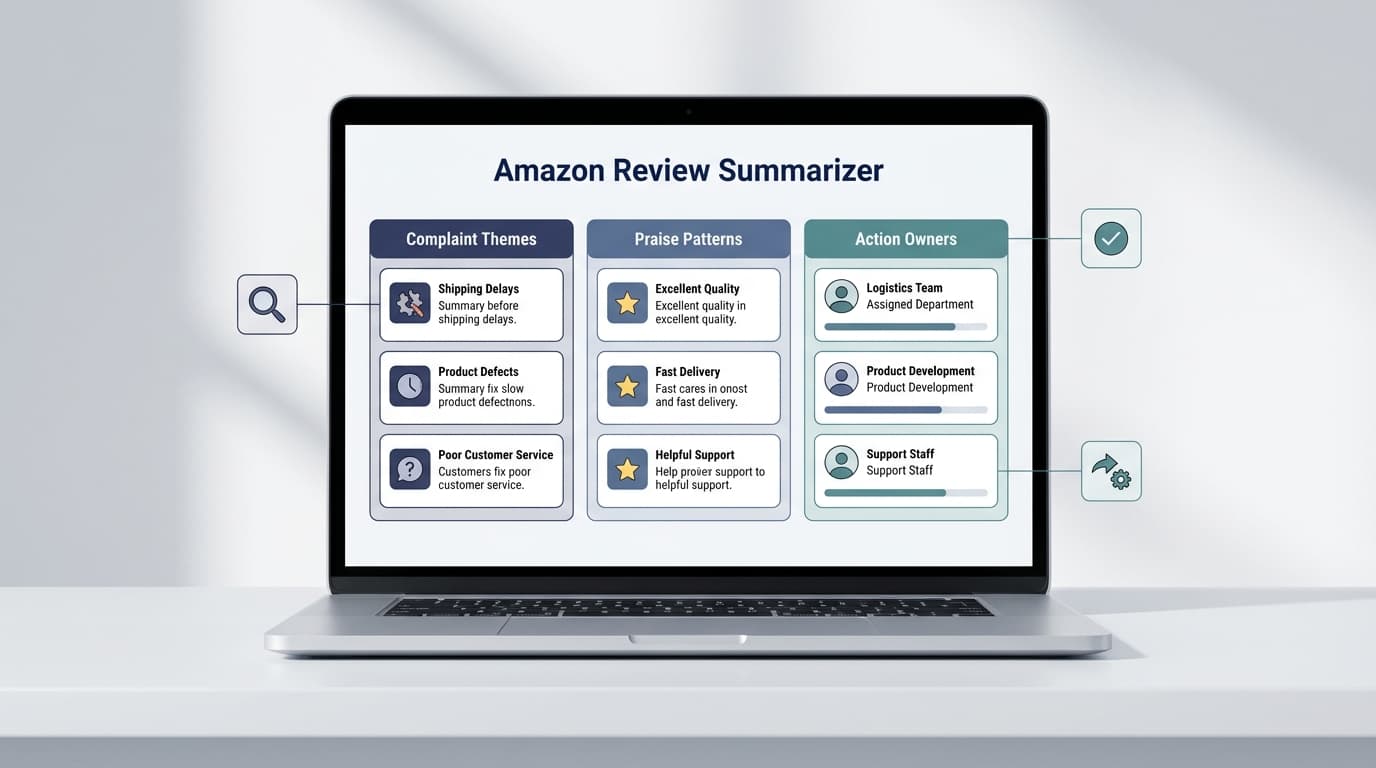
That is why the best amazon review summarizer does more than compress text. It turns raw reviews into repeated complaint themes, stable praise patterns, timing shifts, and owner-ready next actions. It still leaves room for a human to read the raw review when the pattern matters, but it removes the need to read every comment one by one before the team can prioritize.
For Amazon sellers, ecommerce operators, and category owners, the goal is not to replace judgment. The goal is to make review evidence usable faster.
What an Amazon review summarizer should do first
The first job of an amazon review summarizer is not sentiment scoring. It is pattern detection.
If fifty recent reviews describe the same setup confusion in slightly different words, the summarizer should group that into one visible issue. If buyers keep praising battery life, fit, scent, or packaging quality, the summarizer should show that as a stable praise pattern instead of scattering those comments across dozens of isolated snippets.
The summary should answer five questions quickly:
| Question | What the summary should show | Why it matters |
|---|---|---|
| What are buyers repeating? | Repeated complaint themes and praise patterns | Repetition is a stronger signal than one memorable review |
| How recent is the pattern? | A clear time window or trend shift | Teams need to know whether the issue is current |
| How severe is it? | Rating context, wording intensity, and frequency | Not every complaint deserves the same response |
| Which product or variation is affected? | ASIN, variation, bundle, or market context | Root causes often sit at the child-ASIN or package level |
| Who should act next? | Product, support, listing, ops, or marketing owner | Summaries only matter when someone can do something with them |
An amazon review summarizer that stops at "customers like the product but mention shipping issues" is too vague. A useful summary says the shipping issue is concentrated in a recent review wave, tied to one variation, and should route to operations before the support team writes another workaround.
Why sellers need more than a positive-or-negative summary
Many teams hear "amazon review summarizer" and expect a faster way to scan sentiment. That is part of the job, but it is not the full job.
Amazon review sentiment analysis can help sort the review pile, but a seller still needs the summary to explain what the sentiment means in business terms. A negative cluster around durability is different from a negative cluster around expectation mismatch. One may need product or packaging work. The other may need better images, bullets, or A-plus content.
This is where a better amazon review summarizer becomes useful:
- It separates complaint clusters from one-off comments.
- It keeps praise patterns visible so marketing and listing teams know what to reinforce.
- It shows whether the signal is fresh enough to trust.
- It helps the team decide when to read the verbatim review instead of trusting the summary alone.
The right output is not just shorter text. The right output is a better first-pass decision layer.
The minimum fields every amazon review summarizer should surface
If you are comparing tools or building an internal workflow, the summary view should include more than a text block. At minimum, it should expose these fields:
| Field | What good looks like | What to avoid |
|---|---|---|
| Theme label | Plain-language complaint or praise cluster | Abstract tags that hide what buyers actually mean |
| Review count | How many reviews support the pattern | No frequency signal at all |
| Time window | Recent period or trend comparison | A timeless summary that mixes old and new issues |
| Rating mix | Whether the pattern appears in low-, mid-, or high-rating reviews | A single overall score with no rating context |
| Representative wording | Real buyer phrasing from the raw reviews | Generic paraphrases only |
| Product scope | ASIN, variation, or market affected | A summary that blends different products together |
| Owner suggestion | Listing, support, ops, product, or marketing next step | No handoff guidance |
Without those fields, an amazon review summarizer becomes a cosmetic dashboard. With them, it starts to act like a review-analysis workflow.
What a seller should do after reading the summary
The best amazon review summarizer does not end with an insight card. It should lead to a next action.
Use a simple rule:
- Group repeated complaints and praise into visible patterns.
- Validate the most important patterns by reading raw review examples.
- Route each confirmed pattern to the right owner.
- Recheck the same pattern after the team changes listing copy, support content, packaging, or the product itself.
That workflow matters because summaries can flatten nuance. A cluster labeled "poor quality" may actually contain three different problems: packaging damage, missing parts, and unrealistic listing expectations. The summary is still valuable because it tells you where to look first. It just should not pretend to be the final root-cause analysis.
When an Amazon review summarizer is enough and when you still need raw reviews
An amazon review summarizer is enough for first-pass prioritization. It is not enough for every decision.
Use the summary alone when:
- you need to see which complaint themes repeat most often,
- you want to compare praise patterns across products,
- you need a weekly view of what moved up or down,
- or you need to decide which issues deserve deeper review.
Read the raw reviews when:
- the complaint could trigger a product, compliance, or safety decision,
- the theme might be mixing multiple root causes into one label,
- the wording affects listing claims or support macros,
- or the pattern is new and the team has not confirmed it before.
This is the practical difference between an amazon review summarizer and a complete review-analysis workflow. The summarizer helps you find the right pile. The raw review helps you verify what is really inside it.
What praise patterns should a summarizer keep visible
Sellers often focus too hard on complaint clusters and forget that a good amazon review summarizer should preserve praise patterns too.
Praise matters because buyer language often tells you what to reinforce in:
- listing bullets,
- title and image emphasis,
- ad hooks,
- A-plus content,
- FAQs,
- support templates,
- and even competitive positioning.
If buyers keep repeating that a product is "easy to clean," "fits better than expected," or "works right out of the box," those phrases are not just compliments. They are evidence of what the market already values.
The summary should therefore surface praise patterns with the same discipline used for complaints:
| Praise signal | What it can support |
|---|---|
| Repeated convenience wording | Listing bullets, hero copy, image captions |
| Repeated outcome wording | Ads, PDP copy, FAQ reinforcement |
| Repeated comparison wording | Competitive positioning and objection handling |
| Repeated trust wording | Support reassurance and conversion messaging |
A weak amazon review summarizer hides positive detail behind one line such as "customers like the product." A stronger one shows what they like, how consistently they say it, and where that language can be reused carefully.
How to connect an amazon review summarizer to sentiment analysis
Amazon review sentiment analysis and an amazon review summarizer should work together, but they are not the same thing.
Sentiment analysis helps sort the review base into positive, neutral, mixed, and negative patterns. The summarizer should then explain what is inside those patterns.
For example:
| Sentiment bucket | What the summarizer should clarify |
|---|---|
| Negative | Which complaint themes repeat, which ASINs are affected, and which owner should act |
| Mixed | Whether buyers like the core product but dislike setup, packaging, or expectation gaps |
| Positive | Which praise patterns deserve reinforcement in listing or messaging |
| Neutral | Whether the review is informational, comparative, or low-signal |
That combination is more useful than a score-only view because sellers do not act on polarity alone. They act on repeated meaning.
A simple dashboard view for sellers
If you want one summary format that product, support, and listing teams can all use, keep it simple:
| Section | What to show | Primary owner |
|---|---|---|
| Top complaint themes | Frequency, recency, rating band, example wording | Product, ops, support |
| Top praise patterns | Repeated positive language and product strengths | Marketing, listing, product |
| Trend shifts | Which themes are rising or fading | Founder, GM, category owner |
| Variation hotspots | Which child ASIN or bundle shows concentrated issues | Ops, product |
| Action queue | What changed, who owns it, and what to recheck next | Cross-functional |
That structure keeps the amazon review summarizer from becoming another passive report. The team can review one page and decide what needs action this week.
Where VOC AI fits
VOC AI is useful when a seller wants more than a one-line amazon review summarizer. VOC AI's public product and feature pages position the platform around review analysis, buyer language, sentiment analysis, product research, competitor analysis, and decision support for ecommerce teams.
That means the useful workflow is not just "summarize my reviews." It is:
- group repeated complaints and praise faster,
- compare themes across products or competitors,
- inspect buyer wording before changing a listing,
- and route important patterns into product, support, operations, or marketing work.
You should still review the raw evidence before making high-stakes changes. But you should not need to read every review manually before seeing what deserves attention.
What to look for before you choose an amazon review summarizer
If you are evaluating a tool, use this checklist:
| Check | Why it matters |
|---|---|
| It groups repeated complaint themes instead of only generating a generic paragraph | Pattern detection is the real time saver |
| It keeps representative buyer wording visible | Teams need context before they rewrite copy or change a workflow |
| It shows scope by ASIN, variation, market, or time range | Problems often hide inside one segment |
| It connects summaries to action owners | Insight without routing does not change execution |
| It works with a broader amazon review sentiment analysis workflow | Summary alone is not enough for ongoing monitoring |
| It does not promise guaranteed ranking, conversion, or sales results | Good tools support decisions; they do not guarantee outcomes |
The safest choice is usually the one that makes the evidence easier to inspect, not the one that sounds the most automated.
FAQ
What should an amazon review summarizer show sellers?
An amazon review summarizer should show repeated complaint themes, praise patterns, time shifts, representative buyer wording, product scope, and the most likely next owner. A short generic paragraph is not enough if the team needs to decide what to fix or rewrite next.
Is an amazon review summarizer the same as sentiment analysis?
No. Amazon review sentiment analysis helps sort review language by polarity or emotional direction. An amazon review summarizer should go further by explaining which complaint or praise patterns sit inside those buckets and what decisions those patterns support.
When should sellers read the raw reviews instead of trusting the summary?
Sellers should read the raw reviews when a pattern could affect product changes, compliance, support promises, or listing claims, or when a new complaint cluster may be hiding multiple root causes under one summary label.
Can a summary help improve listing copy?
Yes, if it preserves repeated buyer wording and clear praise or expectation-gap patterns. Those signals can guide bullet rewrites, image emphasis, FAQs, and objection handling, but they do not guarantee better conversion or ranking outcomes on their own.
What is the biggest mistake sellers make with review summaries?
The biggest mistake is treating the summary like the final answer. A summary should help prioritize where to look and what owner should act. It should not replace raw-review validation for high-impact product, support, or listing decisions.
An amazon review summarizer becomes valuable when it helps the team move from messy review text to repeated patterns, owner-ready actions, and faster validation. If the output does not help you decide what to do next, it is not solving the real seller problem.