Updated September 10, 2026.
A review summarizer is useful only when a team can trust the summary enough to change what happens next. The output has to do more than shorten a wall of customer reviews. It has to preserve the source set, show the themes, keep contradictions visible, and route the result to someone who can act.
This practical guide is for product, CX, marketing, ecommerce, and research teams that already know they need a review summarizer and now need a repeatable operating model. If you are still choosing software, start with the review summarizer tools evaluation framework. If you already have a workflow and need to measure whether it is working, use review summarizer metrics that actually matter. If you are still defining the category, read what is a review summarizer and when does it matter.
What a team review summarizer should produce
A team-facing review summarizer should produce a decision packet, not just a paragraph.
The packet should answer six questions:
- What review cohort was summarized?
- What are customers repeatedly praising, complaining about, requesting, or comparing?
- Which raw reviews support each claim?
- What evidence weakens or contradicts the main pattern?
- Which owner should respond?
- What will the team check after action is taken?
Google's documentation for AI-powered review summaries is a useful baseline because it frames summaries as grounded in user reviews and designed to help people make decisions. Team workflows need the same grounding, plus cohort control, evidence links, and owner routing.
Start with one decision sentence
Do not begin with "summarize these reviews." Begin with the decision the review summarizer is supposed to support.
Use this format:
We need to decide whether [team] should [change / investigate / monitor] [artifact or workflow] for [customer or product cohort] because [review signal] may be affecting [business outcome].Examples:
- We need to decide whether product should investigate setup failures for first-time users because recent two-star reviews mention the same first-use break point.
- We need to decide whether marketing should rewrite the comparison section because competitor reviews show buyers care about an attribute our page barely explains.
- We need to decide whether support should add a macro because new reviews repeat a question that should have been answered before purchase.
That sentence keeps the review summarizer focused. A broad prompt creates a broad summary. A decision sentence tells the tool which signals matter, which evidence belongs in scope, and who will use the result.
Lock the review cohort before analysis
Most weak summaries come from mixed evidence. A review summarizer can sound confident while blending old and new reviews, different products, different markets, or different rating bands.
Write a cohort contract before you run the summary.
| Field | What to record | Why it matters |
|---|---|---|
| Product scope | Product, SKU, ASIN, feature, app, competitor, or collection | Prevents a blended product story |
| Source | Amazon, Shopify app, app store, marketplace, survey, support-adjacent reviews, or imported CSV | Separates review context from other feedback |
| Date window | Last 30 days, post-release period, post-pricing change, or all-time baseline | Keeps stale issues from driving current action |
| Rating band | All reviews, one to three stars, four to five stars, or split by rating | Separates complaints from praise |
| Market or language | Country, region, marketplace, or language | Avoids mixing expectations that do not share context |
| Segment | New buyers, repeat customers, enterprise accounts, trial users, or competitor switchers | Makes the output assignable |
| Exclusions | Old versions, duplicate reviews, unrelated products, incentivized samples, or known spam | Keeps noise visible |
| Decision owner | Product, CX, marketing, ecommerce, support, research, or operations | Prevents orphaned findings |
If two teammates use different cohorts, they are not debating the same evidence. The cohort contract is what makes a review summarizer repeatable.
Choose the right source mix
A review summarizer is strongest when the source set matches the decision. Do not add more sources just to make the report look complete.
| Decision | Best source set | Avoid |
|---|---|---|
| Product defect triage | Recent low-star reviews, variant data, support escalations, return reasons | All-time review averages |
| Listing or PDP rewrite | Positive reviews, negative objections, buyer questions, competitor review language | Internal positioning docs alone |
| CX macro or help-center update | Reviews that mention confusion, support tickets, chat transcripts, first-use issues | High-level sentiment only |
| Competitive response | Your reviews, competitor reviews, rating-band split, market context | Comparing products without segment control |
| Roadmap input | Repeated feature requests, use-case language, severity, recency, revenue or account context | Treating every request equally |
| Research follow-up | Edge cases, contradictions, unknown segments, surprising language | Forcing the summary into a recommendation |
For ecommerce and marketplace teams, customer reviews often carry buyer language, usage context, objections, quality issues, and competitor comparisons in the same dataset. For B2B and SaaS teams, reviews are usually one input next to surveys, support tickets, call notes, and product analytics. The review summarizer should state which evidence it used and which evidence it did not use.
Use a source-to-claim table
Every important finding from the review summarizer should be traceable. If the team cannot inspect the source reviews behind a claim, the summary is not ready for a decision.
Use this source-to-claim table:
| Claim | Evidence required | Good output | Bad output |
|---|---|---|---|
| Customers struggle during setup | Review IDs, dates, rating mix, setup context, exact snippets | "Recent two-star reviews from first-time users mention pairing failures during setup." | "Setup is a pain point." |
| Buyers praise durability | Rating band, product variant, use case, repeat mention count | "Four- and five-star reviews for the travel variant praise daily-use durability." | "People like quality." |
| A competitor has a gap | Competitor product, market, theme, quote snippets, recency | "Competitor reviews mention replacement-part delays after purchase." | "Competitors have support issues." |
| The issue may be isolated | Counterexamples, segment split, version or market difference | "Complaints cluster in the older model; newer reviews are neutral." | "Mixed sentiment." |
| A team should act | Owner, proposed change, expected signal, recheck date | "Support owns a macro update; recheck repeat setup questions in 14 days." | "Consider improving support." |
The best review summarizer workflow treats polished language as secondary. Traceable claims matter more than smooth prose.
Preserve contradictions before assigning work
A review summarizer should not flatten every dataset into one clean story. Contradictions are often the signal that saves the team from a bad action.
Before assigning work, ask:
- Does the theme hold inside the target cohort, or only in a noisy edge case?
- Do positive reviews contradict the complaint?
- Did a product, price, fulfillment, packaging, policy, or onboarding change happen inside the date window?
- Does the issue appear in one segment but not another?
- Would the proposed action actually change a future signal?
If the answer is unclear, the next action may be "investigate" rather than "ship." That is still useful. A good review summarizer helps the team decide what kind of action is justified.
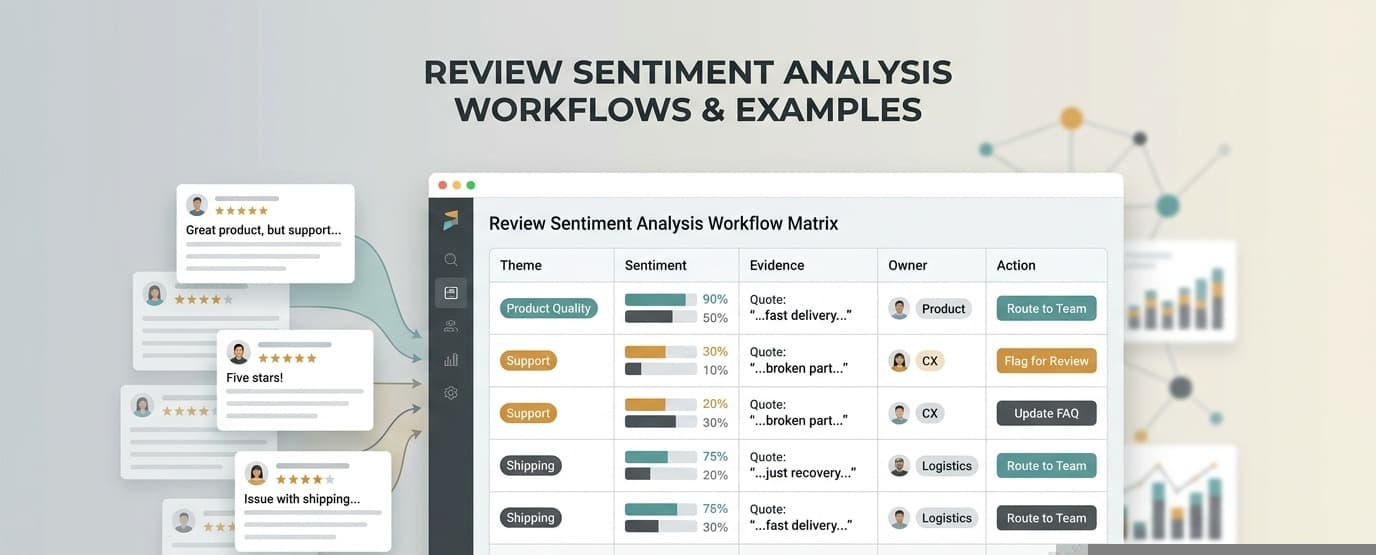
Route findings by owner
Do not end with a list of themes. End with ownership.
| Finding type | Primary owner | Output the owner needs |
|---|---|---|
| Repeated defect, failure, or quality issue | Product, QA, operations | Severity, recurrence, affected segment, evidence, recheck date |
| Confusing promise, sizing, compatibility, or comparison | Marketing, ecommerce, growth | Buyer language, objection, page section, copy hypothesis |
| Repeated pre-purchase or post-purchase question | Support, CX, education | Question pattern, sample wording, macro or FAQ draft |
| Feature request or unmet use case | Product, research | Segment, use case, frequency, revenue or account context, counterevidence |
| Competitor weakness or strength | Marketing, product, strategy | Competitor, theme, proof line, risk of overclaiming |
| Retention or renewal risk | CX, success, lifecycle | Friction pattern, customer segment, trigger, follow-up signal |
The review summarizer should make this routing visible. If a finding has no owner, next step, or recheck signal, it is still research material, not an operating output.
Build a reusable decision packet
Use this template for every review summarizer run:
Decision sentence:
Decision owner:
Business outcome:

Review cohort:
Source:
Date window:
Rating band:
Segment:
Exclusions:

Main theme:
Customer situation:
Representative evidence:
Counterevidence:
Confidence: high / medium / low

Recommended action:
Action type: ship / test / investigate / monitor / decline
Expected signal change:
Recheck date:
Reusable language:
Learning note:
The decision packet should be short enough to read in a meeting and specific enough to survive a challenge. If a stakeholder asks "who said this?" the answer should be one click or one row away.
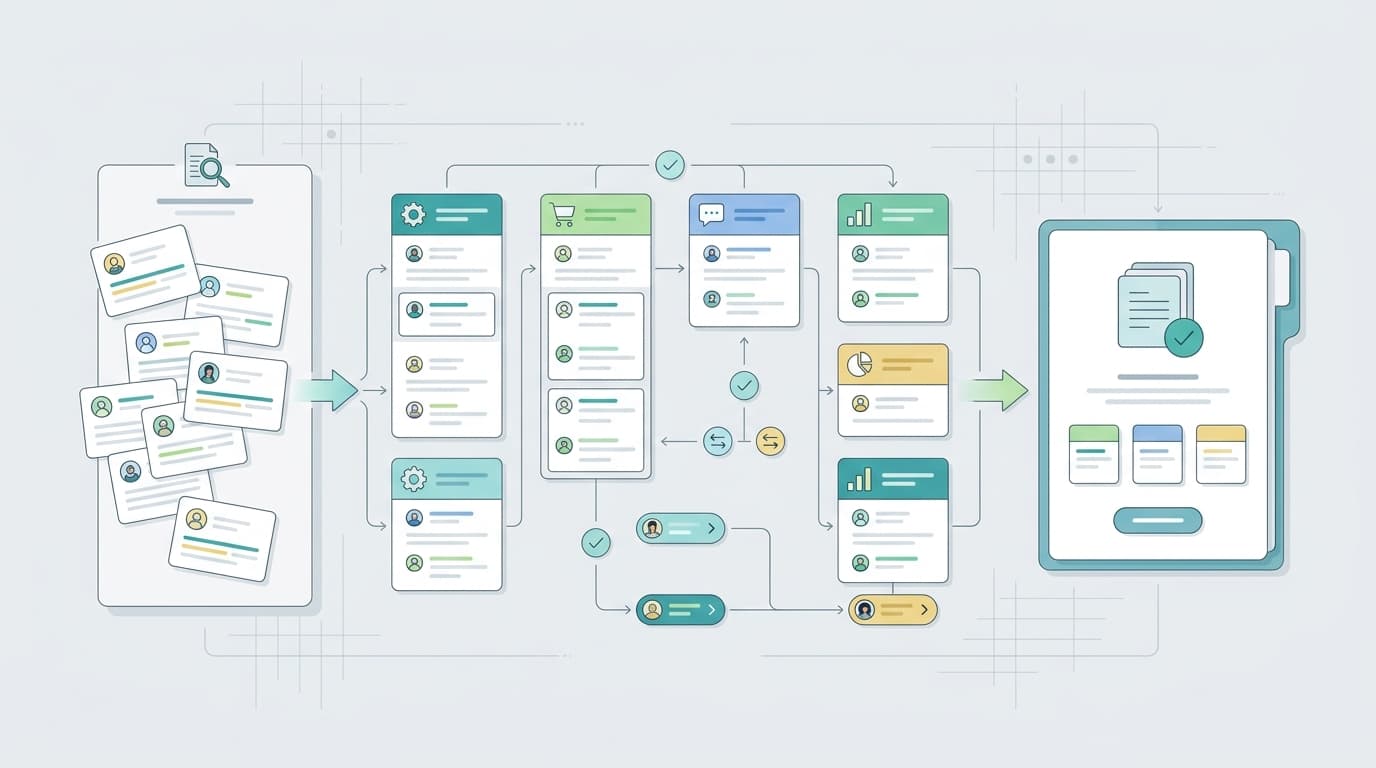
Run the review summarizer workflow in seven days
For a first implementation, keep the workflow small. One decision-grade packet per week is better than ten broad summaries no one uses.
| Day | Work | Output |
|---|---|---|
| 1 | Write the decision sentence and owner | One decision question |
| 2 | Lock the cohort and exclusions | Cohort contract |
| 3 | Run the review summarizer and extract themes | Initial summary and theme table |
| 4 | Trace major claims back to source reviews | Source-to-claim table |
| 5 | Add counterevidence and confidence notes | Defensible finding set |
| 6 | Route findings to owners and choose action type | Decision packet |
| 7 | Save reusable language and schedule recheck | Learning note and recheck date |
This cadence keeps the review summarizer inside the team's operating rhythm. It also gives you a clean way to compare old manual review work with the new AI-assisted workflow.
Decide what should be automated
Some parts of review summarization can be automated. Others should remain human-reviewed.
| Workflow step | Good automation candidate | Human review needed when |
|---|---|---|
| Ingesting reviews | Pulling new reviews into a table or dashboard | Source permissions, privacy, or channel rules are unclear |
| Grouping themes | Clustering repeated language and issues | The theme would trigger a product, legal, pricing, or public claim |
| Drafting summaries | Producing first-pass themes, snippets, and contradictions | The output will be sent to customers or executives |
| Owner routing | Suggesting product, support, marketing, or CX owners | Accountability or priority is contested |
| Recheck reminders | Scheduling follow-up reviews after a change | The signal depends on seasonality or another team event |
OpenAI's evals guidance is relevant here: teams should test model outputs against explicit criteria. For a review summarizer, useful criteria include faithfulness to the source reviews, evidence coverage, contradiction preservation, theme specificity, and action readiness.
Add lightweight governance
Review data can include personal details, sensitive context, irrelevant links, or adversarial text. Treat reviews as untrusted input, even when they are public.
Use four rules:
- Do not let a review summarizer silently turn an unverified claim into a public statement.
- Do not send sensitive customer details to systems that are not approved for that data.
- Do not hide model prompts, cohort filters, or version changes when the workflow is repeated.
- Do not automate customer-facing responses without human approval.
The OWASP GenAI Security Project is a useful reference for LLM application risks, and NIST's AI Risk Management Framework is a practical reference point for trustworthy AI governance. A small team does not need a heavy governance program for every review summarizer pilot, but it does need explicit rules for source data, output review, and owner approval.
How VOC.AI fits
VOC.AI is relevant when reviews need to become repeatable customer evidence, not just a quick summary.
The current Voice of Customer Analysis page positions VOC.AI around a 2B+ review corpus, buyer language, sentiment across themes, and decision-ready outputs that connect reviews to product, support, listing, and research actions. That makes it useful when a team needs a review summarizer workflow with evidence, theme structure, and next-step routing.
Engineering teams can use the Review Analysis API when the same review summarizer logic needs to run inside internal dashboards, agents, or scheduled workflows. The current API page lists REST API, Python SDK, and MCP support for review, keyword, listing, and sales-estimate signals.
When you evaluate rollout cost, use the current Pricing page to choose between the VOC review analytics platform plans and API or MCP subscriptions. Do not decide from a blog article alone, because pricing and usage limits can change.
Common mistakes
Mistake 1: Asking for a summary before naming the decision
The review summarizer will return something readable, but the team will not know what to do with it. Start with the decision sentence.
Mistake 2: Mixing cohorts
All-time reviews, recent reviews, low-star reviews, and competitor reviews answer different questions. Keep the cohort visible.
Mistake 3: Trusting themes without evidence
A theme is not ready until the team can inspect the source reviews behind it.
Mistake 4: Removing minority opinions
Contradictions often explain which segment should be excluded, monitored, or researched next.
Mistake 5: Ending with a report
The final output should be a decision packet with owner, action type, expected signal change, and recheck date.
FAQ
What is a review summarizer?
A review summarizer is a tool or workflow that condenses customer reviews into themes, complaints, praise, questions, and decision notes. For teams, it should also preserve cohort scope, source evidence, contradictions, owner routing, and follow-up signals.
How should a team use a review summarizer?
Use a review summarizer by writing a decision sentence, locking the review cohort, summarizing the evidence, tracing claims back to source reviews, preserving contradictions, assigning an owner, and scheduling a recheck after action.
What should a review summarizer output include?
A useful review summarizer output should include the cohort, theme table, source evidence, counterevidence, confidence note, recommended action, owner, expected signal change, and recheck date.
Is a review summarizer the same as sentiment analysis?
No. Sentiment analysis labels tone or polarity. A review summarizer explains what customers are saying, why it matters, which evidence supports it, and what a team should do next.
When is a lightweight review summarizer enough?
A lightweight review summarizer is enough when the decision is low stakes, the review set is small, and a human will verify every important claim before action.
When do teams need review analysis instead?
Teams need review analysis when the workflow must compare cohorts, preserve evidence, support recurring decisions, route findings across teams, or run through APIs and dashboards. For broader evaluation criteria, use the customer feedback analysis tools evaluation framework and the AI review analysis metrics guide.
Bottom line
A review summarizer should not be judged by how smooth the paragraph sounds. It should be judged by whether a team can trace the evidence, understand the cohort, preserve contradictions, assign an owner, and make a better decision. If the output cannot become a decision packet, it is not yet a workflow.