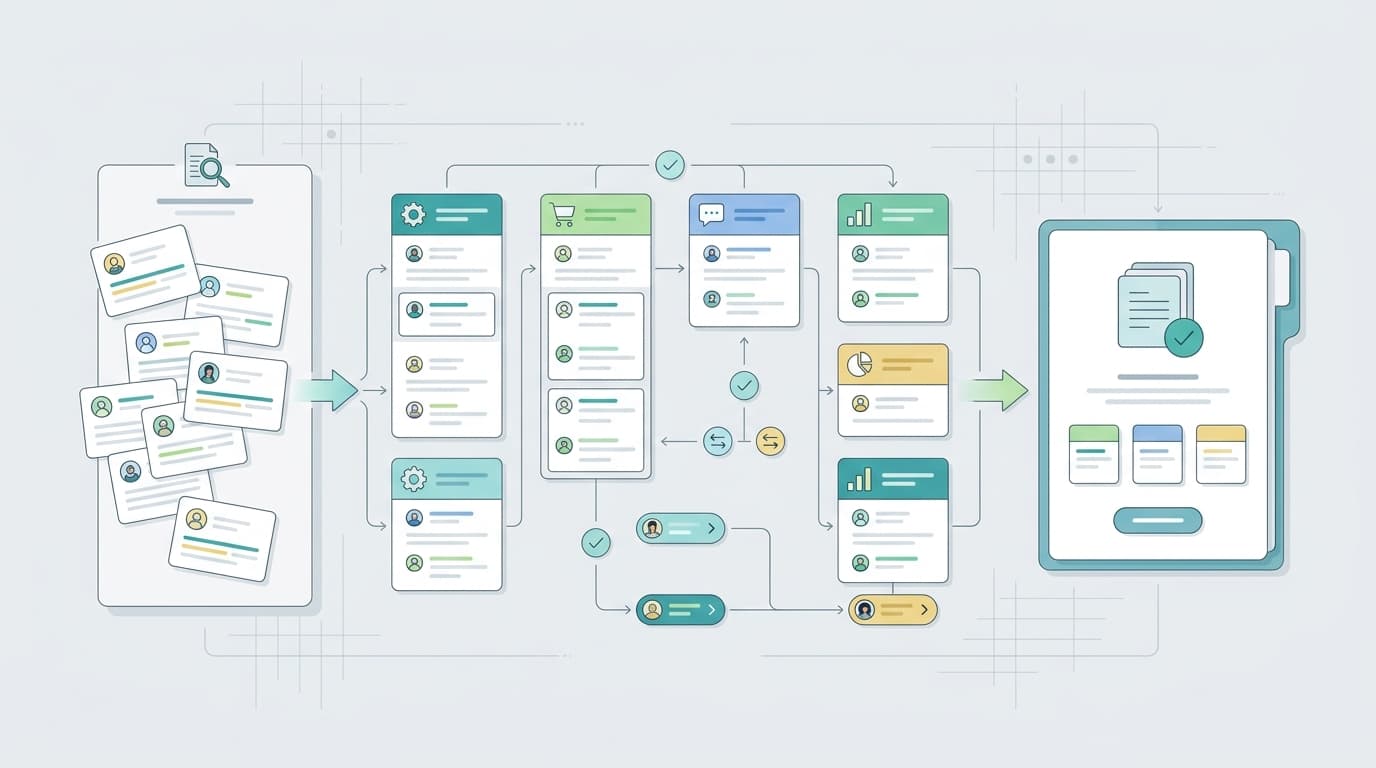
ChatGPT can make Amazon reviews easier to read, but it should not become a shortcut for guessing. Sellers still need clean inputs, repeatable prompts, and a compliance-aware process.
Amazon reviews are customer evidence. They show what buyers praise, what they complain about, and what language they use when describing the product. Amazon’s own guide to customer reviews and star ratings notes that shoppers can use review filters such as verified purchase status, star rating, and review search to narrow the evidence they read. Sellers should use the same discipline when analyzing reviews with AI.
Use this guide with exports from your own records, Seller Central views, or a dedicated tool such as VOC AI when you need structured Amazon review intelligence instead of one-off prompting.
Quick comparison
Workflow | Best use | Watch-out |
Theme summary | Find the main reasons buyers praise or complain | Do not paste private buyer data into a public prompt |
Complaint clustering | Group durability, fit, packaging, usability, and support issues | Validate sample size before prioritizing |
Competitor gap review | Compare your ASIN against similar products | Keep competitor claims factual and review-backed |
Listing language | Pull buyer vocabulary for bullets and A+ copy | Do not manufacture review language |
1. Summarize the Top Review Themes
Start with a small, structured batch: star rating, review date, verified purchase status if available, product variation, and the review text. Ask ChatGPT to return themes, not final conclusions.
A useful prompt is:
Group these reviews by recurring product experience. Return theme, evidence phrases, star-rating mix, affected product variation, and what the seller should inspect next. If the evidence is thin, label it as insufficient evidence.
This works best when paired with Amazon filters such as star rating, recency, verified purchase, and in-review search. The goal is not to make ChatGPT decide what customers think. The goal is to make repeated review evidence easier for humans to inspect.
For larger catalogs, use VOC AI’s Amazon review analysis workflow to work from a broader review intelligence base instead of copying hundreds of comments manually.
2. Cluster Complaints Before Deciding What to Fix
A review summary that says “quality issue” is too broad. Sellers need to know what kind of quality issue appears repeatedly.
Ask for specific complaint clusters such as:
- Zipper failure
- Confusing setup
- Color mismatch
- Strong odor
- Damaged packaging
- Missing instructions
- Accessory compatibility
- Incorrect sizing
- Weak battery life
- Poor fit
Then rank clusters by severity and repeat rate. The point is not to let the model decide the roadmap. The point is to make recurring buyer language visible enough for product, support, and listing teams to review.
A better prompt pattern:
Create a table with complaint cluster, exact buyer phrases, likely root cause, affected use case, repeat count, severity, and confidence level. Label any cluster as insufficient evidence if it appears only once.
Keep the original review IDs or URLs in your working file so a human can inspect the source. This matters because AI can summarize patterns, but it cannot prove that the sample is complete or representative.
3. Compare Competitor Gaps
Competitor reviews are useful because disappointed buyers often describe the product they expected. Feed ChatGPT comparable review samples from similar ASINs and ask it to identify gaps your product can credibly solve.
A useful competitor prompt is:
Compare these review samples from three competing ASINs. Identify repeated buyer frustrations, unmet expectations, feature gaps, and language that appears across multiple products. Do not create claims that are not supported by the review text.
This can help sellers improve:
- Product positioning
- Image callouts
- Bullet points
- A+ content
- Product bundles
- Packaging
- Setup instructions
- Support scripts
Pair this with a structured review analysis workflow such as VOC AI review analysis so the output connects to source reviews, not just a pasted sample.
Keep competitor claims factual and review-backed. Do not turn competitor complaints into exaggerated marketing copy.
4. Extract Buyer Language for Listing Copy
Reviews are a voice-of-customer library. Buyers often describe product benefits and problems in simpler language than brands use.
Ask ChatGPT to extract phrases buyers use for:
- The job to be done
- Objections
- Sensory details
- Comparison points
- Setup concerns
- Sizing concerns
- Use cases
- Emotional reactions
A safe prompt is:
Extract repeated buyer phrases from these reviews. Group them by use case, benefit, objection, and sensory detail. Do not rewrite them as testimonials. Only include language that appears in the review text.
The safe output is a language bank, not fabricated testimonials.
If buyers repeatedly mention “fits under an airplane seat” or “hard to clean around the lid,” those phrases can inform bullets, FAQs, comparison charts, and image callouts. They should not be presented as quotes unless they come from real, traceable reviews.
This distinction matters because the FTC final rule on fake reviews and testimonials prohibits fake or false consumer reviews and testimonials. ChatGPT should help sellers understand customer language, not invent customer proof.
5. Draft Better Product FAQs
ChatGPT is strong at turning repeated confusion into question-and-answer formats. Give it a list of recurring buyer questions and ask for concise, answerable FAQs.
This is especially useful for reducing pre-purchase uncertainty around:
- Sizing
- Setup
- Care
- Replacement parts
- Returns
- Compatibility
- Warranty basics
- Package contents
A useful prompt is:
Turn these recurring review questions into product FAQ drafts. Keep answers concise. Only use information from the provided product documentation and review evidence. Mark any answer that requires confirmation from the seller.
Do not ask ChatGPT to invent warranty terms, material claims, certifications, compatibility details, or safety claims. Those should come from your product documentation, compliance team, or supplier records.
Academic work such as AmazonQA shows why reviews and product questions matter: buyer-generated content often contains practical information that listings do not fully explain. Sellers can use that insight to make listings clearer before customers need to ask.
6. Build a Weekly Monitoring Brief
For ongoing monitoring, ask ChatGPT to compare this week against a baseline.
The brief should include:
- New complaint clusters
- Sentiment shifts
- Repeated words
- Product-change requests
- Reviews that require support follow-up
- Issues tied to a specific variation
- Issues tied to shipping or packaging
- Issues that appeared after a product update
A useful monitoring prompt is:
Compare this week’s reviews against the prior four-week baseline. Return new complaint clusters, sentiment shifts, repeated buyer phrases, affected product variations, and recommended follow-up owner. Separate product issues from logistics and support issues.
This workflow is especially useful for sellers managing multiple ASINs. A single negative review may not require action, but a new repeated pattern may indicate a product, packaging, or listing problem.
If you use an AI provider for business data, review its privacy settings first. OpenAI’s business data privacy page states that, by default, data from covered business products and APIs is not used to train OpenAI models. Even so, teams should avoid unnecessary personal data in prompts and follow internal data policies.
7. Know When ChatGPT Is Not Enough
ChatGPT is a flexible analysis layer, not a review data platform. It does not automatically collect compliant review data, deduplicate reviews, track ASIN history, maintain dashboards, preserve source context, or manage recurring team workflows.
Use ChatGPT for:
- One-off summaries
- Drafting analysis tables
- Clustering small samples
- Generating prompt-based workflows
- Turning review themes into FAQ drafts
- Exploring buyer language
Use a dedicated review analysis tool when you need:
- Large review volumes
- Recurring dashboards
- Competitor tracking
- ASIN-level history
- Source preservation
- Sentiment reports
- Team workflows
- Negative review monitoring
This is where VOC AI fits naturally. VOC AI helps Amazon teams analyze review themes, sentiment, competitor gaps, and buyer language from review data instead of manually reading every comment or relying on one-off ChatGPT prompts.
What ChatGPT Should Not Do With Amazon Reviews
ChatGPT should not be used to write fake Amazon reviews, generate fake buyer testimonials, manipulate star ratings, or create customer quotes from people who did not actually use the product.
Amazon invests in review trust because reviews help shoppers make purchase decisions. Its overview of creating a trustworthy reviews experience explains why authentic feedback matters to the marketplace.
Sellers should use AI to understand real customer feedback, not to manufacture social proof.
Avoid using ChatGPT to:
- Write fake buyer reviews
- Rewrite negative reviews as positive claims
- Create testimonials from non-customers
- Generate fake competitor complaints
- Pressure customers to change reviews
- Suppress legitimate criticism
- Misrepresent customer sentiment
The safest use case is analysis: summarize what real buyers said, verify the pattern, and use the insight to improve the product, listing, or support experience.
Best Practices for ChatGPT Amazon Review Analysis
Use Clean Inputs
Clean inputs lead to better outputs. Include review text, star rating, date, product variation, and verified purchase status when available.
Avoid analyzing only extreme reviews. A balanced review set should include positive, neutral, and negative feedback.
Keep Source Context
Do not separate AI summaries from the original review source. Keep review IDs, URLs, product variations, and dates in the working file.
This makes the output easier to verify and safer to use in product decisions.
Ask for Evidence Phrases
Do not accept broad labels such as “quality issue” or “bad experience.” Ask ChatGPT for exact phrases from reviews.
Evidence phrases help teams see whether the model is summarizing real patterns or overgeneralizing.
Separate Product Issues From Support Issues
A complaint about damaged packaging may require a logistics fix. A complaint about confusing setup may require better instructions. A complaint about poor fit may require product design changes.
Review analysis should assign the issue to the right owner.
Verify Before Acting
ChatGPT can summarize quickly, but sellers should verify important conclusions before changing a listing, product, or support process.
Check whether the pattern is repeated, recent, tied to a specific variation, and supported by enough reviews.
FAQ
Can ChatGPT analyze Amazon reviews?
Yes. ChatGPT can analyze Amazon reviews if you provide review text or a structured export. It can summarize themes, cluster complaints, extract buyer language, and draft analysis tables. It cannot guarantee that your sample is complete, compliant, or representative.
Is it safe to paste Amazon reviews into ChatGPT?
Use only data you are allowed to process and avoid unnecessary personal information. For business use, check your AI provider settings, internal data policy, and marketplace data rules before uploading review text.
What is the best prompt for Amazon review analysis?
A strong prompt asks for a table with theme, evidence phrases, star-rating mix, likely root cause, recommended action, affected product variation, and confidence level. It should also require the model to say when evidence is too thin.
Can ChatGPT detect fake Amazon reviews?
ChatGPT can flag suspicious language patterns, but it should not be treated as proof. Use marketplace policy signals, review authenticity tools, and manual review before acting on suspected fake reviews.
Can ChatGPT write Amazon reviews?
ChatGPT can generate review-like text, but sellers should not use it to create fake Amazon reviews or testimonials. AI-generated fake reviews can violate platform rules and consumer protection laws.
When should I use a dedicated review analysis tool?
Use a dedicated review analysis tool when you need recurring dashboards, competitor tracking, large review volumes, source preservation, ASIN-level history, sentiment reports, or team workflows beyond one-off prompting.
How can VOC AI help with Amazon reviews?
VOC AI helps Amazon sellers analyze review themes, sentiment patterns, competitor gaps, negative reviews, and buyer language from structured review data. It is most useful when sellers need repeatable review intelligence rather than manual review reading or one-off ChatGPT prompts.