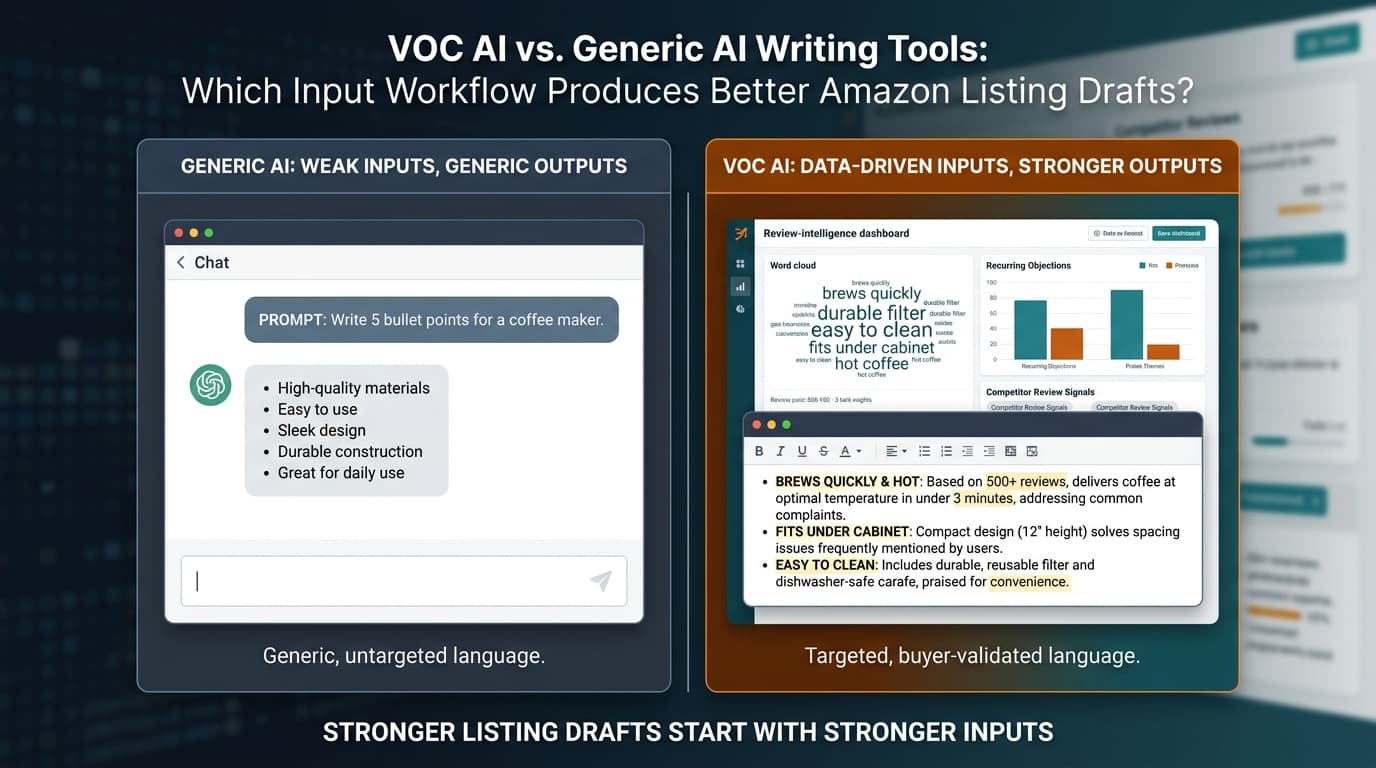
Generic AI writing tools can make Amazon listing work feel faster. You paste a few product details into a prompt, ask for bullets or a title, and get a clean draft in seconds. That speed is real. The problem is that many sellers are not actually blocked by drafting speed. They are blocked by weak inputs.
If the prompt starts with a thin spec sheet, vague feature claims, or internal brand wording, the output usually sounds polished but generic. It may read well, but it still misses the phrases buyers use, the objections that slow purchases, and the product details that matter most on the page.
That is the difference between a generic AI writing workflow and a review-led input workflow. A generic model can rewrite what you tell it. A strong amazon review analysis tool can help you decide what the draft should say before the first bullet is generated.
This article compares VOC AI with generic AI writing tools for Amazon listing inputs. It does not argue that sellers should stop using writing models. It argues for a stricter sequence: use buyer-language and review signals first, then use the writing model to turn those inputs into cleaner listing copy.
Why generic AI writing tools feel useful right away
Generic AI writing tools solve an obvious pain fast. They help sellers:
- generate title and bullet drafts quickly
- test multiple copy angles without rewriting by hand
- tighten phrasing and remove repetition
- format ideas into cleaner PDP-ready structure
- turn rough notes into usable first drafts
That is valuable. If your team already knows the real buyer objections, the strongest purchase motivations, and the use cases that deserve emphasis, a writing model can save time.
The problem starts when the team assumes the model can discover those priorities on its own. In most listing workflows, it cannot. It only predicts from the information it receives.
Where prompt-only listing workflows usually break down
The weak point in prompt-only listing work is not sentence generation. It is input quality.
When sellers prompt from a blank page, they often run into four problems:
| Workflow problem | What happens in practice | Why it weakens the listing |
|---|---|---|
| Thin source inputs | The prompt uses internal feature notes instead of customer evidence | The copy sounds brand-centered, not buyer-centered |
| Generic benefit language | The output repeats phrases like "high quality" or "easy to use" | The listing loses specificity and differentiation |
| Missed objections | Real hesitations from reviews never make it into bullets or FAQ copy | The page fails to answer the reason buyers hesitate |
| Weak priority order | The model treats all inputs as equally important | The strongest benefit or risk does not get front-loaded |
This is why a polished draft can still underperform operationally. It may read better than the old copy, but it does not reflect the real complaints, expectations, and motivations visible in review data.
What a review-led input workflow adds before the draft starts
An amazon review analysis tool does a different job from a generic AI writing model. It helps the team inspect real customer language before they decide what the listing should emphasize.
That matters because the strongest listing inputs usually come from patterns such as:
- repeated objections in low-star reviews
- recurring praise that reveals real product value
- expectation mismatch between the listing promise and the delivered product
- use-case wording buyers repeat in their own language
- competitor-review complaints that reveal feature gaps or positioning opportunities
If you want stronger listing copy, those signals should shape the prompt before any draft is generated.
VOC AI vs. generic AI writing tools at a workflow level
The fairest comparison is not "which tool writes better sentences." The better question is "which workflow helps the team start with stronger inputs?"
| Decision area | Generic AI writing tools | VOC AI workflow | Why it matters |
|---|---|---|---|
| First-draft speed | Strong | Not the main strength | Draft speed is useful, but it does not fix weak source inputs |
| Buyer-language discovery | Limited by the prompt | Better suited to extracting phrases from review patterns | Listings improve when they reflect how customers actually talk |
| Objection handling | Can rewrite objections if supplied | Helps surface recurring objections before drafting | Many teams miss the complaints that should shape bullets |
| Purchase motivation | Usually inferred from sparse notes | Better suited to finding what buyers repeatedly value | Stronger pages prioritize why buyers purchase, not just what the seller built |
| Competitor review context | Manual unless added by the user | Better suited to comparing competitor complaints and gaps | Market context helps sellers write more precise positioning |
| Best use case | Drafting, reformatting, angle testing | Input enrichment, review analysis, workflow direction | The workflows are complementary, but they do different jobs |
This is the core point: generic AI writing tools help with expression. VOC AI helps with evidence-led input discovery.
When a generic AI writing tool is enough
A generic AI writing tool may be enough if:
- You already have strong customer research.
- You already know the top buyer objections.
- You already know which use case belongs in the lead bullet.
- You only need cleaner wording, variant testing, or formatting help.
In that situation, the writing model is acting like a production accelerator. That is a reasonable use case.
The problem is that many Amazon teams do not start from that level of clarity. They start from a product sheet, a few assumptions, and one or two internal talking points. In those cases, a generic AI writing tool often makes the page sound smoother without making it meaningfully smarter.
When a customer review analysis tool becomes more valuable
A customer review analysis tool becomes more valuable when the real question is not "how do I phrase this?" but "what should I emphasize at all?"
That usually happens when:
- the listing sounds polished but generic
- the team cannot agree on the top objection to answer
- buyers keep mentioning problems the page does not address
- competitor listings appear to frame the category more clearly
- the product has multiple possible use cases and no clear priority
- support tickets and review complaints keep repeating the same language
In those situations, the input layer matters more than the draft layer.
Why buyer language matters more than seller language
Many listing teams still write from the inside out. They start with feature language, then ask a writing model to make it sound better. That workflow often misses how customers naturally describe the value, the problem, or the disappointment.
Buyer language matters because it helps the team answer practical questions such as:
- What exact frustration keeps repeating?
- Which phrase signals expectation mismatch?
- Which scenario or context matters enough to become a bullet?
- Which benefit sounds believable because customers describe it themselves?
VOC AI's current product positioning supports this framing directly. The live Voice of Customer Analysis page describes the workflow as turning customer reviews into product direction, buyer language, and market-ready decisions. That makes it a better fit for sellers who need stronger listing inputs before they open a writing model.
A simple before-and-after workflow example
The difference becomes clearer when you compare the starting prompt.
| Workflow | Prompt starting point | Likely result |
|---|---|---|
| Blank-slate AI drafting | Product features, broad target audience, and a generic request for bullets | Clean but generic copy that may miss buyer concerns |
| Review-led listing workflow | Repeated objections, strongest praise, use-case wording, and competitor complaint themes | Sharper draft direction grounded in customer evidence |
For example, a blank-slate prompt might produce a bullet like:
Premium design for everyday convenience
A review-led prompt is more likely to produce direction such as:
- reduce setup confusion in the first-use bullet
- clarify the scenario where the product works best
- answer the durability concern buyers repeat most often
- replace vague "premium" language with the wording buyers actually use
That does not automatically write the final bullet for you. It improves the quality of the brief the writing model receives.
How VOC AI fits into a stronger Amazon listing workflow
The best way to think about VOC AI is not as a replacement for every generic AI writing tool. It is an input layer that can help you supply better evidence before the draft starts.
That can include:
- recurring objection themes from reviews
- praise patterns that deserve stronger emphasis
- use-case phrases buyers repeat naturally
- competitor-review complaints that reveal positioning gaps
- purchase-motivation clues that help prioritize bullets and titles
The live Product Research and Competitive Analysis pages reinforce that broader workflow. They connect review intelligence to market context and competitor interpretation, which matters when the listing decision is not just wording, but positioning.
If your team needs the educational workflow first, the live guide on how to analyze Amazon reviews using AI is a useful support page. If you already want a practical copy example, see Write Amazon Bullets From Customer Objections and Praise.
The better comparison is input quality, not model quality
Sellers often ask whether VOC AI is "better than ChatGPT" or "better than a generic AI writer." That framing is too loose to be useful.
The more honest comparison is this:
| Question | Better answer |
|---|---|
| Which tool writes a fast first draft? | Generic AI writing tools are good at this |
| Which workflow helps surface buyer language before the draft? | VOC AI is better suited to this |
| Which tool helps identify repeated objections from review data? | VOC AI is better suited to this |
| Which workflow helps compare competitor complaint themes before rewriting the listing? | VOC AI is better suited to this |
| Which workflow is best when the team already knows what to say and only needs a cleaner draft? | Generic AI writing tools may be enough |
This makes the buying decision much clearer. You do not need to pick one and reject the other. You need to decide whether your real bottleneck is drafting speed or input quality.
Common mistakes sellers make with AI listing workflows
- Treating generic AI as a research substitute instead of a drafting tool
- Prompting from internal assumptions instead of customer evidence
- Turning every positive review into a bullet claim
- Ignoring repeated low-star objections because the draft "sounds good"
- Skipping competitor review context before rewriting positioning
- Expecting an AI draft to fix a weak product promise on its own
- Promising ranking, conversion, or sales outcomes the workflow cannot guarantee
These mistakes usually lead to copy that looks finished but still fails to answer the buyer's real hesitation.
How to choose the right workflow for your team
Use this decision table:
| If your situation looks like this | Better next step |
|---|---|
| You already have strong customer research and just need faster writing | Use a generic AI writing tool |
| Your copy is clean but too generic | Add review-led input work first |
| You are unsure which objection deserves the lead bullet | Use VOC AI before drafting |
| You need to compare your listing against competitor complaint themes | Use VOC AI before drafting |
| You already like your writing model and do not want to replace it | Keep the model, but improve the inputs first |
For many sellers, the best answer is a hybrid workflow:
- Pull review signals and buyer language first.
- Decide which objections and benefits deserve priority.
- Feed those insights into the writing model.
- Use the writing model for variants, cleanup, and formatting.
That sequence is usually stronger than asking a model to invent the strategy from a blank prompt.
Final takeaway
Generic AI writing tools are useful when the team already knows what the listing should say. VOC AI becomes more useful when the team still needs to discover what buyers actually care about, how they describe it, and which objections are strong enough to shape the page.
That is why the real comparison is not sentence quality alone. It is workflow quality. If your drafts are fast but still generic, the bottleneck is probably not the writer. It is the input layer.
Start there. Use customer language before brand language. Use repeated objections before generic benefit claims. Then let the writing model turn those stronger inputs into a cleaner Amazon listing draft.
FAQ
Is VOC AI trying to replace generic AI writing tools?
No. The stronger framing is that VOC AI can help improve the inputs before the drafting tool is used. Generic AI writing tools can still help with versioning, rewriting, and formatting after the research step.
What makes an amazon review analysis tool different from a generic writing tool?
An amazon review analysis tool is better suited to surfacing review patterns, recurring objections, praise themes, buyer wording, and competitor feedback context. A generic writing tool is better suited to turning supplied inputs into readable drafts.
When should I use a customer review analysis tool before rewriting a listing?
Use it when the team does not yet know which buyer concern matters most, which benefit deserves priority, or how customers actually describe the product in their own language.
Does this workflow guarantee better Amazon ranking or conversion?
No. A stronger input workflow can reduce guesswork and improve copy relevance, but it does not guarantee ranking, conversion, or sales outcomes.
Can I still use ChatGPT or another AI writer after using VOC AI?
Yes. That is often the most practical workflow. Use VOC AI to improve the research inputs, then use the writing model to turn those inputs into clearer title, bullet, and description drafts.