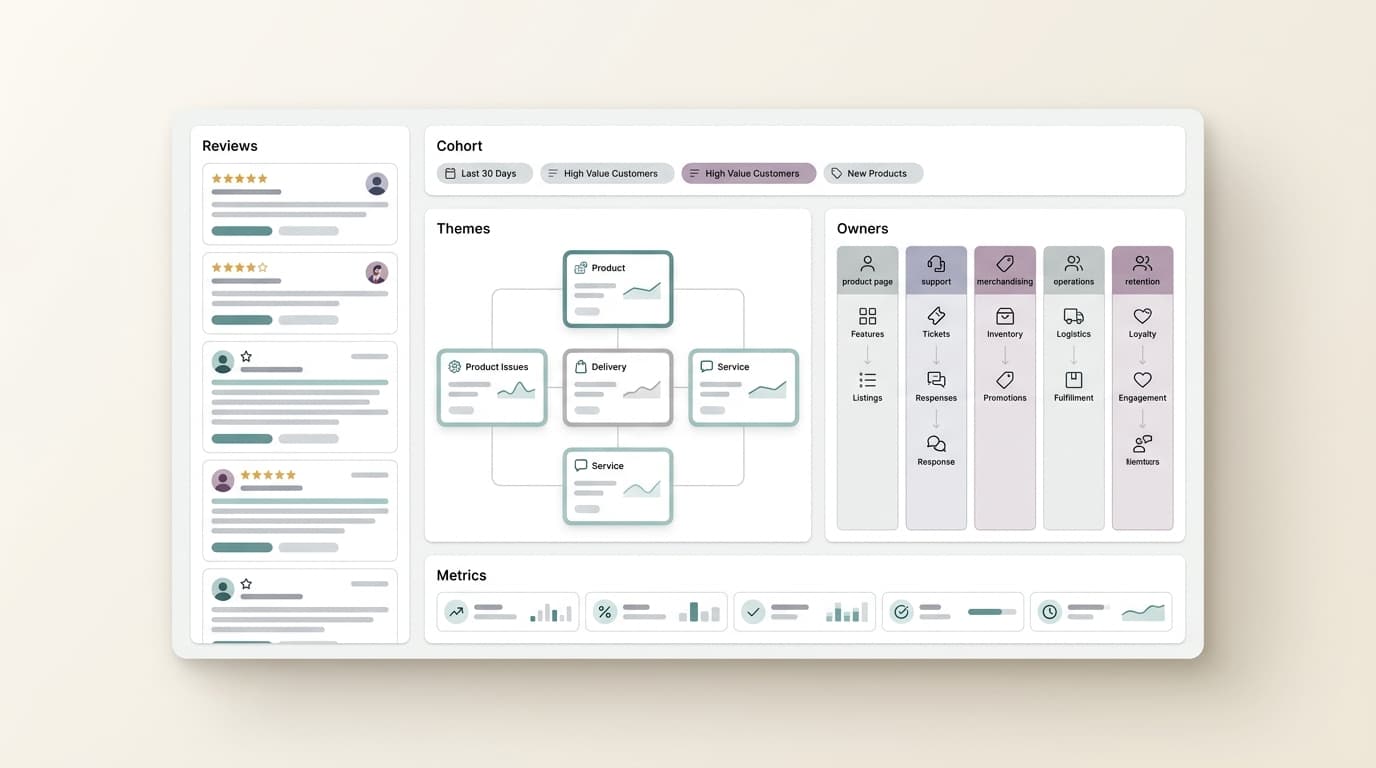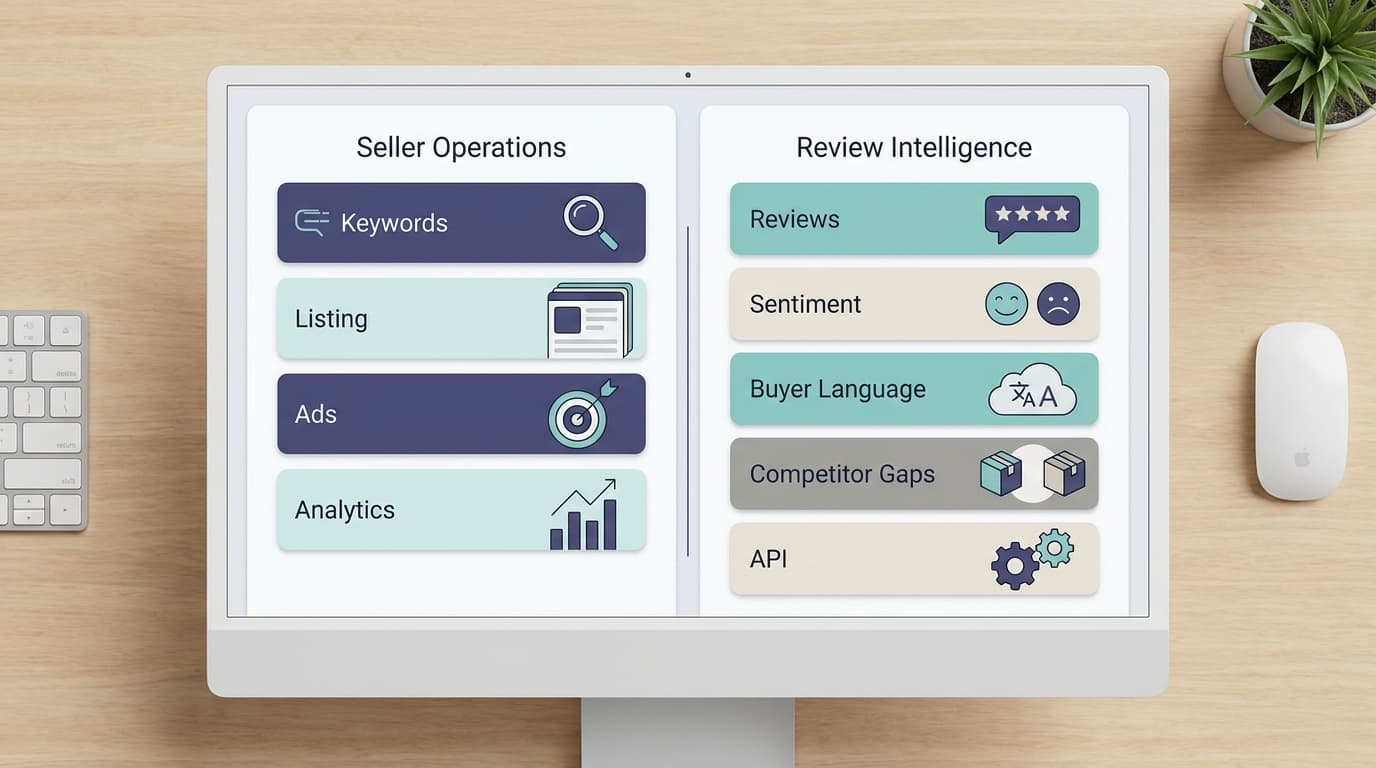
Amazon sellers searching for a Helium 10 alternative are usually not asking whether one tool can replace every other Amazon workflow. They are asking which workflow should own the next decision: keyword research, listing operations, review analysis, competitor gaps, product fixes, or internal reporting.
That distinction matters for a fair VOC AI vs Helium 10 comparison. Helium 10 is a broad Amazon seller suite for product research, keyword research, listing optimization, daily operations, analytics, ads, training, and review-related workflows. Its own help center documents Review Insights, including review topics, snippets, subtopics, trends, rating impact, benchmark views, variation switching, and CSV export for eligible users and marketplaces.
VOC AI is different. It is built around customer-review intelligence, buyer language, product decisions, and API or agent-ready data. Current VOC AI pages describe 2B+ e-commerce reviews, 500M+ tracked products, 30+ categories, daily refresh, REST API, MCP support, and VOC Analysis for turning customer reviews into product direction, buyer language, and decision-ready outputs.
The short version: choose Helium 10 when you need a broad Amazon seller operating suite. Choose VOC AI when the reason you want a Helium 10 alternative is that reviews need to become product, listing, competitor, monitoring, or API decisions.
Quick Decision Summary
| Choose this workflow | When the main job is | Why it fits |
|---|---|---|
| Helium 10 | Running broad Amazon seller operations across product research, keywords, listings, ads, analytics, training, and account workflows. | Helium 10 is positioned as an all-in-one Amazon seller toolset, with Review Insights inside that broader operating stack. |
| VOC AI | Turning reviews into buyer language, complaint themes, competitor gaps, listing inputs, product priorities, and API-ready outputs. | VOC AI is centered on review intelligence and e-commerce data that teams can query through dashboards, agents, REST API, or MCP. |
| Both together | Keeping Helium 10 for marketplace execution while using VOC AI for deeper review-derived evidence. | Many teams need both keyword execution and customer-language intelligence. The split keeps each workflow honest. |
The Fair Comparison Starts With Scope
Review intelligence is not one generic feature. A seller may need to inspect one child ASIN, compare variation-level topics, benchmark a competitor set, rewrite listing language, diagnose a rating change, brief product owners, or move review-derived data into an internal dashboard. Those jobs require different outputs.
Helium 10 Review Insights is useful when the seller is already working inside the Helium 10 and Chrome Extension workflow and wants review context on a product page. Based on Helium 10's own documentation, it can help sellers understand topics and snippets from review data, compare against benchmarks, inspect trends, and export insight data when access and marketplace coverage allow.
VOC AI should be evaluated when the team needs review findings to become reusable operating language: the exact buyer phrases that belong in a listing, the complaint clusters that belong in a product brief, the competitor gaps that belong in a positioning test, and the data handoff that belongs in a dashboard, agent, or report.
That is why VOC AI should not be positioned as a universal replacement for every Helium 10 job. It is a stronger Helium 10 alternative when the bottleneck is review intelligence rather than a broad seller suite.
What Helium 10 Review Insights Does
Helium 10's Review Insights documentation describes a review-analysis workflow inside the Chrome Extension. The public documentation ties the workflow to the selected child ASIN and Amazon customer-feedback data. It references review topics, positive and negative snippets, subtopics, trend views, star-rating impact, benchmark context, variation switching, and CSV export.
Those capabilities should be credited. The useful question is not "does Helium 10 analyze reviews?" It does. The useful question is what the seller needs to do after the review signal appears.
| Helium 10 Review Insights capability | Useful when | Comparison angle |
|---|---|---|
| Review topics and snippets | The seller wants a fast read on recurring positive and negative themes for one product-page context. | Credit the topic view, then compare whether the team needs deeper reuse across product, listing, competitor, or reporting workflows. |
| Subtopics and trend context | The seller wants to see whether a review theme is changing over time. | Avoid saying Helium 10 lacks topic or trend analysis. Compare whether VOC AI's review workflow is better suited for decision packets and ongoing monitoring. |
| Rating impact and benchmarks | The seller wants product-page context against a parent ASIN, category, or benchmark view. | Compare the scope. VOC AI is the better fit when benchmark evidence needs to move into team decisions. |
| CSV export | The seller needs to take insight data out of the extension workflow. | Compare export with API and agent handoff needs. VOC AI documents Review Analysis API, REST API, Python SDK, and MCP support for teams that need programmatic workflows. |
What VOC AI Adds For Review-Derived Buyer Language
VOC AI's current public positioning focuses on e-commerce review intelligence and agent-ready data. The homepage positions VOC AI as a data layer for AI agents, with reviews, keywords, sales estimates, and listing signals available through chat, REST API, Python SDK, or MCP. The VOC Analysis page positions the product around understanding what customers need, hate, expect, and repeat across Amazon.
For Amazon sellers, the value is not just seeing that a review topic exists. The value is turning review evidence into language and decisions:
- Product research: understand why buyers choose, reject, return, or keep products in a category.
- Listing optimization: bring actual buyer wording into titles, bullets, images, comparison tables, FAQs, and A+ content.
- Competitor analysis: compare competitor praise and complaints to find product gaps and safer positioning tests.
- Customer analytics: group buyer expectations, use cases, objections, and motivations into decision-ready themes.
- Monitoring: watch review and rating signals so recurring problems are not discovered only after they damage conversion or trust.
- API and agent handoff: use VOC AI's Review Analysis API when review, keyword, listing, or sales-estimate signals need to move into internal workflows.
That makes VOC AI a practical Helium 10 alternative for review intelligence, not a generic claim that every Helium 10 feature is unnecessary.
Review Intelligence Workflow Chooser
| Seller job | Better fit | Why |
|---|---|---|
| Build a listing around Amazon keyword demand | Helium 10 or the seller's keyword stack | Helium 10 is built around product research, keyword research, listing tools, and seller operations. |
| Inspect review themes while browsing one Amazon product page | Helium 10 Review Insights | The documented workflow sits inside the Chrome Extension and focuses on product-page review context. |
| Extract recurring complaint clusters and exact buyer wording | VOC AI | VOC AI is positioned around review language, pain points, buyer expectations, and product-decision outputs. |
| Compare competitor review gaps across a product set | VOC AI | This workflow needs cross-product buyer-language comparison and source-labeled evidence, not only a single product-page check. |
| Turn reviews into listing and product-roadmap briefs | VOC AI | Buyer language can become structured input for copy, support, product fixes, sourcing, and roadmap prioritization. |
| Monitor account operations, ads, inventory, refunds, and training | Helium 10 | Helium 10's suite covers broader account operations beyond review intelligence. |
| Move review intelligence into dashboards, internal AI workflows, or client reports | VOC AI | VOC AI documents review, keyword, listing, sales-estimate, API, Python SDK, and MCP surfaces for programmatic handoff. |
How To Decide If VOC AI Is The Right Helium 10 Alternative
A strong Helium 10 alternative decision should start with the job your team needs to finish. If the job is broad Amazon execution, keep the all-in-one suite comparison front and center. If the job is review-derived buyer language, VOC AI deserves a deeper look.
A Five-Step Decision Workflow
Use this workflow before choosing a Helium 10 alternative or adding another review-intelligence tool beside your current Amazon stack.
1. Name the decision, not the dashboard
Start with the decision you need to make. Are you rewriting a listing? Choosing a product fix? Comparing competitor gaps? Building a customer-language report? Monitoring rating movement? Feeding an internal AI workflow?
If the decision is mainly keyword demand, listing score, ads, operations, or seller-suite execution, Helium 10 may stay central. If the decision depends on what buyers repeatedly say in reviews, VOC AI should be evaluated earlier as the Helium 10 alternative for that review-intelligence workflow.
2. Separate review context from review action
A review topic can be useful in the moment and still not be enough for team action. Ask what must happen after the topic appears.
| After the review signal appears | What the team needs next | Tool-fit implication |
|---|---|---|
| "People mention battery life." | Exact buyer wording, severity, competitor comparison, and product-owner note. | VOC AI is stronger when the finding must become a decision packet. |
| "A negative topic is trending." | Time window, source scope, affected variations, and monitoring threshold. | Use a review-intelligence workflow that keeps evidence attached. |
| "A listing claim confuses buyers." | Bullet rewrite, image guidance, objection-handling FAQ, and review examples. | VOC AI helps turn review language into listing input. |
| "A product page needs quick context." | Topic and snippet view in the existing research workflow. | Helium 10 Review Insights may be enough when the seller is already inside that workflow. |
3. Check access and data handoff
Pricing and access should come after workflow fit. VOC AI pricing currently presents Free, Basic, Pro, Team Lite, Team Growth, and Enterprise Custom plans, with paid personal plans starting at $29/month and team annual plans starting at $599/year. Helium 10 pricing currently presents Free, Platinum, Diamond, and Custom plans, with Chrome Extension access and Review Insights availability depending on plan and marketplace.
Because pricing and limits change, confirm current access on both vendors' pricing pages before making a final decision.
4. Protect claim safety
Do not build a comparison page around claims that are no longer source-safe. The current comparison should avoid saying:
| Unsafe or outdated claim | Safer replacement |
|---|---|
| "Helium 10 has no review analysis." | "Helium 10 documents Review Insights; compare downstream workflow scope." |
| "Helium 10 only provides surface-level analysis." | "Helium 10 provides review topics and related views; VOC AI is a stronger fit when the output must become buyer-language decisions." |
| "VOC AI guarantees sales, ranking, or rating recovery." | "VOC AI helps teams identify review patterns, buyer language, and decision inputs; outcomes still require execution and validation." |
| "VOC AI accesses private Amazon data." | "VOC AI uses its public product intelligence dataset and documented API or MCP surfaces; confirm field access and compliance requirements for technical workflows." |
5. Decide whether to replace, complement, or split workflows
Not every seller should replace a broad Amazon suite. Some should use both tools. The right Helium 10 alternative may be a dedicated customer-language layer rather than a full replacement for every seller operation.
Keep Helium 10 as the seller-suite workspace when product research, keyword research, listing optimization, ads, analytics, and account operations are the main jobs. Add VOC AI when review intelligence becomes important enough to deserve its own workflow, source labels, buyer-language extraction, and reporting path.
Detailed Comparison Matrix
| Dimension | VOC AI | Helium 10 | Safe takeaway |
|---|---|---|---|
| Primary orientation | Review intelligence, buyer language, product decisions, API/MCP/agent-ready data, and customer-signal workflows. | Broad Amazon seller suite covering product research, keyword research, listing optimization, daily operations, analytics, ads, training, and review tools. | Compare a specialized review-intelligence layer with a broad seller operating suite. |
| Public scale proof | VOC AI currently states 2B+ e-commerce reviews, 500M+ products tracked, 30+ categories, and daily refresh. | Helium 10 presents itself as a comprehensive Amazon seller toolset with multiple plan tiers and Chrome Extension access rules. | Treat each vendor's public metrics as context, not proof of superiority. |
| Review analysis | VOC AI centers review analysis around buyer language, customer needs, complaint themes, product decisions, and dashboards/API/agent handoff. | Helium 10 Review Insights documents topics, snippets, subtopics, trends, star-rating impact, benchmarks, variation switching, and CSV export. | Both offer review intelligence; choose by downstream workflow. |
| Keyword and listing execution | VOC AI can inform listing language from reviews and supports keyword/listing signals in API-oriented workflows. | Helium 10 is stronger as a broader keyword, listing, product research, and operations workspace. | Use Helium 10 for seller-suite execution; use VOC AI for review-derived language and evidence. |
| Competitor review gaps | VOC AI is built for finding buyer complaints, product gaps, and customer-language patterns across review sets. | Helium 10 supports competitor and seller-suite research workflows, with Review Insights for product-page review context. | Use VOC AI when competitor gaps must become product or positioning decisions. |
| API and agent handoff | VOC AI documents REST API, Python SDK, MCP support, and Review Analysis API positioning. | Public Review Insights documentation emphasizes the Chrome Extension workflow and CSV export. | If programmatic review intelligence matters, verify API fields and limits with VOC AI first. |
| Best fit | Teams that need review evidence for product, listing, competitor, monitoring, and internal reporting decisions. | Sellers who need one broad Amazon suite for research, execution, operations, and analytics. | VOC AI is the Helium 10 alternative to evaluate when review intelligence is the bottleneck. |
When Sellers Should Use Both Tools
Some teams should not force a single-tool decision. Helium 10 can remain the operating workspace for Amazon product research, keyword research, listing work, ads, analytics, and account routines. VOC AI can become the customer-feedback layer that explains why buyers complain, what language they repeat, where competitors are vulnerable, and which insights deserve product or listing action.
A practical combined workflow looks like this:
- Use Helium 10 or your current keyword stack to understand demand, listing gaps, rank movement, and seller operations.
- Use VOC AI to analyze reviews across your ASIN, competitor ASINs, and priority categories.
- Group recurring complaints, motivations, use cases, and objections into a product and messaging brief.
- Route findings to product, listing, support, sourcing, or leadership owners.
- Recheck review language after changes to see whether the pattern improves, shifts, or creates a new concern.
Final Decision Matrix
| Your situation | Recommended next step |
|---|---|
| You need one suite for product research, keywords, listings, ads, analytics, training, and daily operations. | Evaluate Helium 10 first, then add VOC AI if customer-review intelligence becomes a deeper workflow. |
| You are comparing competitors and need to know what buyers repeatedly complain about or praise. | Start with VOC AI and use review intelligence to turn buyer language into product and positioning decisions. |
| Your listing gets traffic, but buyers still mention unclear expectations, missing features, or repeated objections. | Use VOC AI to extract buyer wording and route it into listing copy, A+ content, support content, and product fixes. |
| Your team needs review data in dashboards, research reports, client deliverables, or internal AI systems. | Review VOC AI's Review Analysis API, REST API, Python SDK, and MCP support; confirm current fields, limits, and compliance requirements. |
| You only need a quick review-topic check while browsing one Amazon product page. | Use Helium 10 Review Insights if your plan and marketplace access support the workflow. |
FAQ
Is VOC AI a full Helium 10 replacement?
No. VOC AI is not positioned as a complete replacement for every Helium 10 seller-operations workflow. It is a stronger fit when the seller specifically needs review-derived buyer language, customer feedback intelligence, competitor review gaps, monitoring, API handoff, or agent-ready data.
Does Helium 10 have review analysis?
Yes. Helium 10 publicly documents Review Insights with review topics, snippets, subtopics, trends, rating impact, benchmarks, variation switching, and CSV export. A fair comparison should credit those capabilities and then compare workflow scope.
When should an Amazon seller choose VOC AI?
Choose VOC AI when reviews are not just a quick check but a core input for product decisions, listing language, competitor strategy, monitoring, reports, or technical workflows. VOC AI is especially relevant when the team needs customer language and evidence that can be reused outside a single product-page view.
Can sellers use VOC AI and Helium 10 together?
Yes. A common split is to keep Helium 10 for broad seller-suite workflows and use VOC AI as the dedicated review-intelligence layer. That approach separates keyword and operations work from buyer-language research.
Should pricing decide the winner?
Pricing should come after workflow fit. Confirm current plan access on both vendor pages, then compare whether the seller needs an all-in-one Amazon operating suite, deeper review intelligence, monitoring, API access, or both.
Bottom Line
Choose Helium 10 when the priority is a broad Amazon seller suite with product research, keyword research, listings, ads, analytics, operations, training, and quick Review Insights. Choose VOC AI when the priority is turning reviews into buyer-language intelligence for product, listing, competitor, monitoring, and API workflows.
If review intelligence is the reason you are searching for a Helium 10 alternative, start with one product set in VOC AI's Voice of Customer Analysis workflow. Then decide whether VOC AI should be your dedicated buyer-language layer, your primary review-analysis tool, or the review intelligence system that complements your existing Amazon seller suite. For team workflows, contact VOC AI with the ASIN set, comparison window, and decision your team needs to make.