Updated August 24, 2026.
Product research AI is useful only when it changes a product decision your team was already responsible for making.
That sounds obvious until the first report arrives. The AI finds trends, clusters complaints, drafts opportunity summaries, and names competitors. Then the team asks the harder question: what do we do Monday morning?
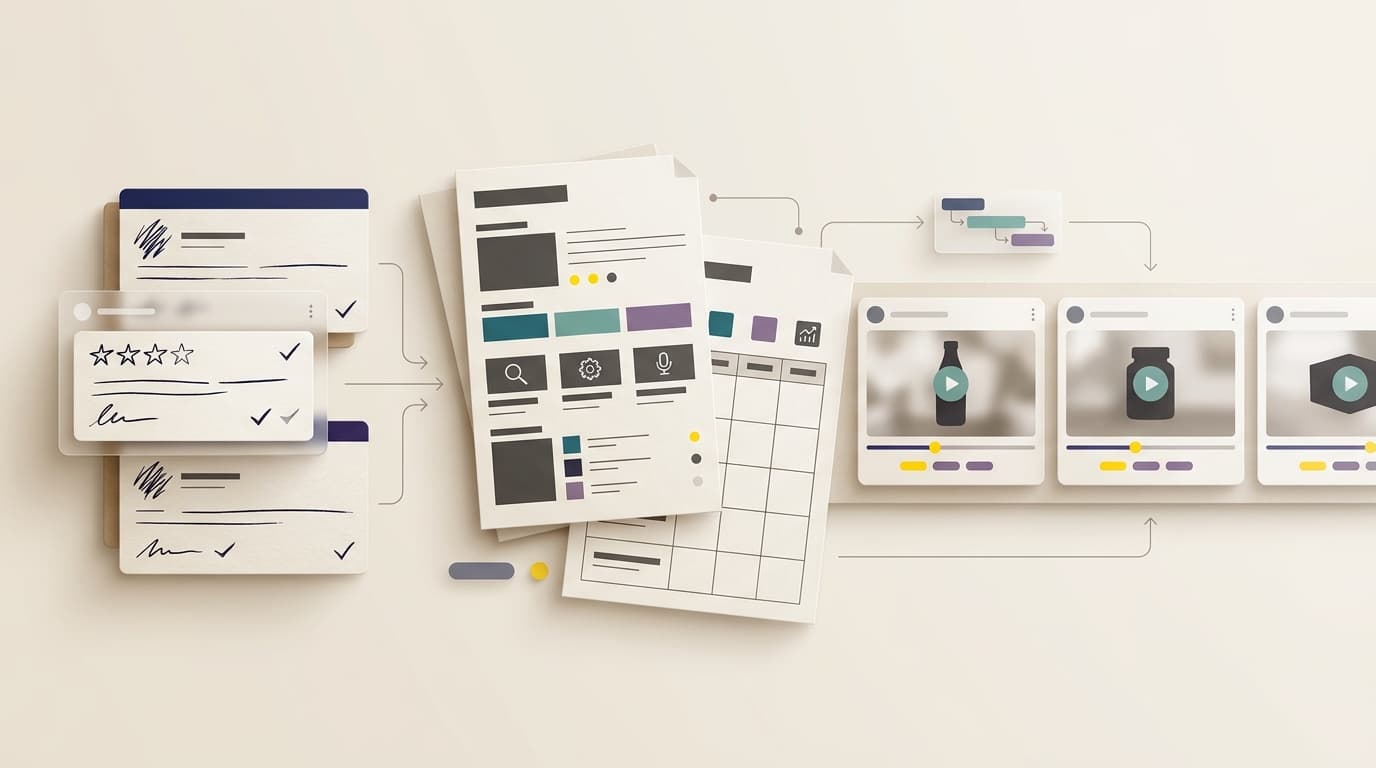
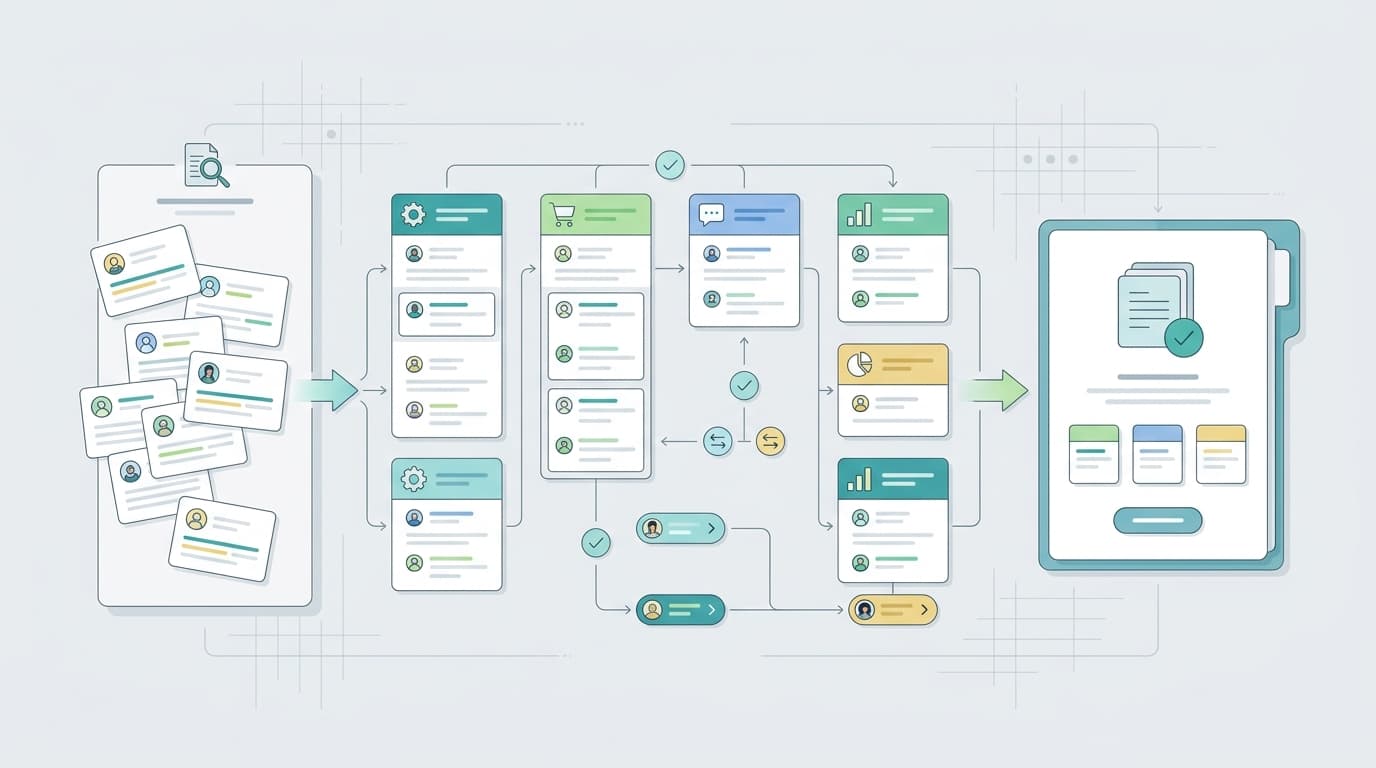
This practical guide gives product, growth, and ecommerce teams an operating workflow for product research AI. It does not try to rank every tool. It shows how to turn review, market, competitor, support, and internal evidence into a decision packet that a product manager, marketer, researcher, or founder can actually use.
If you are still choosing vendors, start with the companion product research AI comparison or the product research AI tools evaluation framework. This page is narrower: it explains how a team should run the workflow after product research AI is in the stack.
Start with the decision, not the model
Before you open any product research AI tool, write one decision sentence:
We need to decide whether to [build, improve, launch, reposition, discontinue, or monitor] [specific product, feature, SKU, bundle, segment, or category] for [customer segment] before [date].
That sentence keeps the workflow from turning into an impressive research dump.
Weak prompt:
Analyze customer reviews for this category.
Better prompt:
Find whether repeat complaints about battery life, setup time, and confusing instructions are strong enough to justify a new accessory bundle for first-time buyers before the September launch meeting.
The second prompt gives the AI a job. It names the product decision, evidence type, buyer segment, and deadline. It also gives your team a way to reject the output if it does not answer the decision.
Build a product research AI signal map
Most teams treat product research AI as a summarizer. The better workflow treats it as a signal map.
Use the map below before any synthesis. It tells the AI what each source can and cannot prove.
| Signal source | What it can prove | What it cannot prove alone | Best use in the workflow |
|---|---|---|---|
| Customer reviews | Pain language, repeated defects, expectation gaps, feature mentions, purchase context | Total addressable demand, margin, inventory risk | Define what buyers already complain about and what language they use |
| Competitor reviews | Gaps in competing products, unmet expectations, category-level irritation | Your team's ability to win the category | Find openings and table-stakes requirements |
| Market and category data | Category movement, price bands, sales-estimate context, demand direction | The exact feature that should be built | Decide whether a pain point sits inside a market worth pursuing |
| Support tickets and chats | Current customer friction, implementation confusion, account-level urgency | Broader market opportunity outside your current base | Prioritize fixes and onboarding changes |
| Surveys and interviews | Motivation, jobs-to-be-done, objections, buyer context | Actual frequency across a large market | Explain why a signal matters |
| Product analytics | Feature usage, activation friction, funnel drop-off | Customer language and competitor context | Validate whether an observed pain appears in behavior |
| Sales calls and CRM notes | Deal blockers, segment-specific objections, revenue context | Whether the broader market shares the same issue | Prioritize by commercial impact |
The point is not to feed every source into one model and hope for a smart summary. The point is to preserve what each source is allowed to prove.
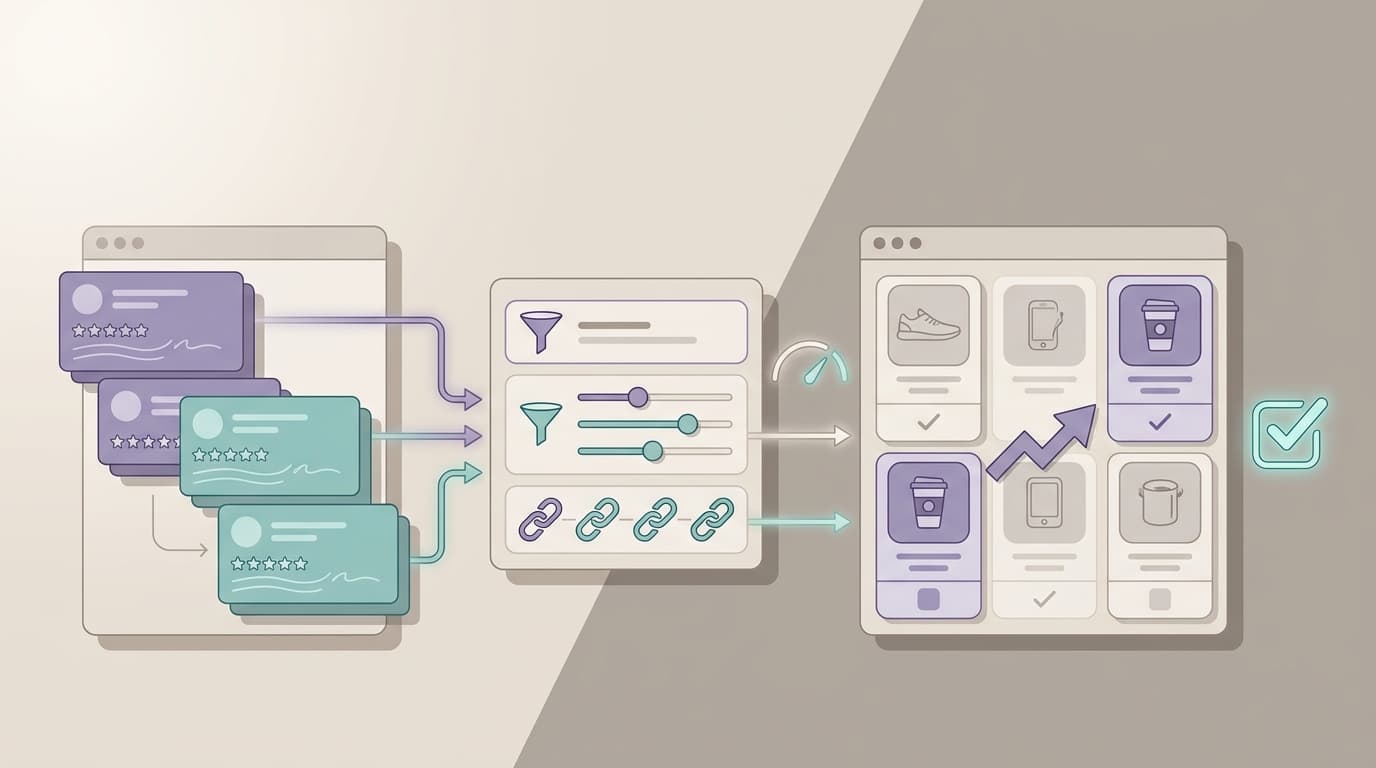
For ecommerce teams, this is where review-backed product research is especially strong. VOC.AI's Product Research page positions the workflow around demand signals, review-backed validation, and launch planning. Its Market Insight page adds category movement, sales estimates, market share, category trends, competitor tracking, product research, and review signals. Those two layers answer different questions: is the market moving, and what are buyers saying inside that movement?
Run the six-step product research AI workflow
Use this workflow whenever a team needs a product, listing, roadmap, launch, or category decision.
1. Lock the cohort
Define the evidence boundary before the AI starts summarizing.
Good cohort definitions include:
- Product or category set
- Competitor set
- Region or marketplace
- Date range
- Star rating range, if reviews are used
- Customer segment or use case
- Exclusions, such as irrelevant accessories, replacement parts, or old versions
Bad product research AI outputs usually start with a vague cohort. If the tool cannot tell you which evidence it analyzed, your team cannot defend the recommendation.
2. Extract themes with source evidence
Ask for themes, but require evidence with each theme.
Each theme should include:
- Theme name
- Short description
- Representative source quote or record
- Source type
- Product, competitor, or account
- Date range
- Sentiment direction
- Estimated severity
- Known counterexample
Do not accept a theme unless the team can inspect the source behind it. The Voice of Customer Analysis page describes this job as clustering feedback by pain point, expectation, and feature mention. For a product team, that clustering is useful only when it stays attached to the source evidence.
3. Separate demand from pain
Product research AI often blends two signals that should stay separate:
- Demand: people are buying, searching, comparing, or entering the category.
- Pain: people are disappointed enough to complain, return, churn, or ask for a better version.
A category can have demand without a product opening. A complaint can be loud without a market worth entering. The best product research AI workflow keeps these two scores separate until the decision meeting.
Use this simple split:
| Question | Evidence to check | Decision meaning |
|---|---|---|
| Is the category active? | Market movement, sales estimates, search interest, competitor activity | There may be room to investigate |
| Is the pain repeated? | Reviews, tickets, interviews, sales notes | There may be a solvable problem |
| Is the pain specific? | Quotes, feature mentions, use-case context | The team can write a sharper requirement |
| Is the pain monetizable? | Price bands, affected segment, conversion or retention impact | The issue may justify investment |
| Is the fix credible? | Roadmap cost, operational constraints, sourcing, brand fit | The team can act without wishful thinking |
4. Preserve contradictions
If the AI returns only a clean answer, push back.
Useful product research AI should preserve contradictions such as:
- Some buyers want a lighter product, while others complain it feels cheap.
- Beginners need more instructions, while expert buyers dislike packaging clutter.
- Low-price competitors win volume, but premium products own stronger loyalty.
- One region complains about durability, while another complains about availability.
- Negative reviews mention setup difficulty, but high-star reviews praise the same advanced controls.
Contradictions are not noise. They are often the segmentation insight.
5. Convert findings into a decision packet
The output should not be a long report. It should be a decision packet.
A useful packet has this structure:
| Packet field | What to include |
|---|---|
| Decision sentence | The exact product decision the research supports |
| Cohort | Source set, date range, competitors, region, and exclusions |
| Top finding | One plain-English answer, not a paragraph of hedging |
| Evidence table | Themes, counts or directional strength, source examples, and counterexamples |
| Segment split | Which users, buyers, use cases, regions, or price bands differ |
| Opportunity type | Build, fix, bundle, reposition, monitor, test, or reject |
| Owner | Product, marketing, support, growth, research, ecommerce, or engineering |
| Next artifact | PRD, listing brief, test plan, roadmap note, support macro, sales enablement, or no-action record |
| Confidence | High, medium, or low, with the reason |
| Recheck date | When the team should refresh the evidence |
This packet is the difference between "the AI found insights" and "the team made a decision."
6. Route the work to the owner
Product research AI should not end in a shared doc with no owner.
Use routing rules:
| Finding type | Primary owner | Follow-up artifact |
|---|---|---|
| Repeated product defect | Product or quality owner | Defect brief with review evidence and severity |
| Missing feature or unmet use case | Product manager | Opportunity brief or roadmap candidate |
| Confusing instructions or onboarding | Support or lifecycle owner | Support macro, setup guide, onboarding experiment |
| Listing mismatch or unclear promise | Marketing or ecommerce owner | Listing-copy brief with buyer language |
| Competitor weakness | Growth, product marketing, or founder | Positioning brief or launch angle |
| Unclear or contradictory evidence | Research owner | Follow-up interview, survey, or manual review |
| High demand but weak pain | Founder or category owner | Monitor-only note or market watch |
The owner does not need to accept the recommendation. They do need to accept, reject, or ask for more evidence.
A weekly product research AI cadence
Teams do not need a giant research sprint every week. They need a repeatable cadence.
Monday: choose one decision
Pick one decision from the backlog. Avoid broad questions. Choose something the team can act on within 30 days.
Examples:
- Should we prioritize a durability fix over a new color variant?
- Which competitor complaint should shape the next listing update?
- Is this category worth a launch test, or should we keep monitoring?
- Which support issue should become a product requirement?
- Which review theme should sales use in the next comparison page?
Tuesday: gather and lock evidence
Export or connect the evidence. Save the cohort definition before synthesis.
If you use VOC.AI for review-backed research, combine the Product Research workflow with Voice of Customer Analysis for buyer-language themes and Market Insight for category context. If the workflow is recurring or embedded, the Review Analysis API supports REST API, Python SDK, and MCP usage for teams that need structured automation rather than one-off dashboard work.
Wednesday: synthesize and challenge
Generate the first synthesis, then challenge it.
Ask:
- What source evidence supports each claim?
- What counterevidence weakens the recommendation?
- Which segment is most affected?
- Which theme is severe but rare?
- Which theme is common but low impact?
- What would change the recommendation?
The challenge step is where product research AI becomes a reasoning aid instead of a content generator.
Thursday: build the decision packet
Compress the output into one packet. Remove generic commentary. Keep the evidence table, owner, confidence level, and next artifact.
Friday: make or defer the decision
End the week with one of five outcomes:
- Build or fix
- Test
- Reposition
- Monitor
- Reject
If the team cannot choose one, the packet should say why. Missing evidence is a valid outcome. Vague confidence is not.
The 30-day rollout plan
If your team is adopting product research AI for the first time, avoid a big platform rollout. Start with one decision loop.
| Timeframe | Goal | Work to complete | Output |
|---|---|---|---|
| Days 1-3 | Pick the decision lane | Choose one recurring product decision and define accepted evidence sources | Decision sentence and source list |
| Days 4-7 | Build the evidence contract | Define cohort fields, required source links, counterevidence, and owner routing | Product research AI packet template |
| Days 8-14 | Run the first packet | Analyze one real decision and challenge the synthesis | Accepted, rejected, or revised packet |
| Days 15-21 | Connect to execution | Turn one accepted finding into a PRD, listing brief, support artifact, or test plan | Owner-owned follow-up artifact |
| Days 22-30 | Review quality | Check whether the packet changed a real decision and what evidence was missing | Workflow scorecard and next decision lane |
Do not measure the first month by number of AI reports generated. Measure it by accepted decisions, rejected assumptions, and evidence gaps made visible.
Product research AI quality checklist
Use this checklist before a product research AI packet reaches a decision meeting.
- The decision sentence is specific.
- The evidence cohort is named and inspectable.
- Review, market, and internal sources are not treated as equivalent proof.
- Each major theme has source evidence.
- Counterevidence is included.
- Demand and pain are separated.
- Segment differences are visible.
- The recommendation names an owner.
- The next artifact is clear.
- Confidence level explains what is strong and what is missing.
- The packet can be reused or refreshed.
- The team knows what would change the recommendation.
If a packet fails more than three of these checks, do not use it to make a product decision.
Where VOC.AI fits
VOC.AI is strongest when product research depends on review-backed evidence, market context, and repeatable workflows.
Use Product Research when the team needs to screen ideas through demand, differentiation, buyer pain points, category context, and roadmap inputs. Use Market Insight when the decision needs category movement, sales estimates, market share, price bands, review volume, ratings, BSR signals, and competitor tracking. Use Voice of Customer Analysis when the team needs to compress large review sets into pain points, motivations, expectations, and next actions. Use the Review Analysis API when product research AI needs to feed an internal tool, agent workflow, or repeatable automation.
If budget and rollout scope matter, the Pricing page currently lists Free, Pro, Team Lite, Team Growth, and Enterprise Custom options, with shared credit usage across API, MCP, and Agent analysis.
That combination matters because product research AI should not stop at finding ideas. It should prove which idea deserves work, who owns the next step, and what evidence would change the team's mind.
Common mistakes
Mistake 1: asking for insights instead of decisions
"Find insights" produces a report. "Decide whether this complaint should change the roadmap" produces a useful workflow.
Mistake 2: mixing every source into one confidence score
Reviews, surveys, interviews, support tickets, and market data do different jobs. Product research AI should connect them, not flatten them.
Mistake 3: ignoring counterevidence
If every finding supports the same conclusion, the packet is probably hiding risk.
Mistake 4: skipping owner routing
An insight without an owner is just content. Route the finding to a product, marketing, support, growth, ecommerce, or research owner.
Mistake 5: measuring output volume
More research reports do not mean better decisions. Track decision adoption, rejected assumptions, owner follow-through, and refresh cadence.
FAQ
What is product research AI?
Product research AI uses machine learning and language models to analyze evidence such as customer reviews, market data, competitor movement, support tickets, interviews, surveys, and product analytics so teams can make product decisions faster.
How should a team use product research AI?
Start with one specific product decision, lock the evidence cohort, extract themes with source evidence, preserve counterevidence, build a decision packet, and route the next artifact to the owner who can act on it.
Is product research AI the same as market research AI?
No. Market research AI often focuses on market size, trends, audience behavior, and competitive context. Product research AI should connect those signals to product decisions such as what to build, improve, launch, reposition, monitor, or reject.
What evidence should product research AI include?
Use the evidence that matches the decision. Reviews are strong for pain language and product expectations. Market data is strong for category context. Support tickets show current customer friction. Interviews and surveys explain motivation. Product analytics validates behavior.
How do you know whether product research AI is working?
Track whether the workflow produces accepted decision packets, clearer owner handoffs, better evidence quality, faster prioritization, and fewer unsupported assumptions. Do not judge it only by how many reports it generates.
The practical bottom line
Product research AI is not a shortcut around product judgment. It is a way to make that judgment easier to inspect.
The useful workflow is simple: name the decision, lock the cohort, preserve the evidence, challenge the synthesis, route the next artifact, and review whether the decision improved. When a team works that way, product research AI becomes more than another dashboard. It becomes a repeatable product decision system.