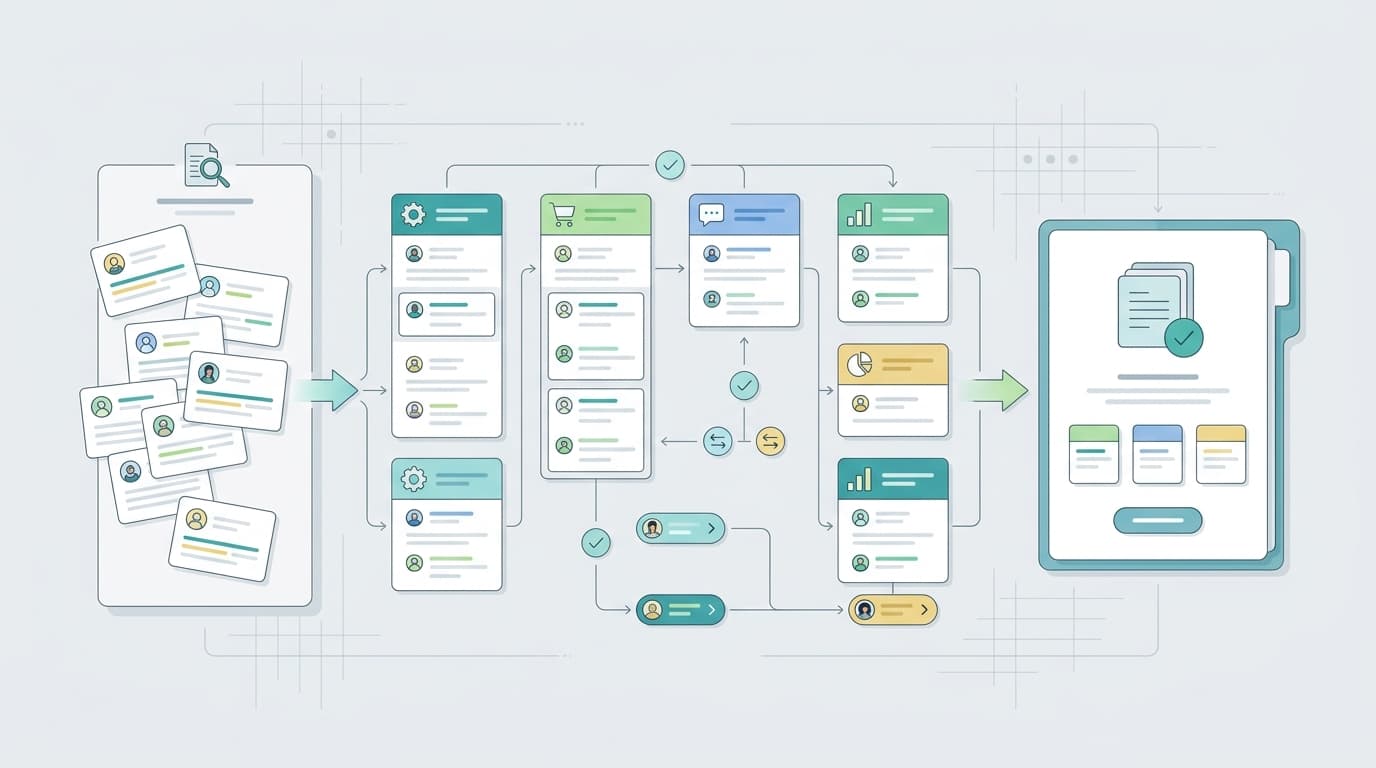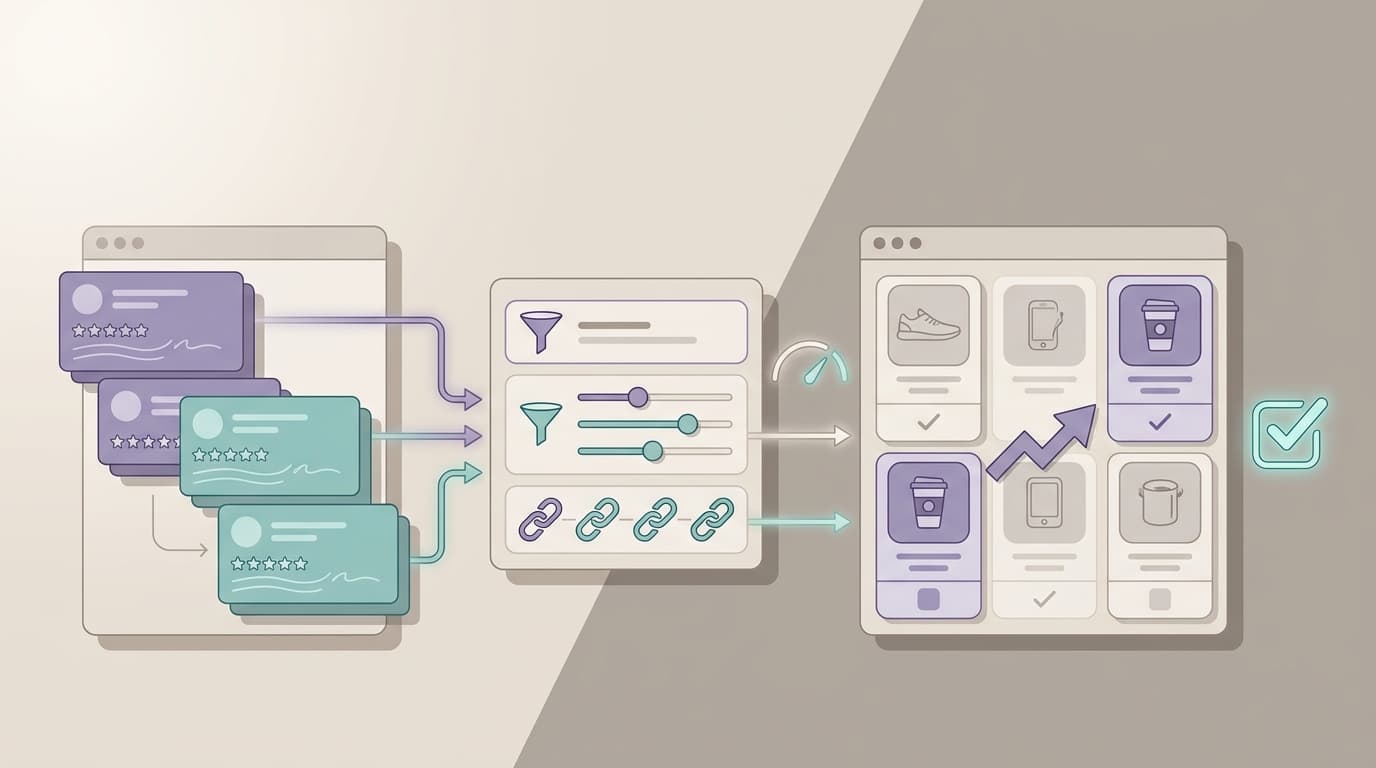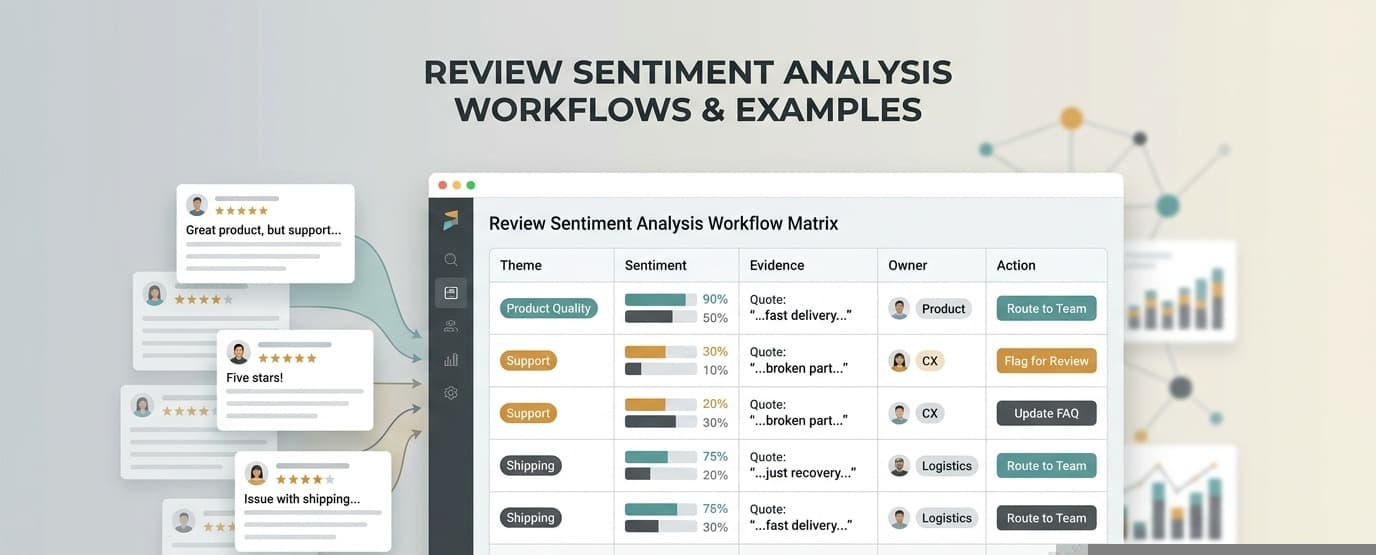
Amazon category trend analysis helps sellers decide whether a category is worth entering before they source inventory, launch a variation, or expand into a new niche. The goal is not to chase one exciting metric. The goal is to compare demand, competition, share concentration, BSR movement, pricing, reviews, ratings, and buyer language until the team can make a clear decision: enter, narrow, wait, monitor, or reject.
A category can look attractive because one product is rising, one keyword is popular, or one competitor has weak reviews. That is not enough. Sellers need to know whether demand is broad enough, whether market share is open enough, whether recent entrants can gain traction, and whether the review signal points to a product gap the team can actually solve.
Use this workflow when you need a reusable category review before committing cash, supplier time, content resources, or launch budget. For a faster software-assisted view, use VOC AI Market Insight to compare market size, share, BSR coverage, competitor movement, prices, reviews, and star-rating trends in one category workflow.
What Amazon Category Trend Analysis Should Answer
A useful category analysis should answer one practical question: is this category big enough, open enough, and stable enough for this team to enter now?
That question has several parts:
- Demand depth: Is there enough buyer activity to support the target margin, inventory risk, and launch cost?
- Share openness: Are sales distributed across enough products and brands, or is the category locked by a few leaders?
- Trend quality: Is BSR movement broad across a competitor set, or is one product creating a temporary spike?
- New entrant traction: Can newer products win reviews, sales, and visibility without extreme discounting?
- Buyer pain clarity: Do reviews and ratings reveal repeated unmet needs the team can address?
- Execution feasibility: Can the team source, ship, support, and market the product without unsupported claims or margin pressure?
Amazon's own seller tools reinforce the idea that opportunity research should look at more than a single keyword. Product Opportunity Explorer is built around demand and opportunity signals, Best Sellers Rank helps sellers understand sales-rank context inside categories, Brand Analytics supports search and purchase insight for enrolled brands, and Customer Reviews can surface product feedback. Category trend analysis combines those kinds of signals into a decision workflow.
The Core Signals to Compare
Start by defining the category boundary. Pick the marketplace, category or subcategory, keyword set, price tier, and competitor cohort. If the scope is too broad, leader brands and unrelated products will distort the result. If it is too narrow, the team may mistake a small pocket of demand for a viable market.
Signal | What to check | Good signal | Risk signal | Decision impact |
Category size | Estimated demand, sales range, active products, and revenue concentration. | Enough demand to support the team's inventory and margin goals. | A tiny market disguised as low competition. | Reject or narrow if the category cannot support the business case. |
Market share | Share held by leading products, challengers, and long-tail sellers. | Share is distributed enough for new entrants to win a realistic niche. | A few brands own most demand, reviews, and pricing power. | Narrow the segment, differentiate harder, or reject the broad category. |
BSR trend | Rank movement across the cohort, not only one product. | Several products show stable or rising demand. | One spike, promotion, or seasonal event drives the story. | Validate trend durability before sourcing. |
New-product activity | Recent launches, review ramp, price tier, and placement changes. | Newer products can gain traction with a clear angle. | New entrants appear but fail to gather reviews or repeat sales. | Enter only if differentiation is strong and timing is realistic. |
Competitor movement | Price, coupon, listing, content, review, and star-rating changes. | Competitors leave visible gaps or respond slowly. | Leaders move fast and compress margins. | Adjust positioning, pricing, and launch timing. |
Price bands | Average selling price, discount depth, bundles, and premium tiers. | Price bands leave room for margin and differentiation. | Demand depends on heavy coupons or race-to-bottom pricing. | Reject or move to a different value tier. |
Review volume | Total reviews, recent reviews, and review velocity across products. | Enough buyer language exists to validate needs and objections. | Low review volume makes the buyer signal thin. | Require more evidence before committing inventory. |
Star ratings | Rating distribution, rating movement, and complaint themes. | Demand exists despite fixable complaints. | Low ratings point to hard product or category execution problems. | Define product specs carefully or reject the risk. |
Buyer language | Use cases, objections, purchase motivations, and repeated pain points. | Repeated needs map to a feasible product, bundle, or listing angle. | Complaints are scattered, subjective, or hard to solve. | Move to product research only when the signal repeats. |
Amazon Category Entry Scorecard
The scorecard below keeps the team from overreacting to one metric. Give each positive factor a simple score from 1 to 5, then subtract the major risks. The exact weights can change by business model, but the logic should stay consistent.
Scorecard factor | Positive evidence | Risk deduction | Owner |
Demand depth | Market size and BSR movement show sustained buyer activity. | Demand is too small, seasonal, or concentrated in one product. | Category manager |
Share openness | Multiple challengers and long-tail sellers can win visible demand. | Top brands control sales, reviews, ads, and price expectations. | Founder or commercial lead |
New-product traction | Recent entrants gain reviews and placement without unsustainable discounts. | New products launch but disappear or stall quickly. | Sourcing and launch lead |
Buyer-pain clarity | Reviews repeat clear, fixable complaints or unmet use cases. | Pain points are vague, isolated, or outside the team's control. | Product and VOC lead |
Margin feasibility | Price bands support target cost, logistics, support, and ad spend. | Category economics require weak materials, risky claims, or heavy coupons. | Finance and sourcing |
Execution risk | Supplier, compliance, support, content, and timing requirements are manageable. | The product needs certification, engineering, or claims the team cannot support. | Operations and compliance |
A simple working formula is:
Category opportunity score = demand depth + share openness + BSR trend quality + new-product traction + buyer-pain clarity + margin feasibility - concentration risk - seasonality risk - execution risk - compliance risk.
The formula is not meant to make category selection automatic. It is meant to force a structured discussion before a team mistakes a single keyword, BSR move, or competitor weakness for a full market opportunity.
A Seven-Step Category Trend Workflow
- Define the category boundary. Write down the marketplace, category, subcategory, keyword set, price tier, excluded product types, and 20 to 100 competing products.
- Pull category trend data. Compare market size, market share, BSR movement, pricing, reviews, and star ratings for the current period and a prior period.
- Segment competitors. Separate leaders, challengers, new entrants, premium products, budget products, seasonal products, and products with unusual review movement.
- Evaluate price pressure. Look for coupon dependence, bundle expectations, price compression, and whether the team's target margin still works.
- Read review and rating signals. Identify repeated praise, complaints, use cases, objections, rating drops, and language buyers use across several products.
- Score category openness. Use the scorecard to decide whether the market is open, risky, too small, too late, or ready for a narrower niche.
- Route the next workflow. Move the finding into Amazon product research, Amazon competitor analysis, listing optimization, review monitoring, or a reject decision.
The output should be a category entry note that a sourcing team can review in one meeting. It should include the category scope, market-size view, share concentration, BSR trend, new-product traction, price bands, review and rating signal, blue-ocean hypothesis, validation needed, and the final decision.
How to Decide: Enter, Narrow, Wait, Monitor, or Reject
Decision | When it fits | Next action |
Enter | Demand is deep, share is not locked, reviews reveal a fixable gap, and margin works. | Move to product specs, supplier validation, listing plan, and launch risk review. |
Narrow | The broad category is crowded, but one segment, use case, price tier, or complaint cluster looks open. | Build a smaller competitor cohort and rerun the scorecard. |
Wait | The trend is promising, but seasonality, sourcing lead time, compliance, or launch timing is unfavorable. | Set a revisit date and track BSR, prices, reviews, and new entrants. |
Monitor | The signal is early, noisy, or driven by a few competitors. | Create a monthly category watchlist and review competitor movement. |
Reject | Demand is too shallow, share is locked, margins are weak, or the buyer pain is not feasible to solve. | Save the evidence and redirect effort to a better category. |
Where Reviews and Ratings Fit
Reviews and ratings are category trend signals, not only customer-service signals. A category with strong sales and repeated one-star complaints may hide a product-improvement opportunity. A category with high ratings and locked share may be harder to enter even when demand is large. A category with few reviews may still be early, but it may also be too small to justify a launch.
Use Voice of Customer analysis to connect review themes to category decisions. Look for repeated language around durability, sizing, packaging, setup, compatibility, missing accessories, confusing instructions, price/value mismatch, and competitor comparisons. Then ask whether your team can solve the issue with a better product, bundle, listing, support workflow, or category positioning.
For the deeper review-analysis method, see how to analyze Amazon reviews using AI. For ongoing competitor movement after launch, use a weekly rhythm like Amazon seller competitor analysis.
How VOC AI Market Insight Fits
VOC AI Market Insight is the conversion path for this workflow because it is positioned around Amazon sales estimation, competitive analysis, product research, market share analysis, market trends, blue-ocean discovery, BSR coverage, competitor movement, prices, reviews, and star ratings. In practice, that means the team can use one workflow to move from category-level demand to competitor-level movement and review-level buyer signal.
A practical workflow looks like this:
- Use Market Insight to compare category size, market share, BSR movement, pricing, review volume, and star-rating movement.
- Use Product Research when the category score suggests a product idea needs validation.
- Use Competitor Analysis when share concentration, price movement, or competitor changes drive the decision.
- Use review intelligence when the opportunity depends on buyer pain, product gaps, or listing language.
- Use VOC AI pricing or the demo path when the team needs recurring category reports or a broader research workflow.
The safest way to use category data is as decision support. Do not treat market size, BSR, or review data alone as proof that a product will succeed. A good category trend analysis reduces avoidable uncertainty, but the team still needs supplier validation, margin checks, compliance review, listing proof, and launch planning.
Common Mistakes in Amazon Category Analysis
- Calling low competition a blue ocean without demand proof. Some categories are quiet because buyers are not there.
- Using one BSR spike as the whole trend. Check whether movement appears across a cohort or only one promoted product.
- Ignoring share concentration. A large category can still be unattractive if the leaders own most sales and trust.
- Reading reviews without scoring feasibility. A repeated complaint matters only if the team can solve it profitably and compliantly.
- Copying old category reports as current evidence. Legacy reports can show format, but category numbers need current validation.
- Forgetting launch timing. A seasonal category may be real, but sourcing and content may arrive after the demand window.
FAQ
What is Amazon category trend analysis?
Amazon category trend analysis is the process of comparing category demand, market share, BSR movement, competitor changes, pricing, reviews, ratings, and buyer language to decide whether a category is worth entering, narrowing, waiting on, monitoring, or rejecting.
Which Amazon category metrics matter most?
The most useful metrics are category size, share concentration, BSR movement, new-product activity, competitor movement, price bands, review volume, review velocity, star ratings, and repeated buyer themes. No single metric is enough by itself.
How do you know whether an Amazon category is a blue-ocean opportunity?
A true blue-ocean opportunity needs enough demand, open enough share, feasible differentiation, and repeated buyer pain the team can solve. Low competition alone can mean weak demand rather than opportunity.
How should sellers use BSR in category analysis?
Use BSR as a demand and ranking context signal across a competitor cohort. Look for broad, sustained movement rather than one isolated product spike, then compare that movement with share, price, review, and rating signals.
Where does review analysis fit in category trend research?
Reviews explain why buyers choose, complain, return, or recommend products. They help sellers connect category demand to product gaps, listing language, competitor weaknesses, and feasibility checks.
What should a category entry scorecard include?
Include demand depth, share openness, BSR trend quality, new-product traction, buyer-pain clarity, margin feasibility, concentration risk, seasonality risk, execution risk, and compliance risk.
Can VOC AI Market Insight guarantee category success?
No. Market Insight can support category and competitor research, but no tool can guarantee product success, ranking, market share, sales, or profit. Sellers still need product, supplier, margin, compliance, and launch validation.