The hardest part of choosing a voice of customer platform is not comparing feature lists. It is determining whether a process can turn messy feedback into a decision your team can defend.
That distinction matters because almost every tool can produce a chart, a sentiment label, or a summary. A useful VOC analysis workflow must do more: preserve the evidence, expose uncertainty, fit the team's operating rhythm, and help an owner decide what happens next.
This buyer's guide is for product managers, UX researchers, support leaders, and ecommerce teams evaluating their first structured VOC workflow. It complements our broad VOC analysis beginner guide and hands-on 25-comment VOC worksheet. Here, the question is narrower: how do you evaluate a VOC analysis method or tool before committing budget, data, and team time?
Start With the Decision, Not the Demo
Do not begin a pilot with “show us your AI insights.” Begin with one recurring decision that currently takes too long, depends on anecdotes, or produces disagreement.
Good pilot questions include:
- Which onboarding problem should the product team investigate next?
- Which recurring complaint should support escalate to engineering?
- Which product weakness matters most to a priority customer segment?
- Which review language should inform a listing or positioning test?
- Which negative theme is growing quickly enough to require intervention?
A weak question such as “what are customers saying?” invites an attractive but unfocused demo. A bounded decision gives you something testable: the same evidence, the same deadline, and a visible consequence.
Write the pilot charter in one sentence:
By [date], [decision owner] will use [sources and segments] to decide [specific action], while preserving the evidence and limitations behind the recommendation.
If a vendor or internal workflow cannot support that sentence, it is not ready for evaluation.
The Seven Capabilities a Beginner Should Evaluate
1. Source coverage and data fidelity
List the sources the decision actually needs: support conversations, reviews, survey responses, interview notes, social comments, community posts, or product events. Then test whether the workflow preserves fields that affect interpretation, such as date, rating, product, plan, market, segment, channel, and source URL.
The important question is not “how many integrations exist?” It is “can we retain the context needed for this decision?” A large connector catalog does not help if account tier, product version, or original wording disappears during import.
For every source, check:
- Can you trace an insight back to the original feedback?
- Are timestamps, segments, and product identifiers preserved?
- Can duplicates, spam, and automated messages be excluded?
- Can analysts document sampling rules and known gaps?
- Can exports be reproduced after the pilot?
2. Coding and taxonomy control
VOC analysis depends on consistent definitions. A theme such as “reliability” can mean crashes, delayed notifications, synchronization errors, damaged packaging, or inconsistent results. If the tool hides those differences inside a broad label, the output may look clean while losing decision value.
Test whether the team can:
- Create, merge, split, and retire codes.
- Define inclusion and exclusion rules.
- Apply more than one code to a feedback item.
- Separate customer situation, problem, cause, desired outcome, and proposed solution.
- Review disagreements between human and automated coding.
- Keep taxonomy changes visible over time.
Beginners do not need a perfect universal taxonomy. They need a small, understandable codebook that can evolve without silently rewriting historical results.
3. Evidence traceability
Every important finding should have an evidence trail. A reviewer should be able to move from a summary to the underlying excerpts, source records, segments, dates, and analysis choices.
During the pilot, select three generated findings and ask:
- Which exact items support this finding?
- Which items contradict it?
- Which segments or sources are overrepresented?
- What changed between the raw data and the final summary?
- Can another analyst reproduce the result?
This is especially important when AI is used to summarize, cluster, or label feedback. The NIST AI Risk Management Framework emphasizes documented, measured, and governable AI use. In a VOC workflow, that means treating generated analysis as decision support—not as evidence that should be accepted without review.
4. Segment and contradiction handling
An average can conceal the people who matter most to the decision. New customers may struggle with setup while experienced users praise flexibility. Enterprise accounts may describe governance problems that never appear in public reviews. A high-volume theme may be irrelevant to the target segment.
Your evaluation dataset should contain at least two meaningful segments. Then test whether the workflow can compare them without losing sample sizes or source context.
Also create a contradiction test. Ask the tool or analyst to show:
- Positive and negative evidence for the same theme.
- Segments where the pattern reverses.
- High-severity issues with low frequency.
- Common requests that do not explain the underlying need.
- Themes supported by one channel but absent from another.
A tool that only makes patterns look stronger will create false confidence. A useful system makes the boundaries of a finding visible.
5. Prioritization and decision fit
Frequency alone is not a roadmap. Buyers should evaluate whether the workflow helps the team combine multiple dimensions without hiding judgment behind an unexplained score.
A simple pilot rubric can use five dimensions, each scored from 1 to 5:
| Dimension | Evaluation question |
|---|---|
| Evidence strength | How consistent, specific, and traceable is the evidence? |
| Segment relevance | How important is the affected segment to this decision? |
| Severity | What happens when the problem occurs? |
| Strategic fit | Does acting support a current company or product priority? |
| Testability | Can the team validate the recommendation with a bounded next step? |
Do not pretend the total is objective truth. Record the owner, assumptions, and rationale behind each score. If prioritization is your main bottleneck, use a deeper customer feedback prioritization framework after the pilot.
6. Workflow adoption and ownership
The best analysis is useless if it arrives after the planning meeting or lives in a separate repository nobody checks.
Map the operating workflow before you evaluate software:
- Who imports or connects the data?
- Who reviews quality and taxonomy changes?
- Who interprets themes?
- Who approves the recommendation?
- Where is the decision recorded?
- Who owns the experiment or intervention?
- When does the team check the outcome?
Then test how well the candidate fits that chain. Look for practical outputs: links that colleagues can open, exports that retain evidence, alerts that do not create noise, and a clear place for decisions and follow-up status.
For a repeatable cadence, connect the pilot to a weekly customer feedback workflow rather than treating it as a one-time research project.
7. Governance, security, and operating cost
Even a small pilot can include personal data, customer conversations, confidential product information, or account details. Ask how the system handles access, retention, deletion, model use, exports, audit history, and human review.
At minimum, document:
- Which data is allowed in the pilot.
- Which fields must be removed or masked.
- Who can access source evidence and summaries.
- Whether customer data is used to train shared models.
- How data and generated outputs are deleted.
- What happens when an AI-generated conclusion is wrong.
- Which records must remain available for audit or reproduction.
Then calculate operating cost beyond the subscription. Include setup, connector maintenance, taxonomy design, analyst review, stakeholder training, recurring quality checks, and switching or export effort. A low-priced tool can be expensive if it requires continuous cleanup; a sophisticated platform can be wasteful if the team lacks a recurring decision process.
A Copyable VOC Analysis Evaluation Scorecard
Score each criterion from 0 to 3:
- 0 — Missing: the workflow cannot support the requirement.
- 1 — Manual: possible only through fragile workarounds.
- 2 — Usable: works for the pilot with documented limits.
- 3 — Operational: repeatable, governed, and easy for the intended owner.
| Category | Weight | Pilot evidence to collect |
|---|---|---|
| Decision fit | 15% | One recommendation accepted or rejected by the named owner |
| Source fidelity | 15% | Field-preservation check and duplicate handling |
| Coding control | 10% | Versioned codebook and reviewed sample |
| Traceability | 15% | Finding-to-source walkthrough for three findings |
| Segmentation | 10% | Comparison of two relevant segments with sample sizes |
| Contradictions | 10% | Visible counterevidence and boundary conditions |
| Workflow adoption | 10% | Completed handoff from analysis to action owner |
| Governance | 10% | Access, retention, deletion, and AI-use answers documented |
| Operating cost | 5% | Estimated monthly labor plus platform cost |
Multiply each 0–3 score by its weight. More important than the total, however, are the non-negotiable gates. A high aggregate score should not compensate for missing source traceability, unacceptable data use, or inability to export your work.
Define those gates before the demo.
A 30-Day Beginner Pilot Plan
Days 1–3: Define the test
- Select one recurring decision and one owner.
- Choose two complementary feedback sources.
- Define the target segment and exclusions.
- Create three to five acceptance criteria.
- Document security and data-use constraints.
Days 4–10: Build the evidence set
- Import a manageable, representative sample.
- Check field preservation and duplicates.
- Read a subset manually before using automation.
- Create a starter codebook.
- Record known sampling limitations.
Days 11–17: Analyze and challenge
- Code the same subset manually and with the proposed workflow.
- Compare agreements, disagreements, and missed context.
- Create candidate themes with supporting excerpts.
- Split results by at least two segments.
- Search deliberately for contradictory evidence.
Days 18–24: Make one recommendation
- Score the strongest themes.
- Write a finding with evidence, limits, and implication.
- Present it to the named decision owner.
- Record whether the recommendation was accepted, rejected, or deferred—and why.
Days 25–30: Test operational fit
- Export the analysis and source references.
- Repeat part of the workflow with a second team member.
- Estimate recurring labor and platform cost.
- Review governance answers.
- Decide: adopt, extend the pilot, change the process, or stop.
Build, Buy, or Start With a Spreadsheet?
Use a spreadsheet when the dataset is small, the decision is narrow, and the team is still learning what its taxonomy and workflow should be. The VOC analysis beginner worksheet is designed for that stage.
Consider a dedicated platform when source volume, recurring analysis, evidence navigation, segmentation, collaboration, or monitoring makes manual work unreliable. VOC AI's Voice of Customer Analysis workflow is designed to bring feedback from multiple sources into one analysis environment, while review-focused teams can evaluate the Review Analysis API for programmatic access to original review fields and AI-analyzed conclusions.
Build internally when the workflow is strategically differentiating, data must remain inside a controlled architecture, or the organization has specialized models and engineering capacity. Include ongoing evaluation, taxonomy operations, model monitoring, connector maintenance, and analyst support in the build estimate—not only the first prototype.
The right answer can change. A spreadsheet may be the best way to define the process before buying. A platform may replace manual work once the operating model is stable. An internal system may become justified after the organization knows exactly which evidence and decisions create value.
Red Flags During a VOC Analysis Demo
Be cautious when a demo:
- Starts with a polished dashboard but no decision question.
- Shows themes without source excerpts or record links.
- Uses sentiment as a substitute for causes and outcomes.
- Hides sample sizes when comparing segments.
- Cannot show contradictory evidence.
- Treats the most frequent request as the automatic priority.
- Promises “fully automated insights” without a review workflow.
- Avoids clear answers about retention, model training, deletion, or exports.
- Requires an expert services engagement to repeat a basic analysis.
- Cannot explain what the team should do when the output is wrong.
The Beginner's Buying Rule
Do not buy a VOC analysis tool because it produces more insights. Buy—or build—a workflow because it helps your team make a specific class of decisions with stronger evidence, less avoidable labor, and clearer accountability.
The proof is not the demo. The proof is a completed decision cycle:
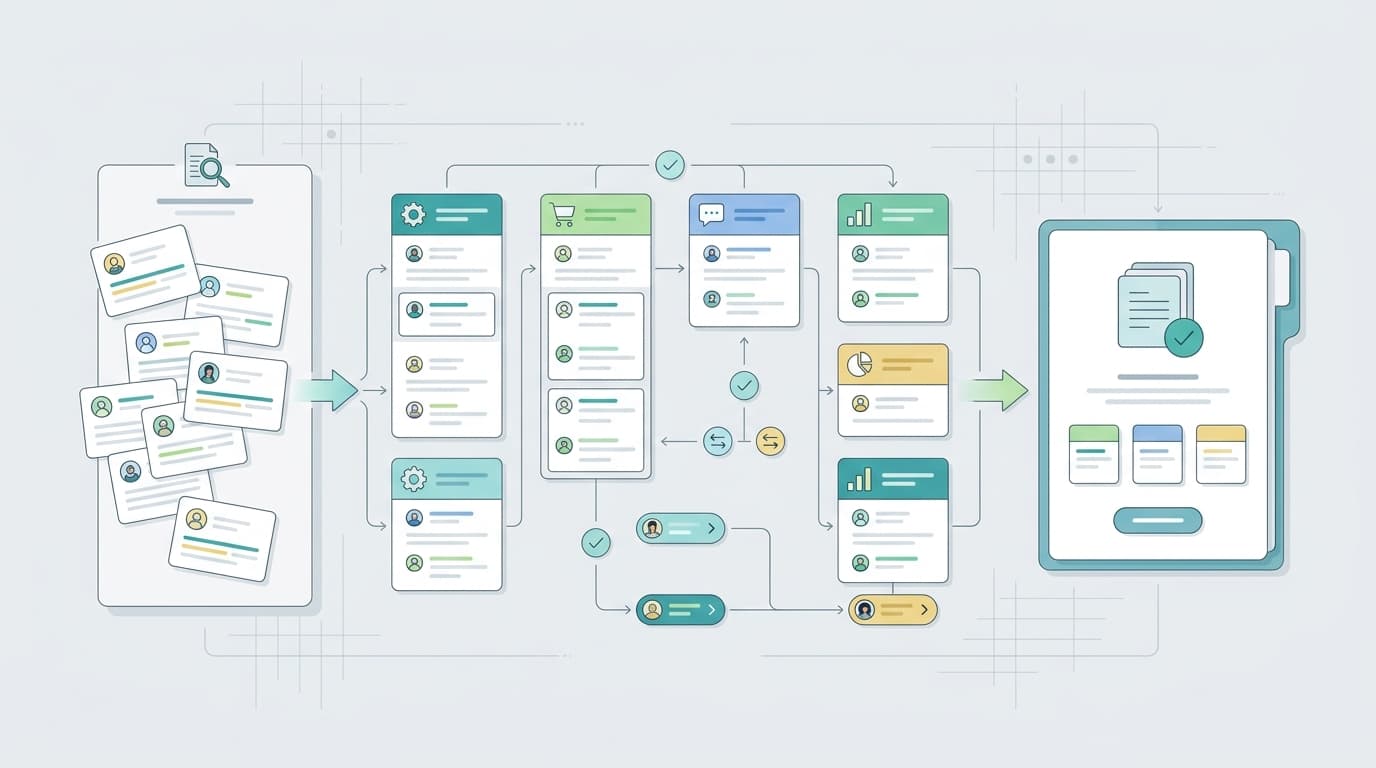
source evidence → transparent analysis → challenged finding → owned decision → measurable follow-up
Run that cycle once during the pilot. If the workflow cannot survive traceability checks, contradiction checks, a real stakeholder review, and an export test, adding more data will not fix it.
If you are evaluating customer feedback across reviews, support, surveys, and social channels, explore VOC AI's Voice of Customer Analysis or contact the team to design a decision-focused pilot.
Frequently Asked Questions
What should a beginner evaluate first in VOC analysis software?
Start with decision fit and evidence traceability. Define one decision, then verify that every important finding can be traced to original feedback with its source, segment, and limitations intact.
How much data is needed for a VOC software pilot?
Use enough data to represent the decision's important sources and segments, but keep the first dataset small enough to review manually. The pilot should test fidelity and workflow quality before it tests maximum scale.
Is AI sentiment analysis enough for VOC analysis?
No. Sentiment can help sort or monitor feedback, but a decision usually requires the customer's situation, problem, cause, desired outcome, segment, evidence strength, and contradictory signals.
How do I compare VOC analysis vendors fairly?
Give each vendor the same bounded decision, dataset rules, security questions, acceptance criteria, and scorecard. Require reproducible outputs and evidence links instead of comparing scripted demos.
When should a team move beyond spreadsheets?
Move when recurring volume, source diversity, collaboration, segmentation, traceability, or monitoring creates more manual risk and labor than the team can reliably manage. Keep the spreadsheet-based process until the team understands the workflow it wants to automate.