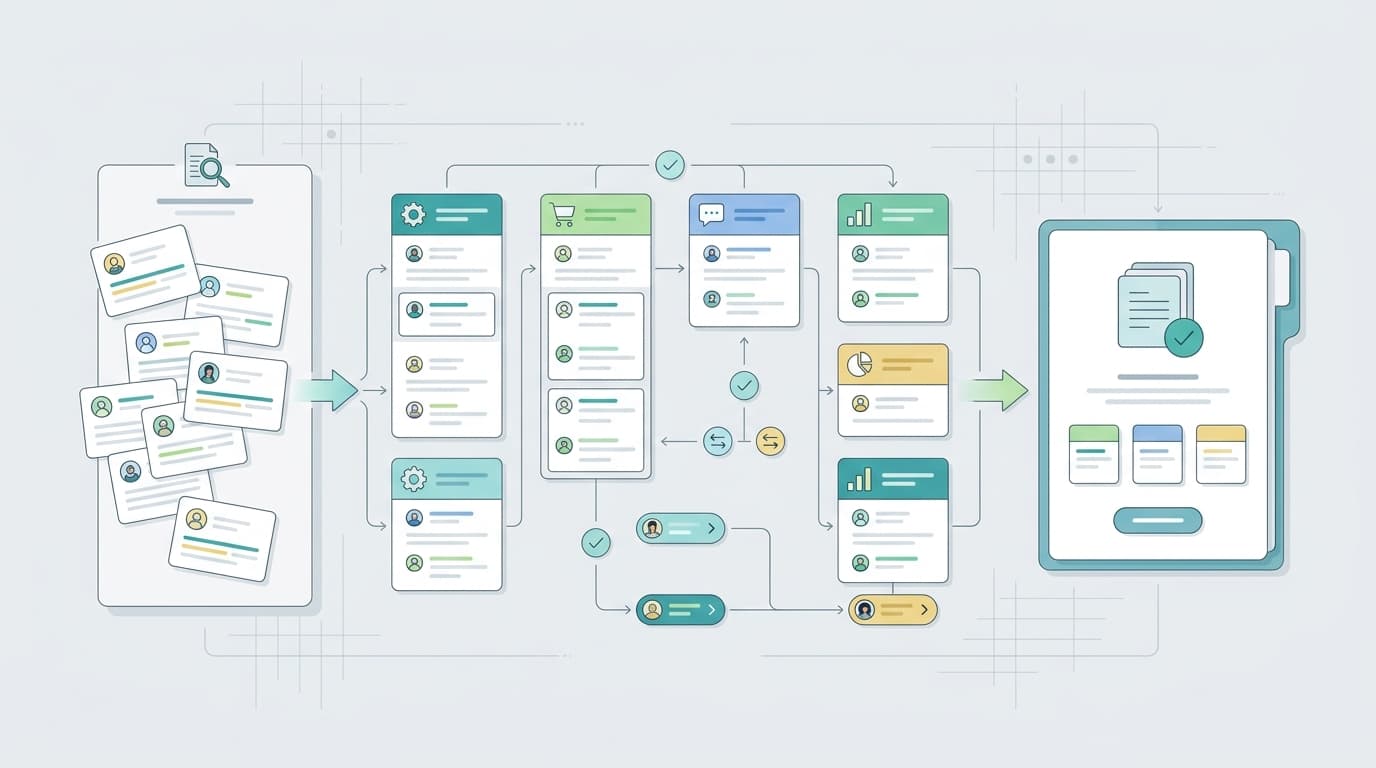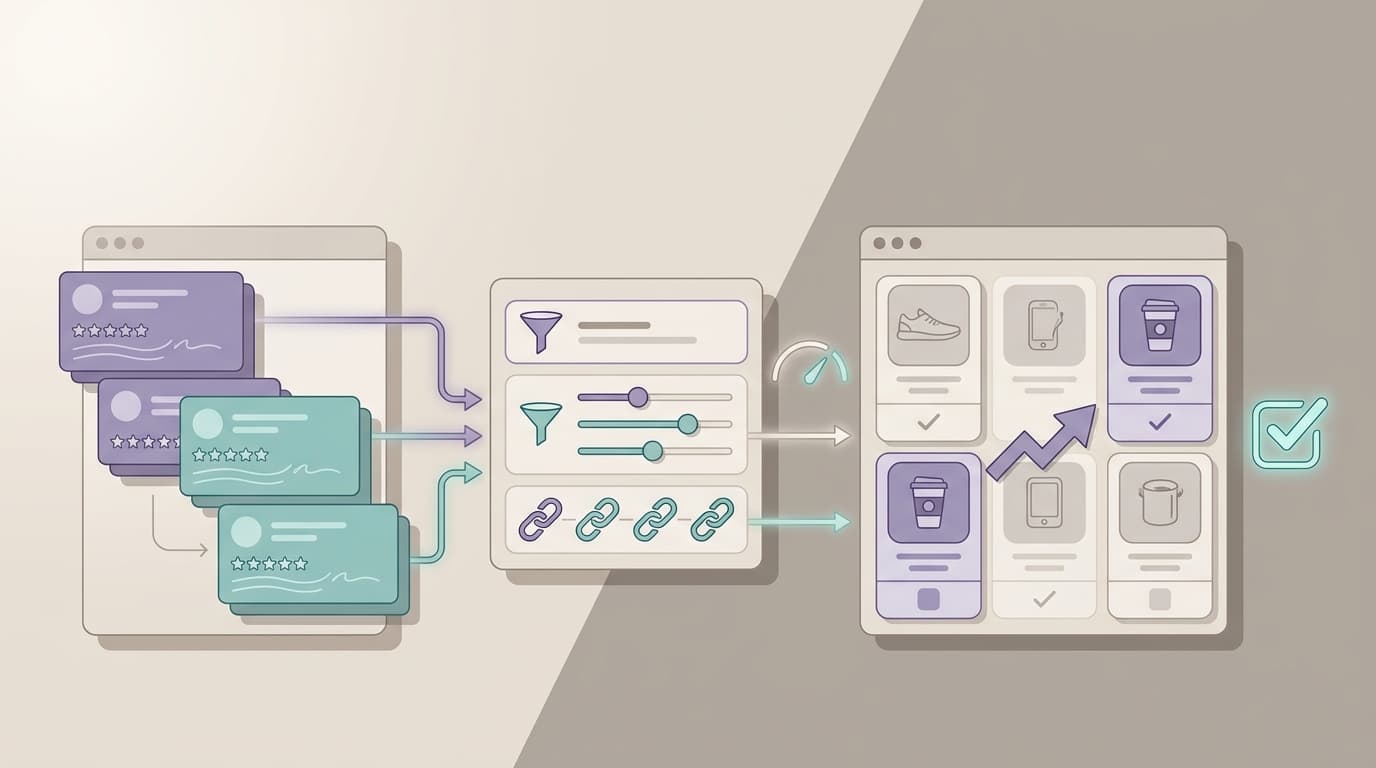
Amazon sellers rarely struggle because they have no data. They struggle because different tools answer different parts of the product decision.
Amazon Product Opportunity Explorer is an Amazon-native research environment for exploring niches, demand patterns, pricing, product features, customer reviews, return reasons, and unmet demand. VOC AI is a review-intelligence workflow designed to help teams examine customer language across products and competitors, organize recurring themes, and turn those patterns into product, positioning, and customer-experience decisions.
The practical question is not, “Which tool has more charts?” It is:
Which workflow gives you the evidence needed for the decision in front of you?
This guide compares Amazon Product Opportunity Explorer and VOC AI by job, evidence type, workflow depth, and handoff. It also shows when the strongest approach is to use them together.
The short answer
Use Amazon Product Opportunity Explorer when you want an Amazon-native view of a niche: customer demand, pricing, trends, product attributes, returns, competition, and opportunity signals within the marketplace.
Use VOC AI when you need to investigate customer language in greater depth across selected products: recurring complaints, desired features, praise patterns, use cases, competitor weaknesses, and the evidence behind a potential product or positioning decision.
Use both when the decision is expensive or hard to reverse. Product Opportunity Explorer can help you identify and size the opportunity. VOC AI can help you pressure-test the offer against what customers repeatedly say.
Amazon Product Opportunity Explorer vs. VOC AI at a glance
| Decision area | Amazon Product Opportunity Explorer | VOC AI |
|---|---|---|
| Primary role | Amazon-native niche and opportunity exploration | Review-based customer and competitor intelligence |
| Best starting point | A product niche or market opportunity | One or more products, ASINs, or competitor sets |
| Core evidence | Amazon demand, pricing, trends, attributes, reviews, return reasons, and opportunity signals | Review text, theme clusters, sentiment, complaints, praise, customer needs, and competitor patterns |
| Best for | Deciding where to investigate | Deciding what to build, fix, emphasize, or validate |
| Marketplace scope | Amazon-native | Customer-review analysis centered on selected products and competitive sets |
| Typical output | Niche shortlist and market hypothesis | Customer-language brief and evidence-backed action plan |
| Strongest combined use | Screen niches, then validate the customer problem before committing | Add depth and traceability to a shortlisted opportunity |
Neither tool guarantees a winning product. Both are decision-support systems. The quality of the decision still depends on your sourcing, economics, operational constraints, and ability to validate the evidence.
What Amazon Product Opportunity Explorer is designed to do
Amazon positions Product Opportunity Explorer as a tool for discovering product opportunities from marketplace data. Its current workflow includes niche search and analysis across customer demand, purchasing behavior, pricing, competition, reviews, return reasons, product features, and trends.
That makes it useful for questions such as:
- Is this niche growing, stable, seasonal, or declining?
- What price bands and product attributes are common?
- Which features appear connected with stronger performance?
- What do reviews and return patterns reveal about customer expectations?
- Does the niche show signs of unmet demand?
- Which products and brands already define the competitive set?
The tool has also evolved beyond simple demand charts. Amazon describes AI-supported research that can summarize customer feedback, analyze product attributes, and help sellers examine opportunity signals inside a niche.
The major advantage is context: the research sits close to Amazon marketplace activity. If your first problem is choosing where to focus, that native context is valuable.
What VOC AI adds to product research
VOC AI starts from a different operating question: What are customers actually saying, and what should the team do with that evidence?
Its product-research workflow is built around review language. Rather than stopping at a top-line signal, teams can use customer comments to examine:
- repeated pain points and failure modes;
- features customers request, misunderstand, or value;
- praise patterns that support positioning and creative briefs;
- use cases that differ from the original product hypothesis;
- competitor weaknesses that may create a design or service opportunity;
- objection language that should be addressed in product pages or support content;
- differences between a broad theme and the raw reviews behind it.
VOC AI says its platform draws on a large review and keyword corpus and supports workflows across product research, competitive analysis, customer analytics, and review analysis. The value is not the size claim by itself. The useful question is whether the workflow helps your team move from a theme to supporting evidence and then to an owner and action.
For a deeper walkthrough, see how to turn customer reviews into product research.
The most important difference: the unit of decision
The clearest way to compare the tools is to look at the unit of decision.
Product Opportunity Explorer helps a seller examine a niche. VOC AI helps a team investigate customer evidence across selected products and competitors.
Those units overlap, but they lead to different next steps.
A niche-level decision
You may be asking:
- Is this market attractive enough to explore?
- What does demand look like?
- What features, prices, and competitors define the category?
- Where does Amazon detect potential unmet demand?
This is where Product Opportunity Explorer is naturally strong.
A product-level decision
You may be asking:
- Which complaint should the next version solve first?
- Is “hard to clean” one problem or several distinct failure modes?
- Which competitor is praised for durability but criticized for setup?
- What language should the listing use to explain a confusing feature?
- Are packaging complaints a product problem, a fulfillment problem, or both?
This is where a dedicated review-analysis workflow becomes more valuable.
The distinction prevents a common mistake: treating a promising market as proof that a specific offer is ready.
Five product-research jobs and the better starting point
1. Discovering niches worth investigating
Start with Product Opportunity Explorer.
An Amazon-native niche view is the logical place to compare demand, trends, pricing, competition, and marketplace opportunity signals. Use this stage to build a shortlist—not a final product specification.
If you need a broader workflow for the step before sourcing, explore VOC AI's review-backed Product Research workflow.
2. Understanding why buyers are dissatisfied
Start with review evidence.
Amazon’s current tool can surface review and return insights, which makes it useful for identifying customer problems. A dedicated VOC workflow becomes helpful when the team needs to decompose those signals into narrower themes, compare products, inspect customer wording, and retain evidence for product, quality, content, and CX teams.
For example, “poor quality” is rarely actionable. The raw customer language may point to weak hinges, inconsistent sizing, a misleading material description, inadequate packaging, or a setup step that causes damage. Each diagnosis has a different owner.
3. Comparing competitor weaknesses
Use the tools in sequence.
Use Product Opportunity Explorer to understand the niche and identify the relevant competitive set. Then use competitor review analysis to compare complaint and praise patterns across selected products.
The goal is not to copy the highest-selling competitor. It is to identify a customer problem your product can solve credibly and profitably.
4. Writing a product requirements or positioning brief
Lean toward VOC AI.
A usable brief needs more than a market score. It should connect each proposed decision to customer evidence:
| Brief section | Evidence to capture |
|---|---|
| Customer problem | Repeated complaint theme and representative review language |
| Proposed feature | Customer need, frequency, severity, and competing solutions |
| Product risk | Return reason, durability concern, confusion, or operational constraint |
| Positioning | Praise language, desired outcome, and objection to overcome |
| Validation plan | Prototype test, supplier check, listing experiment, or support review |
The Voice of Customer Analysis workflow is designed to help teams move from review signals to decisions rather than leaving insights inside a dashboard.
5. Monitoring whether the opportunity changes
Assign each tool a different monitoring job.
Use Amazon-native market signals to revisit the niche, demand, pricing, and competitive landscape. Use review monitoring to watch whether complaint themes, expectations, and product perceptions change after launches, promotions, supplier changes, or listing revisions.
This creates a stronger loop than rerunning the same research only when sales decline.
A combined workflow for higher-confidence product decisions
The strongest process is a staged evidence funnel.
Step 1: Build a niche shortlist
Use Product Opportunity Explorer to identify several niches that fit your demand, price, competition, and operating criteria.
Do not select a winner yet. Create a shortlist with explicit assumptions.
Step 2: Define the decision questions
For each niche, write the questions that marketplace data alone may not settle:
- What failure modes appear repeatedly?
- Which needs are important but poorly served?
- Which complaints can be solved through design, packaging, content, or support?
- Which customer segment experiences the problem most strongly?
- What would make the offer meaningfully different?
Step 3: Analyze reviews across the competitive set
Choose representative products across leaders, challengers, premium offers, and low-rated outliers. Analyze themes across the set instead of relying on one bestseller.
Separate:
- frequent but low-severity friction;
- infrequent but severe failures;
- segment-specific needs;
- product defects;
- expectation and listing problems;
- fulfillment and packaging problems.
Step 4: Trace every recommendation to evidence
For each proposed product or positioning move, record:
- the theme;
- representative customer language;
- affected products or segments;
- confidence and limitations;
- the owner of the next validation step.
This prevents an AI summary from becoming an unsupported product requirement.
Step 5: Run a commercial and operational check
Customer demand for a solution does not prove that the solution is feasible. Check supplier capability, landed cost, compliance, durability, packaging, fulfillment, support impact, and expected margin.
Step 6: Preserve the feedback loop after launch
Continue tracking marketplace conditions and customer language after the product launches. A good research process becomes a learning system, not a one-time report.
A simple buyer scorecard
Score each workflow from 0 to 2 for the specific decision you need to make: 0 means weak fit, 1 means partial fit, and 2 means strong fit.
| Criterion | Weight | Question |
|---|---|---|
| Niche discovery | 20% | Can the tool help us identify and compare attractive market spaces? |
| Amazon-native context | 15% | Does the evidence reflect marketplace demand, pricing, trends, and competition? |
| Customer-language depth | 20% | Can we understand the wording and subthemes behind customer problems? |
| Competitor review comparison | 15% | Can we compare evidence consistently across selected products? |
| Traceability | 15% | Can the team inspect the evidence behind a summary or recommendation? |
| Cross-functional handoff | 15% | Can product, sourcing, marketing, quality, and CX teams act on the output? |
Do not score the tools once for every use case. Score them for the current decision. A workflow can be excellent for niche discovery and only partial for writing a product requirements document.
Common mistakes to avoid
Treating opportunity as validation
A positive market signal is a reason to investigate. It is not proof that your product concept, supplier, economics, or positioning will work.
Reading only the top reviews
The most visible reviews may not represent the full pattern. Compare ratings, time periods, variants, products, and customer segments.
Accepting an AI summary without traceability
AI can compress a large evidence set, but important decisions should still be checked against representative reviews and known data limitations.
Converting every complaint into a feature
Some complaints require clearer instructions, better packaging, quality control, service changes, or more accurate positioning—not another feature.
Ignoring ownership
Every insight needs a next owner. Product, sourcing, quality, listing, logistics, and support teams should not receive the same generic dashboard.
Frequently asked questions
Is Amazon Product Opportunity Explorer enough for product research?
It can be a strong Amazon-native starting point for niche research, demand context, pricing, product attributes, reviews, return reasons, and opportunity signals. Whether it is enough depends on the decision. Teams that need deeper review comparison, customer-language traceability, or cross-functional action plans may add a dedicated VOC workflow.
Does Product Opportunity Explorer analyze customer reviews?
Yes. Amazon’s current product page describes customer review insights and AI-supported analysis alongside other niche and product signals. The fair comparison is therefore not “reviews versus no reviews.” It is the depth, scope, traceability, and downstream workflow you need.
Can VOC AI replace Amazon marketplace research?
VOC AI should not be treated as a replacement for every Amazon-native demand or marketplace signal. Its stronger role is helping teams investigate review language, compare customer themes, and connect evidence to product and customer-experience decisions.
Which tool should a new seller use first?
Start with the decision. If you are searching for niches, begin with Amazon-native opportunity research. If you already have a shortlist or existing ASINs and need to understand complaints, feature gaps, or buyer language, begin with review analysis. For a high-stakes sourcing decision, use both stages.
What should the final research deliverable include?
Include the niche hypothesis, demand and competition context, recurring customer themes, representative evidence, product and operational risks, proposed actions, owners, and validation steps. Avoid a slide deck that reports insights without decisions.
Final recommendation
Amazon Product Opportunity Explorer and VOC AI are most useful at different moments in the same product-research system.
Use Product Opportunity Explorer to understand the Amazon opportunity landscape. Use VOC AI to investigate the customer language inside the shortlist, compare competitor evidence, and build an action-ready brief.
The best workflow does not ask one dashboard to answer every question. It moves from opportunity signal to customer evidence to commercial validation to post-launch learning.
If you want to test that workflow on a real niche or competitor set, discuss a product-research pilot with VOC AI.