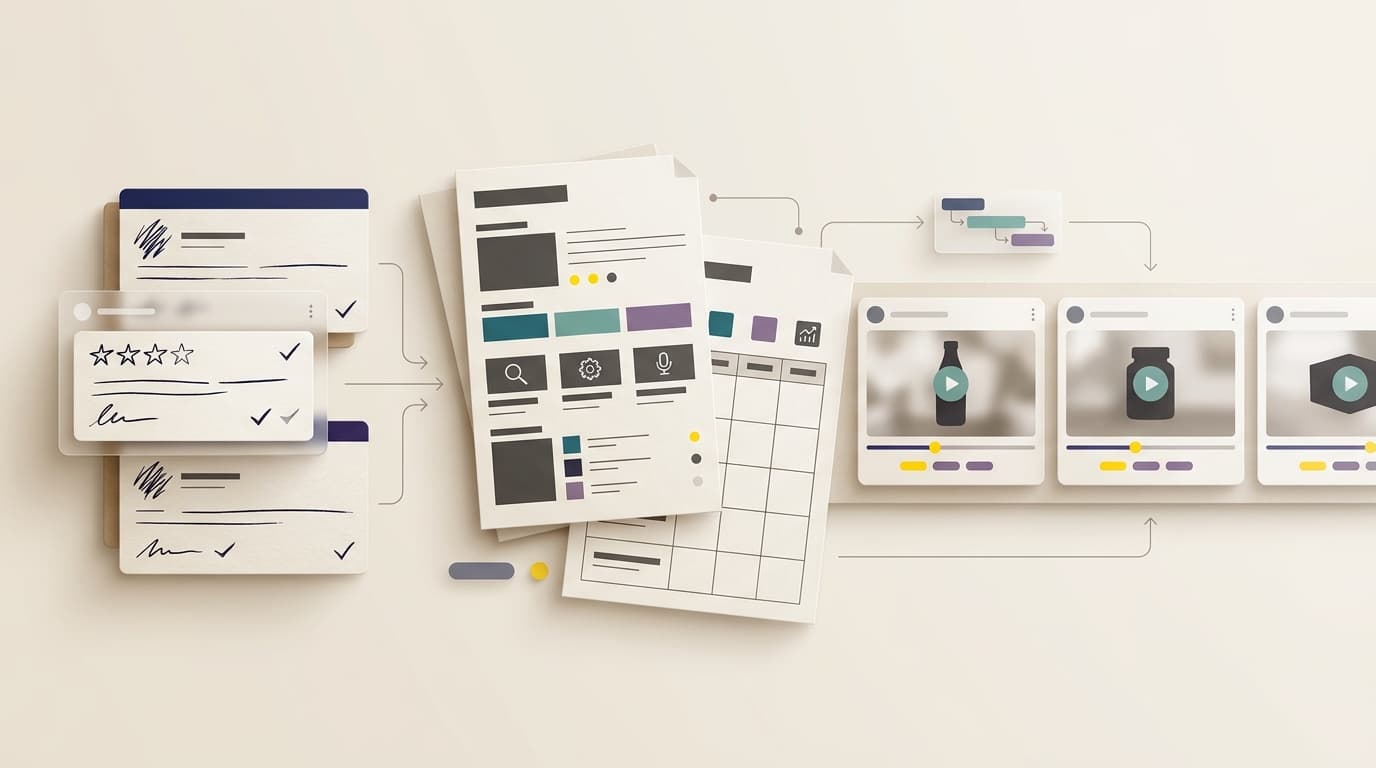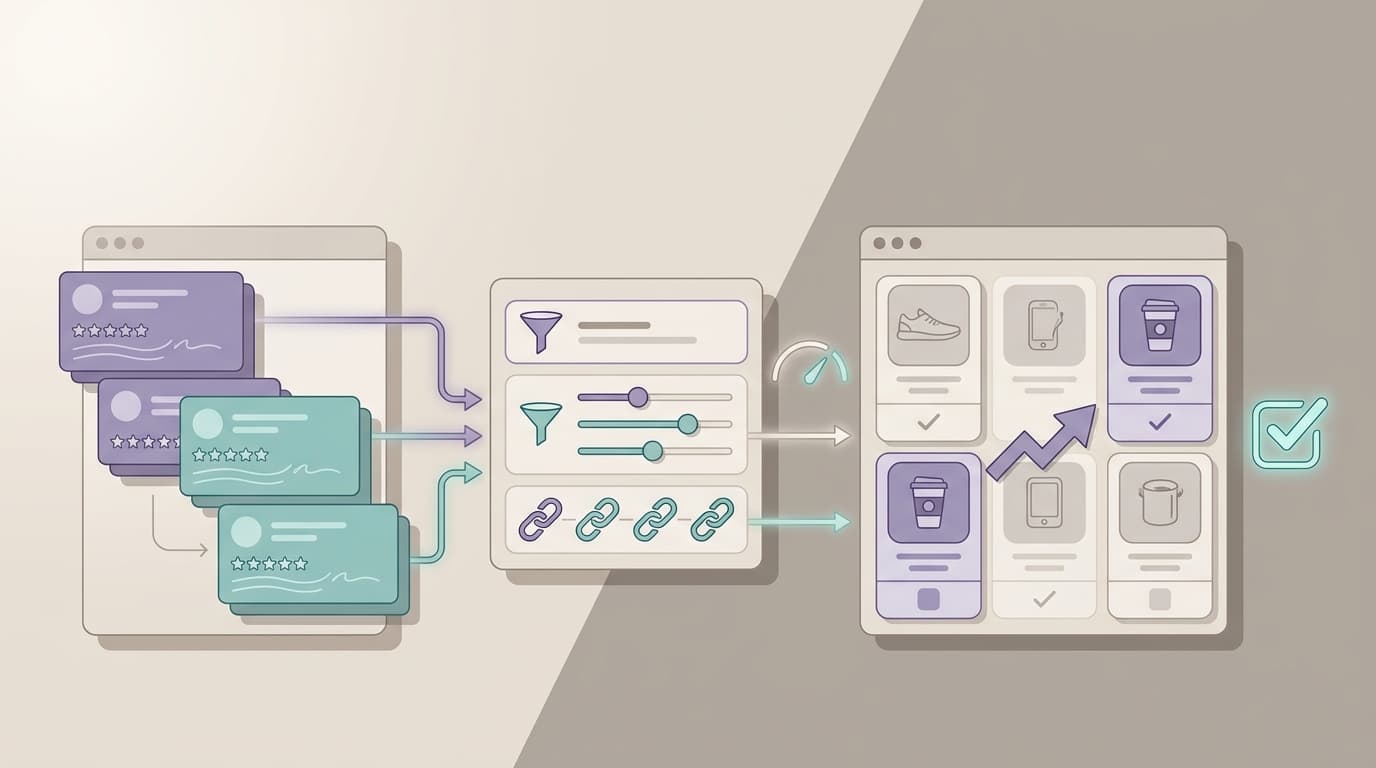
Amazon product research often begins with a demand chart, keyword estimate, category scan, or shortlist of competitors. Those inputs help answer whether a market deserves attention. They do not fully answer whether a product idea solves a repeated buyer problem well enough to justify sourcing inventory.
Customer reviews add the missing post-purchase evidence. They show why people bought, what outcome they expected, which tradeoffs they accepted, what failed in real use, and which complaints repeat across products. Used carefully, those patterns help a seller challenge an attractive product thesis before samples, tooling, packaging, and purchase orders make the decision expensive to reverse.
This guide explains a review-led Amazon product research workflow. It does not replace demand, margin, supplier, or compliance research. It adds customer evidence to those layers so the next decision is more traceable than “the category is growing” or “I found several bad reviews.”
What Amazon product research should prove
A useful research process should test five different questions:
- Demand: Is there enough durable interest to justify deeper work?
- Competition: Is the market structure compatible with your brand, capital, and channel strengths?
- Customer need: Do buyers repeatedly describe an unresolved outcome, friction, or expectation gap?
- Feasibility: Can your team solve the problem at the required cost, quality, safety, and support level?
- Execution readiness: Is the next commitment appropriately sized for the evidence?
Most product dashboards are strongest on the first two questions. Reviews are especially useful for the third, but they also expose feasibility and execution risks that are easy to miss in a category chart.
The goal is not to make reviews predict sales. The goal is to use buyer language to verify, refine, or reject the product hypothesis generated by your market screen.
For a broader category-timing process, start with this Amazon market research framework. Then use the review workflow below after a category passes the first quantitative screen.
Why customer reviews change product research
Search volume and sales direction describe behavior before and around purchase. Reviews describe selected parts of the experience after purchase. That difference matters.
A category may show healthy demand while buyers repeatedly struggle with:
- sizing or compatibility;
- unclear setup or instructions;
- durability under a specific use case;
- packaging damage;
- cleaning, storage, or maintenance;
- missing accessories;
- a promise the product cannot consistently deliver;
- a tradeoff that listings do not explain clearly.
Those themes can affect product specifications, packaging, listing copy, support load, return risk, and positioning. They can also disprove an apparent opportunity. If the complaint is rare, old, caused by misuse, limited to one variant, or already solved by the strongest competitors, it may not support a new product direction.
Review-led Amazon product research is therefore a falsification method as much as an idea-generation method. It asks, “What evidence would make us stop believing this is an opportunity?”
Step 1: Write a falsifiable product hypothesis
Do not begin by collecting thousands of reviews. Begin with a statement that can be challenged.
Use this structure:
We believe [customer segment] wants [desired outcome], but current products create [repeated friction]. We can serve the need with [proposed response] if [cost, quality, safety, or operational constraint] is feasible.
Then add a rejection condition:
We should reject or revise the idea if the friction is isolated, outdated, already solved, tied to an irrelevant segment, or impossible to address within our constraints.
This simple step prevents Amazon product research from becoming an exercise in collecting only supportive evidence.
Step 2: Complete the market screen
Before analyzing review language, establish that the category is worth investigating. Use VOC AI Market Insight or your preferred market research system to record:
- demand direction across multiple time windows;
- seasonality or event sensitivity;
- market and brand concentration;
- price-band structure;
- BSR, search, or sales movement;
- review and rating distribution;
- leading product and competitor movement.
A single spike, bestseller, or keyword estimate is not enough. Compare time windows and note what could be creating the pattern. If you need a structured approach, use this workflow for Amazon category trend analysis.
The output of this step is not “launch.” It is a shortlist plus a clear market hypothesis for customer-evidence research.
Step 3: Build a representative review cohort
One ASIN is not a category. One-star reviews are not the entire customer experience. A useful cohort should match the product decision you are testing.
Include a deliberate mix of:
- category leaders and newer challengers;
- premium, mid-market, and entry price tiers;
- contrasting designs or feature strategies;
- relevant variants and sizes;
- positive, neutral, and critical ratings;
- recent reviews plus an older comparison window;
- products that appear to contradict your thesis.
For example, if the idea is a premium product for frequent travelers, complaints from occasional home users may be less relevant than repeated issues from the target use case. The cohort definition should state who counts, which products are included, the time period, and why.
This is where review-backed product research can reduce manual sorting while preserving the need for a clear cohort and decision question.
Step 4: Extract motivations, outcomes, and friction
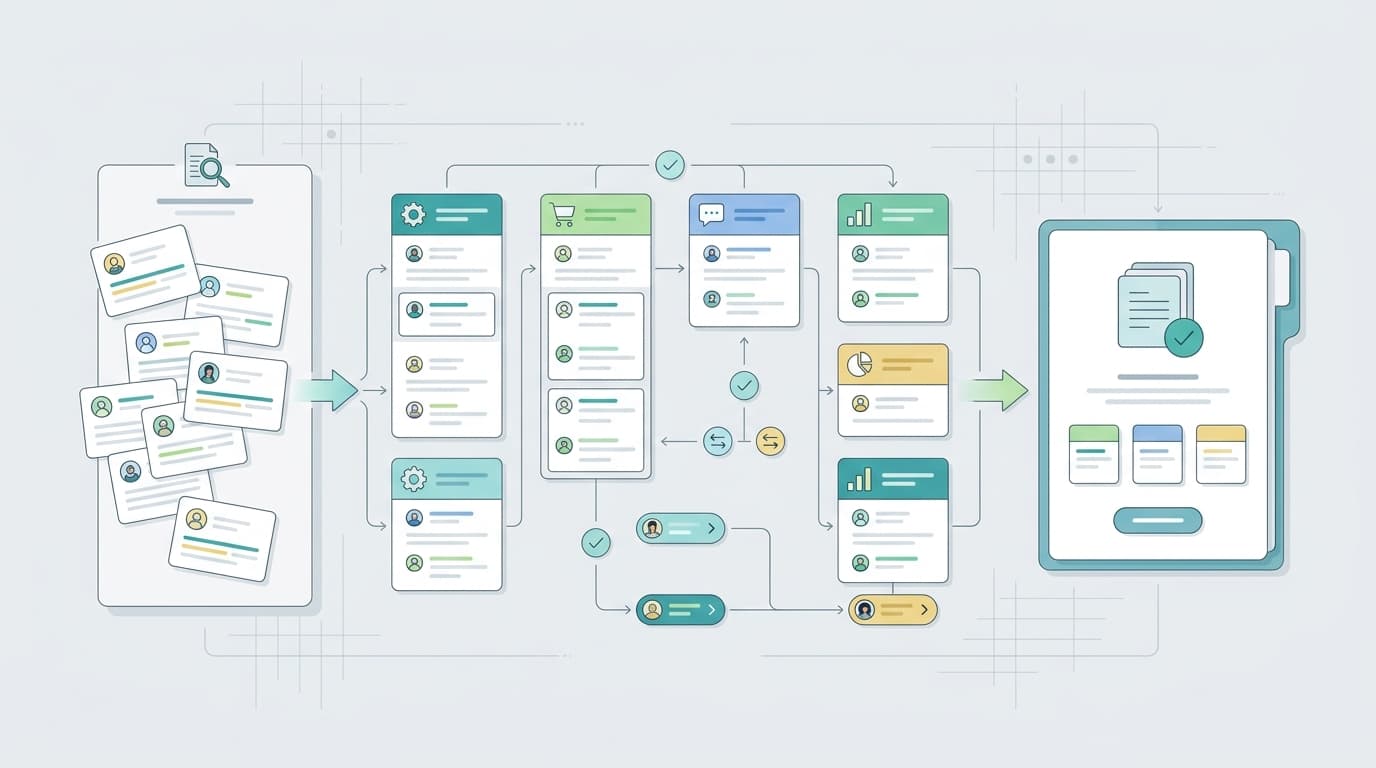
Customer reviews contain more than sentiment. For Amazon product research, code the language into decision-relevant fields:
| Evidence field | Question to answer | Example output |
|---|---|---|
| Purchase motivation | Why did this buyer choose the product? | Needed a compact option for a small apartment |
| Desired outcome | What job did the buyer expect it to do? | Store quickly without sacrificing capacity |
| Usage scenario | Where and how was it used? | Daily use in a narrow kitchen |
| Product strength | What worked well enough to praise? | Easy assembly and stable base |
| Recurring friction | What repeatedly created effort or failure? | Difficult to clean around a fixed joint |
| Workaround | What did buyers do to compensate? | Added a separate liner or cleaning tool |
| Expectation gap | Which promise or assumption was violated? | “Compact” still blocked a cabinet door |
| Switching trigger | Why would someone choose another product? | Better storage dimensions and easier cleaning |
| Accepted tradeoff | What drawback did buyers tolerate? | Higher price for sturdier construction |
A fluent summary is not enough. Keep representative source context, product, variant, rating, and date available so the team can inspect what the theme actually means.
VOC AI's voice-of-customer analysis is designed to organize motivations, usage scenarios, product strengths, weaknesses, and recurring buyer-language patterns across review evidence.
Step 5: Test recurrence, recency, spread, and specificity
A complaint becomes more useful when it survives four tests.
Recurrence
Does the theme appear repeatedly, or is it one memorable story? Emotional language can make a rare issue feel common. Count and compare themes before changing the product thesis.
Recency
Does the issue appear in current reviews and current product versions? Old defects may remain visible long after a brand changes materials, packaging, firmware, dimensions, or instructions.
Spread
Does the theme cross products, brands, variants, price tiers, or designs? A category-level opportunity should not depend entirely on one poorly executed listing.
Specificity
Is the problem precise enough to guide a validation step? “Poor quality” is weak. “The hinge loosens after repeated outdoor use, causing the lid to stop sealing” is more actionable and easier to test.
These tests make Amazon product research less vulnerable to anecdotal review reading.
Step 6: Look for disconfirming evidence
Strong product research tries to break the idea before the market does.
Search specifically for:
- well-rated competitors that already solve the complaint;
- buyers who prefer the current tradeoff;
- complaints caused by incorrect use or unclear listing expectations;
- improvements that would increase cost beyond the target price;
- changes that conflict with safety, compliance, durability, or physics;
- a requested feature that creates another repeated complaint;
- demand concentrated in a segment your brand cannot serve efficiently.
If a competitor already solves the problem, investigate why that solution has not captured the category. The answer may reveal weak distribution, poor positioning, a high price, a different target segment, or a hidden drawback. It may also invalidate the idea.
Step 7: Convert review themes into testable requirements
Do not turn every complaint into a feature. Translate supported themes into requirements with an evidence trail.
Use this format:
| Requirement field | Team entry |
|---|---|
| Target user and scenario | Who experiences the problem, and when? |
| Evidence statement | Which recurring theme supports the requirement? |
| Desired outcome | What should become easier, safer, clearer, or more reliable? |
| Proposed response | Product, packaging, instruction, bundle, or positioning change |
| Tradeoff created | What could get worse if the change is made? |
| Feasibility constraint | Cost, manufacturing, compliance, lead time, quality, or support |
| Validation method | Sample test, prototype, supplier evidence, usability test, or message test |
| Rejection rule | What result would stop or revise the requirement? |
For a deeper implementation method, follow this guide to turn competitor complaints into product requirements.
Step 8: Score the product idea before sourcing inventory
Bring the market and customer layers into one decision record.
| Decision area | Evidence to record | Warning sign |
|---|---|---|
| Demand durability | Multi-window market direction and seasonality | Growth depends on one event, brand, or short window |
| Competitive opening | Concentration, price bands, rating and review barriers | Strong incumbents solve the same need at an efficient price |
| Customer problem | Recurring, recent, spread, specific review theme | Theme is anecdotal, outdated, or segment-mismatched |
| Proposed differentiation | Clear response tied to a desired outcome | Feature idea is copied from complaints without tradeoff analysis |
| Feasibility | Supplier, quality, cost, safety, and support validation | Team cannot deliver the promise consistently |
| Positioning | Buyer language supports a precise expectation | Listing claim would overpromise or attract the wrong user |
| Next commitment | Enter, test, wait, or reject | Commitment is larger than the confidence of the evidence |
Use enter only when the thesis fits your normal investment gate. Use test when one or more assumptions can be reduced with a sample, prototype, supplier check, pricing test, or positioning test. Use wait when the category may be attractive but timing or evidence quality is insufficient. Use reject when disconfirming evidence or feasibility risk outweighs the opportunity.
Common Amazon product research mistakes
Treating review frequency as market size
Reviews can show that a problem exists in the observed cohort. They do not reveal total addressable market or future unit demand. Keep demand estimation in the market layer.
Analyzing only low-star reviews
Critical reviews expose failure modes. Positive and neutral reviews reveal motivations, successful scenarios, acceptable compromises, and which strengths must not be removed during redesign.
Ignoring variants and product changes
Model, size, material, bundle, and version differences can change the meaning of a complaint. Preserve that context.
Choosing the loudest complaint
The most dramatic review is not necessarily the best product opportunity. Prioritize themes that are repeated, relevant to the target segment, commercially meaningful, and feasible to solve.
Stopping at an AI summary
An Amazon review analysis tool should help organize evidence, not hide uncertainty. The team still needs cohort rules, source context, disconfirming evidence, and a decision owner.
Skipping supplier and economics validation
Customer evidence can support a desired outcome. It cannot prove that a supplier can deliver the product consistently or that the economics work.
Frequently asked questions
Can customer reviews replace keyword and sales research?
No. Reviews explain selected post-purchase experiences. Keyword, demand, pricing, competition, margin, and market analysis answer different questions. Strong Amazon product research connects these evidence types instead of asking one source to do every job.
How many reviews should I analyze?
There is no universal number. Sample across relevant products, brands, variants, rating levels, and time windows until the main themes are stable enough for the decision. Higher-cost and harder-to-reverse decisions justify broader coverage.
Should I analyze only competitor products?
Competitor reviews are valuable before launch, but teams with existing products should also compare their own feedback, returns, support contacts, and post-purchase questions. The strongest insight often comes from differences between what the market promises and what customers experience.
What should an Amazon review analysis tool show?
It should preserve review context, organize recurring themes, compare products, expose motivations and usage scenarios, and help teams trace a conclusion back to evidence. A summary without cohort, recency, product, and variant context can create false confidence.
When is a product idea ready for sourcing?
Readiness depends on your normal financial and operational gate. At minimum, the market hypothesis, recurring customer problem, proposed response, tradeoffs, supplier feasibility, economics, and next validation step should be documented.
Make buyer evidence part of the product decision
Amazon product research should do more than find activity. It should help a team decide whether a specific customer problem is durable, relevant, solvable, and worth the next commitment.
Use market data to identify where to look. Use reviews to understand motivations, outcomes, friction, and expectation gaps. Use supplier, economics, and operational validation to determine whether your team can deliver the response. Then choose enter, test, wait, or reject with an evidence trail.
Validate a product idea with review patterns before sourcing inventory. Explore VOC AI Product Research to connect buyer language with competitor and product decisions.