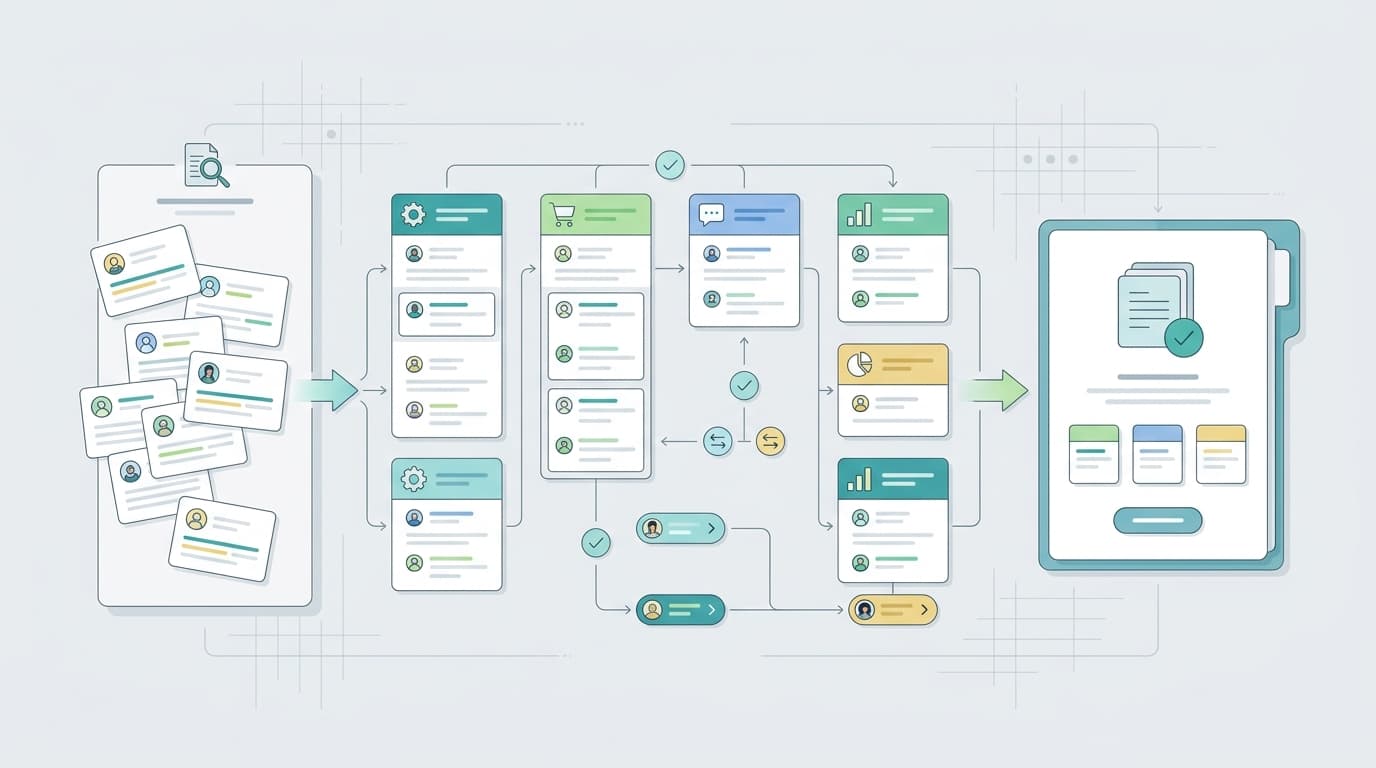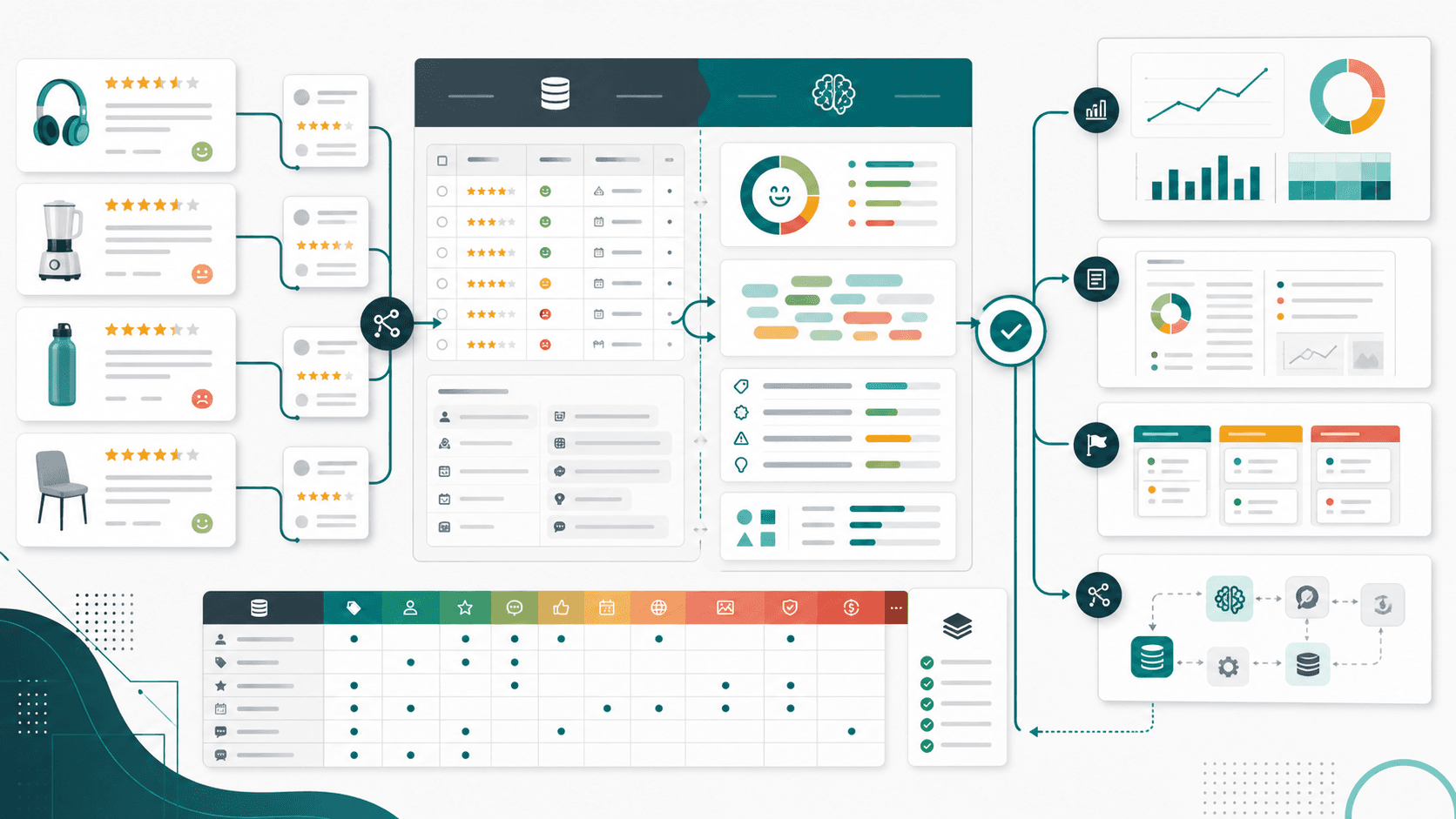
An Amazon reviews API is useful only when the team understands three things before engineering starts: what access route is being used, which review fields are available, and how the data will be governed after it enters a dashboard, report, or internal AI workflow.
That is where many evaluation projects stall. A search for an Amazon reviews API can lead to official Amazon feedback APIs, third-party review-data APIs, scraper-style endpoints, public datasets, and AI review-analysis platforms. They do not all return the same data, they do not carry the same permissions, and they do not support the same decisions.
This Amazon reviews API guide gives developers, agencies, and enterprise sellers a practical way to evaluate access, fields, output shape, and workflow fit. Use it before building a BI pipeline, client reporting system, product roadmap workflow, listing research process, or AI agent that depends on review data.
What An Amazon Reviews API Must Clarify First
Before comparing vendors or wiring requests into production, define the job the API must do. A team that needs weekly review themes for one product has a different requirement from an agency feeding hundreds of ASINs into recurring client reports.
Use these questions as the first filter:
| Evaluation question | Why it matters | What to confirm |
|---|---|---|
| What is the access surface? | Official Amazon APIs, third-party data APIs, and review-analysis APIs solve different problems. | API type, account requirements, allowed use cases, and supported workflow. |
| What product scope is supported? | ASIN, marketplace, variation, and competitor coverage affect data design. | ASIN handling, market coverage, language coverage, and product grouping. |
| Which review fields are returned? | Dashboards and models break when fields are missing or unstable. | Rating, date, review corpus, sentiment, pagination, bulk fetch, and JSON shape. |
| Are derived insights included? | Raw reviews and AI conclusions should be stored and interpreted differently. | Sentiment, topics, buyer language, product weaknesses, listing signals, and market context. |
| How fresh is the data? | Monitoring, alerts, and post-launch triage depend on refresh cadence. | Refresh timing, backfill limits, and historical availability. |
| How will the data be used? | Compliance, retention, and audit needs change by use case. | Internal BI, agency reports, AI agents, listing work, product planning, or CX triage. |
| What happens at scale? | A proof of concept can pass while production fails on limits. | API keys, rate limits, credits, bulk fetch behavior, retries, and support path. |
The strongest Amazon reviews API evaluation starts with workflow design, not with a code sample. Once the team knows which decisions the data must support, it can judge whether a raw review endpoint, official insight API, or VOC AI review-intelligence workflow is the right fit.
Official Amazon API, Scraper API, Or Review Analysis API?
The phrase Amazon reviews API is used loosely. For a production project, separate the options before comparing fields.
| Option | What it usually means | Best fit | Main caveat |
|---|---|---|---|
| Amazon SP-API Customer Feedback API | Amazon's official Selling Partner API surface for feedback insights from reviews and returns. Amazon says ASIN insights include positive and negative review topics, topic mentions, star-rating effect, and month-on-month trends. | Sellers who need official aggregated feedback insights inside approved SP-API workflows. | It is not a generic raw-review export. Amazon documents eligibility, role, language, and refresh constraints. |
| Third-party review-data API | A provider that returns structured review data from product-review surfaces. | Data teams that need review records or review-like fields in their own systems. | Field stability, permissions, availability, and compliance language must be checked vendor by vendor. |
| Scraper-style Amazon reviews API | A scraping endpoint or actor focused on extraction mechanics. | Short-term research when the team has reviewed legality, terms, and reliability. | Avoid building a production workflow around bypass, CAPTCHA, proxy, or login-wall claims. |
| VOC AI Review Analysis API | VOC AI's public API/MCP positioning for review, keyword, listing, and sales-estimate signals, available through REST API, Python SDK, and MCP support. | Sellers, agencies, and AI builders who need Amazon review intelligence inside dashboards, workflows, or AI agents. | Confirm exact plan, field, rate-limit, and governance requirements before production use. |
VOC AI should be evaluated as a review-intelligence layer, not as an official Amazon endpoint. The public Review Analysis API page describes direct access to the same Amazon truth used by VOC AI agent and seller surfaces, while the API and MCP page describes REST, Python SDK, and MCP access for Amazon reviews, keywords, and sales data.
Amazon Reviews API Field Matrix
Field questions are where evaluation becomes concrete. Public VOC AI API/MCP copy currently names a review corpus for any ASIN, star rating, sentiment, date, bulk fetch, and JSON response. Treat those as source-backed field categories, then confirm production details before building a schema.
| Field group | What buyers usually ask for | Source-backed VOC AI framing | Production check |
|---|---|---|---|
| Product scope | ASIN, marketplace, product set, competitor ASINs, variants | VOC AI public pages center workflows around ASINs and Amazon product intelligence. | Confirm marketplace support, variation behavior, parent-child ASIN handling, and competitor coverage. |
| Review corpus | Review records or review bodies for an ASIN | The API/MCP page describes a "Full review corpus for any ASIN." | Confirm pagination, historical depth, filtering, deleted review handling, and media availability. |
| Rating | Star rating, rating distribution, rating impact | The API/MCP page names star rating as part of the reviews API. | Confirm scale, null behavior, aggregation rules, and whether rating is per review or topic. |
| Date | Review date, collection date, update date | The API/MCP page names date as part of the reviews API. | Confirm timezone, original review date versus ingestion date, and refresh cadence. |
| Sentiment | Positive, neutral, negative, mixed, emotion, score | The API/MCP page names sentiment, and VOC AI's review-analysis positioning centers customer understanding. | Confirm labels, confidence scoring, language support, and whether sentiment is per review, topic, or product. |
| Output format | JSON, CSV, warehouse table, API response | The API/MCP page describes bulk fetch and JSON response. | Confirm response shape, nested fields, error states, and compatibility with the target data warehouse. |
| Derived insights | Buyer language, product direction, weaknesses, opportunities, listing signals | The Voice of Customer analysis page describes turning reviews into product direction, buyer language, and market-ready decisions. | Confirm which derived fields are available through API versus UI, and whether they are stable enough for automation. |
| Market context | Keywords, listing, sales estimates, competitor signals | The Review Analysis API page describes pulling review, keyword, listing, and sales-estimate signals into workflows. | Confirm source, coverage, and update cadence for every non-review signal. |
| Access controls | API keys, plan limits, audit, support | The pricing page describes API keys, higher API/MCP rate limits, and Enterprise Custom options. | Confirm key ownership, rate limits, credit model, audit needs, and enterprise terms. |
Do not turn this matrix into a guarantee list without product confirmation. For an Amazon reviews API project, the safer pattern is to publish field categories, route buyers to API access, and confirm exact response details during technical review.
Separate Raw Records From AI Conclusions
Raw review data and AI-derived conclusions should not be mixed in the same table without provenance. Original review records help a team trace evidence. AI conclusions help a team compress repeated themes into decisions.
Use two layers:
| Layer | Store this | Use it for |
|---|---|---|
| Source review layer | ASIN, market, rating, date, review corpus, collection metadata, response identifiers | Auditability, re-analysis, dashboard filters, evidence review, and data quality checks. |
| Analysis layer | Sentiment, topic clusters, buyer language, product direction, listing signals, opportunity themes | Product roadmap inputs, listing briefs, competitor benchmarks, support planning, and executive summaries. |
This separation prevents two common mistakes. First, teams can avoid treating a model-generated theme as if it were a verbatim review. Second, analysts can re-run improved logic later without losing the original evidence trail.
For VOC AI users, the split also fits the product story. VOC AI describes a review intelligence platform built around Amazon review analysis, buyer language, product direction, market-ready decisions, and API/MCP access. That makes the workflow strongest when the data contract keeps original signals and derived insights clear.
Access Workflow For Developers And Agencies
Use this sequence before a production integration:
-
Define the decision owner. Decide whether the Amazon reviews API will support product, listing, CX, market research, agency reporting, BI, or AI-agent workflows. Each owner needs different fields and review cadence.
-
Scope the product set. List the ASINs, marketplaces, competitor sets, variants, and historical windows. Include expected growth so rate limits and credits are evaluated against production use, not only the pilot.
-
Choose the access surface. Use the official Amazon Customer Feedback API when the team needs official aggregated feedback insights in approved Amazon SP-API workflows. Use VOC AI API/MCP access when the team needs review intelligence, JSON outputs, SDK/MCP integration, and workflow-ready signals. Use scraper-style options only after legal, compliance, and reliability review.
-
Confirm the field contract. Ask for sample responses, null rules, response shape, pagination, bulk behavior, error states, and whether each field is raw, inferred, aggregated, or derived.
-
Design storage before the first request. Store original review records separately from sentiment, topics, and AI conclusions. Keep request metadata so reports can explain when the data was pulled and what product scope it covered.
-
Build QA gates. Validate date parsing, duplicate handling, missing fields, language handling, sentiment labels, and ASIN matching. Run a small sample through the dashboard or report template before scaling.
-
Add human review for important decisions. An Amazon reviews API can make review intelligence faster. It should not automatically rewrite listings, change product specs, or drive customer-facing claims without human approval.
When API Access Is Better Than The UI
Not every team needs an API. If the job is one-time review exploration, a UI workflow may be enough. API access becomes important when the work repeats, scales, or feeds another system.
| Need | UI or report workflow | API or MCP workflow |
|---|---|---|
| One ASIN review scan | Usually enough | Usually unnecessary |
| Manual listing refresh | Often enough | Useful if repeated across many products |
| Weekly client reporting | Limited | Strong fit |
| BI dashboard | Limited | Strong fit |
| Product roadmap trend monitoring | Useful for exploration | Strong fit when evidence must refresh |
| Internal AI assistant | Not enough by itself | Strong fit through structured API or MCP access |
| Agency workflow across accounts | Hard to scale manually | Strong fit with API keys, bulk fetch, and templates |
VOC AI's pricing page currently compares Free, Basic, Pro, Team Lite, Team Growth, and Enterprise Custom plans for OpenAPI, MCP, and agent workflows. It also describes API keys and higher API/MCP rate limits for team and enterprise usage. Check the current plan page before writing budget assumptions into a technical plan.
Compliance And Source Checks
Review data can affect product, listing, support, and brand decisions, so governance matters as much as field coverage.
Use these checks before launch:
| Check | Why it matters |
|---|---|
| Official-source distinction | Do not imply that a third-party review-analysis API is an official Amazon API. |
| Terms and permissions | Confirm the team's allowed use, storage, sharing, and downstream processing rules. |
| Data minimization | Store only the fields the workflow needs, especially if reviews contain personal or sensitive context. |
| Evidence traceability | Keep enough metadata to explain where a conclusion came from. |
| Human approval | Require review before customer-facing claims, product changes, or automated listing updates. |
| Vendor change monitoring | Recheck pricing, API fields, rate limits, and documentation before major launches. |
For public content, avoid claims such as "official Amazon reviews API," "bypass Amazon restrictions," "scrape without limits," "guaranteed ranking lift," "guaranteed sales," or "review removal." A better promise is practical: make review intelligence easier to access, structure, and operationalize.
How VOC AI Fits
VOC AI is a fit when a team needs Amazon review intelligence to move beyond one-off exports. The homepage describes a dataset for ecommerce sellers and AI builders, including reviews, keywords, sales estimates, and listing signals available through chat, REST API, or MCP server. It also describes 2B+ ecommerce reviews, 500M+ products tracked, 30+ categories, and daily updates.
The product path is:
- Use Voice of Customer analysis when teams need review-derived product direction, buyer language, and market-ready decisions.
- Use the API and MCP page when developers need REST API, Python SDK, MCP setup, bulk fetch, and JSON output.
- Use the Review Analysis API page when evaluating how review, keyword, listing, and sales-estimate signals fit into engineering workflows.
- Use pricing or contact sales to confirm API keys, credit usage, rate limits, team needs, and enterprise requirements.
If the team already knows its ASIN scope, dashboard owner, and reporting cadence, the next step is a technical review. Confirm the fields, plan, rate limits, and governance model before committing engineering time.
Amazon Reviews API FAQ
What is an Amazon reviews API?
An Amazon reviews API is a programmatic way to access review-related data or review-derived insights for Amazon products. The exact meaning depends on the source. It may refer to Amazon's official Customer Feedback API, a third-party review-data API, a scraper-style endpoint, or a review-analysis API such as VOC AI.
Does Amazon's official API return raw product reviews?
Amazon's Customer Feedback API is documented as an SP-API surface for customer review and return insights. Amazon describes ASIN-level insights such as positive and negative review topics, mentions, star-rating effect, and trends. Treat it as official aggregated feedback insight, not as a generic raw-review export.
What fields should I expect from VOC AI's Amazon reviews API workflow?
Public VOC AI pages support review corpus, star rating, sentiment, date, bulk fetch, JSON response, and broader review, keyword, listing, and sales-estimate signals. Confirm the exact production response shape, supported filters, null rules, and rate limits before integration.
When should a seller use API access instead of the VOC AI UI?
Use the UI for one-time exploration and manual research. Use API or MCP access when review intelligence must feed recurring reports, BI dashboards, client deliverables, internal AI agents, product-roadmap monitoring, or agency workflows across many ASINs.
Can an Amazon reviews API feed an AI agent?
Yes, if the API access, permissions, and data contract support that workflow. VOC AI's public API/MCP page specifically describes REST API, Python SDK, and MCP Server access for bringing Amazon reviews, keywords, and sales data into AI-native tools.
What should developers confirm before building?
Confirm product scope, marketplace coverage, review fields, sentiment labels, JSON schema, pagination, bulk behavior, rate limits, API keys, credit usage, refresh cadence, retention rules, and support path.
Is VOC AI an official Amazon API?
No. Do not position VOC AI as an official Amazon API or official Amazon partner unless legal and product teams provide explicit proof. VOC AI should be framed as a review-intelligence platform and API/MCP workflow for Amazon product signals.
What is the safest next step?
Create a short field checklist, pick a small ASIN sample, confirm the API plan and response shape, and run the sample through the destination workflow. If the output supports the decision owner, scale from pilot to production with QA and governance in place.
The right Amazon reviews API is not just the one that returns data. It is the one whose access model, fields, governance, and workflow fit the decisions your team needs to make.