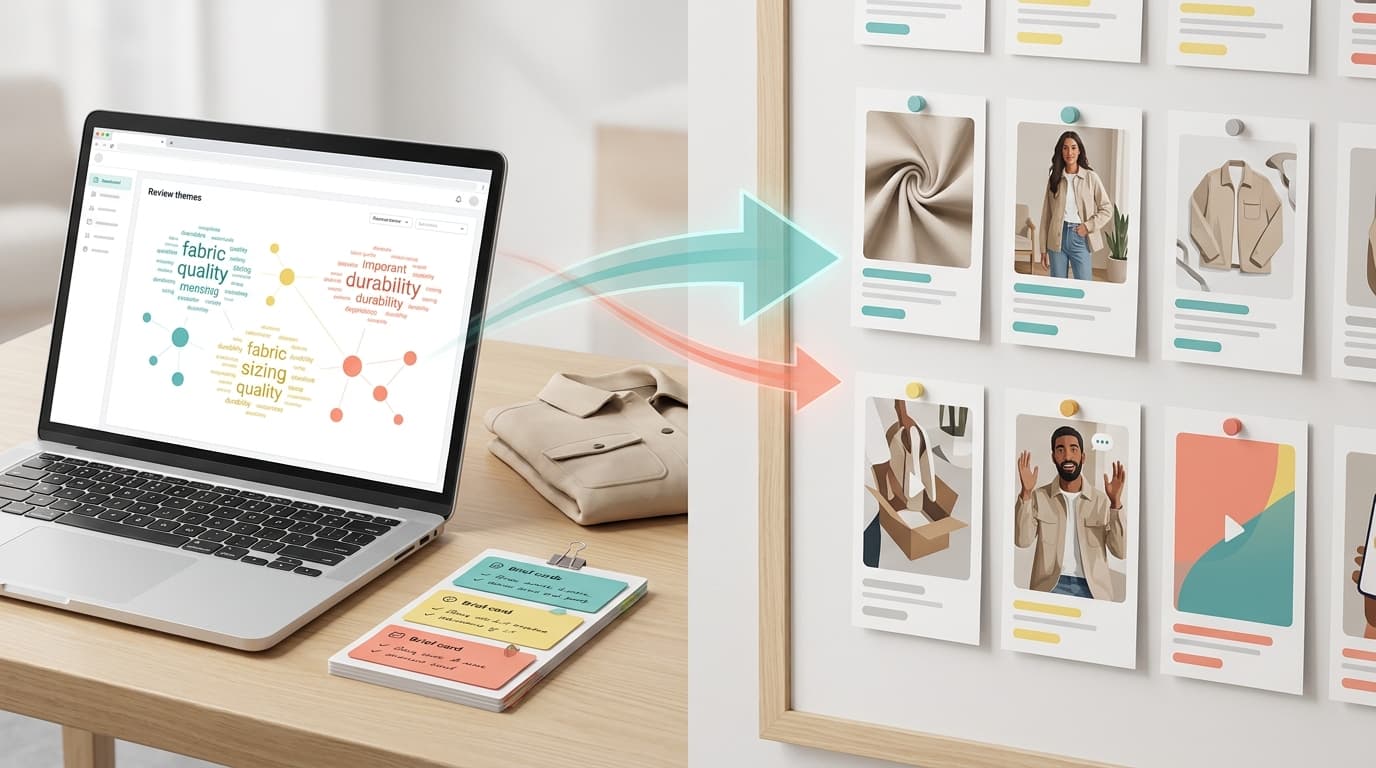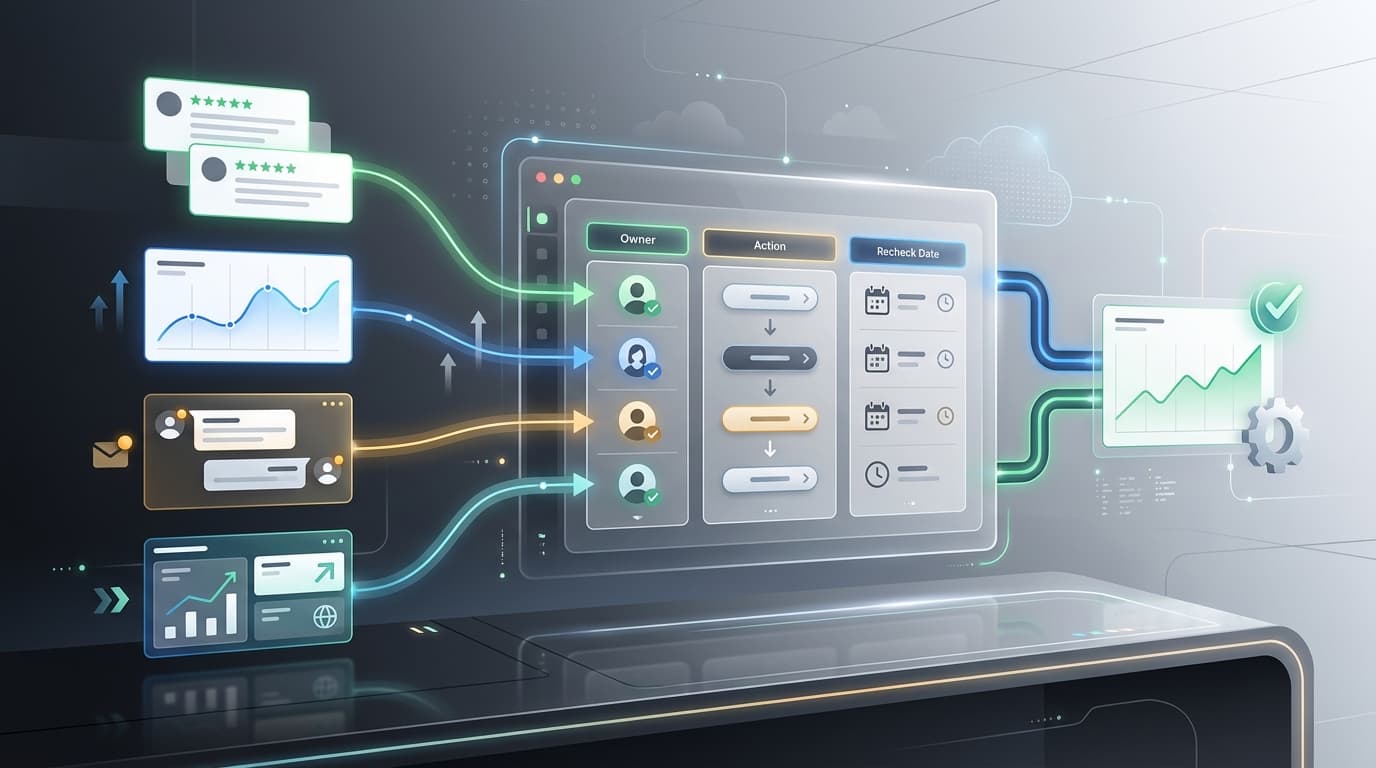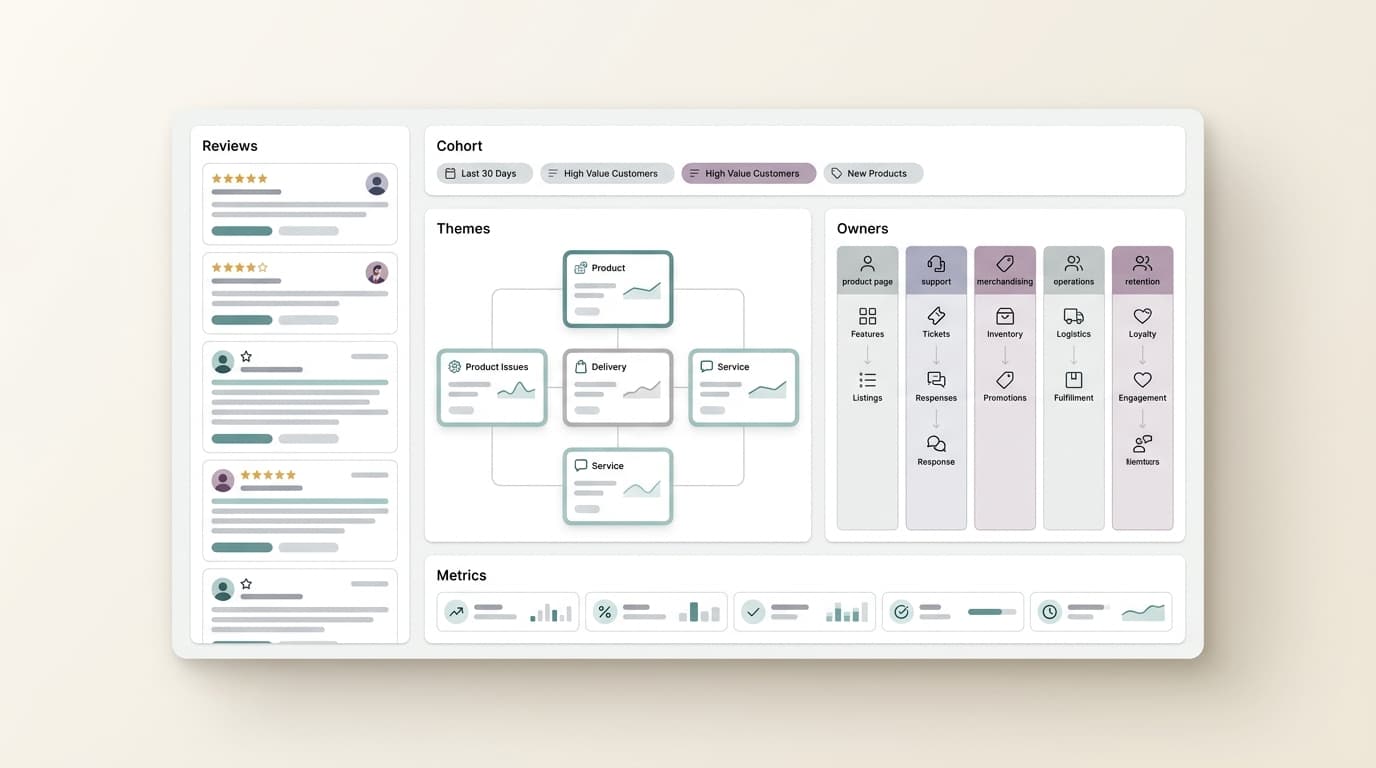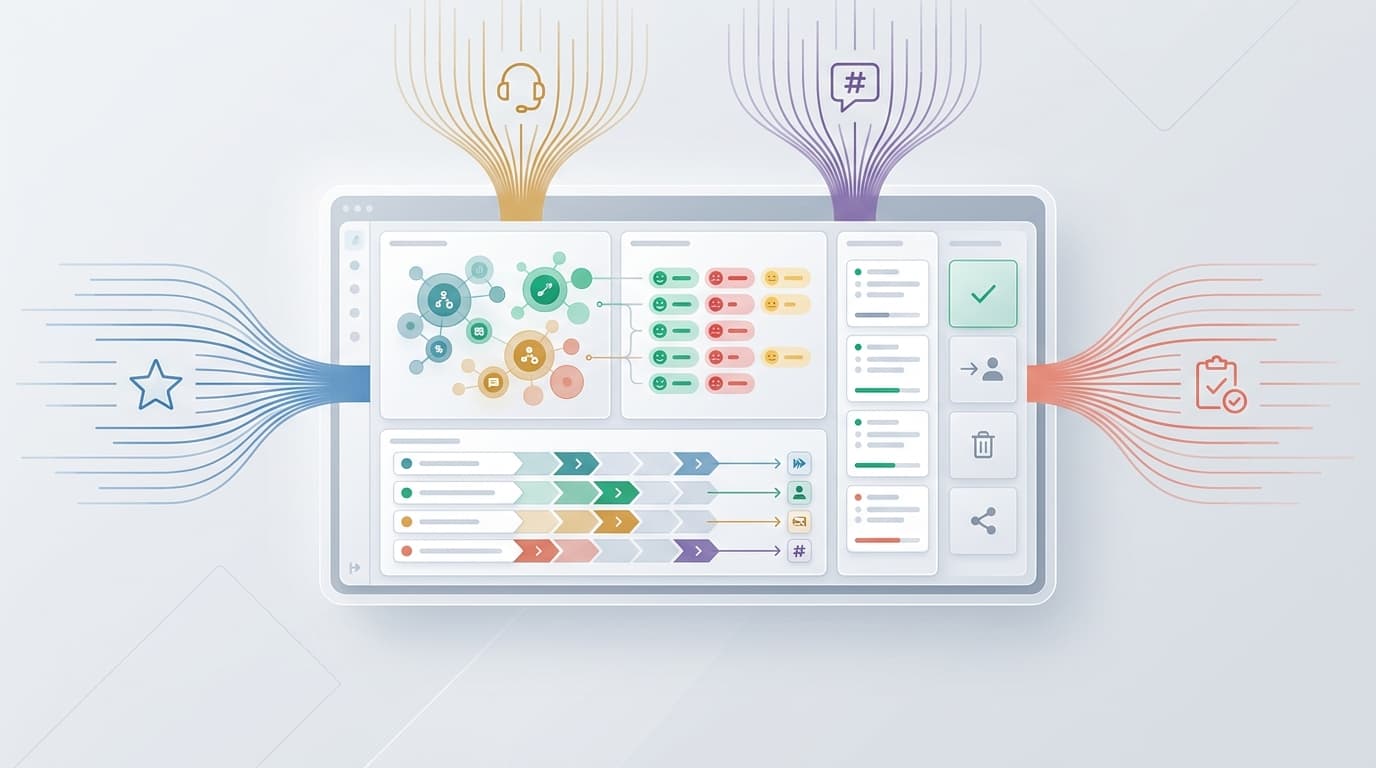
Customer feedback analysis software should do more than collect survey answers. For an e-commerce team, the buying decision is really about whether the software can turn messy shopper signals into product, listing, support, reputation, and growth decisions that an owner can act on.
The hard part is source fit. Product reviews, competitor reviews, support tickets, public social posts, customer questions, returns, and surveys all describe customer pain in different ways. If those sources are merged without context, the team gets a dashboard that looks complete but cannot explain what to fix first.
Use this guide to evaluate customer feedback analysis software by workflow, not by feature labels. The goal is to choose a system that keeps evidence traceable, separates review intelligence from generic survey reporting, and routes each customer signal to the right e-commerce owner.
What Customer Feedback Analysis Software Should Do
Customer feedback analysis software should help an e-commerce team answer five operational questions.
| Question | Why it matters for e-commerce | What to inspect in software |
|---|---|---|
| What are customers repeating? | Repeated review language can reveal defects, missing accessories, setup issues, listing confusion, or unmet use cases. | Theme clustering, phrase grouping, topic taxonomy, variation filters, and review-window controls. |
| How intense is the signal? | One angry review is different from a pattern across low-star, mid-star, and recent reviews. | Sentiment, severity, frequency, recency, rating-band views, and confidence notes. |
| Which source produced the signal? | Reviews, tickets, surveys, and social comments should not all carry the same proof weight. | Source labels, channel filters, provenance, imports, integrations, and audit history. |
| Who owns the next action? | A review theme may need a product fix, listing rewrite, support macro, competitor benchmark, or monitoring queue. | Routing fields, workflows, alerts, owner assignment, exports, and integrations. |
| What does the evidence not prove? | Feedback analysis cannot guarantee ranking lifts, rating recovery, sales gains, or review removal. | Confidence scoring, sample-size warnings, policy notes, and approval controls. |
This is the practical difference between a feedback collector and customer feedback analysis software. A collector captures responses. Analysis software helps teams decide what those responses mean, which action is reasonable, and what proof is still missing.
Why E-Commerce Teams Need A Different Buying Checklist
Many customer feedback analysis software lists are written for SaaS product teams, CX survey teams, or enterprise NPS programs. Those categories matter, but e-commerce operators need a different checklist because the customer signal is spread across public and private channels.
An e-commerce team may need to compare owned product reviews with competitor reviews, connect support tickets to listing confusion, check whether social complaints match verified buyer language, and isolate issues by product, marketplace, date range, package version, or variation. A survey-first tool may be useful for structured post-purchase feedback, but it may not be enough for review intelligence.
Before shortlisting vendors, decide which workflow you are buying for.
| Workflow | Primary source | Best-fit software emphasis | Common mismatch |
|---|---|---|---|
| Review intelligence | Product reviews, competitor reviews, ratings, questions | Theme clustering, sentiment, buyer language, SKU or ASIN context, competitor benchmarks | A survey platform that cannot preserve review context. |
| Support improvement | Tickets, chats, returns, macros, customer service notes | Helpdesk integrations, escalation tags, root-cause routing, SLA views | A review tool that cannot connect to support operations. |
| Social listening | Public social posts, creator comments, marketplace conversations, news | Channel monitoring, narrative tracking, emerging issue alerts | A survey tool that only sees direct responses. |
| Survey and CX measurement | NPS, CSAT, CES, post-purchase forms, research panels | Survey design, journey triggers, respondent segmentation, score trends | A review analytics tool that does not collect structured survey responses. |
| Product and listing decisions | Reviews, questions, returns, support, competitor language | Evidence matrix, owner routing, listing/product/support decision paths | A dashboard that shows sentiment but does not create accountable actions. |
The right customer feedback analysis software for your team is the one that matches the highest-value workflow first. You can add sources later, but you should not start with a generic dashboard if the real problem is review-led product decision making.
The E-Commerce Software Evaluation Matrix
Use this matrix when comparing customer feedback analysis software. Score each criterion from 0 to 3, where 0 means missing, 1 means basic, 2 means workable, and 3 means strong enough for routine operating decisions.
| Criterion | What strong looks like | Score 0-3 | Proof to request |
|---|---|---|---|
| Source coverage | Reviews, support, social, surveys, questions, returns, and competitor signals can be separated and filtered. | Sample import, source filters, and source-label export. | |
| Review context | The tool preserves product, marketplace, variation, rating, date, and competitor context. | Demo using a real or representative product set. | |
| Theme quality | Repeated complaints, praise, objections, feature requests, and buyer phrases cluster into useful themes. | Before-and-after examples with raw comments and grouped themes. | |
| Sentiment and severity | Sentiment is not just positive or negative; it shows intensity, urgency, and possible escalation risk. | Rating-band view, severity tags, and confidence explanation. | |
| Action routing | Themes can move to product, listing, support, competitor benchmark, monitor, or escalation owners. | Workflow screen, owner fields, export, alert, or integration evidence. | |
| Competitor analysis | Competitor review patterns can be compared without mixing unrelated products or price tiers. | Comparable competitor setup and scope controls. | |
| Reporting cadence | The software supports weekly operating reviews, launch monitoring, and campaign or issue follow-up. | Saved views, recurring reports, alerts, and change-over-time examples. | |
| Integrations and API | Data can move into helpdesk, BI, product ops, spreadsheets, or internal systems. | Integration list, export format, API documentation, or implementation sample. | |
| Governance | Teams can control access, audit source use, handle sensitive feedback, and avoid unsupported claims. | Permissions, data handling notes, approval flow, and compliance documentation. | |
| Pricing and scale | The pricing model fits feedback volume, users, markets, and future data needs. | Current pricing page, contract terms, volume limits, and implementation assumptions. |
Do not let a vendor demo skip the source proof. Ask to see how one recent review theme travels from raw text to theme, sentiment, owner, and decision. If the path is unclear, the customer feedback analysis software may create more reporting work instead of better decisions.
Source Checks To Run Before You Buy
A source checklist keeps the evaluation honest. Before choosing customer feedback analysis software, require these checks.
- Separate source types. Owned reviews, competitor reviews, support tickets, social posts, customer questions, returns, and surveys should be labeled separately.
- Keep product scope visible. Product, marketplace, variation, date range, package version, and launch window should stay attached to the signal.
- Review sample size. A theme from three reviews should not be treated the same as a pattern across hundreds of recent comments.
- Check recency. Old reviews may reflect a product, supplier, packaging, or listing version that is no longer live.
- Compare rating bands. A complaint that appears in both one-star and three-star reviews may be more actionable than an isolated one-star outlier.
- Map source to owner. Product defects, listing confusion, support friction, social reputation issues, and survey responses need different owners.
- Add confidence notes. The system should show what evidence is strong, weak, outdated, or channel-specific.
- Avoid outcome promises. The analysis can support prioritization, but it cannot prove guaranteed sales, ranking, conversion, rating, or review-removal outcomes.
This checklist is especially important when customer feedback analysis software includes AI summaries. Summaries are useful only when the team can trace the summary back to the comments, products, dates, and sources behind it.
A 14-Day Proof Of Value Test
Do not evaluate customer feedback analysis software only from a slide deck. Run a small proof of value using one product line, one competitor set, and one support or survey source.
| Day | Test step | Pass condition |
|---|---|---|
| 1 | Define the product, marketplace, time window, and competitor set. | The tool can preserve the scope in saved views or exports. |
| 2-3 | Import or connect review data and one non-review source. | Sources stay labeled and filterable. |
| 4-5 | Cluster themes from recent comments. | Themes are specific enough for product, listing, or support action. |
| 6 | Compare low-star and mid-star review language. | The tool separates severity from simple sentiment. |
| 7 | Add competitor review evidence. | Competitor comparisons stay limited to comparable products or price tiers. |
| 8 | Route themes to owners. | Each top theme has a product, listing, support, social, survey, monitor, or escalation route. |
| 9-10 | Create a decision packet. | The packet includes source map, theme summary, evidence, confidence, owner, and next proof. |
| 11 | Check reporting cadence. | The team can repeat the view weekly without rebuilding the analysis. |
| 12 | Test export or integration. | Data can move into the team system that owns action. |
| 13 | Review governance. | Sensitive data, permissions, and claim controls are clear. |
| 14 | Decide whether to expand. | The team knows which workflow the software improves and which gaps remain. |
The proof of value should end with a decision, not a dashboard. If the team cannot say which themes need product work, listing changes, support updates, competitor benchmarks, or monitoring, the customer feedback analysis software has not passed the operational test.
Which Type Of Software Fits Your Team?
Use the shortlist category that matches your main bottleneck.
| If your bottleneck is... | Prioritize this type of tool | Watch out for |
|---|---|---|
| Too many product and competitor reviews to read manually | Review intelligence and customer review analytics software | Generic sentiment charts that do not preserve SKU, variation, and competitor context. |
| Support tickets repeat the same issue | Support feedback analytics or helpdesk-connected analysis | Tools that summarize tickets but do not connect to product or listing owners. |
| Social conversations move faster than reviews | Social listening with e-commerce context | Tools that monitor mentions but cannot reconcile social signals with buyer reviews. |
| You need structured customer research | Survey and CX feedback platforms | Tools that collect responses well but cannot analyze public review data deeply. |
| Leadership wants one operating view | Unified customer feedback analysis software | Dashboards that combine sources but hide evidence quality and owner routing. |
Most e-commerce teams do not need every feature on day one. They need the first workflow to work cleanly, then a path to connect the other sources without losing traceability.
Where VOC AI Fits
VOC AI fits teams that want customer feedback analysis software centered on e-commerce review intelligence. Current public VOC AI pages describe 2B+ e-commerce reviews, 500M+ products tracked, 30+ categories, and daily refresh on the homepage. The Voice of Customer Analysis page positions VOC AI around turning customer reviews into product direction, buyer language, and market-ready decisions.
That makes VOC AI most relevant when the team needs to analyze product reviews, competitor reviews, customer sentiment, buyer profiles, listing language, and product decision signals before a roadmap, support, or marketing meeting. If public social conversation is part of the workflow, VOC AI also has a Social Listening page for tracking shopper and creator signals across marketplaces and social channels alongside Amazon review data.
For technical teams, VOC AI also describes a Review Analysis API for programmatic access to review and analysis workflows. For budget and plan review, use the current VOC AI pricing page rather than relying on old screenshots or third-party summaries.
Use VOC AI as an evidence and workflow layer, not as an automatic decision maker. Product, support, marketplace, legal, compliance, and leadership owners should still review final decisions, customer-facing claims, warranty actions, safety escalations, and policy-sensitive work. When you are ready to map customer feedback analysis software to your review, support, social, and survey workflows, contact VOC AI with a product set, source list, and proof-of-value goal.
FAQ
What is customer feedback analysis software?
Customer feedback analysis software helps teams turn customer comments, reviews, tickets, surveys, and social signals into themes, sentiment, priorities, reports, and action routes. For e-commerce teams, the right fit depends on whether the core source is reviews, support, social, surveys, or a combined workflow.
How is customer feedback analysis software different from survey software?
Survey software is usually strongest at collecting structured responses. Customer feedback analysis software adds the analysis layer: clustering open-text comments, comparing sources, identifying sentiment and urgency, and routing themes to owners. E-commerce teams often need review and competitor context in addition to surveys.
What data sources matter most for e-commerce feedback analysis?
The highest-value sources are usually owned product reviews, competitor reviews, customer questions, support tickets, returns, surveys, and public social or creator signals. The right mix depends on the decision the team needs to make.
How should a team compare customer feedback analysis software?
Compare tools by source coverage, review context, theme quality, sentiment depth, action routing, competitor analysis, reporting cadence, integrations, governance, and pricing scale. Ask each vendor to show one raw signal becoming a theme, owner route, and decision packet.
Can feedback analysis software guarantee better ratings or sales?
No. Customer feedback analysis software can improve how teams find, prioritize, and route customer signals, but it should not be used to promise sales growth, ranking gains, rating recovery, conversion lift, or review removal.
When should an e-commerce team choose VOC AI?
Choose VOC AI when the main workflow is review intelligence for e-commerce products, especially when product reviews, competitor review patterns, buyer language, sentiment, and product decision support matter more than generic survey collection.