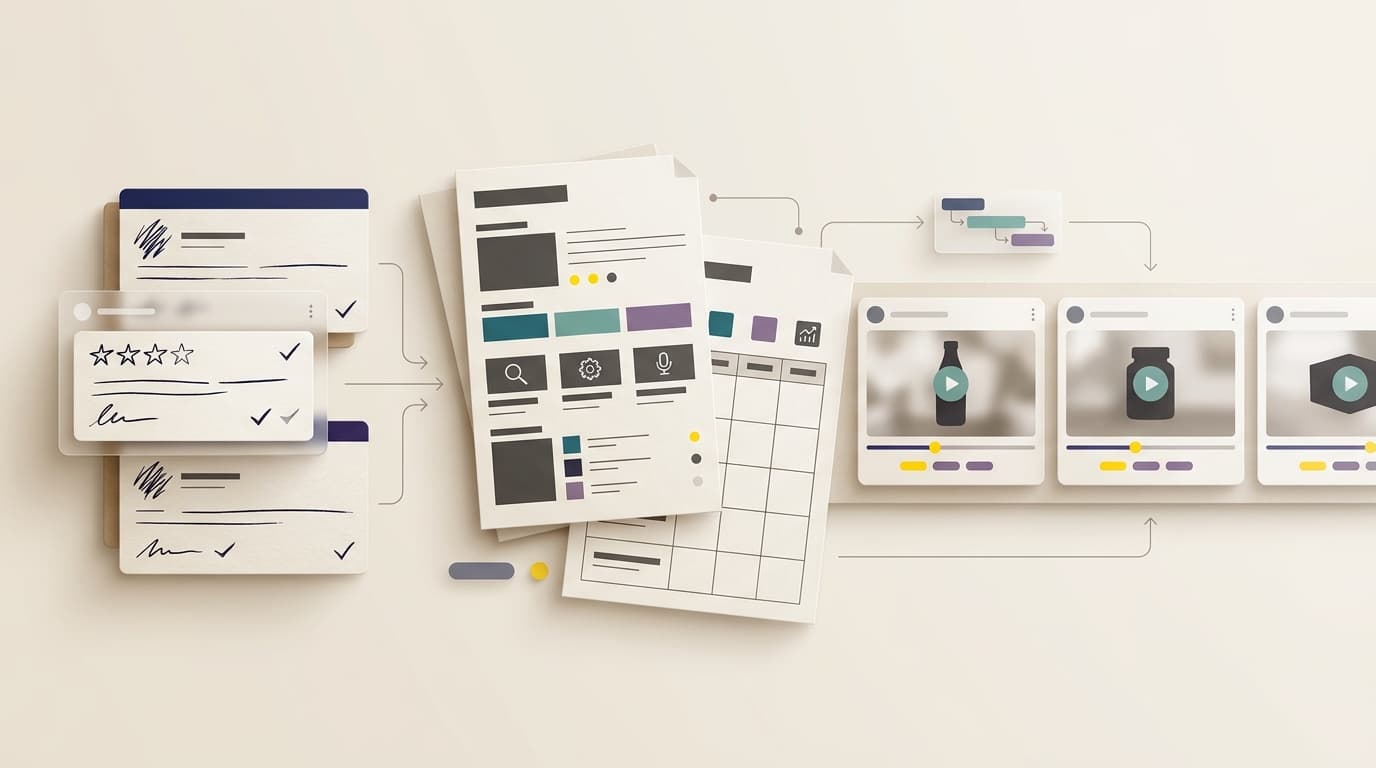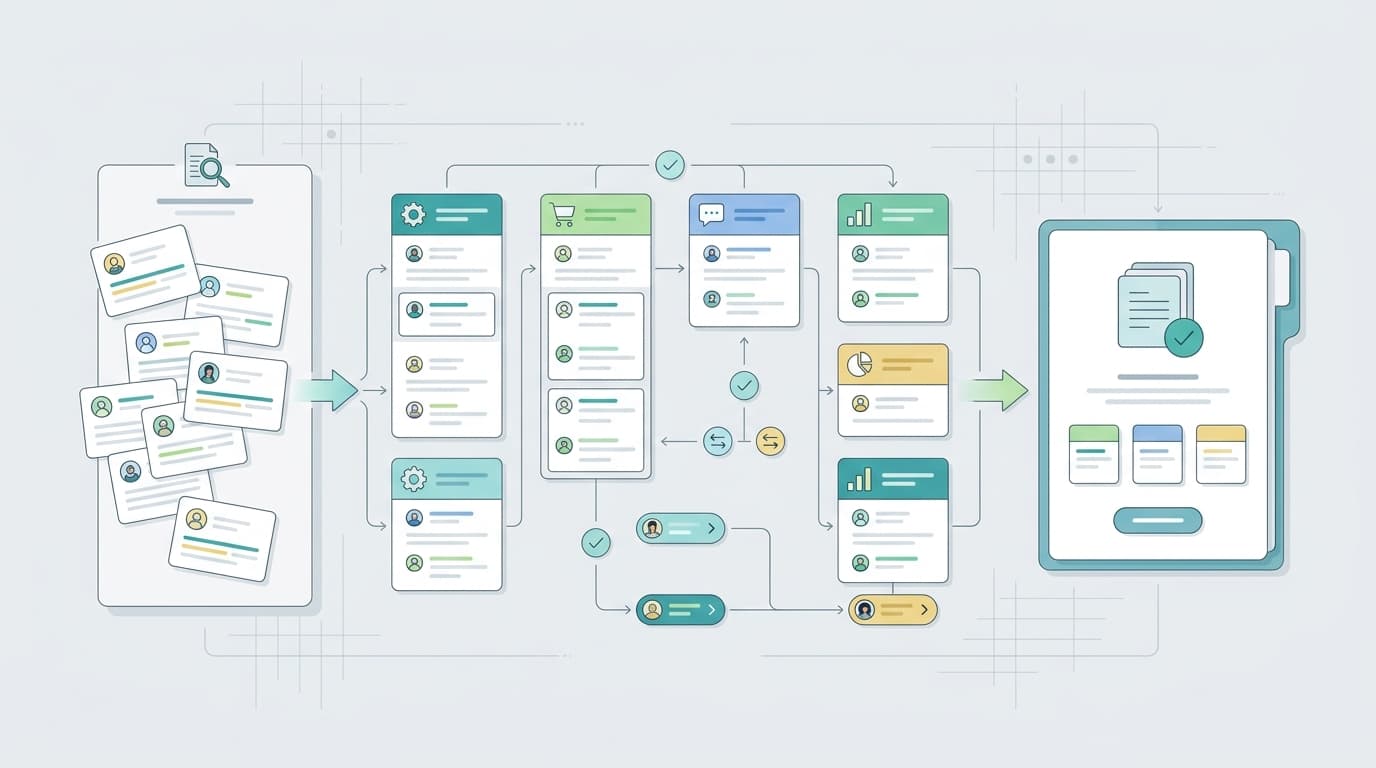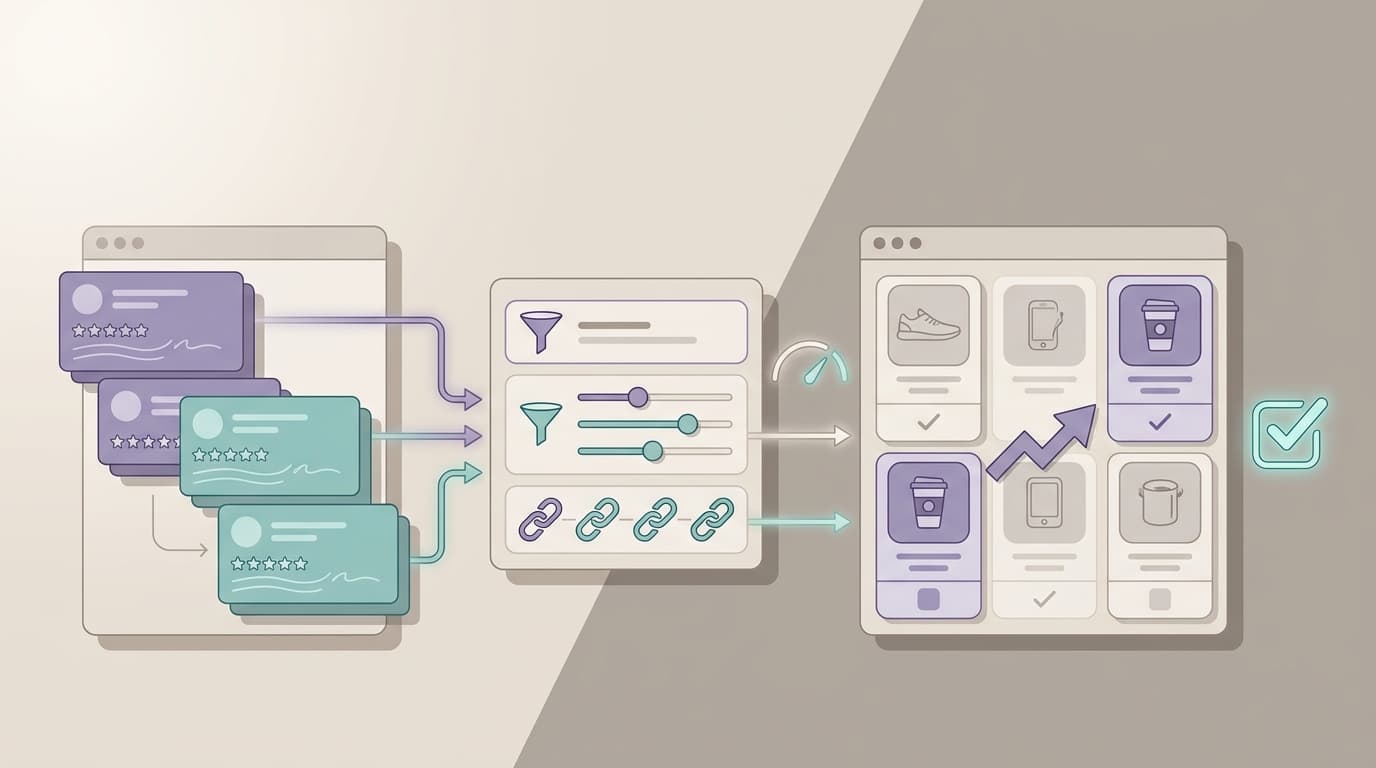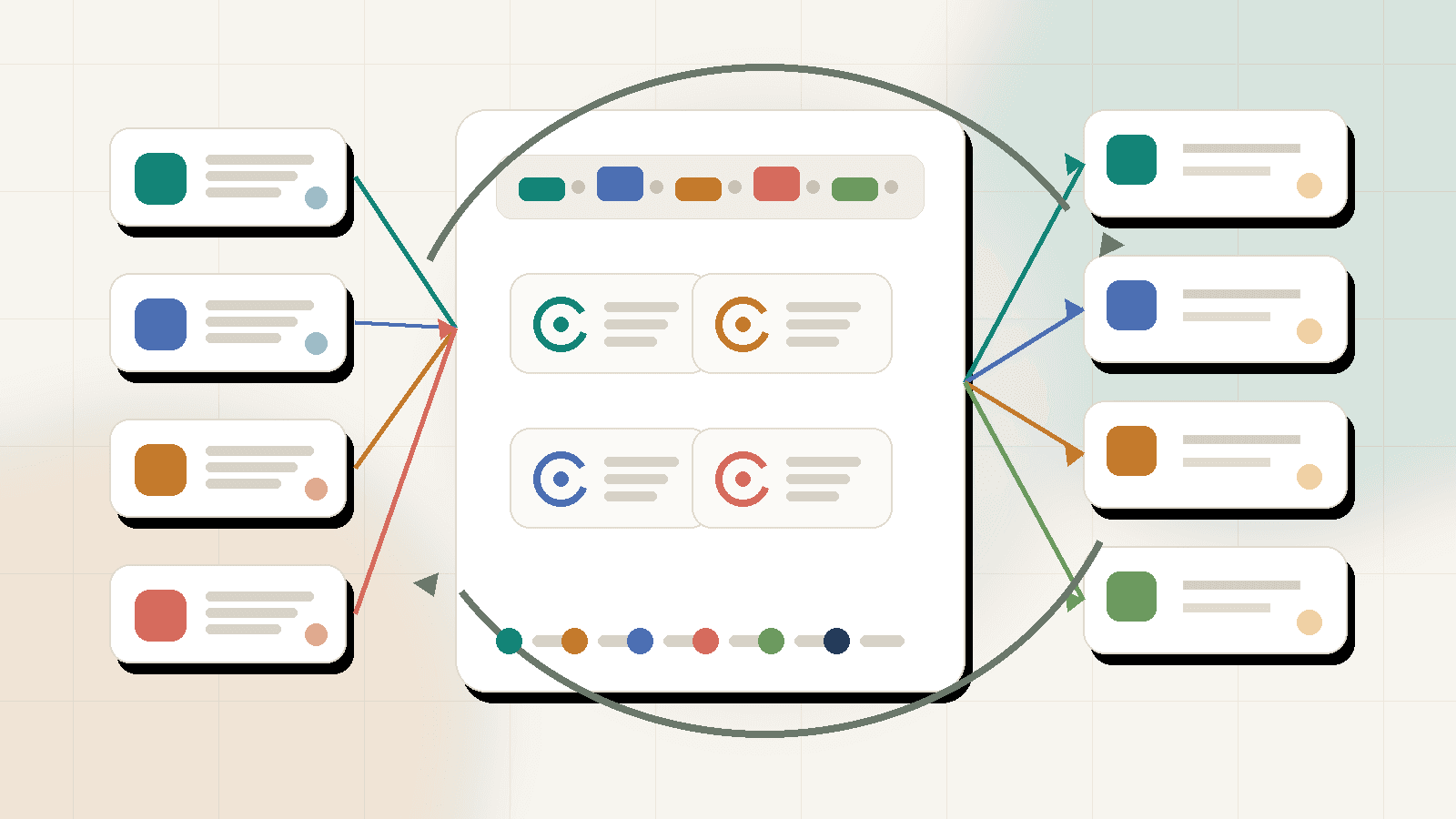
A customer feedback loop in e-commerce is useful only when reviews, support conversations, returns, ratings, and customer questions change what the team does next. The goal is not another insight report. The goal is an owner-ready action: a product fix, listing update, support macro, roadmap note, or monitoring check with a due date.
The hard part is not collecting more feedback. Most teams already have more customer language than they can read. The hard part is deciding which signals deserve action, who owns the action, what evidence is strong enough, and how the team checks whether the change worked. This workflow turns messy feedback into an operating system for product, CX, support, and marketplace teams.
Use this playbook when your team needs a closed-loop workflow from review insight to roadmap decision. It is written for product managers, CX leaders, support teams, and e-commerce operators who need source-safe decisions without claiming that every review proves a defect or that every support ticket should become a product requirement.
What a Customer Feedback Loop Should Change
A customer feedback loop should answer four questions before anyone opens a roadmap ticket:
- What did customers actually say? Keep review text, support language, social comments, ratings, and return clues in separate source lanes.
- What decision could this affect? Map the signal to product, listing, support, merchandising, operations, competitor positioning, or monitoring.
- Who owns the next action? Assign the team that can change the product, page, process, macro, or follow-up report.
- What proves the loop closed? Define the next signal: fewer repeated complaints, cleaner support tags, better listing clarity, lower confusion, or a roadmap decision with evidence attached.
Without those answers, feedback analysis becomes a meeting artifact. With them, the customer feedback loop becomes a repeatable decision workflow.
Start With Source Labels
Do not mix every customer signal into one score. A product review, support ticket, social comment, customer question, and return reason can point to the same issue, but they do not prove the same thing. Source labels protect the team from overreacting to one loud comment or ignoring a pattern that appears across channels.
| Signal source | What it can support | What it cannot prove alone | First owner |
|---|---|---|---|
| Product reviews | Repeated buyer language, feature praise, defects, setup friction, packaging complaints, expectation gaps, and competitor comparisons. | Private support history, return volume, carrier cause, or product-wide defect rate without adjacent evidence. | VOC lead, product manager, marketplace owner. |
| Support conversations | Setup confusion, warranty questions, troubleshooting failures, repeated macros, exchange requests, and pre-purchase objections. | Full category demand or public reputation impact without review and marketplace context. | CX lead or support operations. |
| Social comments and public web | Fast public narratives, creator claim mismatch, viral complaints, comparison language, and emerging expectations. | Actual purchase status, defect frequency, return cause, or whether the audience represents buyers. | Social, brand, or communications. |
| Ratings and review velocity | Whether a theme is visible on the listing, whether review mix changed, and which ASIN or variation needs a closer read. | The reason for the movement without review text and operational context. | Marketplace analytics. |
| Returns and first-party operations | Return codes, inspection notes, refund reasons, shipment timing, and SKU-level operational patterns when the merchant has authorized access. | Public buyer sentiment or competitor context without review and market evidence. | Operations, finance, BI, or returns owner. |
Amazon's seller-facing Customer Reviews tool is a useful reference point because it treats reviews as a source for responding to customers and finding product feedback. That does not mean reviews should be stretched beyond their evidence. A good customer feedback loop keeps each source useful and bounded.
The Closed-Loop Workflow
Use this seven-step workflow to move from reviews to roadmap decisions without losing traceability.
- Define the decision first. Decide whether the loop is about a product change, listing update, support macro, campaign message, competitor benchmark, or monitoring rule.
- Collect source-labeled feedback. Pull recent reviews, high-severity reviews, support tags, customer questions, social comments, rating movement, and authorized first-party data.
- Cluster customer language. Group praise, complaints, motivations, objections, use cases, feature requests, and expectation gaps. Keep example phrases internally, but publish only approved and anonymized language.
- Score the signal. Rank each theme by recurrence, severity, revenue exposure, affected ASINs, source overlap, customer effort, and confidence.
- Map the action. Assign the theme to product, listing, support, CX, operations, merchandising, brand, or analytics with a first action and due date.
- Ship or reject the action. Record whether the team changed something, deferred it, rejected it, or needs more evidence. A closed loop can end with a deliberate no-change decision.
- Monitor the next signal. Recheck review themes, support tags, sentiment, rating movement, and customer questions after customers have had time to experience the change.
This is where the customer feedback loop becomes useful for roadmap planning. The output is not a vague "customers are unhappy" note. It is an action record: signal, evidence, owner, decision, change date, and follow-up signal.
Signal-to-Action Matrix
The matrix below turns review insights and support themes into the right action lane.
| Feedback pattern | Likely meaning | Action lane | Owner | Follow-up signal |
|---|---|---|---|---|
| Repeated product defect language | Customers may be hitting a real quality, durability, compatibility, or variation issue. | Product or QA investigation before roadmap change. | Product, QA, supplier, or engineering. | Fewer matching defect phrases after the fix date, or a documented no-change decision. |
| Expectation mismatch | The product may work, but the page, image, deal, or comparison promise created the wrong expectation. | Listing, image, FAQ, comparison chart, or offer-copy update. | Marketplace content and merchandising. | Fewer "not as described" comments and fewer support questions about the same promise. |
| Setup or usage confusion | Customers need better instructions, troubleshooting, onboarding, or product education. | Support macro, help-center note, insert, setup image, or short product education update. | CX, support operations, and product education. | Lower repeat-contact rate for the tag and fewer reviews mentioning confusion. |
| Competitor praise or complaint repeats | The category may be forming a new expectation, gap, or differentiation point. | Competitor benchmark, product requirement, positioning note, or launch-message test. | Product marketing, competitive intelligence, or product lead. | Roadmap note accepted, product requirement updated, or positioning test defined. |
| Review-derived buying language | Customers use words the team does not use internally. | Listing bullets, A+ content, search-support copy, support macros, and content briefs. | Listing, content, and CX. | Copy updated with product-supported language and monitored for new objections. |
| Sudden negative review or social spike | A new issue may be emerging, or public conversation may be moving faster than product evidence. | Incident triage, source capture, monitoring rule, and owner escalation. | Marketplace, social, CX, and operations. | Spike status marked monitor, fix, escalate, or close with date and evidence. |
Owner Matrix for Roadmap Decisions
A customer feedback loop fails when every team agrees that the insight matters but nobody owns the next action. Use an owner matrix before the roadmap meeting.
| Owner | Owns | Needs from feedback analysis | Should not do yet |
|---|---|---|---|
| Product manager | Roadmap notes, feature prioritization, variant decisions, and product requirements. | Recurring theme, source overlap, severity, affected ASINs, customer wording, and confidence level. | Commit a roadmap item from one review without recurrence or operational context. |
| Marketplace or listing owner | Titles, bullets, images, A+ content, FAQs, comparison charts, and product-page expectation setting. | Exact customer language, objections, unclear promises, and before/after monitoring date. | Copy claims from reviews into the listing unless the product can support them. |
| Support operations | Macros, help content, escalation tags, agent notes, and product-education handoff. | Top repeated questions, failed macro themes, setup confusion, and related reviews. | Turn every support complaint into a product defect before checking clarity and policy. |
| CX or retention lead | Customer experience friction, repeat-contact reduction, post-purchase education, and escalation quality. | Customer effort themes, timing, severity, and customer journey stage. | Use private customer data in public content or external reports without approval. |
| Operations or supply chain | Packaging, fulfillment, supplier batch checks, missing parts, and delivery-condition investigation. | SKU, variation, date range, photos where authorized, support attachments, and return or inspection context. | Blame carrier, warehouse, or supplier before source-labeled evidence is reviewed. |
| Analytics or VOC owner | Dashboards, reports, tags, thresholds, and monitoring cadence. | Definitions, sample scope, owner map, confidence rules, and follow-up metric. | Report aggregate averages that hide one broken variation or one high-severity segment. |
How to Prioritize Roadmap Inputs
Not every repeated complaint belongs on the roadmap. Some issues should become a listing clarification, support macro, packaging check, or monitoring rule. A practical customer feedback loop uses a priority formula to keep roadmap decisions defensible.
feedback_priority =
  recurrence
  + severity
  + revenue_or_customer_exposure
  + source_overlap
  + strategic_fit
  - evidence_uncertainty
  - cost_or_complexity
Use the score to sort discussion, not to automate the decision. A high-score issue may still be deferred if the fix is expensive, compliance-sensitive, or outside the team's control. A low-score issue may still deserve action if it is a safety, trust, or policy risk.
For product managers, the roadmap-ready note should include the theme, evidence source, customer language, affected products or variants, owner, confidence level, recommended action, and next review date. If the recommendation cannot be traced back to feedback, treat it as a hypothesis instead of a customer-backed roadmap decision.
Turn Insights Into Listing and Support Updates
Many feedback themes can be closed faster outside the product roadmap. If customers repeatedly misunderstand size, compatibility, setup, included accessories, warranty, use cases, or limitations, the first action may be a listing or support update.
| Insight | Listing action | Support action | Monitoring action |
|---|---|---|---|
| Customers use a clearer phrase than the team uses internally. | Rewrite bullets or images around product-supported buyer language. | Add the phrase to macros and help-center search terms. | Watch whether new reviews use the phrase with less confusion. |
| Customers ask the same setup question before leaving negative reviews. | Add setup image, FAQ, or product insert reminder. | Update setup macro and escalation tag. | Compare setup-tag volume before and after the update. |
| Customers compare a competitor feature repeatedly. | Clarify the real differentiator or limitation without attacking competitors. | Prepare a comparison-safe answer for support teams. | Track competitor-review themes and new objections. |
| Customers mention damage or missing parts after delivery. | Clarify included contents and handling where appropriate. | Route damaged-item language to operations with evidence. | Monitor review clusters by SKU, bundle, and date window. |
This is the fastest way for a customer feedback loop to create visible change. A listing or macro update can close a loop while product and operations teams investigate deeper root causes.
Monitor the Change and Close the Loop
Closing the loop means checking what happened after the action. Without a follow-up signal, the team only knows that it shipped a change, not whether customer language moved.
For every action, record:
- Theme: the feedback cluster being addressed.
- Source: reviews, support, social, ratings, return notes, or mixed source.
- Owner: the team responsible for changing the product, listing, support process, or monitoring rule.
- Decision: fix, monitor, reject, escalate, or need more evidence.
- Change date: the date the action shipped or the decision was made.
- Next signal: the metric, tag, phrase, or review pattern that should change.
- Next check: the review date, usually 7, 14, 30, or 60 days depending on review volume and customer lag.
Do not mix pre-change and post-change feedback when judging the result. If a listing was updated on July 1, customer reviews from June should not be counted as evidence that the new listing failed. A reliable customer feedback loop respects time windows.
Where VOC AI Fits
VOC AI fits the analysis and monitoring layer of this workflow. Current VOC AI pages position the product around Amazon review intelligence, buyer language, pain points, expectations, sentiment, product research, competitor benchmarks, social listening, API/MCP workflows, and LiveScript. Use those as decision-support capabilities, not as promises that sales, ratings, reviews, rankings, or support outcomes will improve automatically.
- Review intelligence: use Voice of Customer analysis to cluster reviews by pain point, expectation, and feature mention.
- Customer understanding: use customer analytics to organize customer profiles, purchase motivations, and customer language.
- Product research: use product research when review patterns need to become product requirements or category hypotheses.
- Sentiment monitoring: use sentiment analysis to compare how themes change after a listing, product, or support update.
- Social context: use social listening when public conversation may be moving faster than marketplace reviews.
- Repeatable workflows: use VOC AI API and MCP workflows when teams need review data and AI outputs in recurring reports or internal tools.
VOC AI's current product page describes a review corpus of 2B+ reviews and decision-ready outputs for understanding what customers need, hate, expect, and repeat across Amazon. In a customer feedback loop, that scale matters because the team needs more than one dramatic review. It needs patterns that can be traced to decisions.
Start small. Pick one ASIN, one recurring complaint, one owner, and one follow-up date. Then expand the customer feedback loop across product, listing, support, social, and monitoring once the team trusts the action log.
When your team is ready to turn review insights and support themes into an accountable operating rhythm, use VOC AI's Voice of Customer analysis workflow or contact VOC AI to discuss a broader feedback-to-roadmap process.
FAQ
What is a customer feedback loop in e-commerce?
A customer feedback loop in e-commerce is a workflow that collects customer signals, turns them into owner-ready actions, ships or rejects changes, and then monitors whether customer language changes after the decision.
Which feedback sources should e-commerce teams include?
Useful sources include product reviews, star ratings, customer questions, support conversations, social comments, competitor reviews, return clues, and authorized first-party operational data. Keep each source labeled so the team does not overstate what it proves.
How do review insights become roadmap decisions?
Review insights become roadmap decisions when repeated themes are scored by recurrence, severity, exposure, source overlap, strategic fit, uncertainty, and cost. The output should be a traceable roadmap note with owner, evidence, action, and next check date.
What should not go directly onto the roadmap?
Isolated complaints, unsupported feature requests, unclear social comments, and issues that can be solved with listing or support clarification should not become roadmap commitments until the evidence is strong enough.
How do teams know the feedback loop is closed?
The loop is closed when the team records the decision, ships or rejects the action, and checks the next signal after customers have had time to experience the change.
Can AI automate the customer feedback loop?
AI can help cluster feedback, summarize themes, compare sentiment, and monitor changes, but product, CX, support, and operations owners still need to verify evidence and decide which actions are worth taking.