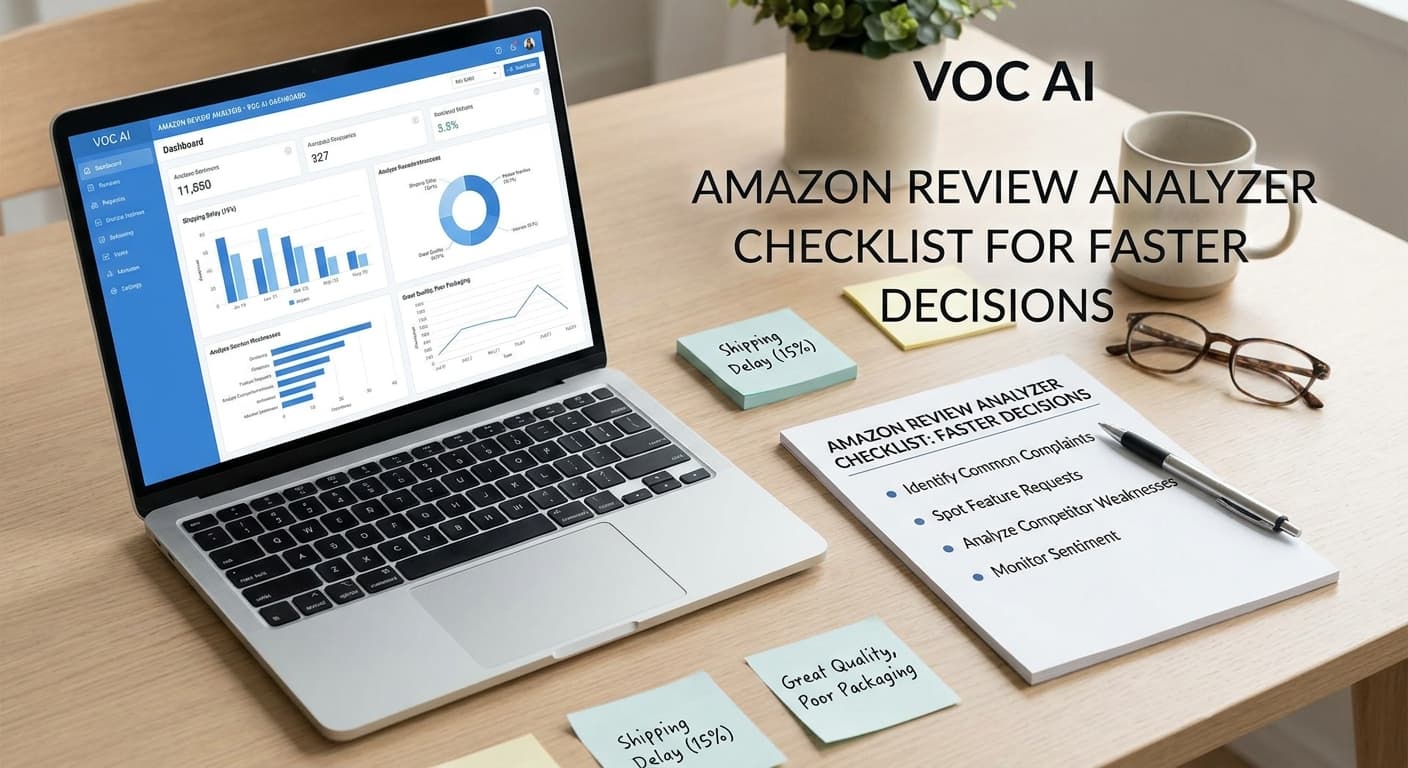
Amazon Review Analyzer Checklist for Faster Decisions
Most Amazon review pages give you a summary. That is useful, but it is not a decision. If you want faster calls, use an Amazon review analyzer as a checklist engine: lock the cohort, preserve buyer language, keep contradictions visible, and route the result to one owner.
This is the practical version of Amazon review analysis. It is for the moment after you already have the data and need to decide what happens next.
Fast checklist
| Check | Pass signal | Red flag |
|---|---|---|
| One decision | You can name the action: fix the product, rewrite the listing, compare competitors, or set up monitoring | The report feels interesting but does not change anything |
| One cohort | One ASIN, one variation, one marketplace, one date range, one rating band | Mixed products, mixed marketplaces, or no time filter |
| Buyer language | The report keeps exact phrases buyers used | The analyzer rewrites everything into generic sentiment |
| Contradictions | Strong praise and repeated complaints are both visible | Only the top complaint theme survives |
| Next owner | Product, content, CX, or research owns the next step | No one owns the follow-up |
1. Start with the decision
Before you open an Amazon review analyzer, define the decision you need to make.
- Should this product change?
- Should the listing change?
- Is the issue urgent enough for support or CX?
- Do we need competitor context?
- Do we need monitoring instead of a one-time read?
If the analyzer cannot answer one of those questions, the scope is too broad.
2. Lock the cohort
The fastest way to get bad output is to mix too many things together.
- One ASIN or one competitor ASIN set
- One marketplace
- One date range
- One rating band when needed
- One version or variation when the issue is specific
Good analysis is narrow enough to explain. Broad analysis is usually too vague to act on.
3. Keep the buyer language
An Amazon review analyzer should keep the words buyers actually used.
That matters because exact phrases are what you reuse in:
- Product positioning
- Listing bullets
- Support macros
- Product research notes
- Competitor gap briefs
If the output only says "negative sentiment" or "shipping issue," it is too thin. You want the sentence buyers keep repeating.
4. Check whether the theme repeats
One complaint does not make a pattern.
Ask three questions:
- Does the same theme repeat across multiple reviews?
- Does it show up in the most recent reviews?
- Does it appear in more than one rating bucket?
That is the difference between noise and a real product signal. A useful Amazon review analyzer makes recurrence obvious.
5. Keep contradictions visible
The best insight is rarely all positive or all negative.
- A feature buyers love, paired with a downside
- A complaint that is offset by a workaround
- A competitor advantage that is only true for one segment
- A rating drop that started after a product or shipping change
If the analyzer hides contradictions, you lose the context that speeds up the decision.
6. Compare like with like
If you are using Amazon review analysis for product research, compare the right things:
- Same category
- Similar price band
- Similar use case
- Similar review volume
That is where review-backed product research becomes useful. A good analyzer should help you compare products by the reason buyers complain, not just by star count.
7. Route each theme to an owner
Every repeated theme should land somewhere.
| Theme | Usual owner | Typical next action |
|---|---|---|
| Product defect | Product or ops | Fix the product or packaging |
| Feature gap | Product | Add, rename, or reposition the feature |
| Listing confusion | Growth or content | Rewrite bullets, images, or FAQ |
| Shipping issue | Ops or CX | Check fulfillment or carrier patterns |
| Competitor advantage | Research | Build a gap brief or comparison note |
If the report has no owner, it is still a summary.
8. Decide if you need monitoring
Not every issue should trigger a redesign.
Use Amazon review monitoring when:
- The issue is small but recurring
- A launch is new and noisy
- A rating drop needs a weekly check
- You want to know whether a fix worked
Use a one-time Amazon review analyzer when you need a quick decision on one cohort. Use monitoring when the question is whether the pattern continues.
9. Capture the exact output you will reuse
Before you close the analyzer, save three things:
- The repeated buyer phrase
- The strongest contradiction
- The next action
Those three lines are what teams actually reuse in product docs, listing updates, and stakeholder updates. Everything else is support.
10. Escalate when the question is bigger than the tool
An Amazon review analyzer is enough for a focused decision. It is not enough for a broader workflow that spans product, CX, and growth.
If you need repeatable analysis across teams, use VOC AI’s Voice of Customer Analysis. If you need the analysis inside a system or pipeline, use the Review Analysis API. If you are still choosing a tool, use the Amazon review analysis tool buyer scorecard and What to Look for in a Customer Review Analysis Tool.
30-minute workflow
If you want a fast operating rhythm, run this order:
- Pick one decision.
- Freeze one cohort.
- Pull the repeated buyer phrase.
- Check for contradictions.
- Compare against one competitor or variant.
- Route the theme to one owner.
- Decide whether this needs monitoring.
- Save the exact line you will reuse.
That is the checklist version of Amazon review analysis. It is smaller than a full research process, but it is usually enough to decide what happens next.
FAQ
What should an Amazon review analyzer show?
It should show the repeated buyer phrase, the strongest theme, the contradiction, and the next action. If it cannot do that, it is closer to a summary than a decision tool.
Is an Amazon review analyzer the same as a review summarizer?
No. A summarizer condenses text. An Amazon review analyzer should help you decide whether to change the product, listing, competitor strategy, or monitoring plan.
Can I use this checklist for competitor research?
Yes. In competitor research, the value is not the star rating. It is the recurring complaint pattern, the feature gap, and the exact wording buyers use.
When should I use VOC AI?
Use it when you need repeatable review analysis, not just a one-off summary. Start with Voice of Customer Analysis or the Review Analysis API depending on whether your workflow is manual or programmatic.
Final check
If the Amazon review analyzer output does not answer one decision, keep the cohort smaller.
If it answers the decision, keep the buyer language, keep the contradictions, and give the next action a name.