Updated August 15, 2026.
A customer insights platform should not be judged by the number of charts it can produce. Growth teams need a system that turns customer evidence into decisions: which audience to pursue, which promise to test, which objection to fix, which product gap to prioritize, and which experiment is worth running next.
That is why the phrase customer insights platform is easy to misunderstand. Some tools are research repositories. Some are survey platforms. Some are product analytics suites. Some are social listening tools. Some are review analysis platforms. All can be useful, but they do not create the same operating loop.
For a growth team, the useful question is more specific:
Can this customer insights platform preserve the original customer evidence, separate signal from noise, and help the team choose the next growth action?
Use this guide as a practical strategy and buying checklist. It is written for teams that already have scattered feedback across reviews, support tickets, surveys, calls, product analytics, sales objections, community posts, and ecommerce marketplace data. The goal is not to collect more comments. The goal is to turn the right evidence into repeatable growth decisions.
What a customer insights platform should do for a growth team
A customer insights platform gives growth, product, CX, and marketing teams a shared way to inspect customer evidence and decide what to do with it.
At minimum, it should help the team:
- Capture customer language from the channels that matter.
- Preserve enough source context to make the evidence auditable.
- Cluster recurring pains, objections, motivations, and use cases.
- Separate strong signals from loud anecdotes.
- Connect customer themes to product, messaging, onboarding, retention, support, or pricing decisions.
- Track what changed after the team acted.
If a platform only produces sentiment scores, summaries, or dashboards, it may still be useful. But it is not yet a complete customer insights platform for growth work. Growth teams need a feedback-to-action loop, not another reporting surface.
The customer feedback intelligence workflow playbook covers this same evidence-to-decision problem at the operating-model level. This article applies that workflow to platform strategy and tool evaluation.
The growth-team customer insights loop
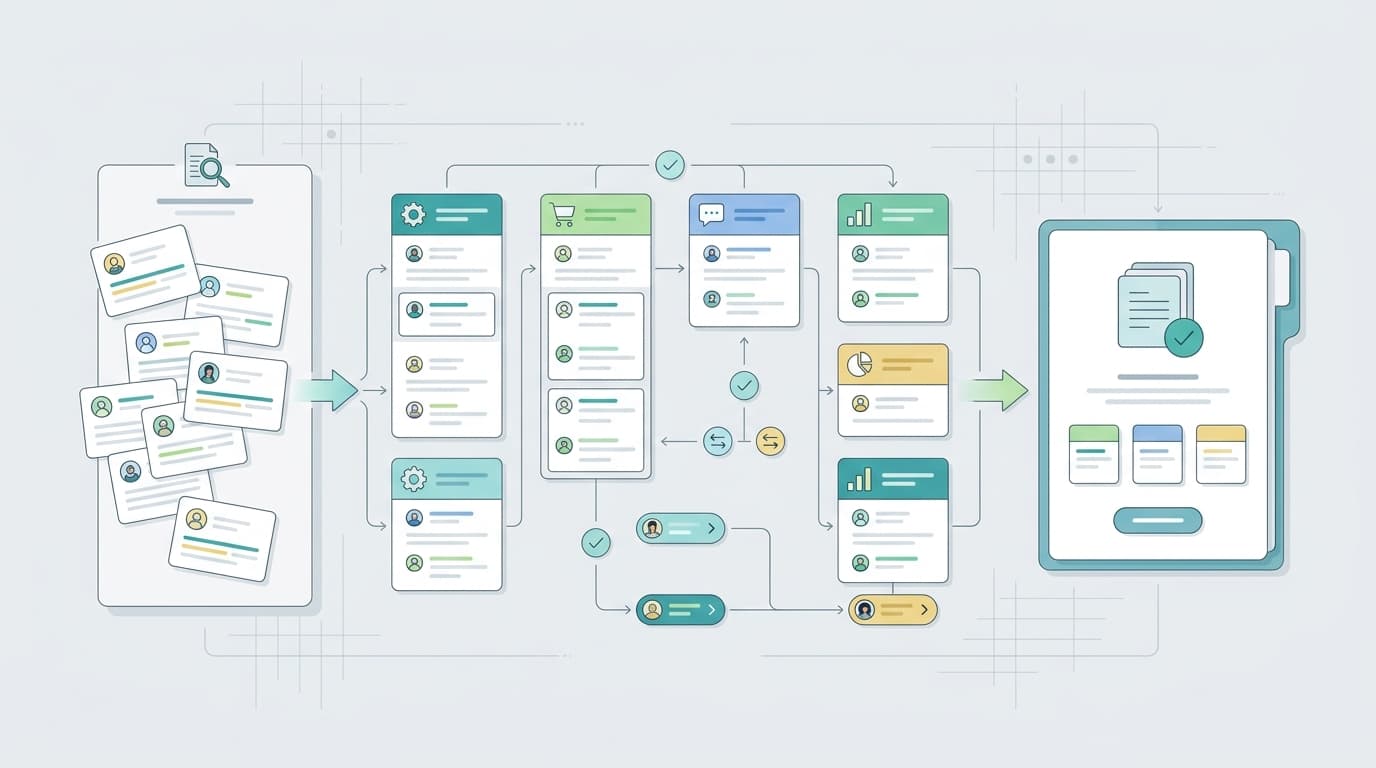
Before comparing customer insights platform tools, define the loop the platform must support. Otherwise the team may buy a system that looks strong in a demo but fails during the weekly growth review.
| Stage | Growth question | Evidence needed | Platform requirement |
|---|---|---|---|
| Find | Where are customers struggling, hesitating, or asking for value? | Reviews, tickets, surveys, calls, returns, communities, analytics | Multi-source intake with source context |
| Explain | What mechanism is causing the behavior? | Verbatim examples, segment, product context, journey stage | Theme clustering plus traceable examples |
| Decide | Which growth action should we take? | Evidence summary, counterevidence, expected impact, owner | Decision packet or handoff workflow |
| Test | Did the action change the customer signal? | Experiment result, conversion metric, support change, review trend | Follow-up tracking and learning notes |
| Reuse | What should become reusable growth knowledge? | Winning language, persistent objection, validated segment | Searchable insight repository |
This loop keeps the customer insights platform tied to action. It also stops the team from confusing data volume with decision quality.
Start with the growth decisions, not the software category
Different teams mean different things when they say "customer insights platform tools." A product leader may want a research repository. A lifecycle marketer may want survey and segmentation data. A CX leader may want ticket and conversation intelligence. An ecommerce growth team may need customer review analysis, competitor review patterns, and exact buyer language.
The best starting point is a decision inventory.
Ask the team to list the recurring growth decisions that currently require customer evidence:
| Decision | Bad version | Better version |
|---|---|---|
| Audience | "Who should we target?" | Which segment shows repeated unmet need, clear use context, and reachable language? |
| Messaging | "What headline should we test?" | Which customer words describe the value, anxiety, or tradeoff most clearly? |
| Offer | "Should we discount?" | What objection blocks purchase: price, trust, feature fit, setup effort, comparison, or timing? |
| Product | "What should we build?" | Which complaint or desired outcome appears across enough evidence to justify a roadmap bet? |
| Onboarding | "Why do users not activate?" | Which expectation gap appears before the first successful moment? |
| Retention | "Why do customers churn?" | Which recurring friction, missing outcome, or service issue predicts downgrade or cancellation? |
| Ecommerce listing | "How should we rewrite the page?" | Which review-backed phrases, objections, and proof points should appear in title, bullets, comparison, or FAQ copy? |
This inventory narrows the customer insights platform search. You are not buying a generic insight engine. You are buying support for the decisions that create or protect growth.
What data sources should the platform connect?
A customer insights platform is only as useful as the evidence it can bring into one reviewable loop.
For most growth teams, useful sources include:
- Public reviews: marketplace reviews, app store reviews, G2/Capterra-style reviews, and social proof comments.
- Support conversations: tickets, live chat, help desk tags, escalation reasons, and macros that fail.
- Surveys: NPS, CSAT, post-purchase surveys, cancellation forms, and open-text responses.
- Sales and success notes: objections, reasons for no-decision, renewal risks, onboarding notes, and expansion blockers.
- Product analytics: behavior signals that show where customer language needs validation.
- Community and social signals: public questions, complaints, comparison threads, creator comments, and niche communities.
- Ecommerce data: product reviews, competitor reviews, listing language, category trends, and customer expectations.
The platform does not need every source on day one. It does need source discipline. A review, a support ticket, a survey response, and a sales note should not be blended into the same conclusion without preserving where each came from.
VOC.AI is strongest when the growth question depends on review-backed ecommerce evidence. Its public VOC Analysis page describes turning customer reviews into product direction, buyer language, and market-ready decisions, while its product knowledge base maps review analysis to pain points, buyer motivations, use cases, product strengths, product weaknesses, and competitor benchmarks. The Review Analysis API page also positions VOC.AI for programmatic review, keyword, sales, and listing data through API and MCP surfaces.
That makes VOC.AI a natural fit when customer reviews are a primary signal in the customer insights platform strategy, especially for Amazon sellers, ecommerce brands, agencies, and teams building repeatable review-intelligence workflows.
The six checks to run before choosing a customer insights platform
Use this checklist before a demo, pilot, or renewal. It is designed to reveal whether a platform supports growth decisions or only produces summaries.
1. Source traceability
Ask whether every theme, summary, and recommendation can be traced back to the original customer evidence.
Good signs:
- Each insight links to examples.
- Verbatim customer language is preserved.
- Source, date, product, segment, and channel are visible.
- AI-generated fields are distinguishable from original evidence.
- Exports preserve enough context for review.
Weak signs:
- The tool gives polished summaries without examples.
- Themes cannot be audited.
- Source channels are merged without labels.
- The platform hides uncertainty.
This matters because growth teams act under pressure. A confident summary can push a team toward the wrong test if nobody can inspect the evidence behind it.
2. Cohort control
A useful customer insights platform lets you choose the customer cohort before drawing conclusions.
Examples:
- New customers in the first 14 days.
- Lost deals from a specific segment.
- Three-star Amazon reviews from the last 90 days.
- Enterprise support tickets after migration.
- Competitor reviews for a specific product category.
- Customers who activated but did not return.
Without cohort control, the team may mix different customer realities into one theme. That is how a real issue for one segment becomes a fake priority for the whole business.
3. Theme quality
Theme quality is not the same as sentiment classification. Growth teams need themes that explain behavior.
Weak theme: "negative onboarding feedback."
Useful theme: "new users expect the import to preserve historical tags, but the first-run flow does not explain what will be retained."
Weak theme: "customers like quality."
Useful theme: "buyers describe the product as reliable after repeated use, but hesitate before purchase because the listing does not prove durability."
For ecommerce teams, this is where review analysis becomes valuable. The VOC analysis examples article shows how different workflows turn raw feedback into decision-ready evidence. The same standard should apply when evaluating a broader customer insights platform.
4. Counterevidence handling
Growth teams should not only ask what customers are saying. They should ask what would make the conclusion wrong.
A good platform makes counterevidence easy to inspect:
- Are there customers who do not share the pain?
- Does the theme only appear in one channel?
- Did the pattern disappear after a product change?
- Is the issue concentrated in one SKU, plan, region, or acquisition channel?
- Does product behavior contradict the feedback theme?
Counterevidence prevents overfitting. It helps the team avoid turning one loud quote into a company-wide priority.
5. Decision handoff
Insights are useful only when they move into an owner-owned decision.
Before choosing a customer insights platform, ask what the output looks like in a real growth review. A strong handoff should include:
- The decision question.
- The evidence window.
- The strongest examples.
- The counterevidence.
- The recommended action.
- The owner.
- The expected signal change.
- The follow-up date.
This is the difference between "users complain about pricing" and "test a plan-comparison FAQ for new trial users who viewed pricing twice but did not start, because recent support and survey evidence suggests confusion about credits rather than price resistance."
6. Reuse and integration
Growth teams compound when insights become reusable. The platform should make it easy to retrieve validated customer language, recurring objections, segment notes, competitor patterns, and experiment learnings.
Useful integration paths include:
- Exportable evidence sets for product and research reviews.
- API access for dashboards, agents, or internal workflows.
- Links into issue trackers, docs, CRM, support systems, or experiment tools.
- Saved taxonomies and queries for recurring reviews.
- Access controls for shared team workflows.
VOC.AI's current pricing page describes a shared credit system across API, MCP, and Agent analysis, with Free, Pro, Team Lite, Team Growth, and Enterprise Custom plans. That matters for teams evaluating a repeatable customer insights platform workflow because the operating cost is tied to data queries, reports, API calls, MCP usage, and Agent analysis tasks.
Customer insights platform tool types: which one fits your growth motion?
The market is crowded because the phrase "customer insights platform" covers several tool categories. Use this comparison to narrow the search.
| Tool type | Best for | Watch out for | Growth-team fit |
|---|---|---|---|
| Research repository | Organizing interviews, usability studies, and research notes | May depend on manual tagging and formal research process | Strong for product/research teams with recurring studies |
| Survey and experience platform | Quantitative feedback, NPS/CSAT, segmentation, benchmarking | Can over-weight survey respondents and under-weight behavioral evidence | Strong for CX programs and lifecycle measurement |
| Product analytics suite | Behavioral funnels, activation, retention, cohorts | Explains what happened more easily than why it happened | Strong when paired with qualitative evidence |
| Support conversation intelligence | Ticket trends, escalation reasons, service quality | May miss non-support buyers and market demand signals | Strong for CX, support, onboarding, and retention teams |
| Social listening platform | Public sentiment, brand monitoring, creator/community signals | Can be noisy and hard to tie to product decisions | Strong for brand, category, and public perception work |
| Review intelligence platform | Review-backed buyer language, product gaps, objections, competitor evidence | Needs source and cohort discipline to avoid overgeneralizing | Strong for ecommerce, marketplace, product research, listing, and competitor decisions |
| API-first feedback intelligence | Embedded analysis, custom dashboards, internal agents | Requires technical ownership and governance | Strong for teams building repeatable internal workflows |
Many teams need more than one category. The strategic choice is deciding which source becomes the decision backbone.
If growth depends on ecommerce review evidence, competitor reviews, product research, and listing language, a review intelligence platform such as VOC.AI can be the backbone. If growth depends on enterprise renewal surveys or formal research repositories, another category may need to lead while review intelligence supports market and message validation.
A 45-minute platform evaluation test
Do not evaluate a customer insights platform only with sample data. Use one real growth question.
Choose a narrow question such as:
- Why are high-intent visitors hesitating before purchase?
- Which objection should the next landing page test address?
- Which product gap appears in competitor reviews but not in our roadmap?
- Which onboarding issue deserves the next sprint?
- Which customer words should be used in the next listing or ad test?
Then run this 45-minute test:
| Minute | Task | What to inspect |
|---|---|---|
| 0-5 | Define the decision question | Is the question specific enough to answer? |
| 5-15 | Import or select the evidence cohort | Can the platform preserve source, date, segment, and channel? |
| 15-25 | Generate themes | Are themes specific, behavior-based, and tied to examples? |
| 25-32 | Inspect counterevidence | Can the team find records that weaken or narrow the theme? |
| 32-40 | Create the decision handoff | Does the output name owner, action, expected signal, and follow-up? |
| 40-45 | Reuse the insight | Can the team export, link, or save the learning for future decisions? |
Score the platform from 1 to 5 on each row. Do not buy the tool that produces the prettiest summary. Choose the one that makes the next decision clearer and easier to challenge.
Where VOC.AI fits in a customer insights platform strategy
VOC.AI should be considered when customer reviews, marketplace evidence, and ecommerce buyer language are central to the growth motion.
The strongest use cases are:
- Product research: validate demand, compare customer tradeoffs, and find review-backed product gaps.
- Listing and message optimization: extract buyer language for titles, bullets, descriptions, comparison sections, FAQs, ads, and creator scripts.
- Competitor analysis: compare rival listings, review patterns, complaints, strengths, and weaknesses.
- Market insight: inspect category trends, market movement, and competitor signals alongside review evidence.
- Review monitoring: detect changes in customer sentiment, ratings, complaints, and operational issues.
- API and MCP workflows: connect review analysis into internal dashboards, agents, reports, and repeatable operating systems.
For teams comparing broader AI review tools, the AI review analysis comparison explains how to separate summary-only tools from decision-grade review analysis. For product discovery teams, the product research AI comparison adds a buyer checklist for review-backed product research.
The practical positioning is simple: VOC.AI is not trying to be every possible customer insights platform category. It is strongest when review evidence should shape growth decisions before the team spends budget on product, listing, positioning, competitor response, or support automation.
Implementation plan: first 30 days
Use the first month to prove one decision loop. Do not connect every source or design a permanent taxonomy too early.
Week 1: choose the decision and evidence contract
Pick one decision owner and one question. Define the minimum evidence fields:
- Source link or ID.
- Customer language.
- Channel.
- Date.
- Product, SKU, plan, or feature.
- Segment if known.
- Journey stage.
- Theme.
- Confidence note.
For ecommerce review work, include ASIN/product, rating, review date, competitor/product context, and whether the comment is about feature, quality, fit, packaging, service, price, or expectation.
Week 2: run the first cohort analysis
Analyze one bounded cohort. Do not mix too many sources.
Examples:
- Last 90 days of three-star reviews for one product line.
- Recent support tickets tied to onboarding.
- Lost-deal notes from one segment.
- Competitor reviews for three products in one category.
- Survey comments from churned customers.
The goal is to produce a decision-ready theme, not a universal taxonomy.
Week 3: create the decision packet
Turn the evidence into a short operating packet:
| Packet section | Required content |
|---|---|
| Decision question | The exact choice and owner |
| Evidence window | Source, segment, date range, and denominator when available |
| Theme | The specific customer mechanism |
| Examples | Representative customer language |
| Counterevidence | Records that weaken or narrow the interpretation |
| Recommendation | Action, test, defer, or monitor |
| Learning check | Signal, metric, guardrail, and follow-up date |
This packet is the output your customer insights platform must support.
Week 4: act and measure the signal
Run one action from the packet:
- Rewrite a listing section.
- Add a landing-page proof block.
- Create an objection-handling email.
- Prioritize one product fix.
- Change onboarding copy.
- Build one support macro.
- Test a competitor-comparison page.
Then check whether the customer signal changed. The learning may be small. That is fine. The point is to prove that the platform can move evidence into a measurable growth action.
Mistakes to avoid
The most common platform mistakes are predictable.
- Buying before defining decisions: The team compares features without knowing which operating loop matters.
- Treating sentiment as strategy: Positive and negative labels rarely explain what to change.
- Blending channels without context: Reviews, surveys, tickets, and calls represent different customer moments.
- Ignoring counterevidence: The team finds support for a theme but never checks where it does not hold.
- Skipping the owner: Insight without ownership becomes research theater.
- Forgetting the follow-up: A platform that never checks whether action changed the signal cannot build growth learning.
- Over-automating too early: AI is useful for classification, clustering, retrieval, and summarization, but the team still needs reviewable evidence and decision accountability.
The NIST AI Risk Management Framework is useful context for AI-assisted workflows because it emphasizes validity, reliability, transparency, and ongoing measurement. In a customer insights platform, that translates into source links, clear AI boundaries, sampling checks, counterevidence review, and outcome measurement.
Final checklist
Use this final checklist before choosing or renewing a customer insights platform:
- Which growth decisions will this platform support in the next 90 days?
- Which customer sources matter most for those decisions?
- Can every summary be traced back to original evidence?
- Can the team control cohorts by segment, source, product, date, rating, plan, or journey stage?
- Are themes specific enough to explain behavior?
- Can the team inspect counterevidence?
- Does the platform create an owner-ready decision handoff?
- Can insights be reused in experiments, roadmap reviews, listings, support, or internal workflows?
- Does pricing match expected query, report, API, and team-seat usage?
- Can the platform prove one evidence-to-action loop in the first 30 days?
The right customer insights platform should make the next growth decision easier to defend. It should preserve what customers actually said, show where the pattern does and does not hold, and help the team act without losing the evidence trail.
If review-backed ecommerce evidence is central to that work, start with VOC.AI's Voice of Customer Analysis, compare operating cost on VOC.AI Pricing, or use the Review Analysis API when the customer insights platform needs to plug into a repeatable internal workflow.