The best ecommerce ads rarely begin with a clever prompt. They begin with a clear understanding of what customers want, what they doubt, and what finally convinces them to buy.
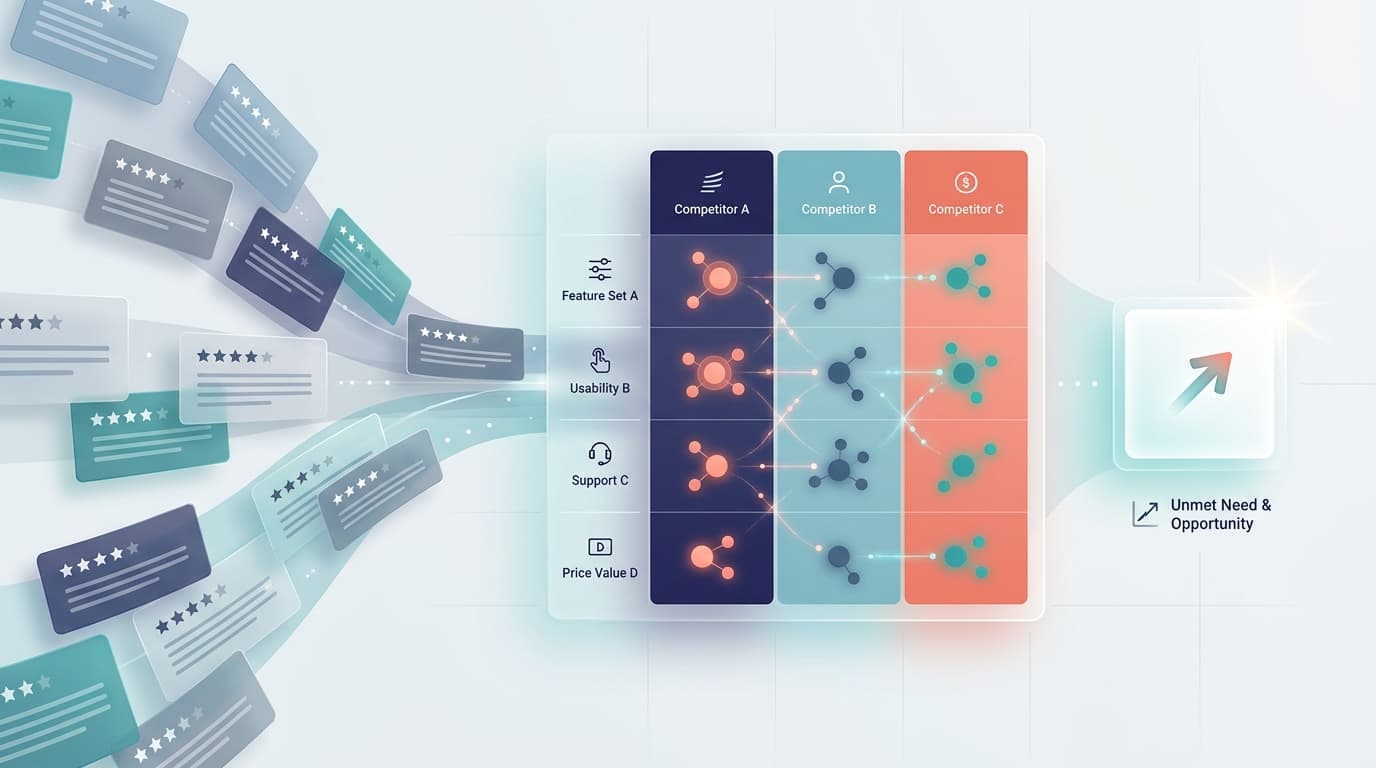
Customer reviews contain that information in the buyer’s own language. They reveal recurring objections, real use cases, unexpected product benefits, sizing concerns, setup problems, and the details customers wish a product page had explained earlier.
But review analysis alone does not create growth. The value appears when customer evidence is translated into better product visuals, UGC-style videos, paid-social concepts, and measurable creative tests.
This guide presents a practical workflow for moving from customer reviews to ecommerce video ads without turning isolated comments into unsupported claims or generating dozens of disconnected creative variations.
Why customer reviews are a creative input, not just a research source
Most creative briefs begin too late in the process. A team decides it needs five new ads, chooses a format, and then asks a writer or AI tool to invent hooks.
That approach can produce content quickly, but it often repeats the same generic promises:
- Better quality
- More convenient
- Premium design
- Perfect for everyday use
- A must-have product
These statements are broad because they are not grounded in a specific customer situation.
Reviews can make the brief concrete. A useful review does not merely say that a product is “good” or “bad.” It may reveal that:
- shoppers were unsure whether the product would fit;
- buyers chose it because a competitor was difficult to clean;
- customers use it in a situation the brand never advertised;
- a small product feature creates most of the perceived value;
- the listing sets the wrong expectation about size, material, color, or setup;
- customers repeatedly describe the benefit using language different from the brand’s copy.
Each of these signals can become a creative decision.
The review-to-creative workflow
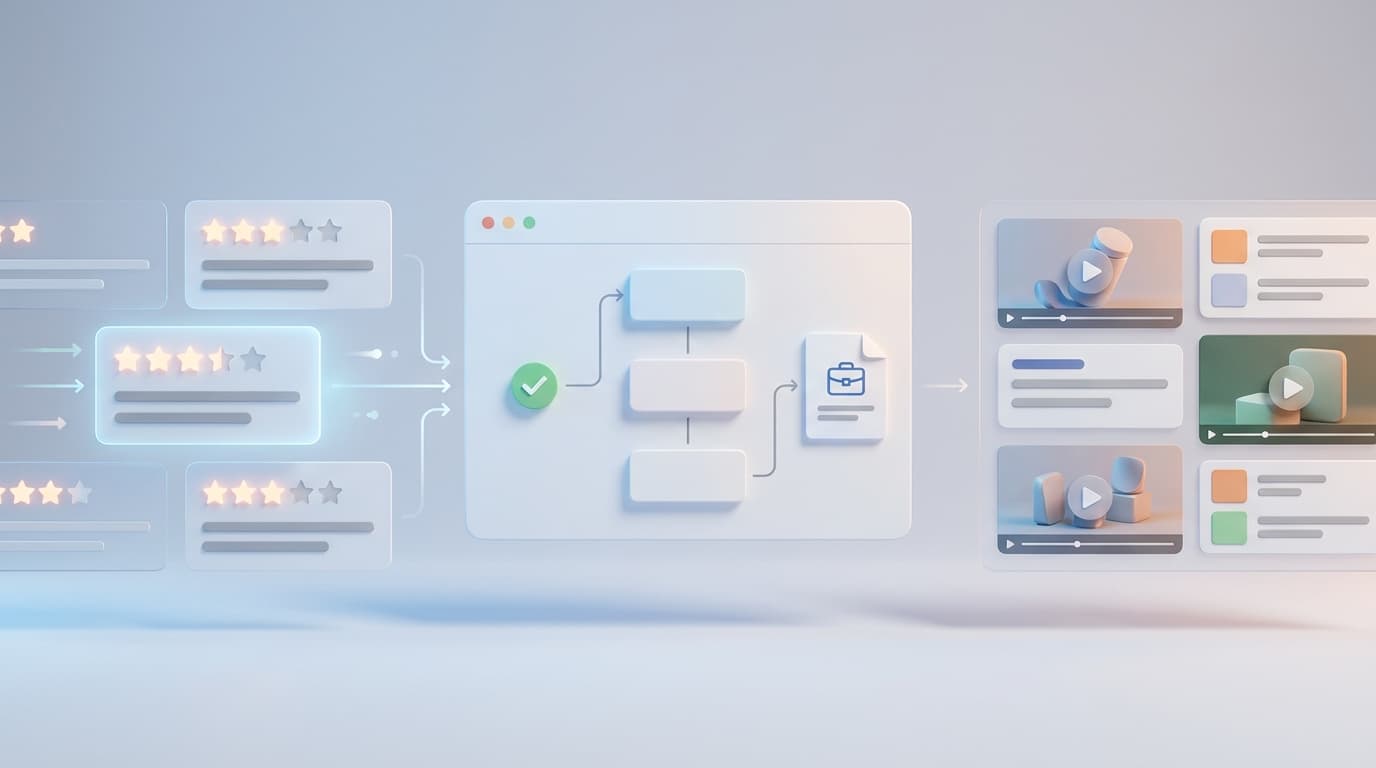
A strong system connects five stages:
- Collect the right customer evidence
- Identify a repeatable customer signal
- Translate the signal into a creative hypothesis
- Produce controlled visual and video variants
- Measure performance and feed the result back into the next brief
The important word is controlled. The goal is not to generate more content for its own sake. The goal is to test one meaningful customer insight at a time.
Step 1: Define the review cohort before analyzing it
Do not combine every available review into one summary. Feedback from different products, variants, regions, time periods, or customer types can point in opposite directions.
Start by defining the evidence set:
| Field | Example |
|---|---|
| Product | One SKU, ASIN, bundle, or product family |
| Market | United States, United Kingdom, or another target market |
| Time period | Last 90 days or post-launch reviews |
| Rating range | Five-star advocacy, three-star friction, or one-star failures |
| Customer type | First-time buyer, repeat buyer, gift buyer, or professional user |
| Competitive scope | Your product, one competitor, or a category set |
The cohort determines what the evidence can legitimately support. A complaint about an old product version should not automatically shape creative for a redesigned version. A use case from one market may not transfer to another.
For teams analyzing large Amazon review sets, a voice-of-customer analysis platform such as VOC.AI can help compress recurring feedback into pain points, expectations, feature mentions, buyer language, and decision-ready themes. The output should still be checked against the defined product and market cohort before it enters production.
Step 2: Separate signals from interesting comments
An unusual review can inspire a creative idea, but it should not be treated as a market truth.
Prioritize signals that meet several of these conditions:
- They appear repeatedly across relevant reviews.
- They describe a clear pre-purchase objection or post-purchase benefit.
- The product can demonstrate the claim visually.
- The brand can support the claim with product facts or approved evidence.
- The signal matters to a commercially valuable customer segment.
- A creative test can measure whether addressing it changes behavior.
For example, “the fabric feels premium” is still too broad. A better signal might be:
Buyers repeatedly mention that the fabric feels soft but does not appear thin under normal lighting.
That observation can lead to a specific creative test involving close-up material shots, daylight scenes, and a proof-oriented voiceover. It is much more actionable than a generic “premium quality” message.
Step 3: Turn the customer signal into a creative hypothesis
A review theme becomes useful only when it changes what the audience sees or hears.
Use this structure:
Because customers repeatedly say [customer signal], we believe showing [visual proof] to [target shopper] in [channel and format] will improve [business metric].
Examples:
- Because customers worry that the storage bag is difficult to pack, show the full packing sequence in a 15-second TikTok demonstration and measure click-through rate.
- Because buyers praise the waistband for staying in place, show normal movement from multiple angles in a UGC-style video and measure product-page visits and conversion.
- Because competitor reviews repeatedly mention difficult cleaning, show a three-step cleaning demonstration in a comparison-led ad and measure add-to-cart rate.
- Because shoppers misunderstand the product’s actual size, place it next to familiar objects in PDP images and measure return reasons and support questions.
This hypothesis gives AI a job to perform. Without it, AI only creates stylistic variety.
Step 4: Build a production-ready creative brief
Before generating anything, convert the hypothesis into structured constraints.
Creative brief template
Product or SKU:
Target customer:
Channel:
Asset format:

Customer evidence:
Primary review theme:
Representative buyer language:
Contradictory evidence:
Confidence level:

Creative hypothesis:
Opening hook:
Proof to demonstrate:
Scene or use case:
Product details that must remain accurate:
Claims to avoid:
Call to action:

Variants to produce:
Success metric:
Review date:
The “product details that must remain accurate” field is especially important for AI-generated ecommerce content. The asset should not change the product’s color, construction, dimensions, packaging, included accessories, or demonstrated capability.
The “contradictory evidence” field prevents overclaiming. If many buyers praise comfort but a meaningful subgroup reports fit issues, the creative should specify who the product is designed for rather than claim it fits everyone.
Step 5: Match the review signal to the right asset
Not every insight should become a talking-head UGC video.
| Customer signal | Best initial format | Why |
|---|---|---|
| Product is difficult to understand | Short demonstration video | Shows the mechanism faster than copy |
| Shoppers question size or fit | Comparison image, fit guide, or multi-angle video | Sets expectations before purchase |
| Buyers praise a visible detail | Macro shot or product close-up | Makes the proof immediately observable |
| Customers describe a real use case | Lifestyle or UGC-style video | Places the product in a recognizable situation |
| Competitor reviews expose a weakness | Comparison-led creative | Clarifies differentiation |
| Setup causes complaints | Tutorial or step-by-step PDP module | Reduces preventable friction |
| Buyer language contains a strong phrase | Hook and caption test | Tests customer language directly |
NewFace can then turn the brief into production assets using an AI Agent, reusable Skills, a visual canvas, and multiple image and video models. Teams can use an AI video ad generator for structured ad variants, an AI UGC video creator for customer-situation concepts, or a product detail page workflow for proof-oriented PDP visuals.
The production tool should execute the strategy—not invent the strategy from nothing.
Step 6: Generate variants that isolate one variable
The easiest way to waste AI-generated content is to change everything at once.
If one version changes the hook, spokesperson, setting, product angle, pacing, and call to action, the team cannot tell what caused the result.
Instead, generate controlled variant groups.
Hook test
Keep the product, scene, proof, and CTA fixed. Change only the opening customer problem.
Proof test
Keep the hook and audience fixed. Change how the product demonstrates the claim.
Audience test
Keep the value proposition fixed. Change the customer situation or use case.
Format test
Keep the customer insight fixed. Compare a UGC-style explanation, product demonstration, and PDP proof module.
This method turns batch generation into learning rather than volume.
Step 7: Keep claims inside the available evidence
Customer reviews are valuable evidence, but they do not automatically authorize every marketing claim.
Before production, ask:
- Is the statement a customer perception, a product fact, or a measurable outcome?
- Does the selected review cohort support it consistently?
- Is there contradictory evidence?
- Does the claim require legal, medical, marketplace, or compliance review?
- Can the visual demonstration be reproduced honestly?
Safer language includes:
- “Customers frequently mention…”
- “Designed for shoppers who prioritize…”
- “Reviews often highlight…”
- “A common use case is…”
High-risk language includes unsupported superlatives, guarantees, universal outcomes, medical promises, and demonstrations that exaggerate the product’s real performance.
AI can accelerate production, but it should not weaken the evidence standard.
Step 8: Measure the result at the right level
Creative performance is not one number. Match the metric to the customer problem and asset type.
| Asset | Useful metrics |
|---|---|
| Paid-social video | Hook hold, watch time, CTR, CPA, conversion rate |
| UGC-style ad | Comment intent, click-through, assisted conversion, creative fatigue |
| PDP image or video | Add-to-cart rate, conversion rate, scroll depth, support questions |
| Fit or sizing asset | Size-related returns, exchanges, fit questions |
| Setup tutorial | Support tickets, activation, negative setup reviews |
| Comparison creative | Conversion on comparison traffic, objection frequency |
Do not judge a review-backed asset only by views. A video that reduces the wrong-size return rate or answers a recurring objection may create more value than a video with high reach and weak purchase intent.
Step 9: Feed performance back into the next creative cycle
The workflow becomes more valuable over time when the team preserves both customer evidence and production outcomes.
For each test, store:
- the review cohort;
- the customer signal;
- the creative hypothesis;
- the prompt or workflow;
- the generated variants;
- the approved final asset;
- channel performance;
- customer comments and new objections;
- the decision to repeat, revise, or stop.
This creates an ecommerce creative memory. The team no longer starts each campaign from a blank prompt. It starts from accumulated evidence about which customer problems, proof formats, models, workflows, and messages work for a specific product and audience.
Example: Turning one review pattern into a video test
Imagine a clothing brand finds a repeated review pattern:
Customers like the garment’s support, but many are unsure whether it will roll during normal movement.
The team can translate that signal into the following brief:
Target customer: Shoppers concerned about comfort during a full day of wear
Format: 15-second vertical product demonstration
Hook: “Will it stay in place when you move?”
Proof: Standing, sitting, walking, and reaching in normal daily movement
Product constraint: Preserve the real waistband, seams, fit, and fabric thickness
Claim limit: Do not promise identical results for every body type
Variants: Three opening hooks; the proof sequence remains fixed
Metric: CTR, conversion, fit questions, and roll-down-related returns
The review provided the problem. The brief defined the proof. AI accelerated production. Performance data determines whether the idea becomes a repeatable workflow.
Common mistakes to avoid
Treating sentiment as a creative strategy
“Customers are positive” does not tell a creative team what to show. Extract the specific motivation, objection, use case, or proof.
Using one dramatic review as the headline
Isolated comments can inspire exploration but should not become claims without broader support.
Generating many unrelated concepts
Volume without controlled variables produces assets, not learning.
Ignoring negative and contradictory evidence
The most useful creative insight may be an expectation that needs correction, not a benefit that needs amplification.
Measuring only views
The right outcome may be conversion, lower return risk, fewer support questions, or stronger qualified intent.
Final takeaway
Customer reviews and AI creative tools solve different parts of the same problem.
Review analysis identifies what buyers care about, how they describe it, and what prevents them from purchasing. A structured brief turns that evidence into a testable creative direction. AI production tools then create the visuals, videos, and variants needed to test the idea at speed.
The strongest workflow is therefore not:
Prompt → generate → publish
It is:
Customer evidence → creative hypothesis → controlled production → performance learning → reusable workflow
That is how ecommerce teams move from producing more content to building a creative system that becomes smarter with every campaign.
Suggested CTA
Turn a customer-backed creative brief into product videos, UGC concepts, PDP assets, and controlled creative variants with NewFace.