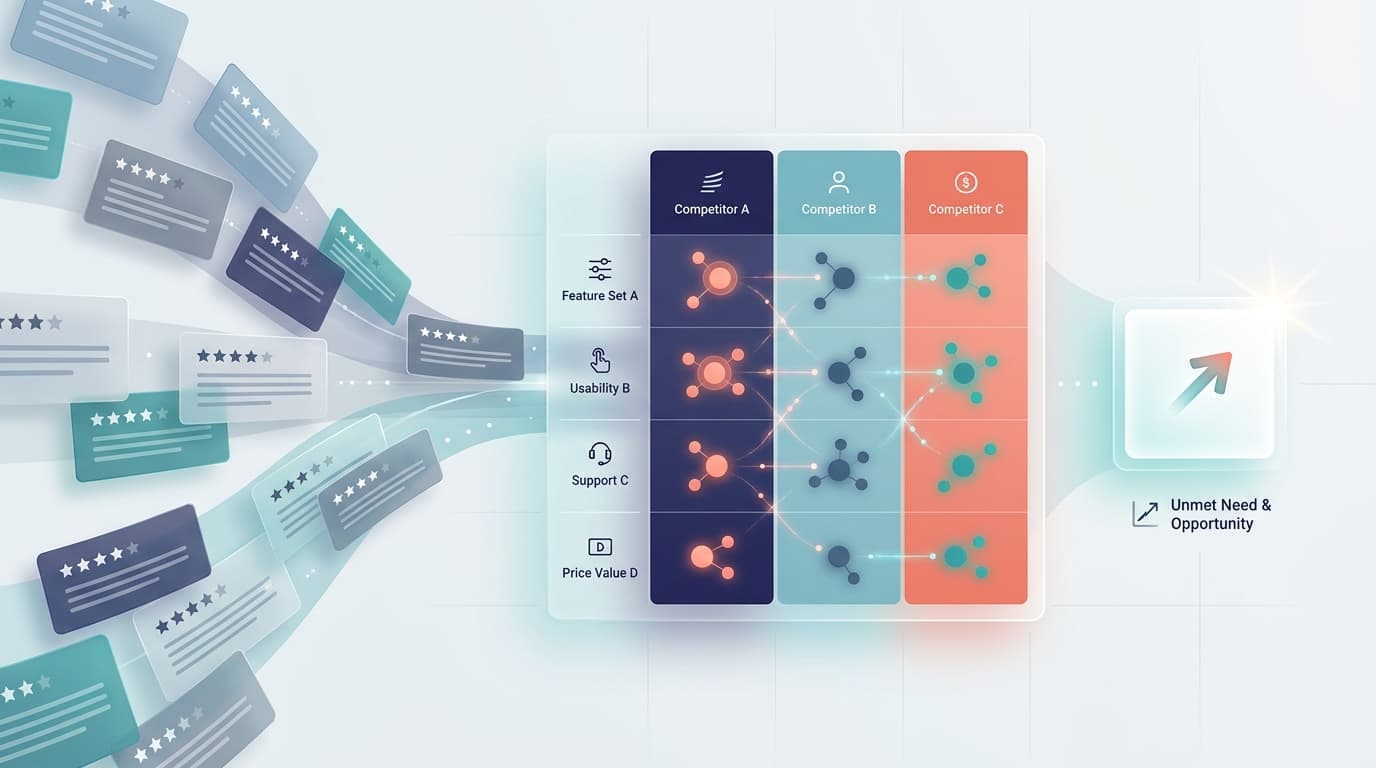
Review mining for competitive analysis turns scattered customer complaints, praise, and tradeoffs into a structured view of where products compete—and where customer needs may still be underserved.
The method is more useful than comparing average star ratings. A rating can tell you that experiences differ, but it rarely explains whether the cause was product performance, packaging, setup, listing expectations, support, or a specific use condition. Competitive decisions need that missing context.
They also need restraint. Reviews are a self-selected evidence source, not a representative market survey. A loud complaint is not automatically a large market opportunity, and a recurring request is not automatically a profitable feature. Good review mining for competitive analysis preserves the evidence, normalizes the comparisons, and converts patterns into hypotheses that can be validated before a team changes a product, listing, or campaign.
This guide provides a practical workflow, scoring model, comparison matrix, worked example, and reusable decision canvas.
What is review mining for competitive analysis?
Review mining for competitive analysis is the systematic comparison of customer review evidence across your product and competing products to identify recurring strengths, weaknesses, expectations, tradeoffs, and possible gaps.
The useful unit of analysis is not simply a positive or negative review. It is a customer event with context:
- Product: Which product or variation was reviewed?
- Attribute: Which part of the experience was discussed?
- Situation: What was the customer trying to do?
- Expectation: What did the customer believe would happen?
- Event: What actually happened?
- Consequence: Why did the result matter?
- Cause hypothesis: Was the likely issue product, packaging, instructions, listing, fulfillment, support, or fit?
- Evidence strength: How specific, recent, and traceable is the observation?
When these records are compared consistently, reviews can reveal competitive patterns that a star-rating table hides.
What competitive review mining can—and cannot—tell you
Review evidence can support several types of decisions:
- which product attributes generate repeated praise or frustration;
- where one competitor appears strong under a particular use condition;
- which tradeoffs customers repeatedly accept or reject;
- whether a complaint is associated with one product, several products, or the whole category;
- which expectations may be created by listing copy rather than the product itself;
- where packaging, instructions, or support may offer a faster intervention than a redesign;
- which product-gap hypotheses deserve interviews, prototypes, tests, or further market research.
But review mining for competitive analysis cannot establish market prevalence from review frequency alone. It also cannot prove causation, forecast demand, determine engineering feasibility, or tell you whether customers will pay for a proposed improvement.
Treat the output as a competitive evidence system: stronger than anecdotes, more explainable than a summary, and still incomplete without validation.
If your goal is broad category discovery, start with review mining for market research. If you already know the opportunity and need to route it into a roadmap, use review mining for product development. This article owns the comparison layer between those two decisions.
Review mining for competitive analysis workflow
| Stage | Core question | Output |
|---|---|---|
| 1. Frame | What competitive decision must be made? | Decision statement |
| 2. Scope | Which products and reviews are comparable? | Evidence-set specification |
| 3. Normalize | Can every observation be traced to context? | Evidence records |
| 4. Taxonomize | Are equivalent attributes coded consistently? | Shared taxonomy |
| 5. Compare | Where do products differ by attribute and situation? | Competitive evidence matrix |
| 6. Weight | Which patterns deserve attention first? | Weighted signal score |
| 7. Diagnose | What intervention layer is implicated? | Cause-and-owner map |
| 8. Hypothesize | Where might a defensible gap exist? | White-space hypothesis |
| 9. Validate | What evidence is needed before action? | Validation plan |
Step 1: Define the competitive decision
Do not begin with “analyze our competitors.” That request is too broad to produce a reliable answer.
Write one decision statement instead:
We need to decide whether to improve, reposition, or deprioritize [attribute] for [customer/use case] before [launch, sourcing decision, listing rewrite, or campaign].
Useful decision questions include:
- Which complaint cluster should influence the next product specification?
- Which competitor advantage should we neutralize, and which should we ignore?
- Is a conversion problem caused by a missing capability or an expectation mismatch?
- Which category weakness could support a differentiated positioning angle?
- Which apparent product defect may actually be a packaging or instruction problem?
The decision determines the products, time window, review depth, and metadata you need.
Step 2: Build a comparable evidence set
Competitive review analysis fails when the products are not genuinely comparable. A premium product with a specialized use case should not be treated as a direct substitute for an entry-level general-purpose option without recording that difference.
Create an evidence-set specification before collecting reviews:
| Field | Example rule |
|---|---|
| Decision | Evaluate leak resistance for a travel-use product update |
| Products | Our product plus three direct alternatives |
| Variations | Match capacity and material where possible |
| Market | Same country and marketplace |
| Time window | Most recent 12 months, with older evidence retained separately |
| Rating coverage | Sample across low, middle, and high ratings |
| Review context | Keep date, variation, verification marker when available, and helpfulness context |
| Exclusions | Duplicates, irrelevant variations, unsupported promotion, and reviews without usable product context |
| Known asymmetries | Price tier, bundle contents, launch date, audience, and fulfillment model |
A fixed review count per product can improve comparability, but it does not remove selection bias. Record the sampling rule so another analyst can reproduce or challenge the result.
Step 3: Convert reviews into traceable evidence records
Avoid summarizing whole reviews into one sentence. A single review may praise portability, criticize durability, and describe a packaging failure. Split it into atomic observations while preserving the original source context.
Use a record like this:
| Field | Example |
|---|---|
| Product | Competitor B, 24-ounce variation |
| Review date | 2026-05-18 |
| Rating | 2 stars |
| Attribute | Seal reliability |
| Situation | Carried sideways in a work bag |
| Expectation | No leakage during a commute |
| Event | Moisture appeared around the lid |
| Consequence | Customer stopped carrying it near electronics |
| Sentiment | Negative |
| Cause hypothesis | Seal design, assembly tolerance, or closure instructions |
| Evidence quote | Short source excerpt retained internally |
| Analyst confidence | Medium |
This structure makes review mining for competitive analysis auditable. A product manager can inspect the underlying observation instead of accepting an opaque AI conclusion.
Step 4: Normalize a shared attribute taxonomy
Customers use different words for the same issue. “Drips,” “leaks,” “wet bag,” “lid failure,” and “doesn’t seal” may all belong to one functional theme, but collapsing them too early can erase important distinctions.
Use a three-level taxonomy:
- Experience domain: performance, usability, durability, packaging, listing, fulfillment, support, or value.
- Attribute: seal reliability, battery life, sizing accuracy, setup clarity, odor, noise, or material feel.
- Event subtype: gradual seepage, sudden opening, gasket displacement, user closure error, or damage in transit.
Maintain a synonym map, but keep the customer’s original wording in the evidence record. The taxonomy supports comparison; the source language preserves nuance.
Also separate absence from silence. If customers do not mention an attribute, that does not prove the product performs well. It may be unimportant, expected, difficult to observe, or simply missing from the sample.
Step 5: Build an attribute-by-competitor evidence matrix
The core artifact in review mining for competitive analysis is a matrix that compares products by the same attributes and use conditions.
| Attribute | Our product | Competitor A | Competitor B | Competitor C | Category reading |
|---|---|---|---|---|---|
| Seal reliability | Mixed in sideways carry | Strong in upright use | Repeated lid complaints | Sparse evidence | Possible gap under travel conditions |
| Cleaning | Narrow opening complaints | Easy-access praise | Dishwasher concerns | Removable parts praised | Design tradeoff, not universal winner |
| Material feel | Durable but heavy | Lightweight praise | “Flimsy” language | Premium feel, higher price | Segment preference differs |
| Instructions | Closure confusion | Clear setup praise | Minimal mention | Diagram complaints | Low-cost experience opportunity |
| Packaging | Isolated damage | Repeated dent reports | Strong protection | Excess packaging complaints | Fulfillment and sustainability tradeoff |
Do not reduce each cell to a positive or negative label. Include:
- direction of evidence;
- number of usable observations in the defined set;
- recency distribution;
- use conditions;
- consequence severity;
- exceptions and contradictory evidence;
- analyst confidence;
- links to source records.
This prevents a visually neat matrix from becoming a false certainty machine.
Step 6: Weight signals without pretending they are market truth
Raw mention counts reward products with more reviews and themes that are easy to describe. A weighted score can help prioritize investigation, but it should not be presented as objective market size.
Use a simple investigation score:
Investigation priority =
  normalized recurrence
  × consequence severity
  × recency weight
  × context specificity
  × cross-source confidence
Score each component on a transparent scale, such as 1–5.
- Normalized recurrence: How often does the theme appear within the sampled evidence for that product?
- Consequence severity: Does the event create mild annoyance, failed use, safety concern, return intent, or product abandonment?
- Recency weight: Is the evidence recent enough to reflect the current product version?
- Context specificity: Does the review describe the variation, situation, and failure clearly?
- Cross-source confidence: Does the pattern appear across ratings, products, channels, support data, returns, or interviews?
Keep the component scores visible. A high total based on vague reviews should not outrank a smaller but highly specific failure pattern without discussion.
Step 7: Diagnose the intervention layer
The same complaint can point to different fixes. “Too small” may indicate a product-dimension problem, an unclear listing image, an audience mismatch, or a customer who selected the wrong variation.
Route each meaningful theme through this diagnostic stack:
| Layer | Diagnostic question | Possible owner |
|---|---|---|
| Product | Does the design fail under the intended condition? | Product, engineering, sourcing |
| Quality | Is performance inconsistent across units or batches? | Quality, supplier operations |
| Packaging | Did the product arrive damaged, incomplete, or hard to open? | Packaging, operations |
| Instructions | Could clearer setup or care guidance prevent the event? | Product education, CX |
| Listing | Did imagery or copy create the wrong expectation? | Ecommerce, marketing |
| Fulfillment | Was the experience caused by shipping, inventory, or handling? | Operations, marketplace team |
| Support | Could faster diagnosis, replacement, or recovery reduce the consequence? | Customer experience |
| Segment fit | Is the product being evaluated by a use case it was not designed to serve? | Strategy, positioning |
This is where competitor review analysis becomes operational. Instead of producing a generic weakness list, it identifies the likely decision owner and the fastest credible intervention.
For a deeper product-spec workflow, see how to turn competitor complaints into product requirements.
Step 8: Write white-space hypotheses, not conclusions
A competitive gap is not “competitors have bad reviews.” It is a specific combination of customer, situation, attribute, consequence, and missing alternative.
Use this hypothesis format:
For [customer or use situation], current alternatives repeatedly create [undesired event or tradeoff] around [attribute]. A product or experience that delivers [proposed difference] may improve [customer outcome], if [validation condition] is confirmed.
Example:
For commuters carrying drinkware beside electronics, several alternatives show specific leakage concerns during sideways transport. A closure system that provides a clearer lock state and reliable seal under motion may reduce uncertainty and bag damage, if controlled tests confirm performance and interviews confirm willingness to switch or pay.
Notice what the statement does not claim. It does not say the whole market has the problem, that the proposed design will solve it, or that customers will buy it. It turns review evidence into a testable competitive hypothesis.
Step 9: Validate before changing the product or message
Match validation effort to decision risk.
| Hypothesis | Useful validation |
|---|---|
| Listing expectation mismatch | Listing comprehension test, search-term review, conversion experiment |
| Setup confusion | Usability test, instruction prototype, support-ticket comparison |
| Product performance gap | Bench test, quality audit, prototype test, return-reason review |
| Segment-specific need | Customer interviews, concept test, use-case survey |
| Willingness to pay | Price sensitivity research, preorder test, offer experiment |
| Category-wide complaint | Broader competitor set, multiple channels, longitudinal analysis |
The larger the investment, the more independent evidence you need. A copy change may justify a controlled experiment. A tooling change or new product launch requires stronger technical and commercial validation.
Worked example: portable drinkware comparison
Imagine a team comparing four portable drinkware products before its next sourcing cycle.
Initial review pattern
- Product A receives praise for low weight but mixed durability feedback.
- Product B receives repeated seal complaints, especially in bags.
- Product C is praised for material feel but criticized for cleaning difficulty.
- The team’s product receives mixed feedback about knowing whether the lid is fully closed.
Weak conclusion
Customers want a leakproof bottle that is easy to clean.
That statement is too generic. It ignores situation, tradeoffs, evidence quality, and competitor differences.
Better competitive interpretation
The evidence matrix suggests three separate tensions:
- Portability versus durability: lightweight designs may be valued, but some evidence associates them with reduced confidence in long-term use.
- Seal confidence versus cleaning complexity: stronger closure systems may introduce more parts or harder cleaning.
- Actual performance versus state visibility: some dissatisfaction may come from not knowing whether the product is correctly closed.
Resulting hypotheses
- Test whether a visible or tactile lock-state cue reduces closure errors.
- Bench-test sideways transport after repeated opening and cleaning cycles.
- Compare customer preference for fewer parts versus easier deep cleaning.
- Rewrite listing visuals to show the intended closure sequence and carry orientation.
- Review packaging and support records to separate transit damage from product failure.
The result of review mining for competitive analysis is not one feature request. It is a set of bounded, owner-specific decisions with clear next evidence.
Common mistakes in competitive review analysis
Comparing stars instead of experiences
Average ratings combine many attributes and customer situations. Compare atomic events and consequences instead.
Treating mention share as market share
Review frequency describes the sampled review set. It does not establish category prevalence or demand.
Ignoring variation and version changes
A complaint tied to an old model, different size, or specific material can distort a product-level conclusion.
Mixing product, listing, and fulfillment causes
If every complaint becomes a product defect, teams overinvest in redesign and miss faster interventions.
Removing contradictory evidence
Exceptions can reveal segment differences, correct usage, quality inconsistency, or conditions under which a competitor performs well.
Copying competitor review language into claims
Customer observations can inspire research questions, but public claims about your product require evidence for your product. The FTC’s guidance on endorsements, influencers, and reviews and its Consumer Reviews and Testimonials Rule Q&A are useful references for teams handling reviews in marketing and commerce.
Automating synthesis without preserving traceability
AI can accelerate clustering and comparison, but decision-makers still need access to the source observations, taxonomy rules, confidence, and exceptions.
Reusable competitive review mining canvas
Use this template for each decision:
Competitive decision:
Products and variations:
Market and time window:
Sampling rule:
Known product asymmetries:

Priority attribute:
Customer/use situation:
Observed event:
Customer consequence:
Products where observed:
Contradictory evidence:
Likely intervention layer:

Normalized recurrence:
Consequence severity:
Recency:
Context specificity:
Cross-source confidence:

White-space hypothesis:
What this evidence does not prove:
Validation method:
Decision owner:
Decision deadline:
How VOC AI can support review mining for competitive analysis
VOC AI is positioned to help ecommerce teams analyze customer review language, compare competitor patterns, and organize evidence for product and market decisions. The practical value comes from moving beyond isolated review reading toward repeatable theme comparison and traceable workflows.
Teams can use VOC AI’s competitor analysis workflow to explore comparative customer feedback, connect the findings to review-backed product research, and evaluate how Amazon-native opportunity data differs from deeper customer-language analysis in the Amazon Product Opportunity Explorer vs. VOC AI comparison.
The tool should support the decision process—not replace validation. Keep the evidence set, source context, category assumptions, competing explanations, and next test visible.
Final takeaway
Review mining for competitive analysis works when it converts customer experiences into a comparable, traceable evidence system.
The strongest workflow does five things:
- scopes genuinely comparable products and review evidence;
- normalizes observations with context and a shared taxonomy;
- compares attributes, situations, consequences, and contradictions;
- separates product gaps from packaging, listing, fulfillment, and support issues;
- turns patterns into bounded hypotheses with explicit validation plans.
That discipline helps teams find product gaps without confusing review volume with market truth. The output is not a colorful competitor scorecard. It is a better set of decisions about what to investigate, improve, test, or leave alone.