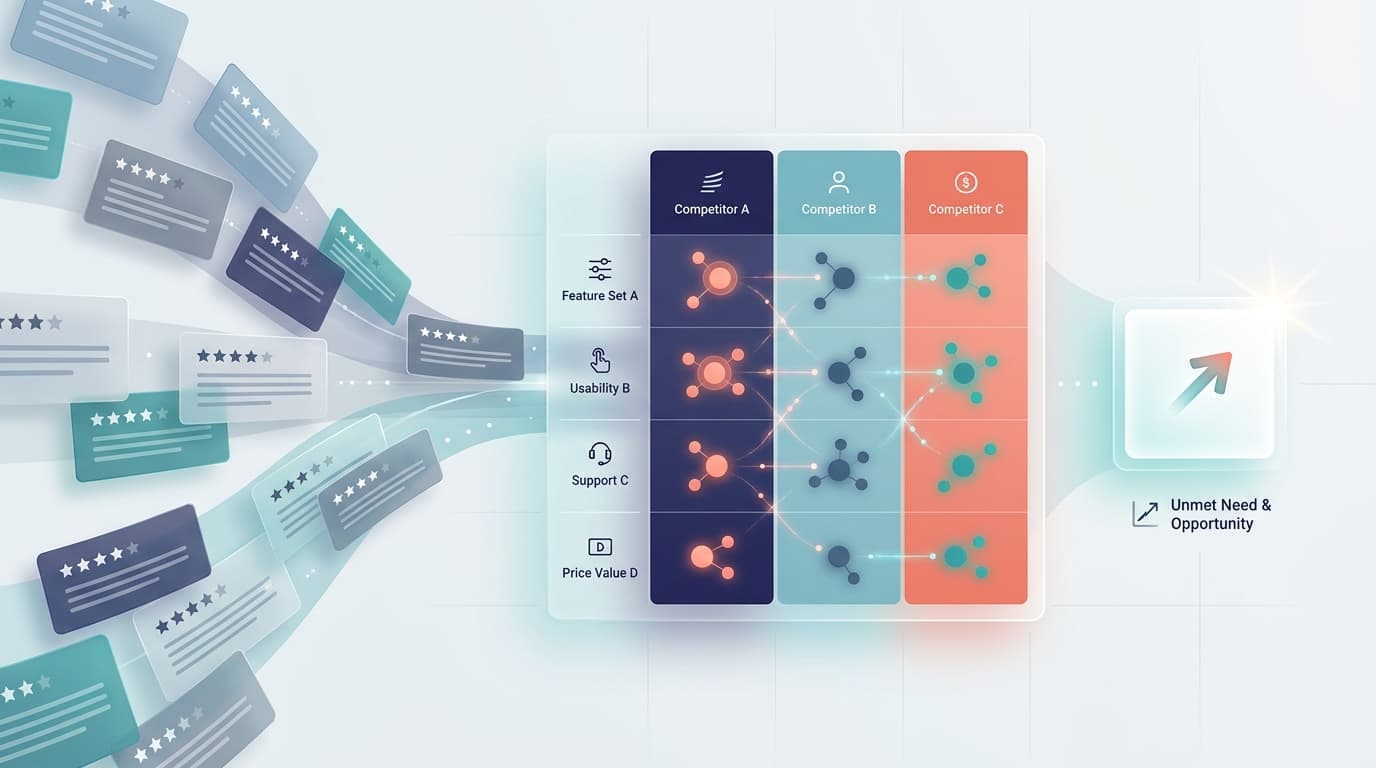
An Amazon market research tool can tell you whether a niche appears active, competitive, seasonal, concentrated, or crowded. That is essential—but it is not always enough to decide what to sell, how to improve it, or which promise your listing should lead with.
The missing layer is often customer language: the repeated reasons buyers choose a product, regret a purchase, tolerate a tradeoff, switch brands, or return an item. A strong category decision combines both layers before inventory is committed.
This guide compares VOC AI Market Insight with the broader category of Amazon research dashboards. It is not a feature-count contest. It is a decision framework for choosing the right evidence at each stage of product research.
The short answer: dashboards show where; customer language helps explain why
Use an Amazon market research tool when you need a fast quantitative screen of a category. Add customer-language analysis when the decision depends on unmet needs, product tradeoffs, positioning, expectation risk, or whether an apparent opportunity is durable.
In practice, the tools answer different questions:
| Decision question | Best starting evidence |
|---|---|
| Is demand visible and is the category moving? | Market and product research dashboard |
| How concentrated is the competitive set? | Market and competitor metrics |
| What price bands and product patterns appear common? | Category dashboard |
| Why do buyers choose one option over another? | Review and customer-language analysis |
| Which complaints could become product requirements? | Recurring review themes with context |
| Which listing promise is likely to create expectation risk? | Review language, use cases, and counterexamples |
| Should we enter, test, wait, or reject? | Both quantitative and qualitative evidence |
The practical conclusion is simple: a dashboard is the map; customer language is the explanation attached to the terrain.
What an Amazon research dashboard is designed to do
Most Amazon product research workflows begin with measurable market signals. Depending on the tool, sellers may evaluate search behavior, sales or demand estimates, pricing, review counts, ratings, category movement, competitor activity, or niche-level patterns.
Amazon's own Product Opportunity Explorer is an important example. Its public description includes niche information derived from searches and purchases as well as pricing, reviews, returns, and customer review insights. In other words, sellers should not assume every Amazon research dashboard is “review-blind.” Some products already bring quantitative and customer evidence into the same research experience.
Third-party platforms also support different versions of the market-screen workflow. Helium 10 describes product research and market-tracking tools for discovering opportunities and monitoring markets and competitors. Jungle Scout provides product-research tools and educational resources centered on evaluating demand and competition.
These workflows are useful because they help sellers reduce a very large market into a smaller set of candidates. A good Amazon market research tool can support questions such as:
- Is this category worth a deeper look?
- Is activity concentrated among a few established products?
- Are price and demand patterns compatible with our business model?
- Is a trend persistent enough to investigate rather than chase?
- Which products and competitors deserve closer review analysis?
That is the correct role of the quantitative screen: narrow the field before expensive work begins.
Where a dashboard-only decision becomes risky
The risk appears when a seller turns a market signal directly into a product decision.
For example, visible demand does not automatically reveal whether buyers are satisfied. A rising niche may be pulled by a temporary use case, a new design, a single dominant brand, a seasonal event, or a recurring failure in existing products. Those scenarios can look similar on a chart but require different actions.
An Amazon market research tool may show that a category is active. It may not fully answer:
- Which product attributes buyers refuse to compromise on.
- Whether a complaint is widespread or limited to one model or variant.
- Whether positive reviews praise the core product or a secondary benefit.
- Which use cases are underserved versus merely mentioned.
- Whether buyers understand the product before purchase.
- Which promises create returns because the listing sets the wrong expectation.
- Whether a “gap” is economically or technically reasonable to solve.
This is where review-backed customer-language analysis becomes useful. The goal is not to replace market metrics. It is to test the story you are telling yourself about those metrics.
What VOC AI adds to the research workflow
VOC AI Market Insight supports market-context analysis across category trends, market share, product performance, pricing, reviews, ratings, and competitor movement. It is the quantitative side of the workflow: identify markets and products that deserve investigation.
The next step is customer-language analysis. VOC Analysis organizes review evidence into themes such as motivations, scenarios, strengths, weaknesses, sentiment, and buyer language. Review-backed product research then helps connect those signals to product-opportunity questions.
These are connected capabilities, not a claim that every field lives in one screen. The useful distinction is between three jobs:
- Screen the market. Find categories, competitors, and products that justify deeper work.
- Explain the buyer experience. Identify recurring praise, objections, use cases, and expectation gaps.
- Turn evidence into a decision. Decide whether to enter, test, wait, or reject—and document why.
For teams already using another Amazon market research tool, VOC AI does not have to replace that dashboard. It can serve as the qualitative validation layer before sourcing, positioning, or inventory decisions.
A fair comparison: when each workflow fits
| Workflow | Strong fit | Main limitation | Recommended next step |
|---|---|---|---|
| Amazon research dashboard alone | Early category screening, competitor mapping, demand and price exploration | A market pattern can be easy to overinterpret without buyer context | Shortlist products for deeper analysis |
| Customer-language analysis alone | Understanding complaints, praise, use cases, and buyer vocabulary | Review themes need market and economic context | Check category size, competition, and feasibility |
| Dashboard plus customer language | Category entry, product redesign, positioning, sourcing, and larger inventory commitments | Requires a disciplined review process and human judgment | Use a documented decision gate |
The combined workflow is especially valuable when the cost of being wrong is high. A quick content idea may not require extensive validation. A tooling change, product redesign, manufacturing commitment, or inventory order does.
The enter, test, wait, or reject decision gate
Every shortlisted opportunity should end with one of four decisions. This prevents research from becoming a collection of attractive charts and interesting review quotes.
1. Enter
Choose enter when the market evidence is compatible with your economics and the customer evidence points to a recurring, solvable need.
Before entering, confirm:
- The demand pattern is not explained only by a temporary spike.
- The opportunity is not dependent on beating an entrenched brand at its strongest attribute.
- The complaint or unmet need appears across relevant products, not just one defective listing.
- Your sourcing, compliance, margin, and operational constraints support the proposed improvement.
- The product and listing can set an accurate expectation.
2. Test
Choose test when the evidence is promising but incomplete. Testing may mean a smaller inventory order, a concept test, a revised listing, a limited product variation, or additional research on a narrow buyer segment.
An Amazon market research tool often gets you to the test stage. Customer-language analysis helps define what the test should prove. Instead of “try this niche,” the hypothesis becomes specific: “buyers in this use case may prefer a lighter design, but we need to confirm that durability concerns do not outweigh the benefit.”
3. Wait
Choose wait when the evidence is real but timing or confidence is weak. You may need more recent reviews, a longer demand window, additional supplier evidence, a clearer cost structure, or confirmation that a trend extends across multiple products.
Waiting is not indecision. It is a documented research outcome with a trigger for reassessment.
4. Reject
Choose reject when the apparent gap is not practical, profitable, differentiated, or safe to solve. Common reasons include dominant-brand concentration, weak economics, contradictory buyer needs, compliance exposure, or a complaint that is loud but rare.
Rejecting a category after structured research is a win. It protects time and inventory capital.
A review-to-decision workflow for Amazon sellers
Use this seven-step workflow after your Amazon market research tool produces a shortlist.
Step 1: Write the market hypothesis
State the opportunity in one sentence without promotional language. For example: “This category appears to have steady buyer activity, but established products may underserve compact-space users.”
Step 2: Define the evidence window
Record the marketplace, observation date, products reviewed, variants, review date range, and rating bands. This reduces the chance of mixing old product failures with a current design.
Step 3: Separate themes from anecdotes
Group repeated praise, complaints, use cases, and objections. Do not turn one vivid review into a category conclusion. Look for recurrence across products and brands.
Step 4: Find counterevidence
For every attractive theme, look for evidence against it. If buyers ask for a lighter product, do other buyers associate weight with stability? If a compact design is praised, does it reduce capacity? Tradeoffs often define the real product opportunity.
Step 5: Translate language into requirements
Convert validated themes into a product, listing, or research requirement. A complaint such as “hard to clean around the hinge” is more useful when rewritten as a testable requirement: “the hinge area should be accessible without disassembly.” See how to turn competitor complaints into product requirements.
Step 6: Recheck the market screen
Return to the quantitative evidence. Does the proposed improvement fit the price band? Is the affected segment large enough to matter? Are competitors already solving the issue in newer variants? Use an Amazon category trend analysis to keep the review insight attached to market context.
Step 7: Make and record the decision
Choose enter, test, wait, or reject. Record the strongest supporting evidence, strongest counterevidence, unresolved question, owner, and reassessment date.
A synthetic example: when the two layers disagree
Imagine an Amazon market research tool flags a growing home-organization niche with acceptable price bands and multiple active sellers. The first conclusion might be: enter quickly.
Review analysis, however, shows three recurring patterns:
- Buyers praise capacity but complain that the product is difficult to move when full.
- Compact models are easier to handle but receive complaints about instability.
- Many negative reviews come from buyers who expected a permanent storage solution from a lightweight product.
This is a synthetic example, not original VOC AI performance data. Its purpose is to show how the decision changes.
The dashboard says the niche deserves attention. Customer language says the opportunity is not simply “more capacity.” The better hypothesis may involve a specific balance of mobility, stability, and expectation-setting. The team might choose test, not enter, until it can validate the design tradeoff and listing promise.
Questions to ask before choosing an Amazon market research tool
Tool selection should follow the decision you need to make. Ask:
- Does the tool help me screen categories or explain buyer behavior—or both?
- Can I trace an insight back to the products, reviews, time period, or market context behind it?
- Can I compare themes across competitors rather than inspect products one by one?
- Does the workflow help me find counterevidence, not just attractive opportunities?
- Can my team turn insights into product requirements, listing changes, or test plans?
- Does it support the marketplace and category relevant to this decision?
- Will a human still review high-impact sourcing, compliance, and inventory decisions?
The “best” Amazon market research tool is therefore not a universal winner. It is the tool—or combination of tools—that produces enough evidence for the next decision without pretending uncertainty has disappeared.
Frequently asked questions
Can an Amazon research dashboard replace reading customer reviews?
It can reduce how much manual review reading you need, especially when it includes review insights. It should not eliminate source checking for high-impact decisions. Sellers should still inspect representative review evidence, recent patterns, variants, and counterexamples before turning a theme into a product requirement.
Is customer review analysis enough for Amazon product research?
No. Reviews explain experiences and language, but they do not replace demand, competition, pricing, margin, sourcing, compliance, or operational analysis. The strongest workflow connects review evidence to the broader Amazon market research framework.
When should I add customer-language analysis?
Add it when your decision depends on why buyers choose, complain, return, switch, or tolerate a tradeoff. It is particularly useful before product changes, positioning decisions, larger inventory commitments, and category entry.
Does VOC AI replace Helium 10, Jungle Scout, or Amazon Product Opportunity Explorer?
Not necessarily. Teams can use VOC AI alongside an existing Amazon market research tool. The useful question is whether your current workflow already gives you enough traceable customer-language evidence to validate the market story before you act.
How do I validate a category trend with reviews?
Start with a dated market hypothesis, inspect recurring themes across relevant products, separate recent from historical feedback, check variants, look for counterevidence, and then return to the market data. This review-signal validation workflow explains the process in more detail.
Final recommendation
Use an Amazon market research tool to find where deeper investigation is justified. Use customer-language analysis to understand what buyers are actually rewarding, rejecting, misunderstanding, or still missing.
For a fast early screen, a dashboard may be enough. For a category entry, product redesign, positioning change, or meaningful inventory commitment, use both layers and finish with a documented enter, test, wait, or reject decision.
Explore VOC AI Market Insight, then pair the market screen with customer-language analysis before choosing a category.