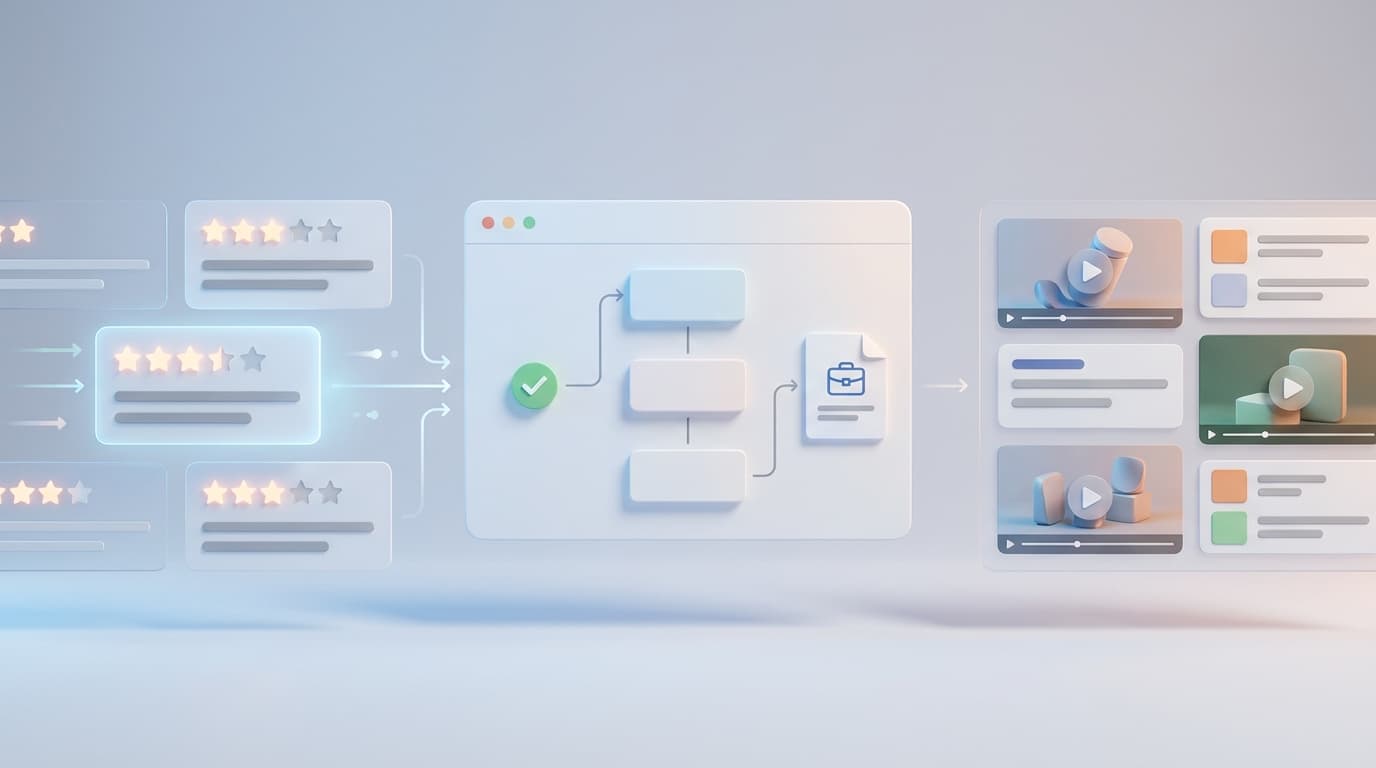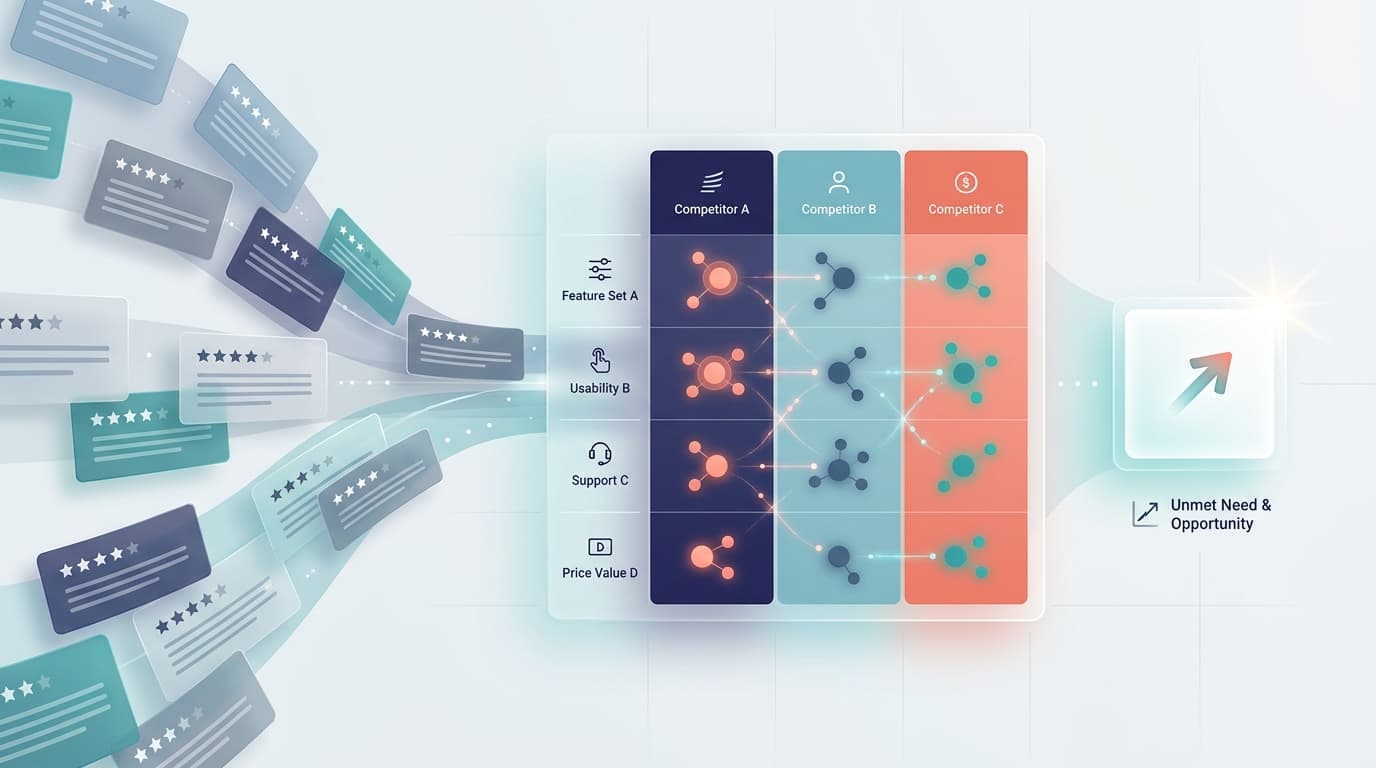
Review mining for marketing turns customer reviews into evidence for positioning, messaging, creative briefs, landing pages, and campaign tests. Instead of guessing which benefit sounds persuasive, marketers study how customers describe the situation, expectation, outcome, and tradeoff in their own words.
The opportunity is bigger than collecting catchy quotes. A review may contain the job a customer was trying to complete, the obstacle they feared, the product attribute they noticed, the result they experienced, and the condition that made the result possible. When those elements repeat across a defined evidence set, they can help a marketing team build messages that are more specific and easier to test.
But customer language is not automatically a marketing claim. Reviews are subjective, the reviewer population is self-selected, and one memorable phrase may not represent a broader pattern. A responsible workflow preserves source context, separates observation from inference, and validates important messages before scaling them.
This guide explains how to use review mining for marketing as a repeatable evidence-to-message workflow.
What is review mining for marketing?
Review mining for marketing is the systematic analysis of customer reviews to identify recurring language, buying situations, desired outcomes, objections, product expectations, proof cues, and meaningful contrasts that can inform marketing decisions.
The goal is not to paste review quotes into advertisements. It is to understand the structure beneath the language:
- Situation: What was happening when the customer began looking?
- Job: What were they trying to accomplish?
- Obstacle: What made that job difficult?
- Decision criterion: What mattered during comparison?
- Expectation: What did they believe the product would do?
- Experience: What happened during setup or use?
- Outcome: What practical or emotional result followed?
- Tradeoff: What compromise did they accept or reject?
- Proof cue: What detail made the review credible?
These elements can support a message architecture, but they remain evidence from a bounded review set. They do not prove that every buyer shares the same need or that a product will produce the same outcome for everyone.
What review mining can contribute to marketing
Marketing teams often have access to product features, keyword lists, sales notes, and campaign results. Reviews add a different layer: post-purchase customer language tied to a real experience.
Review mining can help teams:
- discover the phrases customers use instead of internal product vocabulary;
- connect features to specific use cases and outcomes;
- identify objections that should be answered before purchase;
- distinguish expected benefits from unexpected moments of value;
- compare which strengths and weaknesses are associated with different products;
- develop campaign angles grounded in traceable evidence;
- write research questions for message testing;
- create a shared language library for content, paid media, sales, and product teams.
For broader discovery work, start with review mining for market research. If the decision concerns roadmap priorities or product interventions, use the review mining for product development workflow. This article owns the next step: translating validated customer evidence into marketing hypotheses and testable messages.
Review mining for marketing workflow at a glance
| Stage | Core question | Output |
|---|---|---|
| 1. Frame | Which marketing decision must the evidence inform? | Decision statement |
| 2. Scope | Which reviews belong in the analysis? | Evidence-set specification |
| 3. Normalize | Can each observation be traced to context? | Evidence records |
| 4. Code | Which message ingredients appear? | Customer-language codes |
| 5. Compare | Where do patterns repeat or diverge? | Segment matrix |
| 6. Control | What may be quoted, paraphrased, inferred, or tested? | Claim tiers |
| 7. Architect | How should the message be organized? | Message architecture |
| 8. Adapt | How does the message change by channel? | Channel briefs |
| 9. Validate | Which message performs with the intended audience? | Test results and learning |
Step 1: Define the marketing decision
Start with a decision, not a general request to “find customer insights.”
Useful decision statements include:
- Choose one positioning territory for a new product page.
- Develop three paid-social angles for a specific use case.
- Rewrite a landing-page hero around a clearer customer outcome.
- Build an objection-handling section for shoppers comparing alternatives.
- Create an email sequence for customers replacing an existing product.
- Decide whether a feature deserves primary, supporting, or proof-level prominence.
A strong decision statement identifies the audience, product, channel, lifecycle stage, and action you want to influence.
For example:
Identify message territories for first-time apartment dwellers comparing compact air purifiers, with the goal of improving the relevance of a category landing page.
This is much more useful than “analyze air-purifier reviews.” It determines which products, reviews, codes, and comparisons matter.
Step 2: Design a defensible evidence set
Review mining for marketing becomes unreliable when the dataset is assembled without a scope rule. Define the evidence set before reading for themes.
Record:
- product names and identifiers;
- brand and competitor coverage;
- review source;
- collection date and review period;
- rating bands;
- verified-purchase status when available;
- product variants;
- languages and markets;
- inclusion and exclusion rules;
- duplicate handling;
- suspected spam or authenticity flags;
- known gaps in the data.
The evidence set should match the marketing decision. If you are writing replacement messaging, prioritize reviews that explicitly mention a previous product or reason for switching. If you are developing onboarding content, focus on setup, first-use, confusion, and early success. If you are testing premium positioning, compare the language used across price tiers rather than pooling the entire category.
Do not assume five-star reviews are the only useful source. Mixed and negative reviews often reveal expectations, objections, tradeoffs, and failed outcomes. Positive reviews show which experiences customers value, while lower ratings explain the conditions under which the promise breaks.
Step 3: Create traceable evidence records
Copying a sentence into a swipe file removes the context that gives it meaning. Create a structured record for every passage used in the analysis.
| Field | What to capture |
|---|---|
| Source | Platform, product, URL or identifier, review date |
| Segment context | Product tier, variant, use case, or explicit customer context |
| Rating | Rating and any available verification metadata |
| Verbatim evidence | Exact passage retained for internal analysis |
| Situation | What was happening before the purchase? |
| Job | What was the customer trying to accomplish? |
| Obstacle | What problem, fear, or constraint appeared? |
| Attribute | Which product or service detail mattered? |
| Outcome | What changed after use? |
| Emotion | What feeling was explicitly expressed? |
| Comparison | What alternative or previous experience was mentioned? |
| Interpretation | Analyst conclusion, kept separate from the quote |
| Confidence | High, medium, or low based on clarity and corroboration |
The separation between evidence and interpretation is essential. “Fits under the counter” may be a direct observation. “Designed for small kitchens” is a marketing interpretation. “The best choice for every small kitchen” is a much broader claim that the review cannot support.
Step 4: Code the ingredients of a message
Broad sentiment labels rarely provide enough detail for copy. Code reviews around the components of a persuasive message.
Customer context
- role or use case;
- trigger event;
- environment;
- experience level;
- constraint;
- alternative being replaced.
Desired progress
- functional job;
- emotional job;
- social job;
- avoided consequence;
- definition of success.
Decision language
- comparison criterion;
- objection;
- hesitation;
- expected proof;
- reason for choosing;
- reason for rejecting.
Experience language
- noticed attribute;
- setup event;
- moment of value;
- friction point;
- unexpected benefit;
- broken expectation.
This produces more useful clusters than isolated topics such as “size,” “quality,” or “easy.” A specific code might be “stores in a narrow cabinet after daily use” or “felt confident assembling without asking for help.” The context explains why the attribute matters.
Step 5: Build a customer-language matrix
Cluster related evidence into a matrix that connects the buyer’s situation to a possible message.
| Message element | Evidence question | Marketing use |
|---|---|---|
| Audience situation | When does this problem become urgent? | Hook and targeting hypothesis |
| Desired outcome | What progress does the customer want? | Value proposition |
| Obstacle | What prevents progress today? | Problem framing |
| Decision criterion | What matters during comparison? | Benefit hierarchy |
| Product mechanism | Which attribute enables the result? | Reason to believe |
| Experienced outcome | What happened after use? | Proof direction |
| Tradeoff | What does the customer fear giving up? | Objection handling |
| Customer phrase | How is the idea expressed naturally? | Copy vocabulary |
| Boundary condition | When does the promise fail? | Qualification and risk control |
Then compare the matrix across meaningful groups:
- your product versus competitors;
- high versus low ratings;
- new versus older reviews;
- premium versus budget tiers;
- first-time versus experienced users when stated;
- use cases or environments;
- product variants;
- customers who replaced an alternative versus first-time buyers.
This comparison prevents a loud but narrow cluster from becoming the entire campaign. It also helps distinguish category language from product-specific evidence.
Step 6: Use claim tiers before writing copy
Customer language can inspire marketing, but not every insight should become a public claim. Create clear tiers.
Tier 1: Directly attributable review evidence
An exact customer statement with a traceable source, used only with the permissions, disclosures, and context required for the intended channel.
Tier 2: Faithful paraphrase
A concise restatement that preserves the meaning and boundary of the source evidence without implying more certainty, typicality, or causation.
Tier 3: Pattern summary
A description of a repeated pattern within the defined dataset, labeled accurately. For example, “compact storage appeared repeatedly in the analyzed reviews” is safer than “customers everywhere demand compact storage.”
Tier 4: Marketing hypothesis
An evidence-informed message that has not yet been validated. It belongs in a test plan, not in a factual-results report.
Tier 5: Substantiated product claim
A public claim supported by the evidence appropriate to that claim, which may require product data, testing, legal review, or other documentation beyond reviews.
The US Federal Trade Commission provides guidance for marketers on soliciting and paying for online reviews and on the use of endorsements and testimonials. Treat disclosure, authenticity, permission, typicality, and substantiation as publishing requirements—not cleanup tasks after the campaign is built.
Step 7: Turn evidence into a message architecture
Once the patterns are compared and the claim tiers are assigned, create a message architecture rather than jumping directly to headlines.
Use this structure:
| Layer | Question | Example format |
|---|---|---|
| Audience | Who is this for, in what situation? | For people who… |
| Tension | What do they want without sacrificing? | Get X without Y |
| Primary promise | What progress should the message emphasize? | Move from A to B |
| Mechanism | How does the product support that progress? | Because the product… |
| Proof | What evidence increases confidence? | Supported by… |
| Objection response | What hesitation must be resolved? | Even if you worry about… |
| Boundary | What must remain qualified? | Best suited when… |
Create two or three competing message territories. Each territory should contain:
- a clearly defined audience and situation;
- one primary customer tension;
- one outcome direction;
- a product mechanism;
- a proof plan;
- an objection to answer;
- source evidence;
- a disconfirming signal;
- a validation method.
Do not collapse every positive theme into one overloaded value proposition. A message becomes easier to understand and test when it makes one coherent argument.
Step 8: Adapt the evidence to each channel
The same customer insight should not be copied unchanged across every surface.
Product and category pages
Prioritize clarity, comparison criteria, mechanisms, proof, objection handling, and qualification. Link benefits to the product attributes that make them plausible.
Paid social and display
Use a narrow situation, tension, or surprising contrast as the opening hypothesis. Keep the destination page aligned with the same promise.
Search ads
Match the message to explicit intent. Review-derived language can improve relevance, but the ad still needs an accurate claim and a landing page that fulfills it.
Use lifecycle context. A pre-purchase sequence may answer comparison objections, while a post-purchase sequence may reduce setup friction or help customers reach the first moment of value.
Sales enablement
Organize evidence by use case, objection, alternative, and proof requirement. Preserve links back to the source records so sales teams can understand the boundaries.
Content marketing
Turn repeated customer questions into educational pages, comparison guides, checklists, and examples. For a broader evidence workflow, see how to do Amazon review analysis and Amazon product research from customer reviews.
Step 9: Validate the message before scaling it
Review mining narrows the field of ideas. It does not replace market validation.
Build a test card for each message territory:
| Test field | What to document |
|---|---|
| Audience | Who should respond to the message? |
| Situation | Which trigger or use case is present? |
| Message | What single promise or tension is tested? |
| Evidence basis | Which review clusters support it? |
| Claim tier | Is it a quote, paraphrase, pattern, hypothesis, or substantiated claim? |
| Channel | Where will the test run? |
| Primary metric | Which behavior indicates relevance? |
| Guardrail | Which negative outcome should not increase? |
| Learning rule | What result supports, weakens, or redirects the hypothesis? |
Depending on the decision, validation may include customer interviews, concept tests, landing-page experiments, paid-message tests, sales-call review, support feedback, or conversion analysis. Use the result to update the evidence library. A losing message may reveal a weak segment definition, an unclear mechanism, a missing proof cue, or a customer tension that matters only after purchase.
A worked example: from review cluster to message test
Imagine a team marketing a compact kitchen appliance. In a defined competitor-review set, the team finds repeated evidence around three connected events:
- Customers want the appliance available for daily use.
- Counter space is limited, so the product is stored after each use.
- Awkward cleaning or storage makes the routine feel harder than expected.
A weak summary would be “customers care about convenience.”
A stronger evidence record separates the components:
- Situation: small kitchen with limited permanent counter space;
- Job: complete a daily preparation task without adding clutter;
- Obstacle: setup, cleaning, and storage create repeated friction;
- Decision criterion: footprint and ease of putting the product away;
- Desired outcome: a routine that remains easy enough to repeat;
- Tradeoff: compact size cannot eliminate useful capacity;
- Boundary: the pattern is concentrated in a specific use case and product tier.
The team can now create competing marketing hypotheses:
- Territory A: reclaim counter space without abandoning the daily routine;
- Territory B: move from use to clean to storage with fewer steps;
- Territory C: compact storage without reducing the capacity needed for everyday use.
Each territory needs product evidence. If the product dimensions, cleaning design, or capacity do not support the argument, the team should not promote it simply because competitor reviews reveal demand.
Common review-mining mistakes in marketing
Treating frequent words as messages
A word such as “small” can mean compact, insufficient, lightweight, cramped, or easy to store. Read the event and outcome around it.
Using only positive reviews
Positive reviews reveal valued outcomes. Negative and mixed reviews reveal broken expectations, tradeoffs, objections, and qualification needs.
Removing source context
Without the product, date, variant, rating, and surrounding passage, a quote becomes difficult to interpret and risky to reuse.
Equating review frequency with market prevalence
Report frequency within the analyzed set. Do not convert it into a population claim without appropriate research.
Turning customer outcomes into guaranteed outcomes
A reviewer’s experience does not automatically substantiate a general product-performance claim.
Copying competitors’ customer language blindly
Competitor reviews reveal category tensions and unmet expectations. Your product still needs a credible mechanism and proof before it can own the message.
Skipping the validation loop
Review mining for marketing should produce hypotheses, briefs, and testable message territories. Campaign performance and additional research determine what scales.
How VOC AI supports a review-to-message workflow
VOC AI can help teams analyze customer feedback, compare recurring themes, and organize review evidence for downstream decisions. The practical advantage is not automatic copy generation by itself. It is the ability to move from a large body of review text toward structured patterns while retaining a workflow for checking examples, exceptions, and segment differences.
Teams can connect this analysis to Voice of Customer Analysis, use Competitor Analysis to examine alternatives, and route product-related findings into the product-development workflow rather than forcing every insight into a marketing campaign.
Keep people in control of scope, coding rules, claim decisions, and final copy. AI can accelerate clustering and comparison, but marketers remain responsible for the meaning, accuracy, legality, and strategic use of the output.
Review mining for marketing template
Use this compact canvas for each message territory:
| Field | Entry |
|---|---|
| Marketing decision | The decision this evidence must inform |
| Audience and situation | The segment and trigger supported by evidence |
| Customer job | What the customer is trying to accomplish |
| Tension | The desired outcome and unwanted tradeoff |
| Repeated language | Phrases and concepts found in the evidence set |
| Product mechanism | The attribute or workflow that can support the promise |
| Proof requirement | What must be demonstrated or substantiated |
| Objection | The hesitation the message must answer |
| Boundary | Where the message may not apply |
| Claim tier | Quote, paraphrase, pattern, hypothesis, or substantiated claim |
| Channel adaptation | How the idea changes by surface |
| Validation plan | Test, audience, metric, guardrail, and learning rule |
Frequently asked questions
Is review mining the same as sentiment analysis?
No. Sentiment analysis classifies emotional polarity or related signals. Review mining for marketing examines the situation, job, obstacle, decision criterion, product experience, outcome, tradeoff, and language that may support a message.
Can customer reviews be used directly in ads?
Sometimes, but permission, attribution, disclosure, authenticity, context, channel rules, and claim substantiation all matter. Follow applicable laws and platform requirements before publishing a testimonial or review excerpt.
How many reviews are needed for review mining?
There is no universal number. The right evidence set depends on the decision, category, segment, product diversity, review quality, and pattern stability. Document the scope and avoid claiming representativeness that the dataset cannot support.
Should marketers analyze competitor reviews?
Yes, when the reviews are collected and used appropriately. Competitor reviews can reveal category expectations, switching triggers, unmet needs, and comparison criteria. They do not prove that your product can satisfy those needs.
What is the output of review mining for marketing?
The best output is not a word cloud. It is a traceable message architecture with evidence records, customer tensions, claim tiers, competing message territories, channel briefs, and a validation plan.
Turn customer language into a disciplined messaging system
Review mining for marketing is most valuable when it connects evidence to decisions. Define the audience and marketing question, collect a defensible review set, preserve context, code message ingredients, compare segments, control claims, build competing territories, and validate before scaling.
That process gives marketing teams something more durable than a folder of quotes: a shared, traceable system for learning how customers describe value—and for testing whether the brand can credibly own that language.
Discuss a review-to-message workflow with VOC AI if your team wants to turn large volumes of customer feedback into structured marketing evidence.