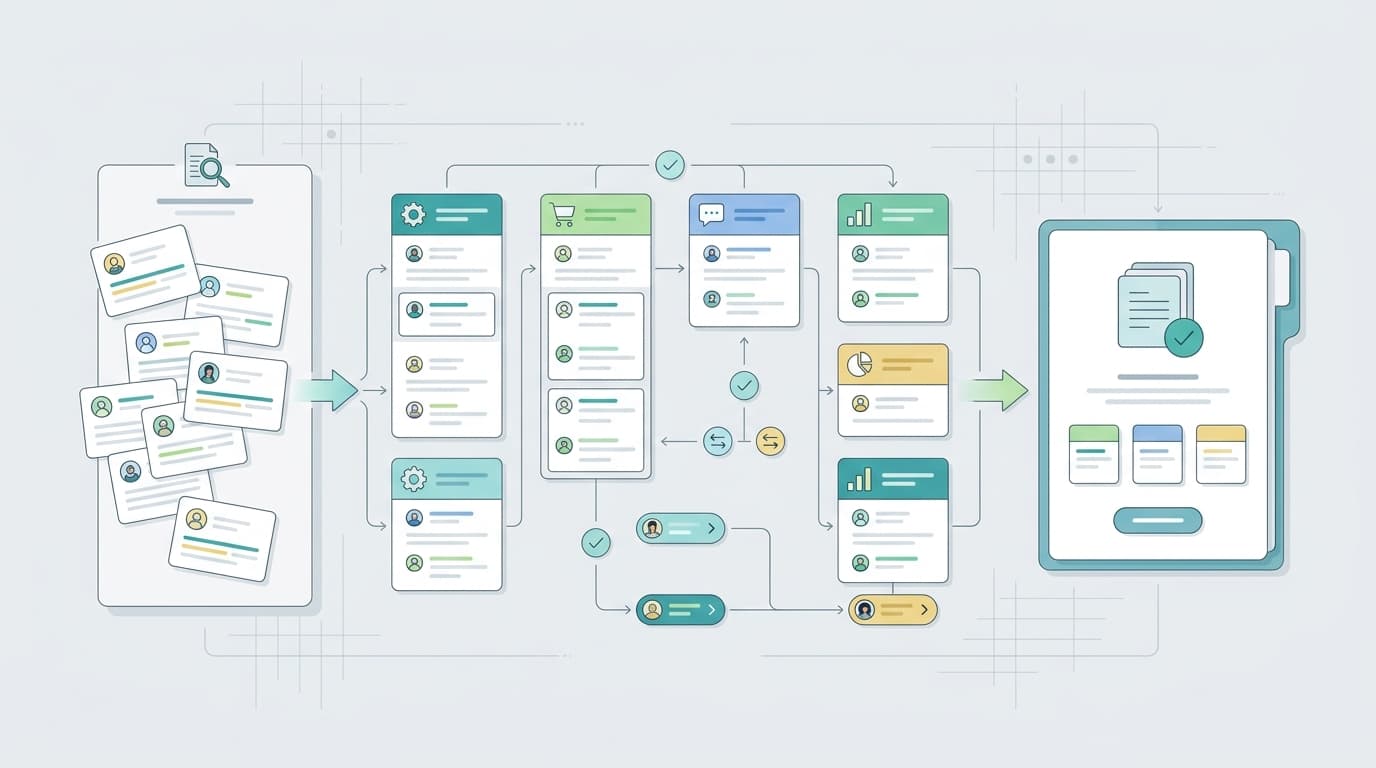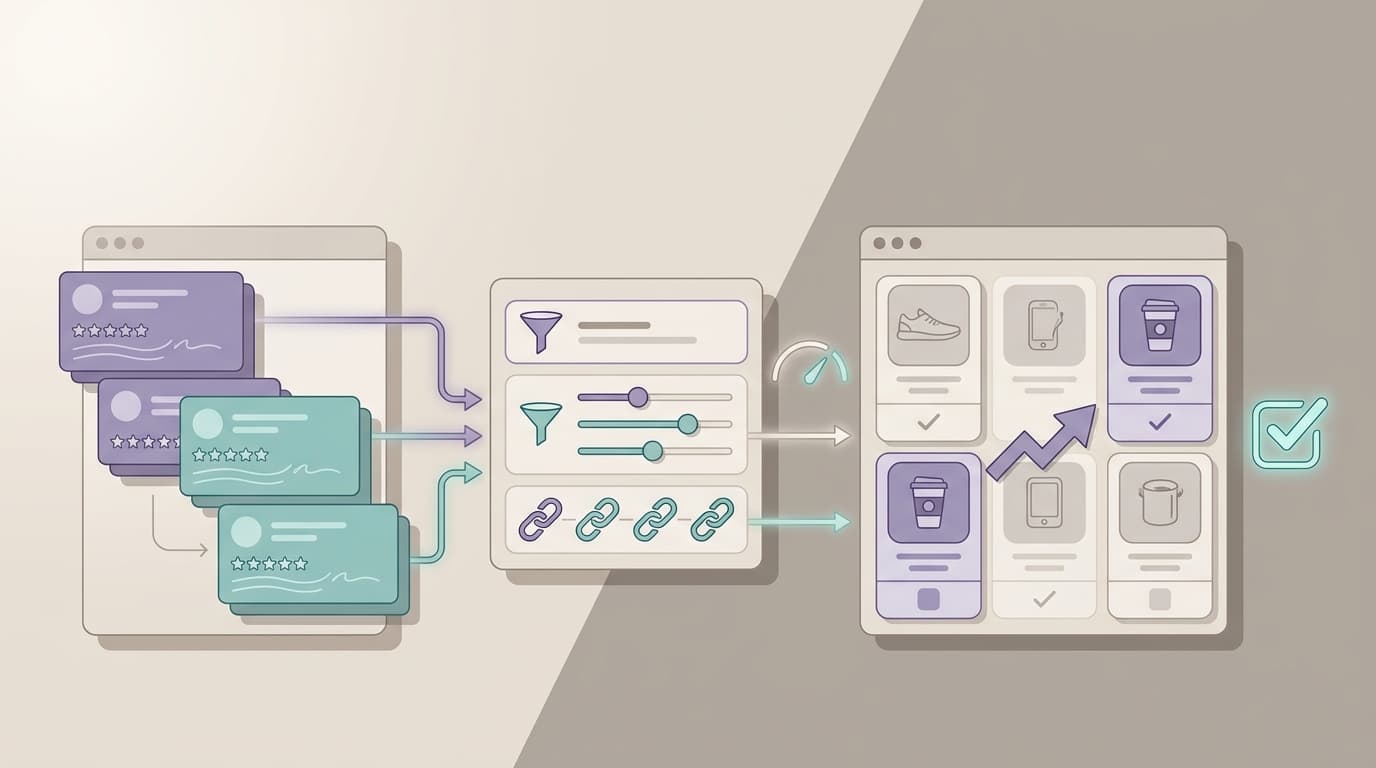
Traditional market research often begins by asking customers questions. Review mining for market research begins with what customers already chose to say after buying, using, comparing, returning, or recommending a product.
That difference makes reviews valuable for early market discovery. They can reveal the language customers use, the jobs they are trying to complete, the tradeoffs they accept, the alternatives they compare, and the conditions that turn an ordinary product attribute into a meaningful benefit or frustration.
But a review dashboard is not automatically market research. Star averages, word clouds, and broad sentiment labels can hide the context behind a pattern. Useful research requires a defined question, a defensible evidence set, structured coding, segment comparisons, traceable quotes, and a clear boundary between discovery signals and validated market conclusions.
This guide provides a practical workflow for turning ecommerce reviews into consumer insight without overstating what the data can prove.
What is review mining for market research?
Review mining is the systematic collection and analysis of customer reviews to identify repeated needs, expectations, use cases, product attributes, decision criteria, and market tensions.
For market researchers, the objective is not simply to classify feedback as positive or negative. It is to answer questions such as:
- What job is the customer hiring the product to do?
- Which outcomes matter most in a specific use case?
- What tradeoffs are customers willing or unwilling to accept?
- Which product attributes shape choice, satisfaction, or rejection?
- How do needs differ by segment, product tier, brand, variant, or season?
- Which competitor weaknesses may represent an opportunity?
- What language should the team test in positioning, concepts, and research instruments?
The output should be a set of market hypotheses supported by traceable evidence—not a pile of quotes and not a claim that reviews represent every potential buyer.
Where reviews fit in the market-research toolkit
Reviews are strongest as a source of behavior-adjacent, unsolicited language. Customers describe what happened after a real purchase, often in concrete terms: where they used the product, what failed, what surprised them, what they compared it with, and whether the outcome justified the price.
That makes review mining useful for:
- category and use-case discovery;
- competitor and product-positioning research;
- attribute and benefit mapping;
- concept and message development;
- emerging complaint monitoring;
- research-question design;
- early opportunity screening.
Reviews are weaker when the research question requires a representative estimate of the entire market, precise demographic inference, causal explanation, or direct access to non-buyers. Public reviewers are a self-selected group, review authenticity can vary, and available metadata may be incomplete. The US Federal Trade Commission’s rule on fake reviews also reinforces why authenticity and provenance deserve explicit controls in any review-based workflow.
Use reviews to discover and sharpen hypotheses. Use surveys, interviews, experiments, behavioral data, returns, support data, and market performance to validate the decisions that carry material risk.
Review mining workflow at a glance
| Stage | Research question | Deliverable |
|---|---|---|
| 1. Frame | What market decision must this research inform? | Decision statement |
| 2. Design | Which products, brands, segments, and periods belong in scope? | Evidence-set specification |
| 3. Collect | Can every review be traced to its source and context? | Review dataset |
| 4. Code | What job, attribute, event, outcome, and emotion appear? | Structured evidence records |
| 5. Cluster | Which patterns repeat within meaningful segments? | Theme and tension map |
| 6. Compare | Where do brands, tiers, use cases, or periods differ? | Segment comparison |
| 7. Evaluate | How strong, severe, distinct, and current is each signal? | Prioritized signals |
| 8. Translate | What should the team investigate or test next? | Market hypotheses and validation plan |
The discipline is sequential. Starting with a dashboard and looking for an interesting chart encourages confirmation bias. Starting with a decision creates a research design.
Step 1: Define the market decision first
“Analyze reviews in this category” is too broad. A better project starts with a decision the team expects to make.
Examples include:
- Which underserved use case should guide the next concept test?
- Which benefit can a challenger brand credibly own?
- Why do premium products win despite similar specifications?
- Which competitor complaint is severe enough to justify product differentiation?
- Which customer language should appear in a survey, interview guide, or landing-page test?
- Is an apparent category trend broad, or concentrated in one product, variant, or time period?
Write the question as a decision statement:
We need to decide [decision] for [market or segment]. Review evidence will help us identify [signals]. We will validate important hypotheses with [additional method] before committing.
This statement prevents review mining from becoming an open-ended search for confirmation.
Step 2: Build an evidence set that matches the question
The dataset determines what the analysis can reasonably say. Document inclusion and exclusion rules before interpreting the content.
At minimum, define:
- Market: country, language, marketplace, and category.
- Competitive set: direct competitors, substitutes, premium options, value options, and relevant challengers.
- Product level: parent product, individual listing, model, size, color, bundle, or generation.
- Time window: recent period, launch period, before-and-after change, or seasonal comparison.
- Rating mix: all ratings or a deliberate mix of positive, neutral, and negative reviews.
- Review status: verified-purchase signals, incentives, duplicate handling, and suspicious-content rules where available.
- Minimum context: review text, rating, date, product identity, source URL, and any relevant variant metadata.
Avoid collecting only one-star reviews when the objective is market understanding. Negative reviews are useful for finding friction, but positive and mixed reviews reveal valued outcomes, acceptable compromises, and the reasons customers choose a product despite limitations.
For category-level work, compare several product and price tiers. A pattern found in one popular listing may be a product problem rather than a market need.
Step 3: Preserve provenance and research hygiene
Every insight should be traceable to the underlying evidence.
Keep these fields with each review:
- source marketplace and URL;
- product, brand, model, and variant;
- rating and review date;
- review text;
- relevant use case or segment clues;
- coding labels;
- analyst or model confidence;
- duplicate, authenticity, or ambiguity flags.
Do not remove uncertainty during cleanup. If a reviewer’s context is unclear, mark it unknown rather than inferring a demographic or use case. If the review describes shipping damage but not product quality, preserve that distinction.
Traceability is also essential when AI assists with coding. Researchers should be able to move from a summarized theme back to representative reviews, exceptions, and conflicting evidence. A polished summary without an evidence trail is difficult to audit and easy to overtrust.
Step 4: Code reviews by customer event, not keywords alone
Keyword counts can surface vocabulary, but they rarely explain what the customer experienced. The same word can describe different events, and customers can describe the same problem with different words.
Use a structured coding frame:
| Field | Question |
|---|---|
| Job or use case | What was the customer trying to accomplish? |
| Product attribute | Which feature, material, dimension, service, or experience mattered? |
| Event | What happened during selection, setup, use, maintenance, or return? |
| Outcome | Did the product enable, block, delay, simplify, or worsen the job? |
| Expectation | What did the customer believe would happen? |
| Trigger | Under which condition did the outcome occur? |
| Consequence | What practical or emotional cost followed? |
| Comparison | What alternative, previous product, or competitor was mentioned? |
| Evidence | Which verbatim passage supports the code? |
This approach follows the logic of thematic analysis: codes capture meaningful features of the data, while themes organize related evidence around a research question. The researcher still needs to review boundaries, contradictions, and alternative explanations rather than accepting an automated cluster as final.
Step 5: Create a market tension map
The most useful themes often contain a tension rather than a simple preference.
Examples:
- customers want lighter weight without sacrificing durability;
- they want easy setup without losing advanced control;
- they want premium performance without premium maintenance;
- they want compact storage without reducing usable capacity;
- they want sustainable packaging without damage in transit.
Express each theme as a tension:
For [segment or use case], customers value [desired outcome], but current options create [tradeoff or failure], especially when [condition].
Then attach:
- supporting-review count within the defined evidence set;
- product and brand spread;
- positive, mixed, and negative examples;
- exceptions or counterexamples;
- trend direction;
- confidence level;
- unanswered questions.
This is more actionable than reporting that “durability was mentioned frequently.”
Step 6: Segment before you generalize
Aggregate themes can conceal the most important differences. Compare signals across dimensions relevant to the decision:
- product tier or price band;
- brand and model;
- product variation;
- rating band;
- review recency;
- use case;
- first-time versus experienced users when explicitly stated;
- replacement versus first purchase;
- geography or language when available and appropriate.
A complaint may be common only in a low-price tier. A valued feature may matter only to a specialist use case. A sudden issue may begin after a redesign, supplier change, or listing update. A phrase that appears category-wide is a stronger market-language candidate than one concentrated in a single product.
If you are exploring ecommerce category timing, connect these qualitative patterns to the broader Amazon market research workflow for category, timing, and launch decisions. Review evidence explains the customer experience; market and commercial data show the scale and movement around it.
Step 7: Score signals without pretending they are market size
Frequency inside a review set is not the same as population prevalence. Label it accurately: “appeared in 18% of the analyzed reviews” is different from “18% of customers have this problem.”
Use a signal score to prioritize follow-up research:
| Factor | Question | Score |
|---|---|---|
| Evidence frequency | How consistently does the theme appear in the defined set? | 1–5 |
| Market spread | Does it appear across products, brands, or tiers? | 1–5 |
| Consequence severity | How serious is the customer outcome? | 1–5 |
| Distinctiveness | Does the signal reveal a non-obvious tension or gap? | 1–5 |
| Recency or momentum | Is the pattern stable, emerging, or increasing? | 1–5 |
| Traceability | Is the theme supported by clear, auditable evidence? | 1–5 |
One practical prioritization formula is:
Research priority = frequency + market spread + (severity × 2) + distinctiveness + momentum + traceability
The result ranks hypotheses for investigation. It does not prove demand, revenue potential, or product-market fit.
Step 8: Use the signal-to-hypothesis canvas
Turn each priority signal into a research-ready hypothesis with this canvas:
| Canvas field | What to capture |
|---|---|
| Market signal | The repeated customer event or tension |
| Evidence scope | Products, brands, dates, ratings, and review count analyzed |
| Segment | The customer context explicitly supported by evidence |
| Customer language | Representative phrases with source traceability |
| Competing explanations | Other reasons the pattern may appear |
| Market hypothesis | What may be true about the need, segment, or category |
| Decision implication | What the team might change if validated |
| Validation method | Survey, interview, concept test, experiment, sales data, returns, or support data |
| Disconfirming evidence | What result would weaken the hypothesis |
Example:
Signal: Commuters praise compact storage but report leaks when bottles are carried horizontally.
Hypothesis: A commuter segment values packability but considers leak protection a non-negotiable threshold.
Decision implication: Test positioning and a concept that combines compact storage with a more secure closure.
Validation: Recruit category buyers for a concept test, compare willingness to choose, and monitor leak-related return reasons.
Disconfirming evidence: The issue is concentrated in one defective batch or one product rather than the broader segment.
How to combine review mining with other research
Use the next method to answer the uncertainty reviews cannot resolve.
| Review-mining finding | Best follow-up |
|---|---|
| Repeated problem language | Survey answer options and interview probes |
| Possible underserved segment | Segment screener and depth interviews |
| Competitor weakness | Concept or prototype test |
| Claimed willingness to pay | Choice experiment or live pricing test |
| Emerging theme | Ongoing monitoring plus sales, search, and support signals |
| Conflicting needs | Segmentation study |
| Product failure pattern | Returns, quality, supplier, and support investigation |
This is the critical handoff: review mining improves the speed and specificity of subsequent research. It should reduce vague questions, not eliminate validation.
Common mistakes in review-based market research
Treating review frequency as market prevalence
Reviewers are not a random sample. Report findings within the evidence set and validate population claims separately.
Reading only negative reviews
This identifies friction but misses choice drivers, delight, and accepted tradeoffs.
Mixing product defects with market needs
A single listing’s quality issue is not automatically a category opportunity. Compare competitors and tiers.
Letting AI summarize without an audit trail
Require traceable quotes, source records, exceptions, and confidence notes for every important theme.
Ignoring time and variants
An aggregate theme may disappear when separated by product generation, variation, batch, or season.
Jumping from a theme to a solution
Write the customer tension first. Test alternative explanations and solutions afterward.
Overlooking non-product interventions
The right response may be a listing, packaging, instructions, support, quality, or positioning change—not a new feature.
How VOC AI supports review-led market discovery
Manual review mining becomes difficult when researchers need to compare large product sets, preserve customer language, and revisit themes as the market changes.
VOC AI’s Market Insight and Product Research workflows are designed to help ecommerce teams move from customer and competitor evidence toward market and product decisions. Teams can also use competitor review analysis to examine where products underperform and connect those signals to positioning or concept hypotheses.
The strongest operating model still keeps people in the decision loop:
- define the market question;
- use AI to structure and compare review evidence;
- inspect the underlying customer language;
- challenge the theme with alternative explanations;
- validate consequential hypotheses with additional data;
- monitor whether the signal changes over time.
If your team is evaluating a repeatable review-led research process, talk with VOC AI about a scoped market-insight workflow.
Review-mining checklist for market researchers
Before sharing conclusions, confirm that you can answer yes to each question:
- Is the business decision explicit?
- Does the evidence set match the market question?
- Are products, variants, time windows, and rating bands documented?
- Can every major theme be traced to source reviews?
- Are positive, mixed, and negative experiences represented?
- Have product-specific issues been separated from category-level patterns?
- Are segment differences visible?
- Are frequency and prevalence described accurately?
- Are conflicting examples and uncertainty included?
- Does each priority signal have a validation plan?
Review mining is most valuable when it creates a disciplined bridge between observed customer language and the next market decision. The goal is not to replace research with reviews. It is to start research with stronger evidence, sharper questions, and clearer hypotheses.
Method and source notes
- The Federal Trade Commission’s final rule on consumer reviews and testimonials informs the authenticity and provenance safeguards described in this guide: FTC final rule on fake reviews and testimonials.
- The coding and theme-development guidance is informed by Braun and Clarke’s foundational approach to thematic analysis: Using thematic analysis in psychology.
- Product descriptions in this article are limited to VOC AI’s public Market Insight, Product Research, and Competitor Analysis pages.