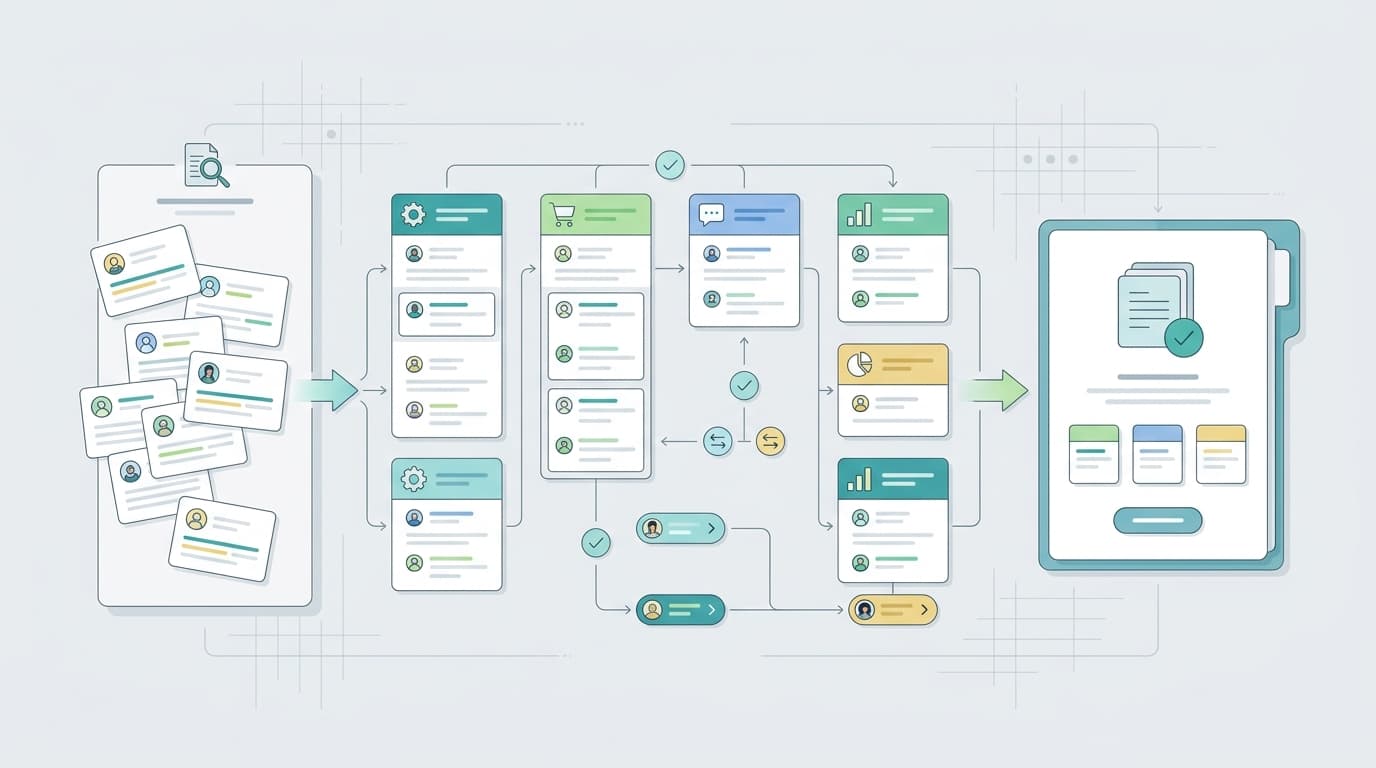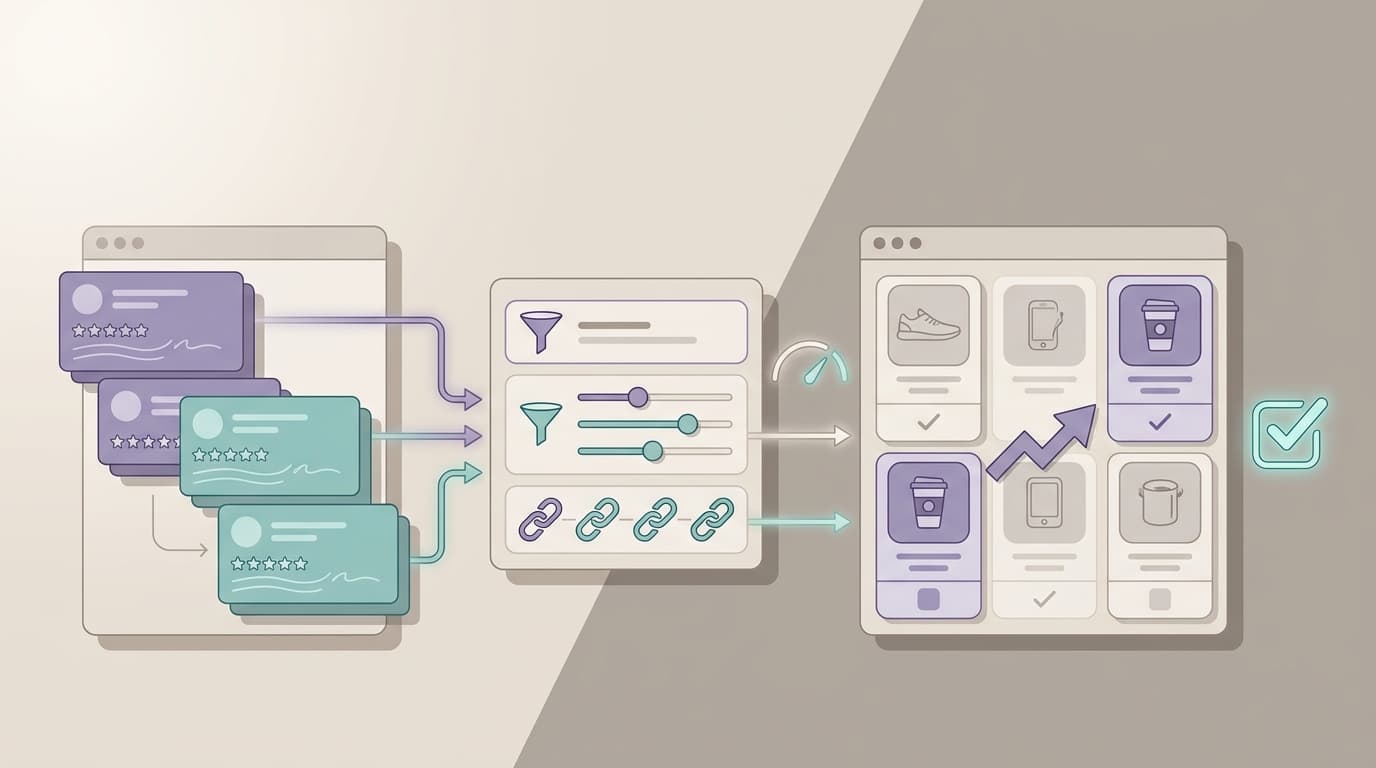
Technical ecommerce teams do not usually debate API access and scraping in the abstract. They debate ownership.
One path gives the team a narrow extraction project it can control directly. The other gives the team a managed review-data workflow that is easier to reuse across reports, internal tools, and agent-driven analysis.
That is the real decision behind the amazon review api search. The question is not whether scraping can ever work. It is whether the team wants to keep maintaining a brittle pipeline once review data needs to feed recurring operating work.
This guide compares VOC AI API with scraped review pipelines through that lens: maintenance burden, schema stability, downstream reuse, and AI-ready outputs.
Why ecommerce teams still build review scrapers
Scraping still has a real appeal.
For a small proof of concept, a scraper can feel faster than a vendor evaluation cycle. A developer can pull a narrow set of fields, prove a hypothesis, and decide later whether the workflow deserves more investment.
That is why scraper-led review pipelines still appear inside ecommerce teams that want to:
- test one category or one ASIN family quickly,
- extract a limited set of review fields for internal experiments,
- validate whether review data is useful before a broader workflow decision,
- or avoid introducing another external dependency too early.
That first-stage logic is reasonable. The problem starts when the same proof of concept becomes production infrastructure.
Where scraped review pipelines usually work
Scraped review pipelines are still defensible in a few narrow situations.
| Situation | Why scraping can still be acceptable |
|---|---|
| One-off extraction experiment | The team needs a temporary answer, not a durable shared system |
| Narrow internal use case | Only one consumer needs the data and the field set is small |
| Short-lived validation | The goal is to prove demand for a workflow before committing budget |
| Disposable prototype | The team expects to replace the pipeline if the use case survives |
In those cases, the team may decide that direct ownership is worth the tradeoff.
The mistake is assuming those conditions will still hold once review data needs to support repeated reporting, monitoring, product decisions, or internal AI workflows.
Where scraped review pipelines become brittle
The hidden cost of scraper-led review pipelines usually appears after launch.
The first version may look fine in a demo. The maintenance debt arrives later, when several teams start depending on the same workflow and the extraction layer becomes a silent operating surface.
Selector and markup drift
Scraped pipelines inherit the fragility of the page structure they depend on. When selectors, markup, or page layouts change, the extraction logic needs repair.
That repair work is often manageable once. It becomes expensive when the team has to keep proving that the pipeline still captures the right fields correctly.
Schema cleanup and field inconsistency
Raw extraction is not the same as reusable structure.
Even when the scraper still runs, downstream teams can end up spending extra time normalizing fields, cleaning unexpected values, mapping product scope, and rechecking whether the same column still means the same thing.
This matters most when review data needs to feed more than one consumer.
Retry, throttling, and monitoring overhead
A “simple scraper” often grows into an operations surface:
- retries,
- failure alerts,
- scheduling,
- rate and block handling,
- and pipeline health checks.
That overhead does not disappear just because the first extraction succeeded.
Analysis debt after extraction
Many teams do not stop at raw review rows. They want repeated complaint themes, grouped buyer language, comparison views, and faster interpretation.
That creates a second project: turning extracted text into usable conclusions. The team may end up owning both the extraction layer and the analysis layer.
What a managed review-data workflow changes
A managed workflow changes the ownership model.
Instead of asking whether the team can extract review data at all, the team asks whether it can get repeatable structure and usable outputs with less maintenance burden.
Current VOC AI public product pages position the API offer around review, keyword, sales, and listing data through API and MCP surfaces. The same public product language also ties the workflow to engineering and agent use cases, not just dashboard viewing.
That difference matters because the buyer is often not looking for raw rows alone. The buyer wants a data layer that can support:
- repeated reporting,
- internal tools,
- analyst handoff,
- product and competitor workflows,
- and AI-agent or MCP-connected use cases.
When the workflow has to support those downstream consumers, the stability of the substrate starts to matter more than the thrill of direct extraction ownership.
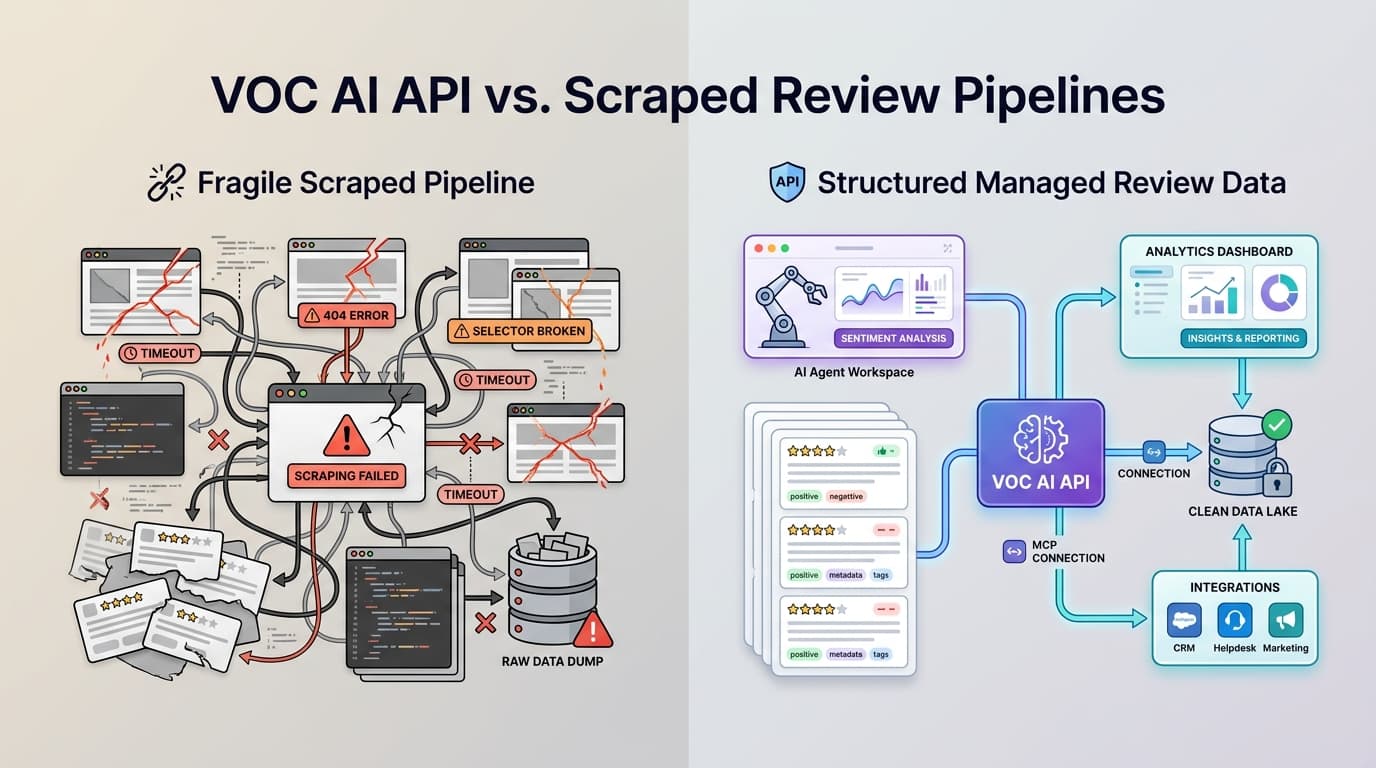
VOC AI API vs. scraped review pipelines
The cleaner comparison is not “official” versus “unofficial.” It is “workflow you must maintain” versus “workflow you can reuse.”
| Decision area | Scraped review pipeline | VOC AI API workflow |
|---|---|---|
| Initial setup | Can be quick for a narrow proof of concept | Better fit when the team wants faster time to reusable access |
| Maintenance burden | Engineering owns drift, breakage, retries, and cleanup | Better fit when the team wants less extraction-layer maintenance |
| Schema stability | Often requires normalization and defensive parsing downstream | Better fit when multiple downstream consumers need more repeatable structure |
| Analysis layer | Teams often still need separate grouping or summarization logic | Better fit when the workflow must move from data access toward usable conclusions |
| Team reuse | New consumers often create new custom branches | Better fit when ops, BI, product, and agent workflows need a shared substrate |
| AI-ready use | Raw rows still need shaping before they are useful in many agent flows | Better fit when the team wants API and MCP-style access in the same evaluation |
| Best use case | Temporary extraction or narrow internal experiment | Ongoing review-data workflows and repeated operational use |
This does not mean a scraper never wins. It means the scraper wins most often when the use case stays small on purpose.
Raw review access is not the whole workflow
Teams searching amazon reviews api or amazon product reviews api are often trying to solve a broader operational problem than data access alone.
They usually want answers such as:
- Which complaint theme is repeating most often?
- Which review pattern changed after a launch or promotion?
- Which buyer wording should move into listing or ad copy?
- Which issue belongs to listing, support, operations, or product owners?
That is why raw extraction alone is only part of the stack. The rest of the work is interpretation, grouping, and routing.
VOC AI’s public review-analysis positioning is stronger for teams that want to connect those layers instead of rebuilding them separately.
When scraping is still acceptable
Scraping is still a reasonable choice when the team can answer yes to most of these questions:
- Is the use case temporary rather than recurring?
- Will only one internal consumer depend on the data?
- Can the team tolerate breakage and manual fixes?
- Is raw extraction enough without a second analysis workflow?
- Would replacing the prototype later be acceptable?
If those answers hold, a scraper can still be a defensible short-term move.
The problem is that many ecommerce workflows stop satisfying those conditions after the first success.
When a managed review-data workflow is the better fit
A managed workflow is usually the better choice when the team expects one or more of the following:
- repeated reporting on review patterns,
- shared use across ops, BI, product, and growth teams,
- integration into internal tools or automations,
- AI-agent workflows that need review and product data in a structured surface,
- or less appetite for ongoing extraction maintenance.
This is the point where the decision shifts from “Can we build it?” to “Do we want to keep owning it?”
That is the better evaluation frame for a technical buyer comparing VOC AI API with a scraper-led pipeline.
How to evaluate review-data workflows before committing
Use a small decision checklist before the team chooses a path.
| Evaluation question | Why it matters |
|---|---|
| How many consumers will depend on the data? | Multi-team reuse amplifies schema and maintenance problems |
| Does the workflow need recurring reporting? | Repeat use raises the cost of brittle extraction |
| Will the team need grouped conclusions, not just raw rows? | Extraction alone rarely answers the business question |
| Does the team want API and agent-ready access in one evaluation? | Surface choice affects future integration speed |
| How much engineering time can maintenance consume after launch? | The hidden cost often decides the real ROI |
If the team cannot answer those questions clearly, it is usually underestimating the cost of the second and third month of ownership.
Where Amazon’s own Customer Feedback API fits
Amazon’s current Selling Partner API documentation still describes its Customer Feedback API as a way to programmatically retrieve insights from customer reviews and returns.
That matters as market context. It confirms that the buyer demand is not imaginary: teams do want programmatic access to customer-feedback signals.
But for many ecommerce teams, the practical decision is still broader than one documentation surface. They need to decide whether the total workflow should remain an internally maintained extraction-and-analysis project or move toward a managed review-data layer that can support repeated business use.
Where VOC AI fits
VOC AI is strongest in this comparison when it is framed as a managed review-data workflow for ecommerce teams that want less maintenance debt and faster reuse.
The current public VOC AI API page positions the product around review, keyword, sales, and listing data through API and MCP surfaces. The broader VOC AI product pages also keep the value tied to seller and operator outcomes: product research, competitor analysis, buyer language, and review intelligence.
That makes VOC AI a cleaner fit when the team wants to:
- use review data in internal tools,
- connect data access with repeatable analysis workflows,
- support agent-native or MCP-based use cases,
- and avoid turning a one-off scraper into a permanent maintenance burden.
Helpful supporting routes include:
Conclusion
Scraped review pipelines can still work for narrow experiments. The issue is not whether scraping is possible. The issue is whether the team wants to keep owning the maintenance burden after the workflow becomes important.
That is why the better comparison is not API versus scraper as a technical ideology fight. It is reusable workflow versus ongoing maintenance debt.
If the team needs a temporary extraction project, scraping may still be enough. If the team needs a review-data layer it can reuse across reports, tools, and AI workflows, VOC AI API is the stronger fit.