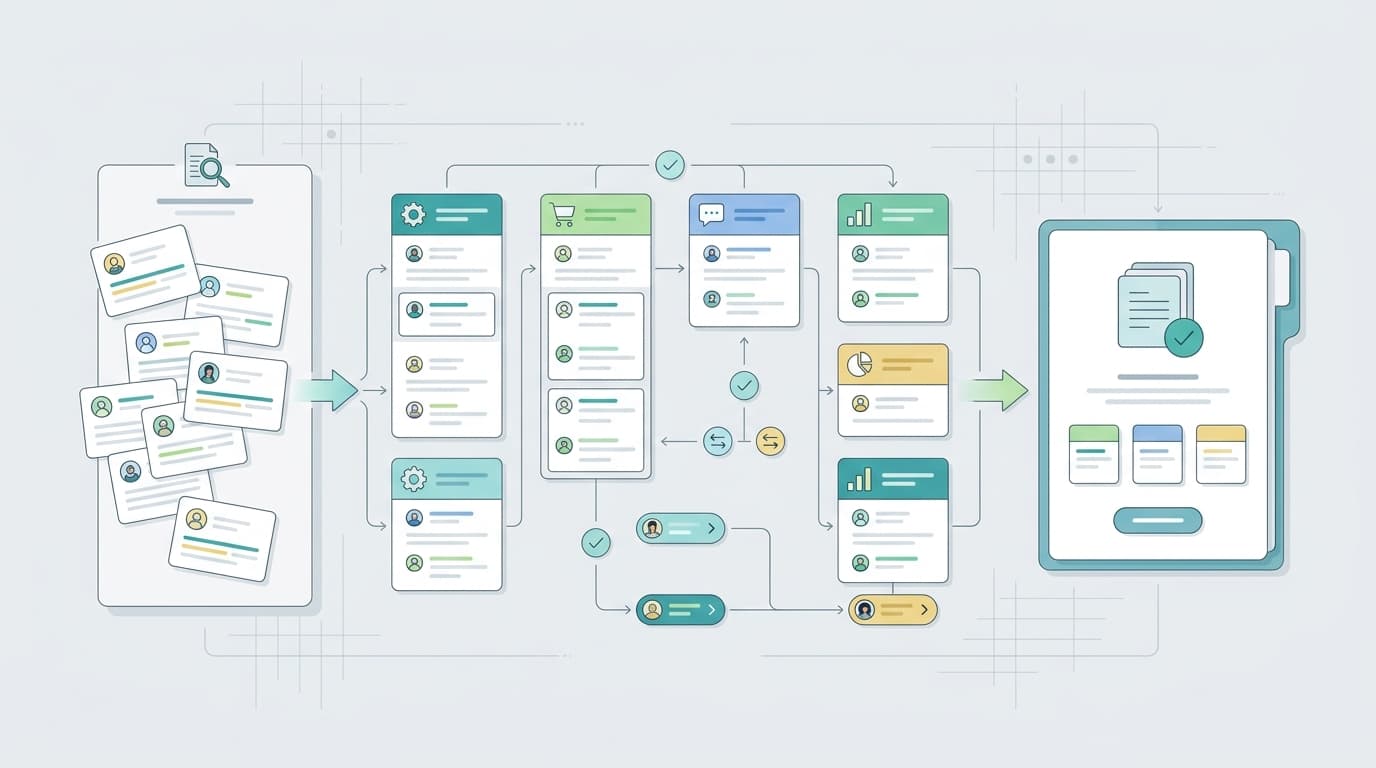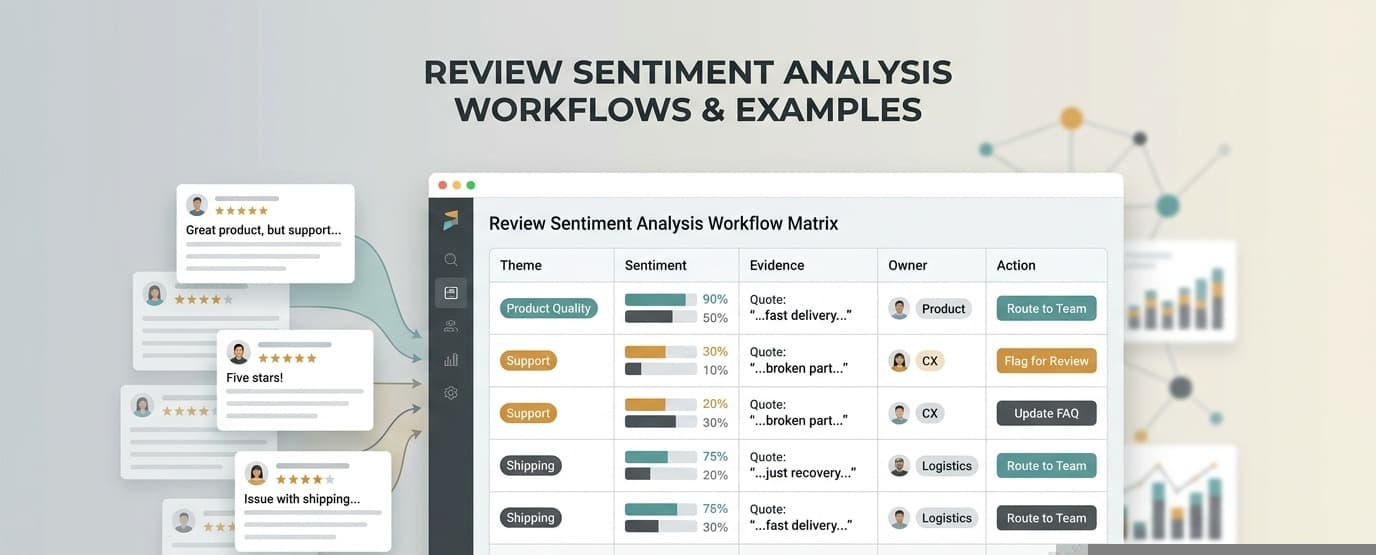
You do not need a research repository, a perfect taxonomy, or thousands of responses to practice VOC analysis.
You need a small evidence set, one decision question, and a repeatable way to move from raw customer language to a conclusion another person can verify.
This hands-on companion to our VOC analysis beginner guide gives you exactly that. You will take 25 feedback items, code them in a spreadsheet, build a small set of themes, and choose one next action without pretending the sample represents every customer.
The goal is not to produce a polished “voice of the customer” presentation. The goal is to complete one evidence-backed analysis cycle and learn where judgment enters the process.
What You Will Produce
By the end of this VOC analysis beginner worksheet, you will have five outputs:
- A decision question with a defined segment and time window.
- A 25-row evidence table that preserves the original customer wording.
- A starter codebook with consistent labels.
- Three to five themes with supporting and contradicting evidence.
- One action recommendation with an owner and a validation step.
Twenty-five items are not enough to estimate the prevalence of a problem across your entire customer base. They are enough to practice the mechanics, discover taxonomy problems, and identify questions worth testing with a larger or more representative dataset.
Before You Start: Pick One Decision
Beginners often start with a source: “We should analyze our support tickets.” Start with a decision instead.
Use this sentence:
We need to decide [decision] for [customer segment] based on feedback about [experience] from [time window].
Examples:
- We need to decide which onboarding problem to investigate next for new team administrators based on feedback from their first 30 days.
- We need to decide whether to rewrite a help article for trial users based on recent support conversations about data imports.
- We need to decide which packaging complaint deserves a root-cause investigation based on verified product reviews from the last quarter.
A good decision question is narrow enough that a feedback item can be marked relevant or not relevant. “What do customers think?” is not a usable question because almost every comment can be forced into it.
Build the 25-Row VOC Analysis Sheet
Create a spreadsheet with one row per feedback item and these columns:
| Column | What to record | Why it matters |
|---|---|---|
| Evidence ID | A stable ID such as SUP-014 |
Lets teammates trace a finding back to its source |
| Source | Interview, survey, support, review, sales note, or other channel | Makes source bias visible |
| Date | When the feedback was created | Prevents old and current evidence from blending silently |
| Segment | Plan, role, lifecycle stage, product, market, or another relevant group | Helps you spot concentration and differences |
| Verbatim | The customer’s exact words | Preserves meaning and supports review |
| Context | What the customer was trying to do | Separates the job from the complaint |
| Code | A short label for the issue or need | Makes comparison possible |
| Theme | The broader pattern the code supports | Connects individual items to a finding |
| Evidence direction | Supports, contradicts, or is neutral | Prevents one-sided summaries |
| Severity | Low, medium, or high for that customer | Adds consequence without claiming prevalence |
| Confidence note | What is known, inferred, or missing | Keeps uncertainty visible |
If you are working from reviews or support data, remove direct identifiers that are not required for the analysis. Keep enough source context to audit the finding, but do not copy sensitive customer information into an informal worksheet.
Choose 25 Feedback Items Without Cherry-Picking
The exercise is useful only if you do not select 25 comments that already support your preferred answer.
Use one of these starter sampling rules:
Option 1: Consecutive items
Take the first 25 relevant items after a fixed date. This is simple and reduces hand selection, although it can still overrepresent a temporary event.
Option 2: Stratified items
Choose a fixed number from meaningful groups. For example:
- Five new customers.
- Five established customers.
- Five successful users.
- Five users who needed support.
- Five users who abandoned or downgraded.
This is useful when your decision depends on differences between groups. Do not treat the resulting proportions as population estimates unless the sample design supports that conclusion.
Option 3: Mixed sources
Choose a fixed number from complementary channels, such as ten support conversations, ten open-text survey responses, and five interviews. The mix can reveal whether a pattern appears in more than one context.
Record the sampling rule at the top of the sheet. If someone cannot tell how the evidence was selected, they cannot judge how much confidence to place in the result.
Run the VOC Analysis Beginner Exercise
Set aside 30 to 60 minutes for the first pass. Do not automate the coding until you understand the material well enough to notice when an automated label is wrong.
Step 1: Read all 25 items without coding
Read the complete set once. Write short notes about repeated jobs, expectations, barriers, workarounds, and outcomes.
Do not create a theme after the first dramatic quote. The first pass is for orientation, not conclusion writing.
At the end, write three provisional observations. Phrase them as possibilities:
- Some administrators may understand setup but struggle to standardize it across teammates.
- Import failures may be concentrated in one file format.
- Customers may be asking for visibility rather than another notification.
The word may matters. It reminds you that the observation still needs to survive coding and contradiction checks.
Step 2: Apply short, concrete codes
A code should describe what is happening in the evidence. Keep it specific enough to be useful and broad enough to reuse.
| Customer statement | Weak code | Better code |
|---|---|---|
| “I did not know the import had failed until my teammate asked where the records were.” | Negative feedback | Silent import failure |
| “We rebuilt the same dashboard for each workspace.” | Feature request | Repeated dashboard setup |
| “The warning appears, but it does not tell me which records will change.” | Confusing | Missing change impact |
Use action-oriented labels such as cannot find, manual repeat work, missing status, unexpected change, or needs approval context.
For this first exercise, allow up to two codes per item. If every row gets five or six codes, your labels are probably too broad or you are trying to answer several decision questions at once.
Step 3: Create a starter codebook
When a code appears a second time, add it to a separate codebook tab.
| Code | Definition | Include | Exclude | Example evidence ID |
|---|---|---|---|---|
| Silent import failure | The user receives no timely, visible indication that an import failed | Missing status, late discovery, teammate discovers failure | A visible error that explains the fix | SUP-014 |
| Repeated dashboard setup | The user manually recreates an existing dashboard configuration | Copying layouts or filters between workspaces | Creating a new dashboard for a different job | INT-006 |
Definitions reduce label drift. Without them, missing status, unclear status, and no notification may become three codes for the same underlying pattern.
Do not force every item into the codebook. Add other, unclear, or not relevant when the evidence does not support a confident label. An honest unresolved row is better than invented precision.
Step 4: Group codes into themes
A theme should explain a repeated customer problem, need, expectation, or outcome. It should not merely repeat the name of a product area.
Weak theme:
Imports
Stronger theme:
Teams lose trust in imports when completion and failure states are not visible at the moment they need to verify the data.
Use this structure:
[Customer or segment] experiences [need, barrier, or outcome] when [situation], which affects [job or consequence].
For each theme, record:
- The codes it contains.
- The number of supporting items.
- The source and segment mix.
- One or two representative evidence IDs.
- Any contradicting or boundary evidence.
- What information is still missing.
Thematic analysis is iterative: codes and themes are refined as you compare them with the dataset rather than accepted as final after the first grouping pass. That is why this worksheet keeps the original evidence beside the code and theme.
Step 5: Run the contradiction check
For every theme, ask:
- Which rows do not fit?
- Does the pattern appear in more than one source or segment?
- Could one incident or account generate several similar comments?
- Is the customer describing a cause, a symptom, or a preferred solution?
- What evidence would make us reject the theme?
Suppose eight comments ask for more notifications. Two other comments say notifications are already overwhelming. The finding is not simply “send more notifications.” The stronger interpretation may be that users need a reliable status view and selective alerts for exceptions.
Contradictions often improve the recommendation because they expose the conditions under which a pattern changes.
Step 6: Prioritize one theme transparently
Do not turn 25 rows into an authoritative business score. Use a small rubric to make your reasoning inspectable.
Score each theme from 0 to 2 on these dimensions:
| Dimension | 0 | 1 | 2 |
|---|---|---|---|
| Decision relevance | Outside the current decision | Indirectly relevant | Directly changes the decision |
| Evidence breadth | One narrow source or segment | Some variation | Multiple relevant sources or segments |
| Consequence | Minor inconvenience | Meaningful friction | Blocks a critical job or creates material risk |
| Confidence | Mostly inferred | Some context is missing | Evidence and context are clear |
| Testability | No practical next test | Test is possible but vague | Small, owned validation step is clear |
Add the scores, but keep the notes. A total without the reasoning creates false certainty.
For a broader operational model, use the dedicated guide on how to prioritize customer feedback. This worksheet intentionally keeps the rubric small so a beginner can finish the exercise.
Step 7: Write one evidence-backed recommendation
Use this format:
For [segment], we observed [theme] in [evidence scope]. The pattern affects [job or outcome]. We recommend [next action] because [reason]. Confidence is [low, medium, or high] because [evidence quality and limitations]. [Owner] will validate it by [date or event] using [measurement or research method].
Example:
For new workspace administrators, we observed uncertainty about whether imports completed successfully in 9 of 25 support and survey items. The pattern affects the ability to verify setup before inviting teammates. We recommend testing a persistent import-status panel before adding more alerts. Confidence is medium because the pattern appears in two sources, but the sample overrepresents users who contacted support. Product Design will test the status concept with five recent administrators and compare support contacts during the next import release.
Notice what the recommendation does not say. It does not claim that 36% of all customers have the problem. It describes the evidence set, its limits, and the next validation step.
How to Use AI Without Losing the Evidence
AI can accelerate parts of VOC analysis, especially on larger datasets. It should not make the source trail disappear.
Use AI to propose:
- Candidate codes for review.
- Similar comments that may belong together.
- Possible theme names.
- Contradicting examples.
- Questions the current evidence cannot answer.
Keep a human reviewer responsible for:
- The decision question and sampling rule.
- Codebook definitions.
- Ambiguous or high-consequence evidence.
- Theme boundaries and contradiction checks.
- The final recommendation.
Require every generated theme or summary to point back to the exact evidence IDs that support it. NIST’s Generative AI Profile emphasizes documenting and evaluating AI risks across the system lifecycle; in a VOC workflow, traceable evidence and reviewer correction records are practical controls that make mistakes easier to find and fix.
If your evidence is primarily product reviews, VOC.AI Voice of Customer Analysis is designed to help teams analyze review language for customer needs, product strengths, weaknesses, and competitive differences. Keep the same discipline: use generated patterns as a path back to evidence, not as a substitute for it.
A Copyable Theme Card
Use one card per proposed theme:
Theme name:
Decision question:
Theme statement:

Supporting evidence IDs:
Contradicting evidence IDs:
Sources represented:
Segments represented:

Customer job or expected outcome:
Observed barrier or need:
Consequence:

What we know:
What we infer:
What is missing:

Decision relevance (0-2):
Evidence breadth (0-2):
Consequence (0-2):
Confidence (0-2):
Testability (0-2):

Recommended next action:
Owner:
Validation method:
Review date:
Your 30-Minute VOC Analysis Beginner Guide
If you only have 30 minutes, use this compressed schedule:
| Time | Action | Output |
|---|---|---|
| 0–5 minutes | Write the decision question and sampling rule | Clear scope |
| 5–10 minutes | Read all 25 items | Three provisional observations |
| 10–20 minutes | Apply one or two codes per item | First-pass code set |
| 20–25 minutes | Group codes and check contradictions | Three to five candidate themes |
| 25–30 minutes | Score themes and write one recommendation | Owned next step |
Then schedule a second pass. A fast first pass is useful for learning the dataset; it is not permission to skip review, source checks, or validation when the decision has meaningful consequences.
Common Worksheet Mistakes
Counting before defining
If three reviewers use different definitions for the same code, the count is not comparable. Define the label before treating frequency as a signal.
Mixing several decisions
Onboarding, pricing, reliability, and documentation can appear in the same source set. If they do not serve the same decision, split the analysis.
Confusing a requested feature with the underlying need
“Add a notification” may mean “help me trust the process completed.” Code the situation and desired outcome, not only the proposed solution.
Hiding source and segment bias
Support data overrepresents people who ask for help. Interviews may overrepresent customers willing to talk. Reviews often lack account context. Record the limitation instead of treating all sources as interchangeable.
Finishing with a theme deck
A theme without an owner, decision, or validation method becomes repository inventory. Put the result into a recurring customer feedback workflow so evidence moves into decisions and outcome checks.
What to Do After the First 25 Items
Your first worksheet should produce better questions, not premature certainty.
Next, choose one path:
- Expand the sample if the theme needs a prevalence estimate or broader segment coverage.
- Conduct targeted interviews if the evidence shows a pattern but not the underlying cause.
- Join behavioral data if customers describe friction that can be checked against product usage.
- Run a small experiment if the recommendation is reversible and measurable.
- Monitor the theme if the evidence is important but not yet strong enough to act.
As the workflow grows, keep the beginner rules: a decision question, an explicit sample, preserved customer language, defined codes, visible contradictions, and an owned validation step.
That is the difference between collecting feedback and using VOC analysis to make a decision.
Frequently Asked Questions
Is 25 feedback items enough for VOC analysis?
It is enough for a beginner practice exercise and may surface hypotheses. It is not automatically enough to estimate how common a problem is across your customer base. Sample adequacy depends on the decision, source quality, segment variation, and consequence of being wrong.
What is the best first source for a VOC analysis beginner worksheet?
Choose the source closest to the decision. Support conversations are useful for troubleshooting friction, interviews for context and motivations, open-text surveys for directional breadth, reviews for post-purchase expectations, and product analytics for observed behavior. Two complementary sources are often more useful than one large undifferentiated export.
Should beginners use sentiment analysis first?
Not necessarily. Sentiment can help triage a large dataset, but positive or negative labels do not explain the customer job, barrier, cause, segment, or decision implication. Start by reading a small sample and coding concrete evidence.
How many themes should a 25-item exercise produce?
Usually three to five candidate themes are manageable. If you have 15 themes, your themes may be too narrow. If you have one, it may be too broad. Recheck the decision question and code definitions.
What should I do if two analysts disagree?
Compare the code definitions and the exact evidence. Record the disagreement, revise ambiguous definitions, and keep a decision rule for future rows. Disagreement is useful when it reveals a hidden assumption.