Customer feedback rarely fails because nobody collected it. It fails because nobody knows what should happen next.
A support lead flags a recurring complaint. A product manager sees a similar theme in interviews. Sales has three deal notes that sound related. Someone adds the issue to a spreadsheet, another person creates a backlog item, and the team moves on. Two weeks later, the same evidence returns in a different meeting with a different label.
This customer feedback intelligence workflow playbook solves that operational gap. It gives product teams a weekly system for moving from incoming signals to an evidence-backed decision, with explicit owners, handoffs, service levels, and follow-up checks.
This is a companion to the broader customer feedback intelligence workflow playbook, which explains the three core jobs of triage, investigation, and decision follow-through. The playbook here focuses on the operating layer: who does each job, when they do it, what they hand off, and how the team prevents feedback from disappearing between tools and meetings.
The customer feedback workflow in one view
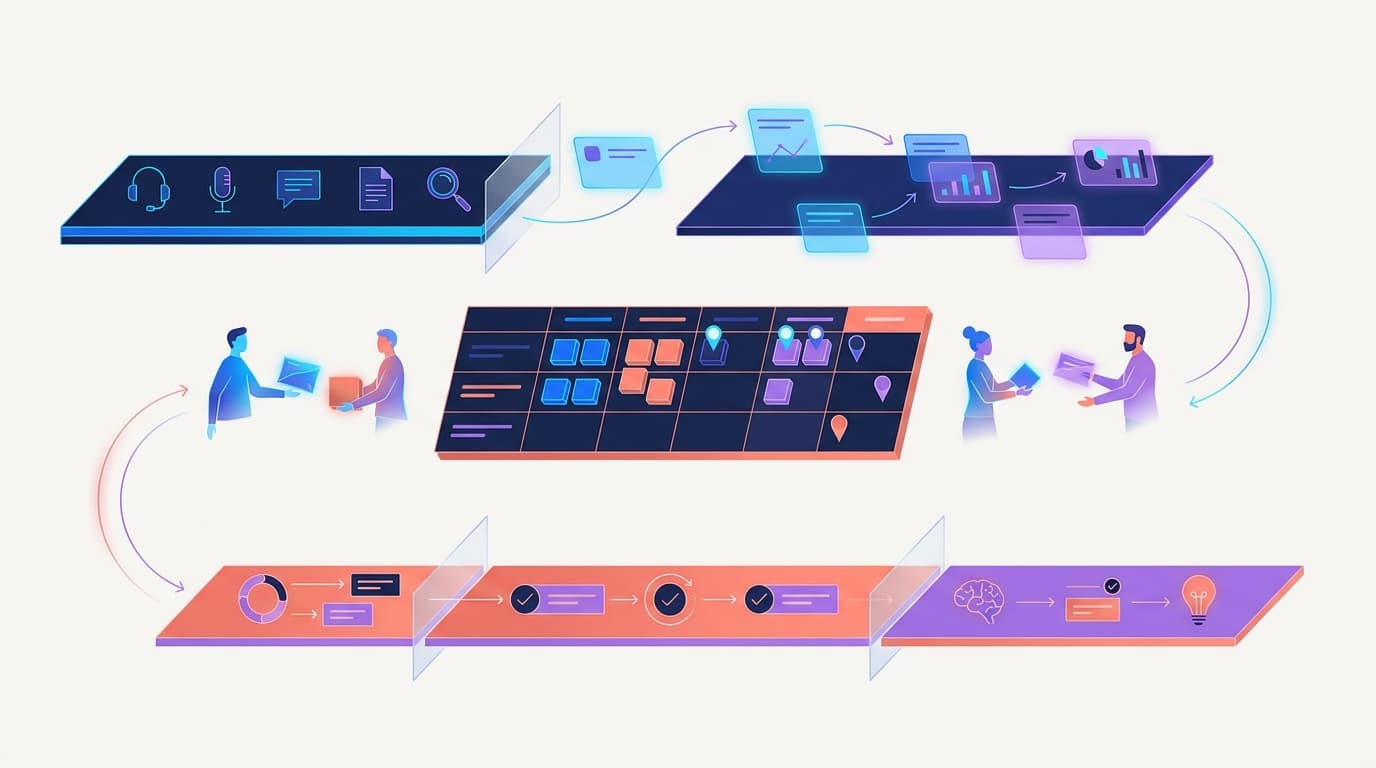
A practical customer feedback workflow should run on two speeds:
- Continuous intake: capture and normalize evidence as it arrives.
- Scheduled synthesis: review patterns, assign investigations, make decisions, and check outcomes on a predictable cadence.
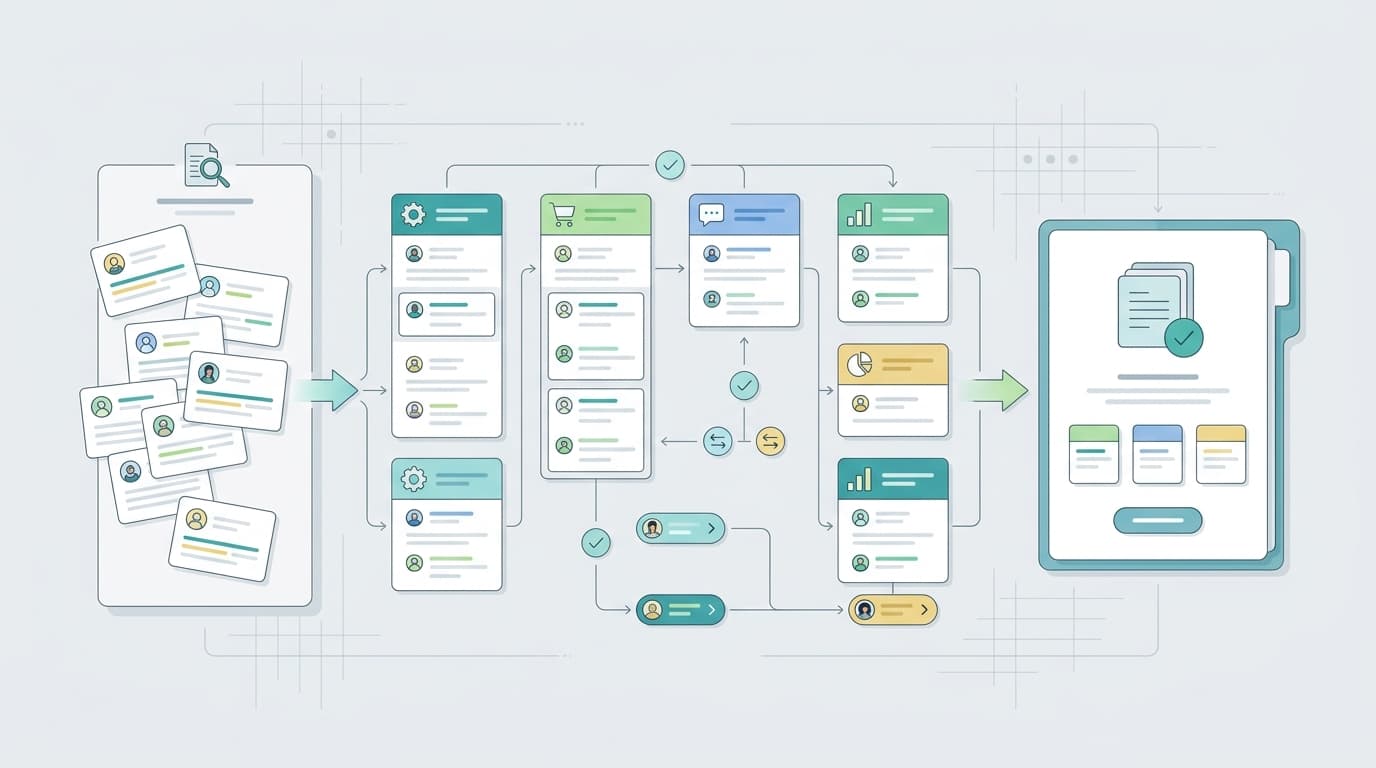
The complete loop looks like this:
- Capture a traceable evidence record.
- Route urgent signals immediately.
- Group related evidence into a candidate theme.
- Review candidate themes in a weekly intelligence meeting.
- Assign a bounded investigation when confidence is low.
- Create a decision record when the team acts or declines to act.
- Hand the decision to a delivery owner.
- Check the result and return the learning to the evidence system.
The sequence matters. Teams create confusion when they treat every comment as a roadmap request, every cluster as a proven problem, or every shipped change as a solved problem.
Why a weekly cadence works better than a feedback inbox
An inbox is a storage mechanism. A cadence is an operating mechanism.
Without a cadence, customer evidence competes with every other source of work. The loudest complaint, most senior stakeholder, newest sales request, or most memorable interview can become the de facto priority. A scheduled workflow forces the team to compare evidence using the same questions every week.
A weekly rhythm also creates useful constraints:
- Small signals do not require an immediate meeting.
- Urgent issues do not wait for the next quarterly planning cycle.
- Investigations receive an owner and a deadline.
- Decisions preserve the evidence and assumptions behind them.
- Outcomes return to the same system that produced the recommendation.
For deeper theme scoring after the team has formed reliable patterns, use the guide on how to prioritize customer feedback. The workflow here decides when a theme is ready for that prioritization step.
Start with five roles, not one feedback owner
One person can perform several roles, especially on a small team. The important rule is that the roles remain distinct.
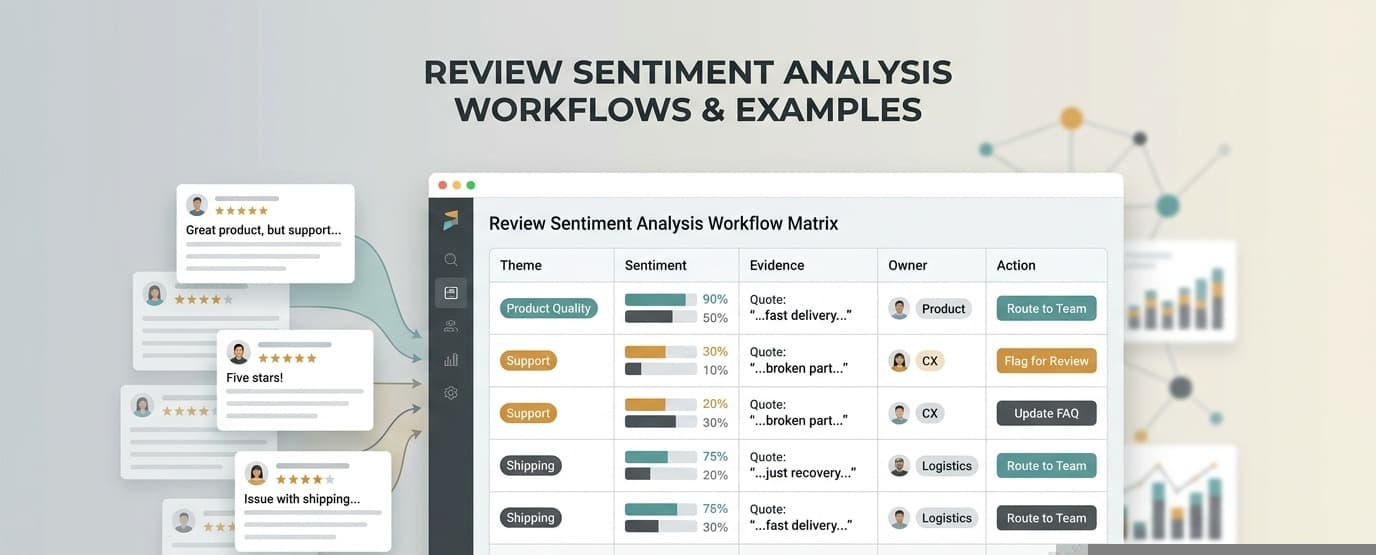
| Role | Core responsibility | Typical owner | Required handoff |
|---|---|---|---|
| Signal steward | Keeps incoming evidence traceable and routes urgent items | Support ops, product ops, researcher, PM | Evidence record or escalation |
| Evidence owner | Tests whether a candidate theme is real and bounded | PM, UXR, analyst | Evidence packet |
| Decision owner | Chooses act, investigate, monitor, or decline | Product lead, functional leader | Decision record |
| Delivery owner | Executes the approved intervention | Product, support, marketing, operations | Delivery status and release context |
| Learning owner | Checks whether the action changed the target outcome | PM, analyst, product ops | Outcome note and next recommendation |
Do not assign “customer feedback” to a committee. Committees can contribute evidence, but each active theme needs one evidence owner and each consequential choice needs one decision owner.
Build the minimum operating artifacts
The workflow does not require a new platform on day one. It requires a small set of consistent records.
1. Evidence record
An evidence record preserves the original signal and enough context to interpret it later.
| Field | Example |
|---|---|
| Evidence ID | Stable ticket, call, review, survey, or note link |
| Customer language | Short verbatim excerpt |
| Source | Support, interview, review, survey, sales, return, community |
| Date | When the signal occurred |
| Customer context | Segment, plan, product, region, journey stage |
| Behavior or consequence | Abandoned setup, requested refund, created workaround, expanded usage |
| Initial tag | Provisional label, not a final conclusion |
| Urgency flag | Safety, security, compliance, access, outage, churn, or reputation risk |
If feedback comes from many systems, normalize the fields before merging the meaning. The guide to analyzing ecommerce feedback across channels explains why source context should survive aggregation.
2. Candidate-theme card
A candidate theme is a hypothesis, not a conclusion.
Use this format:
We believe a defined customer group is struggling with a specific job or moment, because we observed these recurring signals across these sources. We are not yet sure whether the main mechanism is X, Y, or Z.
The uncertainty sentence is essential. It stops a neat label from pretending to be an explanation.
3. Evidence packet
An evidence packet is the handoff from investigation to decision.
It should contain:
- The decision question
- Affected customer and product context
- Date range and sources reviewed
- Representative examples linked to originals
- Recurrence, severity, and behavior signals
- Counterevidence and non-affected segments
- Plausible mechanisms
- Confidence level and important limitations
- Options considered
- Recommended next step
- Proposed owner and learning check
4. Decision record
Record decisions even when the answer is “not now.”
| Field | What to write |
|---|---|
| Decision | Act, investigate, monitor, or decline |
| Rationale | Evidence and constraints that drove the choice |
| Owner | One accountable person |
| Scope | What is and is not included |
| Expected change | Behavior, experience, or operating metric expected to move |
| Check date | When the team will review results |
| Revisit trigger | New evidence that would reopen the choice |
This record prevents old debates from restarting without new evidence.
The weekly customer feedback operating cadence
The following cadence works for a product team handling feedback from support, sales, interviews, surveys, reviews, and product analytics. Adjust the volume thresholds, but keep the handoffs.
Daily: capture and urgent routing
Owner: signal steward
Time: asynchronous, usually 10–20 minutes
Output: traceable evidence records and urgent escalations
The signal steward checks new evidence, merges obvious duplicates, fills missing context, and routes urgent issues through the correct operational channel.
Urgent routing should bypass the normal feedback queue when the signal involves:
- Security, privacy, safety, or compliance risk
- Loss of access or a widespread failure
- A fast-growing incident or reputation issue
- A high-severity defect with a credible reproduction path
- A contractual or customer-critical deadline
Urgent does not mean “important customer.” It means the cost of waiting for the normal cadence is materially higher.
Twice weekly: 20-minute triage sweep
Owner: signal steward
Participants: support or success representative, PM or product ops
Output: route, merge, monitor, or propose a candidate theme
For each new cluster, answer four questions:
- Is this an operational escalation rather than a research question?
- Does an existing theme already explain it?
- Is there enough context to form a candidate theme?
- What evidence would make the next review more useful?
Do not debate roadmap priority in triage. The goal is to improve the evidence and select the next workflow.
Weekly: 45-minute feedback intelligence review
Owner: product lead or product operations
Participants: PM, support or success, research or analytics, rotating delivery partners
Output: investigation assignments, monitoring decisions, or decision-ready handoffs
Use a fixed agenda:
| Minutes | Agenda item | Decision |
|---|---|---|
| 0–5 | Review urgent items and overdue handoffs | Escalate or unblock |
| 5–15 | Check movement in active themes | Continue, split, merge, or close |
| 15–30 | Review up to three candidate themes | Investigate, monitor, or discard |
| 30–40 | Review completed evidence packets | Send to decision owner or request bounded follow-up |
| 40–45 | Confirm owners, deadlines, and check dates | Commit the handoffs |
Cap the number of themes reviewed. A meeting that scans 30 charts but assigns nothing is reporting, not feedback intelligence.
Investigation window: three to ten working days
Owner: evidence owner
Output: evidence packet
An investigation should answer a decision question, not “analyze all feedback.” Good questions are bounded:
- Which onboarding step is producing the repeated setup complaint?
- Is the request concentrated in one segment or broadly distributed?
- Are customers missing a capability, failing to discover it, or misunderstanding it?
- Did the complaint appear after a release, policy change, or channel shift?
- What evidence would contradict the leading explanation?
For product-development applications, the review mining for product development workflow shows how to connect complaint language to mechanisms and intervention options.
Decision handoff: within two working days
Owner: decision owner
Output: decision record and delivery owner
A finished evidence packet should not sit in a repository waiting for someone to notice it. Set a short decision service level.
The decision owner chooses one of four routes:
- Act: approve a defined intervention.
- Investigate: request one specific missing piece of evidence.
- Monitor: define the threshold or signal that would trigger action.
- Decline: document why the team will not act and what could change that choice.
Outcome check: two to six weeks after delivery
Owner: learning owner
Output: outcome note
The check date depends on the intervention. A support macro can be evaluated quickly. A product behavior change may need more time. The team should compare the result with the expected change recorded before delivery.
Ask:
- Did the targeted behavior or experience change?
- Did related complaint language decline, move, or become more specific?
- Did the intervention create a new problem for another segment?
- Was the original mechanism correct?
- Should the team expand, revise, reverse, or stop the intervention?
The shared view for these operating checks belongs in a customer feedback dashboard for product, support, and marketing, not in a disconnected slide deck.
Recommended service levels for feedback handoffs
Service levels should prevent silent queues, not create false precision.
| Handoff | Recommended expectation | Escalation trigger |
|---|---|---|
| New evidence to traceable record | Within 2 working days | Missing source or customer context |
| Urgent signal to operational owner | Same working day | Safety, security, access, outage, or compliance risk |
| Candidate theme to weekly review | Within 7 days | Recurring evidence with meaningful consequence |
| Assigned investigation to evidence packet | 3–10 working days | Scope expands without a new decision question |
| Evidence packet to decision | Within 2 working days | No named decision owner |
| Approved decision to delivery plan | Within 5 working days | Scope or owner remains ambiguous |
| Delivered change to outcome check | 2–6 weeks | No measurable expectation or check date |
Treat these as defaults. A team may need shorter or longer windows, but every queue should have an owner and a visible aging rule.
Where AI helps—and where it should stop
AI can reduce the clerical load in a customer feedback management process. It can suggest tags, group semantically similar comments, summarize a bounded evidence set, retrieve examples, identify possible contradictions, and draft an evidence packet.
It should not silently decide:
- Whether a self-selected feedback sample represents the customer base
- Which customer consequence matters most
- Whether two similar phrases share the same mechanism
- Which tradeoff the company should accept
- Whether the evidence is strong enough for a consequential decision
Keep original evidence links, expose the inputs used for summaries, and require a human decision owner. VOC.AI’s Voice of Customer Analysis can help teams organize review language, pain points, needs, and patterns; the operating workflow still determines how that evidence enters a decision.
Common workflow failure modes
Every channel has a different taxonomy
The same issue becomes “setup,” “activation,” “integration,” and “time to value” in four tools. Preserve source-specific labels, but map them to a shared evidence model for synthesis.
The weekly meeting becomes a dashboard tour
Require a decision question, owner, or handoff for every agenda item. Move passive reporting to an asynchronous update.
A theme has frequency but no consequence
Repeated wording can be useful, but recurrence alone does not reveal severity, affected behavior, or business relevance. Add customer consequence and behavioral context.
The team collects only confirming examples
Every evidence packet should include counterevidence, unaffected segments, and plausible alternative explanations.
“Shipped” is treated as “solved”
Delivery closes a task. An outcome check closes the learning loop.
Nobody owns declined requests
A declined decision still needs a record, revisit trigger, and communication path. Otherwise the same request returns as if the team never considered it.
A 30-day rollout plan
Week 1: define the evidence model
- Choose the minimum evidence-record fields.
- Identify all active feedback sources.
- Name a signal steward for each source.
- Define urgent-routing conditions.
- Create one shared candidate-theme view.
Week 2: run the first cadence
- Hold two short triage sweeps.
- Select no more than three candidate themes.
- Assign one bounded investigation.
- Create the first evidence packet.
- Record every handoff and deadline.
Week 3: connect decisions and delivery
- Name decision owners by problem area.
- Use the four decision routes: act, investigate, monitor, decline.
- Assign delivery and learning owners separately.
- Add expected change and check date to each approved action.
Week 4: audit the system
Review:
- Evidence records missing source links or context
- Themes with no owner
- Investigations with no decision question
- Decisions with no delivery handoff
- Delivered changes with no outcome check
- Old items that should be closed, merged, or explicitly monitored
Do not optimize the dashboard before the handoffs work. A simple table with complete ownership beats a sophisticated interface full of unowned themes.
Customer feedback workflow checklist
Use this checklist in the weekly review:
- [ ] Each item links to original customer evidence.
- [ ] Urgent operational risks have been routed outside the normal queue.
- [ ] Candidate themes state the affected customer and moment.
- [ ] The team distinguishes recurrence from consequence.
- [ ] Every investigation has one evidence owner and a deadline.
- [ ] Every evidence packet includes counterevidence and limitations.
- [ ] Every decision has one accountable owner.
- [ ] Approved work has a delivery owner and defined scope.
- [ ] Every delivered intervention has a check date.
- [ ] Outcome learning returns to the theme and evidence records.
Frequently asked questions
What is a customer feedback workflow?
A customer feedback workflow is the repeatable path that moves customer evidence from capture through triage, investigation, decision, delivery, and outcome learning. A useful workflow defines owners and handoffs instead of stopping at collection or reporting.
How often should product teams review customer feedback?
Capture and urgent routing should happen continuously. Most teams benefit from short triage sweeps once or twice a week, a weekly intelligence review, and monthly or quarterly system audits. The right frequency depends on signal volume and risk.
Who should own customer feedback?
No single function should own every step. Assign separate responsibility for signal stewardship, evidence investigation, decisions, delivery, and learning. One person may hold multiple roles on a small team, but each active handoff should have one accountable owner.
What should be included in a feedback evidence packet?
Include the decision question, affected context, sources and date range, representative examples, recurrence and consequence signals, counterevidence, plausible mechanisms, limitations, options, recommendation, and proposed learning check.
How do you close the customer feedback loop?
Close the loop by recording the decision, assigning delivery and learning owners, checking the expected outcome after delivery, and returning the result to the original evidence and theme records. Communication to customers can be part of the loop, but internal learning must also be preserved.
Turn customer evidence into an operating system
The best customer feedback workflow is not the one with the most tags, dashboards, or summaries. It is the one that makes the next responsible action obvious.
Start with traceable evidence. Separate urgent routing from investigation. Give every theme an evidence owner, every choice a decision owner, and every shipped intervention a learning owner. Then run the same cadence long enough to see where handoffs break.
That is how customer feedback intelligence becomes a management system rather than another inbox.