Updated August 22, 2026.
AI review analysis is useful only when it changes how a team makes decisions. A summary of five thousand reviews can look impressive and still fail if nobody can see the source evidence, assign an owner, or decide what changes next.
This practical guide is for teams that already know reviews are valuable but need a repeatable operating workflow. Use it to turn customer reviews into product, CX, listing, support, or growth decisions without turning every project into a custom research sprint.
If you are still comparing software categories, start with the AI review analysis comparison. If you need to measure a pilot, use the AI review analysis metrics checklist. This page focuses on the practical team workflow: what to prepare, how to run the analysis, how to QA the output, and how to hand it off.
What AI review analysis should produce
AI review analysis should not stop at sentiment, star ratings, or a fluent executive summary. For team use, the output needs to answer seven questions:
- Which review cohort did we analyze?
- What decision does this evidence support?
- Which themes are recurring, specific, and recent enough to matter?
- Which source reviews prove or weaken each theme?
- Which customer segment, product, competitor, variant, or region does the theme affect?
- Which owner should act on it?
- What should we check after the action is taken?
That is the difference between "customers complain about quality" and "recent two-star reviews for the travel case mention zipper failure after repeated use; product should inspect the zipper supplier, support should update replacement guidance, and the team should recheck complaint share in 30 days."
The job of AI review analysis is to compress messy customer language without losing the evidence path.
Start with the decision sentence
Before you upload reviews or open a dashboard, write one sentence:
We are analyzing this review cohort so this owner can make this decision by this date.Examples:
| Team | Decision sentence |
|---|---|
| Product | We are analyzing one-star and two-star reviews from the last 90 days so the product owner can decide which defect investigation belongs in the next sprint. |
| CX | We are analyzing refund-related reviews so support can update macros and escalation rules before the next peak season. |
| Ecommerce | We are analyzing recent competitor reviews so the listing owner can decide which objections the product page must answer. |
| Growth | We are analyzing five-star reviews so the growth team can identify buyer language for landing page and ad-message tests. |
| Research | We are analyzing split opinions around setup so the researcher can decide which customer segment needs interviews. |
This sentence prevents weak AI review analysis. Without it, teams collect attractive themes but do not know whether the output is good enough to use.
Step 1: Define the review cohort
The most common workflow mistake is mixing too many reviews into one analysis. The model may still return clean themes, but the themes may not match the decision.
Define the cohort before running AI review analysis:
| Cohort field | What to specify | Why it matters |
|---|---|---|
| Product scope | Product, SKU, ASIN, plan, feature, or competitor set | Prevents unrelated products from shaping the same theme |
| Date window | Launch window, last 30 days, last 90 days, or pre/post change | Separates current issues from old complaints |
| Rating band | One-star, two-star, three-star, all reviews, or positive-only | Keeps defect triage separate from buyer-language mining |
| Market | Country, language, marketplace, or region | Avoids overgeneralizing local expectations |
| Customer segment | New users, repeat buyers, power users, churned users, or high-value accounts | Helps teams distinguish universal issues from segment-specific friction |
| Competitor label | First-party product, competitor A, competitor B, or category benchmark | Keeps comparison evidence clean |
For ecommerce teams, cohort control is especially important. A broad set of reviews can hide the exact signal that matters: the new variant, the recent packaging change, the competitor product, the review language after a listing rewrite, or the rating band that triggered the investigation.
Step 2: Choose the output format before the run
AI review analysis works better when the team knows what the final output should look like. Do not ask for "insights." Ask for the artifact the owner will use.
| Decision job | Useful output | Weak output |
|---|---|---|
| Product defect triage | Issue table with severity, affected cohort, source examples, and next investigation | Generic complaint summary |
| Listing improvement | Buyer-language bank, objection list, proof points, and copy-test brief | Positive and negative sentiment chart |
| Competitor research | Competitor-by-theme matrix with evidence rows and gaps | Uncontrolled competitor summary |
| Support improvement | Complaint themes mapped to macros, escalation rules, and owner status | Long list of support complaints |
| Roadmap planning | Theme evidence packet with counterevidence, customer impact, and candidate action | Feature-request word cloud |
| Growth messaging | Purchase motivations, exact phrases, use cases, and objections by segment | Broad persona description |
This output-first approach also makes tool evaluation easier. The best AI review analysis tools are not the ones with the most visualizations. They are the ones that can produce the artifact your team can inspect, reuse, and hand off.
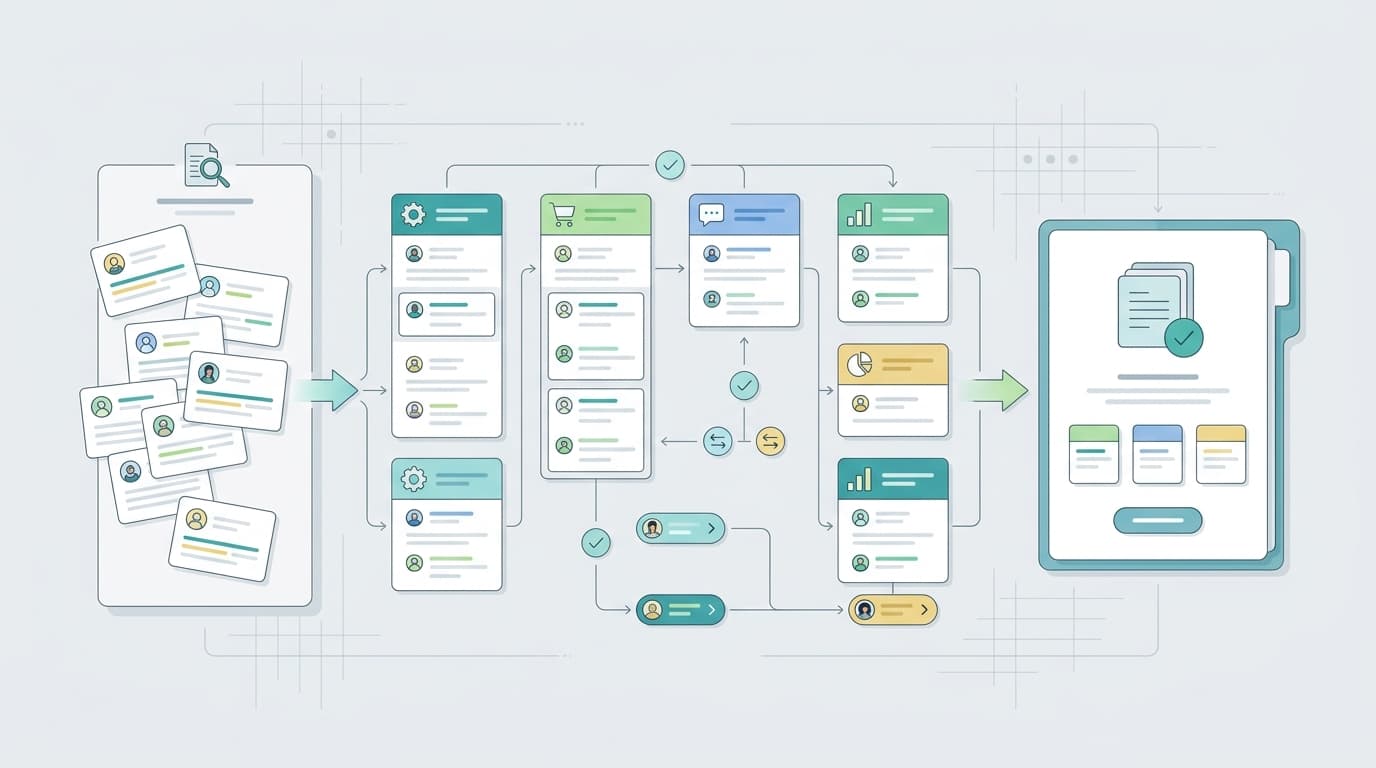
Step 3: Run the analysis in layers
Do not ask the AI to produce the final answer in one pass. A layered workflow catches mistakes earlier.
Layer 1: Evidence inventory
First, confirm the review set:
- source, product, competitor, marketplace, and date window
- review count included and excluded
- rating distribution
- language or region filter
- known product events such as launch, packaging change, price change, or campaign
If the evidence inventory is wrong, stop. Fix the cohort before interpreting themes.
Layer 2: Theme extraction
Next, extract themes that are specific enough to act on. A good theme describes behavior, context, and consequence.
| Weak theme | Better AI review analysis theme |
|---|---|
| Bad quality | Zipper fails after repeated travel use, especially when the case is packed tightly |
| Confusing setup | First-time users do not understand which settings carry over during account migration |
| Price complaint | Buyers accept the price but object when replacement parts are not included |
| Shipping issue | Recent low-star reviews mention cracked corners after delivery for the larger variant |
Ask for theme merging and splitting. If the same problem appears under five labels, merge it. If one broad label contains several distinct decisions, split it.
Layer 3: Evidence and counterevidence
For every important theme, preserve proof:
- representative review snippets or review IDs
- product, variant, competitor, rating, and date
- reviewer language that names the pain or motivation
- examples that disagree with the theme
- segment notes that narrow the claim
Counterevidence matters. If half of buyers say the product is too small and half praise the compact size, the answer is not "make it bigger." The answer may be segment targeting, listing expectation-setting, or variant strategy.
Layer 4: Owner and action mapping
Finally, route findings to owners:
| Finding type | Likely owner | Example action |
|---|---|---|
| Product defect | Product, quality, operations | Inspect root cause, supplier, packaging, or replacement policy |
| Expectation mismatch | Listing, marketing, product | Rewrite page copy, add comparison photos, clarify dimensions |
| Support confusion | CX, support operations | Update macros, help docs, escalation path, or refund guidance |
| Competitor gap | Product research, growth | Validate feature gap, positioning opportunity, or category opening |
| Buyer language | Growth, lifecycle, ecommerce | Add exact phrases to ads, landing pages, FAQs, or listing tests |
| Segment split | Research, product | Run interviews or segment-specific analysis before changing the product |
AI review analysis should make the handoff easier, not replace the owner who makes the judgment.
Step 4: QA the output before anyone acts
Treat AI review analysis like decision support, not automatic truth. Before a finding reaches a roadmap, listing, support workflow, or growth test, run a short QA pass.
Use this checklist:
| QA check | Pass condition | Failure mode |
|---|---|---|
| Cohort match | The evidence set matches the decision sentence | Mixed products, old reviews, or irrelevant rating bands |
| Traceability | Each major claim links back to source reviews | Polished summary with no evidence |
| Theme specificity | Themes name behavior, context, and consequence | Broad labels such as "quality" or "sentiment" |
| Counterevidence | Exceptions and segment splits are visible | The output flattens disagreement |
| Severity | High-risk issues are escalated for human review | The model treats all themes as equal |
| Actionability | Each accepted finding maps to an owner and next step | Report ends in a dashboard |
| Reuse | Evidence can be exported or referenced later | Team relies on screenshots or chat history |
For high-risk categories, do not let AI review analysis make final legal, safety, medical, financial, or compliance judgments. Use it to surface evidence that a qualified human reviews.
Step 5: Create the decision packet
The decision packet is the smallest artifact that lets another owner act without re-reading the whole review set.
Use this structure:
| Field | What to include |
|---|---|
| Decision question | The sentence the analysis was built to answer |
| Cohort | Product, date range, rating band, source, market, and filters |
| Top finding | One specific theme, not a topic bucket |
| Evidence | Source review examples, IDs, dates, ratings, and customer language |
| Counterevidence | Examples or segments that narrow the claim |
| Impact | Why the finding matters for product, CX, listing, support, or growth |
| Owner | Person or team responsible for the next step |
| Action | Ticket, copy test, support update, investigation, interview, or monitoring rule |
| Follow-up metric | What the team will check after action |
| Review date | When the finding will be accepted, rejected, or revisited |
Here is a practical template:
Decision question:
Review cohort:
Accepted finding:
Evidence examples:
Counterevidence:
Affected segment:
Owner:
Next action:
Follow-up metric:
Review date:
Status:
This template is intentionally plain. The point is not to create a beautiful research report. The point is to move customer evidence into the operating system where decisions happen.
A weekly AI review analysis workflow
For most teams, a weekly or biweekly cadence is enough. Daily review analysis can create noise unless the business depends on rapid defect detection or high-volume support changes.
Use this operating loop:
| Day | Workflow | Output |
|---|---|---|
| Monday | Refresh review cohorts and flag rating, complaint, or competitor changes | Candidate analysis queue |
| Tuesday | Run AI review analysis on the top decision question | Theme and evidence draft |
| Wednesday | QA cohort, traceability, counterevidence, and severity | Accepted findings |
| Thursday | Route findings to product, listing, support, CX, research, or growth owners | Decision packets |
| Friday | Update status and follow-up metrics | Learning log and next queue |
The weekly loop keeps AI review analysis connected to actual work. It also prevents teams from treating every review theme as urgent.
A 30-day rollout plan
If your team is starting from spreadsheets or one-off prompts, do not try to operationalize every review source at once.
Week 1: Pick one decision
Choose one recurring decision where reviews already influence the team:
- which defect to investigate
- which product page objection to answer
- which competitor weakness to validate
- which support macro to update
- which buyer language to test in ads or listings
Define the owner, date, cohort, and expected artifact.
Week 2: Run one controlled analysis
Use one review cohort and one decision packet. Do not expand scope midstream. Track how long the manual workflow would have taken and how much cleanup the AI output required.
Week 3: Add QA and handoff
Add the traceability, counterevidence, severity, and owner checks. If the output cannot pass QA, adjust the cohort, prompt, or tool before expanding.
Week 4: Decide whether to repeat
Use the AI review analysis metrics to evaluate the pilot:
- evidence coverage
- traceability rate
- theme quality
- contradiction preservation
- actionability rate
- handoff completion
- time saved per accepted decision
- downstream outcome linkage
If the workflow produces accepted actions with inspectable evidence, repeat it. If it produces interesting summaries with no owner, narrow the decision and try again.
Where VOC.AI fits
VOC.AI is most relevant when AI review analysis depends on ecommerce review evidence, especially Amazon review language, competitor reviews, buyer motivations, product gaps, and recurring complaint patterns.
The current Voice of Customer Analysis page positions VOC.AI around 2B+ reviews, buyer language, decision-ready outputs, clustering by pain point, expectation, and feature mention, and a shared dataset across dashboards, the agent, and the API. That fits teams that need review analysis to become a repeatable operating workflow instead of a one-off report.
For engineering teams, the Review Analysis API gives direct access to review, keyword, listing, and sales-estimate signals through REST API, Python SDK, and MCP support. That matters when AI review analysis needs to feed internal dashboards, agents, recurring reports, or custom decision workflows.
VOC.AI is not a replacement for human product judgment. It is a way to make review evidence easier to cluster, inspect, route, and reuse.
Common mistakes to avoid
| Mistake | Why it hurts | Better approach |
|---|---|---|
| Analyzing every review at once | Themes become broad and hard to act on | Start with one decision and one cohort |
| Trusting summaries without evidence | Owners cannot verify the claim | Require source reviews for every major finding |
| Ignoring counterevidence | Teams overcorrect for one segment | Preserve examples that disagree or narrow the theme |
| Mixing monitoring with strategy | Urgent alerts and long-term research need different workflows | Separate weekly triage from strategic analysis |
| Sending dashboards instead of packets | Owners do not know what to do next | Route accepted findings with owner, action, and follow-up metric |
| Measuring only review volume | Processing more reviews does not prove better decisions | Measure accepted decisions, evidence quality, and handoff completion |
FAQ
What is AI review analysis?
AI review analysis uses AI to turn customer reviews into structured themes, evidence, customer language, contradictions, and decision support. It should preserve the review cohort and source evidence, not only summarize sentiment.
How is AI review analysis different from review summarization?
Review summarization compresses what customers said. AI review analysis should also show scope, source evidence, counterevidence, owner routing, and the decision the finding supports.
How many reviews do you need?
There is no universal number. A small, well-scoped cohort can be more useful than a large mixed dataset. Start with the review set that matches the decision: product, date range, rating band, segment, and competitor scope.
Should product, support, or marketing own AI review analysis?
The decision owner should own the output. Product may own defect triage, support may own macro updates, listing teams may own page changes, and growth may own buyer-language tests. A shared workflow can exist, but each finding needs one accountable owner.
Can AI review analysis automate product decisions?
No. It can surface patterns, evidence, and candidate actions. Humans still need to judge risk, business impact, customer segment, legal or safety implications, and final priority.
Conclusion
AI review analysis works when it becomes a decision workflow, not a prettier way to read reviews. Start with one decision sentence, define the cohort, run the analysis in layers, QA the evidence, preserve counterevidence, and hand each accepted finding to an owner.
That is the practical line between a review summary and decision-grade AI review analysis. The best workflow does not just tell you what customers said. It tells the team what evidence is strong enough to act on, who owns the next step, and what to check after the action ships.