Updated August 24, 2026
A customer insights platform should make decisions easier to inspect, not just easier to summarize.
That difference matters when a product manager, growth lead, CX owner, ecommerce operator, or founder is under pressure to act. The team may already have reviews, support tickets, surveys, sales notes, product analytics, competitor data, and research transcripts. The bottleneck is rarely "no feedback." The bottleneck is deciding which customer signal is strong enough to change the roadmap, messaging, onboarding, listing copy, support process, or next experiment.
This checklist is for that moment. Use it when you are evaluating customer insights platform tools, reviewing a platform output, or deciding whether a customer-evidence packet is ready for the next meeting.
If you came looking for a customer insights platform guide, treat this as the meeting-room layer: a practical customer insights checklist for testing customer insights tools before the team acts on them.
The broader customer insights platform strategy article explains how to choose the platform category and operating model. This page is narrower: it gives the review checklist your team can use before acting on customer evidence.
What "faster decisions" should mean
Faster does not mean skipping review. Faster means the customer insights platform helps the team move from scattered evidence to a clear decision without losing the audit trail.
A decision-ready output should answer six questions:
| Question | Why it matters |
|---|---|
| What decision are we making? | Keeps the analysis from becoming a generic insight report. |
| Which evidence was included? | Prevents mixed cohorts and hidden source bias. |
| Which customer themes are strongest? | Separates repeated signal from one loud anecdote. |
| What could make the conclusion wrong? | Preserves counterevidence before the team overcommits. |
| Who owns the next step? | Turns the finding into product, marketing, support, CX, or growth work. |
| When will we recheck the signal? | Stops customer insights from becoming stale internal folklore. |
If a customer insights platform cannot answer those questions, the team may still get a useful summary. It does not yet have a decision system.
The 12-point customer insights platform checklist
Use this checklist before you trust a platform recommendation, approve a workflow, or bring an output into a decision meeting.
1. Decision question
The analysis must start with one decision question.
Weak question:
What are customers saying?
Better question:
Should we prioritize a setup-flow fix, a pricing-page clarification, or a support macro based on the last 90 days of customer evidence?
The second question tells the customer insights platform what decision it needs to support. It also gives the team a way to reject the output if the answer is too broad.
2. Source inventory
The platform should list the sources included in the analysis.
Common sources include:
- Customer reviews
- Competitor reviews
- Support tickets and chats
- Sales and success notes
- Surveys and cancellation forms
- Product analytics
- Community and social comments
- Marketplace, listing, and category data
- Research interviews or usability notes
Do not treat every source as the same type of proof. Reviews are strong for buyer language, product expectations, and repeated pain. Product analytics is strong for behavior. Sales notes are strong for commercial objections. Surveys and interviews are strong for motivation. A useful customer insights platform keeps those roles visible.
3. Cohort lock
The evidence window must be defined before the summary is generated.
At minimum, lock:
- Date range
- Product, SKU, plan, feature, category, or competitor set
- Customer segment or use case
- Region or marketplace when relevant
- Channel source
- Exclusions
If the platform cannot show the cohort, the output is hard to defend. The team may be mixing new customers with churned customers, enterprise accounts with small sellers, recent complaints with old product versions, or competitor evidence with first-party feedback.
4. Source traceability
Every major claim should link back to the original customer evidence.
Good signs:
- Themes include source examples.
- Verbatim customer language is preserved.
- Source, date, product, channel, and segment are visible.
- AI-generated synthesis is distinguishable from original evidence.
- Exports preserve enough context for review.
Weak signs:
- The platform gives polished conclusions without examples.
- Source channels are blended into one unlabeled summary.
- The tool hides uncertainty.
- The team cannot inspect the records behind the finding.
Source traceability is the first gate for faster decisions. Teams move faster when they do not need to reopen five systems just to check whether a claim is real.
5. Theme specificity
The platform should produce themes that explain behavior, not labels that merely classify sentiment.
Weak theme:
Negative onboarding feedback.
Useful theme:
New users expect imported data to preserve tags, but the first-run flow does not explain what will be retained.
Weak theme:
Product quality complaints.
Useful theme:
Buyers like the core product but complain that the charging case feels cheaper than the price suggests.
Specific themes make action possible. A support owner can rewrite a macro. A product owner can scope a fix. A marketing owner can change proof points. A vague theme only adds another dashboard tile.
6. Signal strength
A customer insights platform should show why a theme deserves attention.
Signal strength can come from:
| Signal type | Example |
|---|---|
| Frequency | The theme appears repeatedly across the selected cohort. |
| Severity | The theme is tied to churn, returns, low ratings, failed activation, or lost deals. |
| Recency | The theme increased after a launch, pricing change, shipping change, or campaign. |
| Segment concentration | The theme is strong in a specific plan, product, region, or use case. |
| Commercial importance | The theme affects a high-value segment, conversion step, retention risk, or category opportunity. |
| Competitive gap | Competitor evidence shows the same unresolved pain or a clear differentiator. |
Do not require one universal score. Require the platform to explain why the signal is strong enough for this decision.
7. Counterevidence
Fast teams need counterevidence because it prevents confident mistakes.
Ask the platform:
- Which customers do not share this pain?
- Is the pattern isolated to one channel?
- Did the issue disappear after a product or policy change?
- Does behavior data contradict the feedback theme?
- Is the complaint common but low impact?
- Is the theme severe but rare?
- Does a competitor solve the issue in a way customers actually value?
If the customer insights platform cannot preserve counterevidence, the team may overfit to the cleanest narrative.
8. Segment split
The output should identify who the evidence applies to.
Useful splits include:
- New versus long-term customers
- First-time buyers versus repeat buyers
- High-intent prospects versus casual browsers
- Trial users versus paid accounts
- Marketplace, region, or language
- Product version, SKU, bundle, or feature set
- Price-sensitive versus quality-sensitive buyers
- Support-heavy accounts versus self-serve accounts
The goal is not to fragment every insight. The goal is to avoid turning a real issue for one group into a fake priority for everyone.
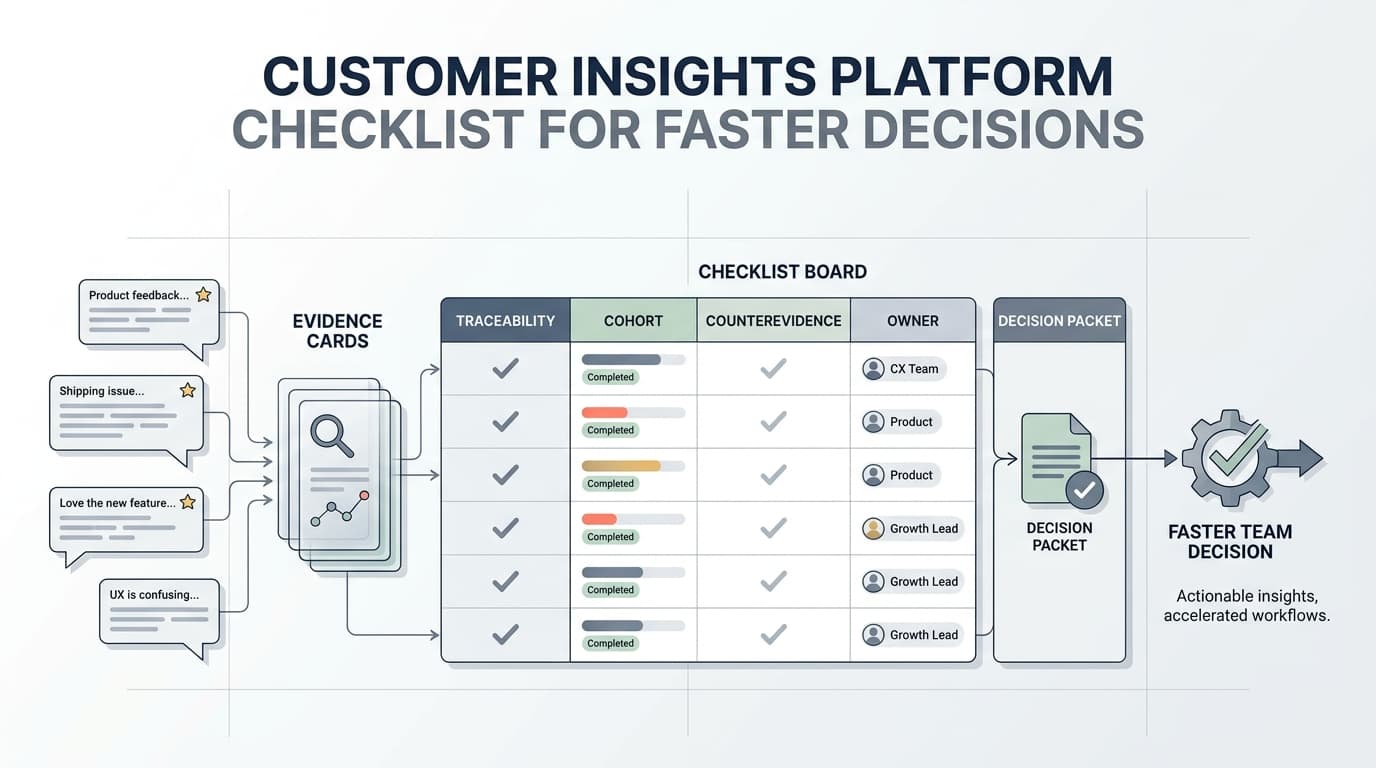
9. Decision packet
The platform output should compress into a decision packet.
Use this format:
| Packet field | Required content |
|---|---|
| Decision question | The decision the analysis supports. |
| Cohort | Source set, date range, segments, and exclusions. |
| Top answer | One plain-English answer. |
| Evidence table | Themes, source examples, signal strength, and counterevidence. |
| Segment note | Who the finding applies to and who it does not apply to. |
| Recommended action | Build, fix, test, reposition, monitor, reject, or research further. |
| Owner | Product, growth, CX, support, marketing, ecommerce, research, or engineering. |
| Next artifact | PRD, experiment brief, listing brief, support macro, roadmap note, help article, sales enablement, or no-action record. |
| Confidence | High, medium, or low, with the reason. |
| Recheck date | When the evidence should be refreshed. |
This is the core asset. A customer insights platform does not need to generate perfect strategy. It needs to produce a packet the team can inspect and route.
Think of the packet as the bridge between customer feedback intelligence and decision-ready customer insights.
10. Owner handoff
An insight without an owner is content, not a decision.
Use a simple routing table:
| Finding type | Owner | Follow-up artifact |
|---|---|---|
| Repeated product defect | Product or quality owner | Defect brief with source evidence |
| Missing feature or unmet use case | Product manager | Roadmap candidate or PRD note |
| Confusing setup or onboarding | CX, support, or lifecycle owner | Support macro, guide, or onboarding test |
| Listing, pricing, or message mismatch | Marketing or ecommerce owner | Copy brief or experiment plan |
| Competitor weakness | Growth or product marketing owner | Positioning brief |
| Unclear evidence | Research owner | Interview, survey, or manual review plan |
| High demand but weak pain | Founder or category owner | Monitor-only note |
The owner can accept, reject, or ask for more evidence. What matters is that the output enters a real workflow.
11. Recheck trigger
Every customer insight has a shelf life.
Set a recheck trigger such as:
- 30 days after a product change
- 14 days after a listing or pricing test
- After 100 new reviews
- After the next support-ticket batch
- After a competitor launch
- Before the next roadmap review
- When a rating, return, conversion, or activation metric moves
This keeps the customer insights platform connected to live decisions rather than archived summaries.
12. Reuse log
The team should be able to reuse accepted findings.
A reuse log can store:
- Winning customer language
- Rejected assumptions
- Recurring objections
- Validated segments
- Product gaps
- Competitor patterns
- Support explanations
- Experiment learnings
- Evidence IDs and source links
This is how a customer insights platform compounds. The next team should not need to rediscover the same customer truth from scratch.
A 20-minute decision-room review
Use this fast review when a platform output is about to enter a meeting.
| Minute | Review step | Pass condition |
|---|---|---|
| 0-2 | Read the decision question | The question names the decision, owner area, and evidence window. |
| 2-5 | Inspect the cohort | Sources, dates, segments, and exclusions are visible. |
| 5-8 | Check the top themes | Themes are specific enough to drive action. |
| 8-11 | Open source examples | Each major claim has inspectable evidence. |
| 11-14 | Review counterevidence | The packet shows what could narrow or weaken the conclusion. |
| 14-17 | Confirm the owner and artifact | Someone owns the next step and knows what to produce. |
| 17-20 | Choose the meeting outcome | Build, fix, test, reposition, monitor, reject, or research further. |
If the packet fails source traceability, cohort lock, or owner handoff, do not use it to make a decision yet.
Customer insights platform scorecard
When comparing customer insights platform tools, score the same real decision in each platform.
| Check | 1 point | 3 points | 5 points |
|---|---|---|---|
| Decision setup | Generic prompt only | Can define a question | Can define decision, owner, evidence window, and output type |
| Source inventory | Hidden or unclear | Sources visible | Sources visible with channel, date, segment, and export path |
| Cohort control | Weak filters | Basic filters | Specific cohort lock with exclusions |
| Traceability | Summary only | Some examples | Every claim links to inspectable records |
| Theme quality | Sentiment labels | Useful clusters | Behavior-specific themes tied to actions |
| Counterevidence | Missing | Manual review possible | Counterevidence is surfaced in the packet |
| Owner handoff | None | Exportable summary | Routed decision packet with owner and next artifact |
| Reuse | Static report | Saved notes | Searchable learning log or workflow integration |
Do not buy the platform with the prettiest summary. Choose the one that produces the clearest decision packet from your real evidence.
Where VOC.AI fits
VOC.AI is strongest when customer reviews, marketplace evidence, buyer language, competitor review patterns, and ecommerce category context are central to the decision.
Use Voice of Customer Analysis when the team needs to cluster reviews by pain point, expectation, and feature mention, then move from customer signal to product, support, listing, or research action.
Use Product Research when the decision needs demand signals, review-backed validation, launch planning, category context, buyer pain points, and roadmap inputs.
Use Market Insight when the team needs Amazon category movement, market size and share shifts, demand estimates, price bands, review volume, ratings, BSR signals, competitor tracking, and product opportunity context.
Use the Review Analysis API when the customer insights platform workflow needs REST API, Python SDK, or MCP support so review, keyword, listing, and sales-estimate signals can feed internal dashboards, agents, or recurring workflows.
If rollout cost matters, the current Pricing page describes one credit system across API, MCP, and Agent analysis, with Free, Pro, Team Lite, Team Growth, and Enterprise Custom plans.
VOC.AI should not be treated as every possible customer insights platform category. It is a strong fit when review-backed ecommerce evidence is the backbone of the decision. If your primary workflow is formal interview storage, enterprise survey benchmarking, or behavioral product analytics, another platform category may lead while VOC.AI supports review intelligence and market evidence.
Common mistakes
Mistake 1: starting with a broad prompt
"Analyze our feedback" produces a report. "Decide whether this issue should change the next roadmap review" produces a workflow.
Mistake 2: accepting summaries without examples
A summary without source evidence is hard to challenge. Do not let a customer insights platform turn original customer language into unverifiable confidence.
Mistake 3: mixing cohorts
Old reviews, new tickets, enterprise objections, first-time buyers, and competitor complaints can all be useful. They should not be blended into one conclusion without labels.
Mistake 4: hiding contradictions
Contradictions often reveal segmentation. Keep them visible until the owner decides whether they matter.
Mistake 5: skipping the next artifact
The meeting should end with a PRD note, experiment brief, listing update, support macro, research plan, monitor note, or explicit rejection. If there is no next artifact, the insight is not decision-ready.
FAQ
What is a customer insights platform?
A customer insights platform helps teams collect, organize, analyze, and act on customer evidence from sources such as reviews, support conversations, surveys, sales notes, research interviews, product analytics, and public market signals.
What should a customer insights platform include?
At minimum, it should include source intake, cohort control, theme analysis, source traceability, counterevidence review, owner handoff, reusable learning, and integration paths into the workflows where decisions happen.
How do you evaluate customer insights platform tools?
Use the same real decision in each tool. Check whether the platform can lock the evidence cohort, preserve source examples, produce behavior-specific themes, show counterevidence, route the next artifact, and save the learning for reuse.
How is a customer insights platform different from a dashboard?
A dashboard shows what is happening. A customer insights platform should help explain why it is happening, which customer evidence supports the explanation, what decision should follow, and who owns the next step.
How can teams make customer insights decisions faster?
Teams move faster by narrowing the decision question, locking the evidence cohort, requiring source traceability, preserving counterevidence, using a decision packet, and assigning an owner before the meeting ends.
The practical bottom line
A customer insights platform is useful when it changes the quality and speed of team decisions.
The working rule is simple: do not ask for more insights until the current evidence can answer a decision. Lock the cohort, preserve the source trail, challenge the clean narrative, route the owner, and recheck the signal after action. That is how a customer insights platform becomes more than a reporting layer. It becomes a faster, more defensible way to decide what customers are telling you to do next.