Updated August 24, 2026.
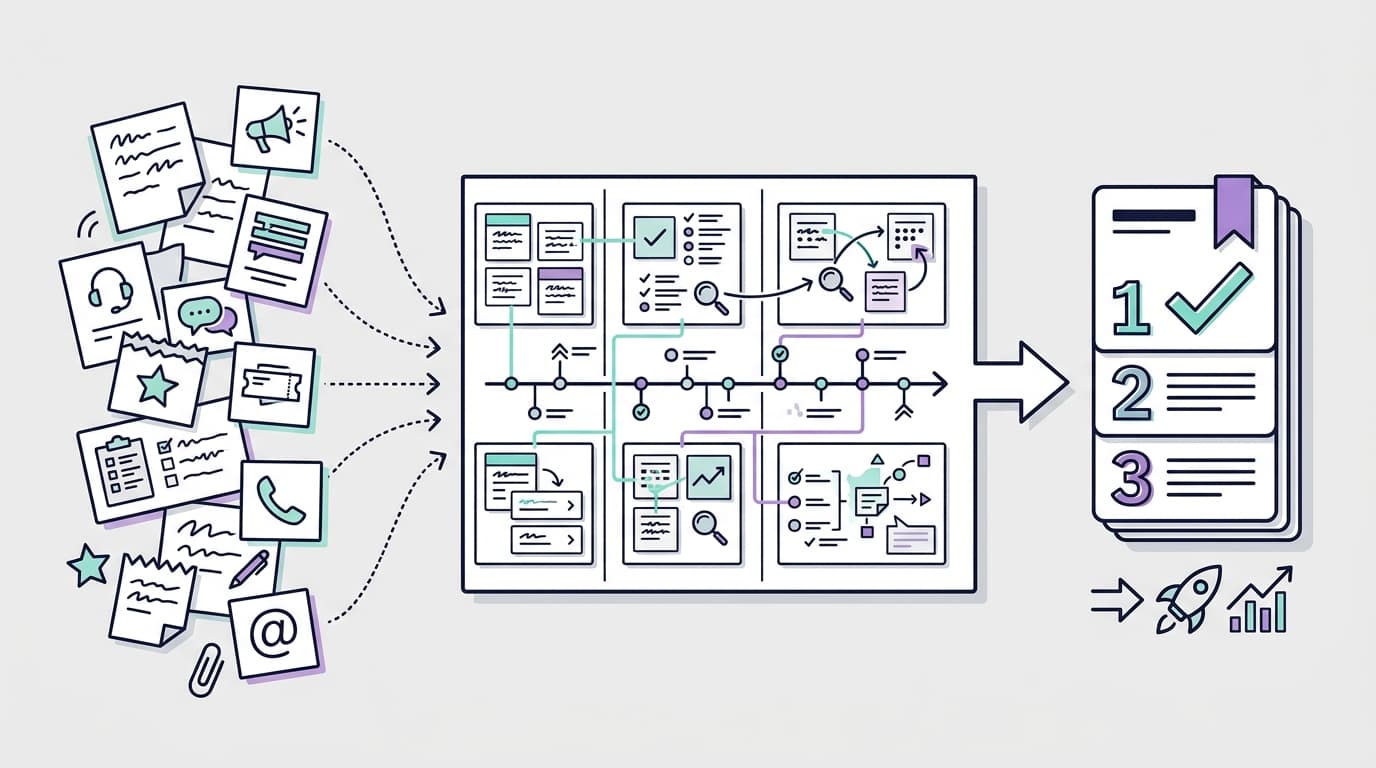
Customer feedback analysis is the process of turning customer language into evidence a team can use to make a decision. The inputs might be reviews, support tickets, survey comments, sales-call notes, research interviews, app-store reviews, community posts, or social comments. The output should not be a prettier summary. It should tell the team what customers are saying, which customers said it, how strong the pattern is, what could make the pattern weaker, and what decision should happen next.
That last part is where most teams get stuck. They collect feedback constantly, but the feedback sits in different tools and arrives with different levels of context. A product manager sees feature requests in Slack. Support sees escalations in Zendesk or Intercom. Marketing sees objections in reviews and social comments. Research sees interview notes. Sales sees competitive pushback. Everyone has evidence, but nobody has the same evidence.
Customer feedback analysis matters when a team needs to move from scattered comments to a defensible choice: what to build, fix, test, rewrite, escalate, or ignore.
What customer feedback analysis means
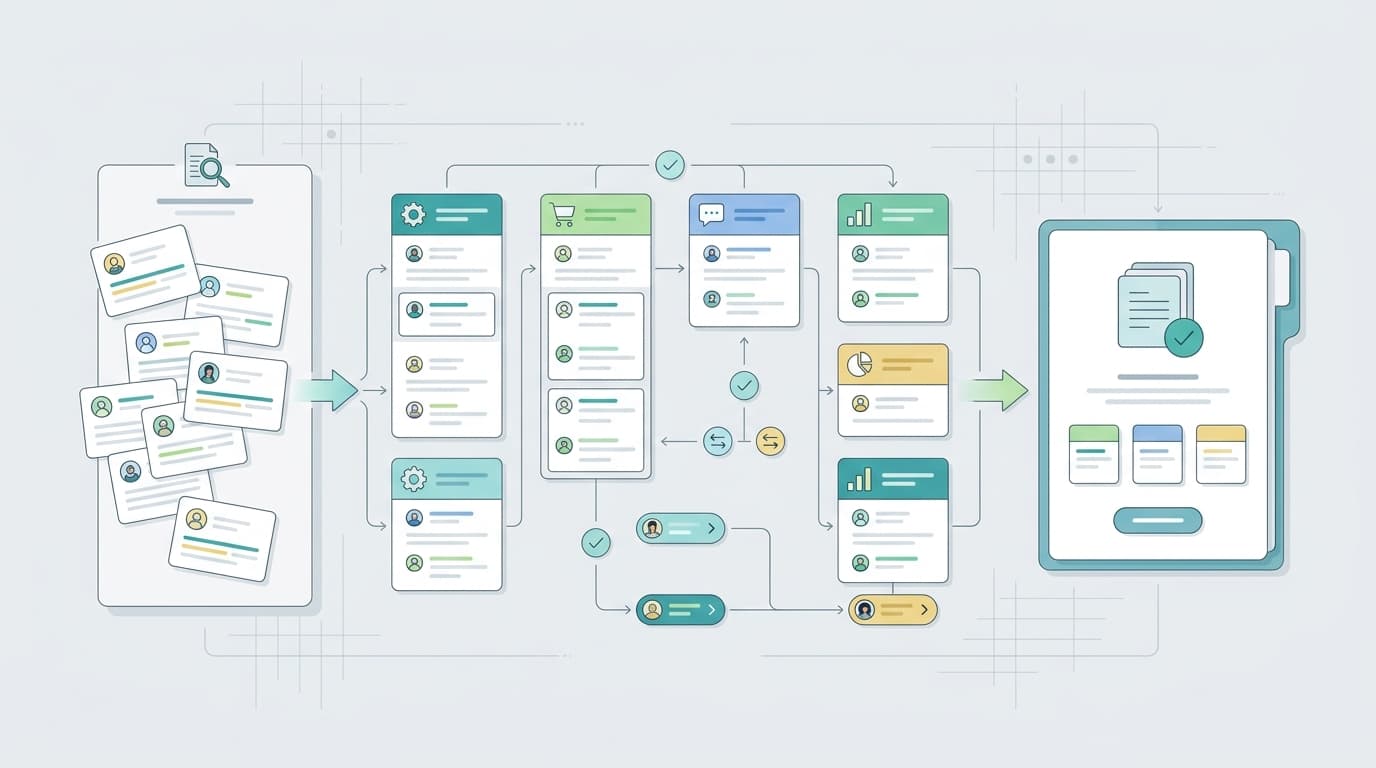
Customer feedback analysis is a workflow with four jobs:
- Collect feedback from the sources that match the decision.
- Structure the evidence by source, cohort, date, customer segment, product, severity, and theme.
- Interpret repeated patterns without losing the original customer language.
- Hand off a decision packet to the person who owns the next action.
The simplest version can happen in a spreadsheet. A mature version can use customer feedback analysis tools, a Voice of Customer platform, a research repository, support analytics, review intelligence, or an API-first workflow. The tool matters less than the discipline: preserve the evidence, control the cohort, write specific themes, check counterevidence, and connect every conclusion to an owner.
For example, "customers dislike onboarding" is not enough. A useful finding sounds more like this:
New trial users who imported historical data in the last 30 days expected tags to carry over automatically. Seven support tickets and four cancellation comments mention lost organization work. The product owner should test an import-preview screen and recheck ticket share two weeks after release.
That is customer feedback analysis. It turns language into a scoped product decision.
What counts as customer feedback
Customer feedback is not one channel. It is any direct or indirect signal where customers describe expectations, friction, outcomes, objections, or alternatives.
| Feedback source | What it is good for | What to watch |
|---|---|---|
| Product reviews | Purchase motivation, product gaps, competitor comparisons, recurring defects, buyer language | Reviews may overrepresent extreme positive or negative experiences |
| Support tickets and chats | Friction, confusion, defects, escalation patterns, operational issues | Support data may miss silent churn or prospects who never contact support |
| Surveys and NPS/CSAT comments | Structured segments, explicit ratings, open-text themes | Respondents are not always representative of the whole customer base |
| Research calls and interviews | Context, workflow detail, why a behavior happens | Sample sizes are smaller and require careful synthesis |
| Sales calls and win/loss notes | Buying objections, competitor comparisons, unmet requirements | Sales notes can mix customer language with rep interpretation |
| App-store and marketplace reviews | Public pain points, rating-linked issues, expectation gaps | Platform context and review recency matter |
| Social and community comments | Emerging language, brand perception, creator or peer discussion | High volume can create noise without decision filters |
| Cancellation and return reasons | Retention risk, failed expectations, operational defects | Forms can be shallow unless paired with verbatim evidence |
Good customer feedback analysis does not treat every source as equal. It asks which source is credible for the decision at hand.
If the decision is a product roadmap tradeoff, reviews, tickets, interviews, and behavioral data may need to agree. If the decision is an ecommerce listing rewrite, review language and competitor objections may matter more. If the decision is a support workflow change, ticket recurrence and severity may be enough.
When customer feedback analysis matters
Customer feedback analysis matters when at least one of these conditions is true.
1. The team has more feedback than it can read manually
Manual review works when the sample is small and the decision is low risk. It fails when feedback arrives every day across reviews, tickets, surveys, social comments, and calls.
The danger is not only wasted time. The danger is selective memory. Teams remember the loudest quote, the newest complaint, or the request that matches an existing roadmap belief. Customer feedback analysis gives the team a repeatable way to see patterns instead of anecdotes.
2. The decision has real cost
Customer feedback analysis matters when the next action uses meaningful time, money, or trust.
Use it before:
- moving a roadmap item up or down
- rewriting a product page or ecommerce listing
- changing onboarding, packaging, shipping, or support policy
- launching a retention experiment
- escalating a defect to engineering or operations
- prioritizing a competitor gap
- investing in a new customer feedback analysis tool
If the action is cheap and reversible, a small sample may be enough. If the action affects a roadmap, a launch, a support process, or a revenue-critical page, the evidence needs more structure.
3. Multiple teams disagree about what customers mean
Product may hear "feature request." Support may hear "workflow confusion." Marketing may hear "positioning gap." Sales may hear "competitive objection."
Customer feedback analysis matters when those teams need one shared evidence set. The workflow should show the source records, the customer segment, the strength of the theme, and the decision owner. Without that, every team can use a different set of quotes to defend a different conclusion.
4. A metric moved and the team needs the why
Analytics can show that activation dropped, returns increased, ratings shifted, win rates declined, or churn rose. Customer feedback analysis helps explain what customers were trying to do, what disappointed them, and which words they used to describe the gap.
Behavior tells you what changed. Customer language helps explain why the change may have happened.
5. The company is replacing intuition with operating cadence
Early teams can often rely on founder calls and ad hoc reading. That breaks when the team grows. Customer feedback analysis becomes important when the company needs a weekly or monthly operating rhythm:
- what changed in the customer voice
- what evidence is strong enough to act on
- what decision was made
- who owns the next action
- what signal will be checked later
The customer feedback intelligence workflow playbook covers that operating cadence in depth. This article focuses on the definition and timing threshold.
When customer feedback analysis does not matter yet
Not every feedback pile deserves a full analysis process.
Customer feedback analysis may be premature when:
- there is no decision owner
- the team is only looking for interesting quotes
- the sample is too small for the action being considered
- the feedback source does not match the decision
- the team cannot inspect the original records
- nobody has time or authority to act on the result
- the question is really a product analytics, pricing, legal, or compliance question that needs another evidence type
The test is simple: if the analysis cannot change a decision, reduce the scope. Use a lighter pass, collect more evidence, or clarify the decision first.
A practical customer feedback analysis workflow
Use this workflow when you need the analysis to support an actual decision.
Step 1: Write the decision sentence
Start with one sentence:
We need to analyze this feedback from this cohort so this owner can decide whether to take this action.
Examples:
- We need to analyze recent onboarding tickets from new Team accounts so the activation PM can decide whether import setup needs a sprint fix.
- We need to analyze two- and three-star reviews for this ASIN and three competitors so the ecommerce lead can decide which product-page objection to answer.
- We need to analyze cancellation comments from the last quarter so the customer success owner can decide which retention experiment to test.
If you cannot write the sentence, you are not ready to analyze. You are still exploring.
Step 2: Define the feedback cohort
Customer feedback analysis changes when the cohort changes. "All feedback" is rarely a useful cohort.
Define:
- source channels
- date range
- product, plan, SKU, ASIN, market, or competitor
- customer segment
- rating, severity, sentiment, or lifecycle stage
- language or region when relevant
- inclusion and exclusion rules
This keeps the team from overgeneralizing. A pattern in recent low-rated reviews may not describe all customers. A problem in enterprise onboarding may not describe self-serve users.
Step 3: Preserve original evidence
Every theme should link back to the original records. Keep the source comment, date, source channel, customer or account segment, product context, and any filter logic used to include the record.
This is especially important when AI is involved. AI-assisted customer feedback analysis can speed up clustering and summarization, but the team still needs to inspect source examples, review theme quality, and separate raw customer language from generated interpretation.
Step 4: Create specific themes
Weak themes sound broad:
- bad onboarding
- price complaints
- quality issue
- feature request
- poor support
Decision-grade themes explain the customer behavior or expectation:
| Weak theme | Decision-grade theme |
|---|---|
| Bad onboarding | New users expect imported history to preserve labels, but the setup flow does not show what carries over |
| Price complaints | Trial users are confused about credit rules, not necessarily objecting to the price |
| Quality issue | Buyers like the travel case design but report zipper failure after repeated use |
| Feature request | Customers ask for bulk export because weekly reporting requires copying quotes into stakeholder decks |
| Poor support | Customers say agents solved the immediate ticket but did not explain how to avoid the issue next time |
Specific themes make action possible.
Step 5: Check counterevidence
Good customer feedback analysis asks what would make the conclusion weaker.
Look for:
- customers who had the opposite experience
- segments where the issue does not appear
- time windows where the problem improved
- channels where the theme is absent
- behavior data that does not support the feedback
- feedback that suggests a different root cause
Counterevidence prevents the team from confusing a plausible story with a strong signal.
Step 6: Build the decision packet
The output should be short enough to use in a meeting and specific enough to act on.
Include:
- decision question
- cohort and source scope
- top themes
- representative evidence
- counterevidence
- confidence label
- recommended action
- owner
- due date or review date
- expected signal change
- link back to the evidence set
This is the difference between "customers are frustrated" and "support should update the import-help flow because recent new-account tickets repeatedly mention missing labels; recheck ticket share and setup completion after the change."
The decision threshold: when is analysis enough?
Customer feedback analysis is enough when the evidence can survive a decision-room challenge.
Use this threshold table.
| Question | Weak answer | Stronger answer |
|---|---|---|
| What did customers say? | They complained about onboarding | Twelve recent new-account records mention lost labels during import |
| Which customers? | Users | Team-plan trials importing historical data |
| How recent? | Recently | Last 30 days, after the new import flow shipped |
| What decision does it affect? | Improve onboarding | Add import-preview copy before the next activation experiment |
| What could make this wrong? | Not sure | Existing users do not report it, and it is absent from mobile setup tickets |
| Who owns the action? | Product | Activation PM owns copy test; support ops owns macro update |
| How will we know? | Fewer complaints | Import-related ticket share and setup completion will be checked in two weeks |
If the analysis cannot answer those questions, it may still be useful exploration. It is not yet decision-ready customer feedback analysis.
How customer feedback analysis tools fit
Customer feedback analysis tools help when the volume, repetition, or workflow cost is too high for manual review.
Use tooling when you need:
- faster clustering across large feedback sets
- source traceability from themes to original records
- repeatable cohorts and saved filters
- theme comparison across products, competitors, plans, or time windows
- AI-assisted summaries with human review
- structured exports to docs, tickets, dashboards, or internal agents
- governance around permissions, audit trails, and usage
The customer feedback analysis tools evaluation framework goes deeper on how to compare tools. The short version: do not buy software only because it summarizes feedback. Buy it when it preserves evidence, controls cohorts, supports counterevidence review, and produces a clean decision handoff.
Where VOC.AI fits
VOC.AI is strongest when customer feedback analysis depends on ecommerce review intelligence.
The current Voice of Customer Analysis page positions VOC.AI around turning customer reviews into product direction, buyer language, and market-ready decisions. It highlights 2B+ reviews, feedback clustering by pain point, expectation, and feature mention, and using the same dataset across dashboards, the agent, and the API.
That makes VOC.AI useful when the decision depends on questions like:
- Which product complaint appears repeatedly in recent reviews?
- Which competitor weakness should product research investigate?
- Which buyer language should appear in a listing, FAQ, ad, or creator brief?
- Which review-backed issue should product, support, or operations own?
- Which feedback workflow should move into an API or internal agent?
For engineering teams, the Review Analysis API describes REST API, Python SDK, and MCP support for pulling review, keyword, listing, and sales-estimate signals into internal workflows. The current pricing page describes one credit system across API, MCP, and Agent analysis, with free, personal, team, and enterprise options.
VOC.AI is not a replacement for every customer feedback system. A research repository may still be better for interview libraries. A support platform may still be better for queue management. A survey platform may still be better for structured NPS or CSAT programs. VOC.AI fits best when review-backed ecommerce evidence is central to the decision.
Customer feedback analysis examples
Use these examples to decide whether the workflow matters now.
| Situation | Does customer feedback analysis matter? | Why |
|---|---|---|
| A founder wants three quotes for a pitch deck | Not much | A lightweight quote pull is enough if no product decision is being made |
| A PM is deciding whether to delay a roadmap item | Yes | The decision has opportunity cost and needs source-backed evidence |
| Support sees a spike in one complaint after a release | Yes | The team needs recency, severity, root-cause clues, and owner routing |
| Marketing wants exact customer language for a landing page | Yes, but narrow | Review and call language can improve copy if source context is preserved |
| A team has five survey comments from one account | Not yet | The sample may guide follow-up questions, but it is weak for broad prioritization |
| An ecommerce team is comparing competitor complaints | Yes | Review-backed themes can reveal product gaps, objections, and positioning angles |
| A weekly exec meeting wants a dashboard number only | Maybe not | A metric may be enough unless the meeting needs to make a decision |
The best use cases have a clear owner, a bounded question, enough evidence to inspect, and a next action that can be measured.
FAQ
What is customer feedback analysis?
Customer feedback analysis is the process of collecting, structuring, interpreting, and handing off customer language so a team can make a decision. It uses feedback sources such as reviews, tickets, surveys, interviews, calls, app-store comments, and social posts.
Why is customer feedback analysis important?
Customer feedback analysis is important because it helps teams move beyond anecdotes. It shows which customer patterns are repeated, which source records support them, which segments are affected, and what decision or action should follow.
What is the difference between customer feedback analysis and sentiment analysis?
Sentiment analysis classifies emotional tone. Customer feedback analysis is broader. It may include sentiment, but it also covers themes, evidence quality, cohorts, counterevidence, decision ownership, and follow-up measurement.
When should a team use customer feedback analysis tools?
Use customer feedback analysis tools when feedback volume is too high for manual review, when multiple sources need to be compared, when findings must be traceable, or when the output needs to move into a repeatable product, support, CX, research, or ecommerce workflow.
What is the first step in customer feedback analysis?
The first step is writing the decision sentence: what feedback you will analyze, from which cohort, for which owner, and for which decision. Without that sentence, the analysis usually becomes a generic summary instead of decision-ready evidence.
Final take
Customer feedback analysis matters when the team is about to make a decision that deserves better evidence than the loudest quote. Start with the decision, define the cohort, preserve the source records, write specific themes, check counterevidence, and hand the result to an owner.
If review-backed ecommerce evidence is central to that decision, VOC.AI can help turn reviews, buyer language, product gaps, and competitor signals into a workflow your team can repeat.