Choosing an Amazon review analysis tool is harder than it looks because products with similar labels often solve different jobs.
One tool may estimate whether reviews look trustworthy. Another may collect and filter reviews. A third may summarize common pros and cons. A seller-focused platform may go further by connecting buyer language to product requirements, competitor comparisons, listing inputs, or monitoring.
That means there is no useful “best tool” without a decision in mind.
This guide compares the main Amazon review analysis workflows available in 2026 and explains how to test them with the same ASIN. The goal is not to crown a universal winner. It is to help sellers, ecommerce operators, and agencies identify which workflow produces evidence they can verify and use.
Disclosure: VOC AI publishes this guide and is included as one option. Vendor capabilities can change, so verify current availability, marketplace coverage, plan limits, data rights, and pricing before purchasing.
Quick answer: which Amazon review analysis tool fits which job?
| Tool or workflow | Best fit | What to verify before choosing |
|---|---|---|
| VOC AI | Structured voice-of-customer analysis, buyer-language discovery, product research, competitor review analysis, and decision-ready outputs | Supported data scope, evidence traceability, export needs, and the right workflow for your team |
| SellerSprite Review Analysis | Amazon-oriented review filtering, review statistics, variant analysis, product-definition research, and exports | Marketplace coverage, plan limits, filter depth, and whether the output supports your next decision |
| AMZScout AI Review Analyzer | Fast AI-assisted orientation to customer opinions and recurring product themes | Input method, review coverage, evidence visibility, and whether summaries preserve important context |
| Kimola | Collecting and analyzing Amazon reviews within a broader consumer-research workflow | Supported domains, collection limits, privacy requirements, source traceability, and licensing |
| ReviewMeta | Shopper-oriented screening for potentially unnatural review patterns | Availability and methodology; do not treat authenticity screening as seller-grade voice-of-customer analysis |
| Manual spreadsheet or general AI workflow | Small, bounded research tasks where the team controls the source data and review process | Data rights, sampling bias, repeatability, privacy, hallucination risk, and the cost of rebuilding the workflow |
The right shortlist depends on whether you need authenticity screening, review collection, theme analysis, or a repeatable decision workflow.
Start with the job, not the feature list
Before comparing tools, write down the decision the analysis must support. For example:
- Should we change a product requirement before the next manufacturing run?
- Which competitor complaint is frequent and specific enough to investigate?
- Which buyer objections should the listing address more clearly?
- Are recent reviews showing a new quality or packaging issue?
- Which customer segment describes the strongest use case?
- Can an agency reproduce the same analysis across multiple clients or ASINs?
A feature such as “AI sentiment analysis” is not a decision. It is one component of a workflow.
The useful output is a chain your team can inspect:
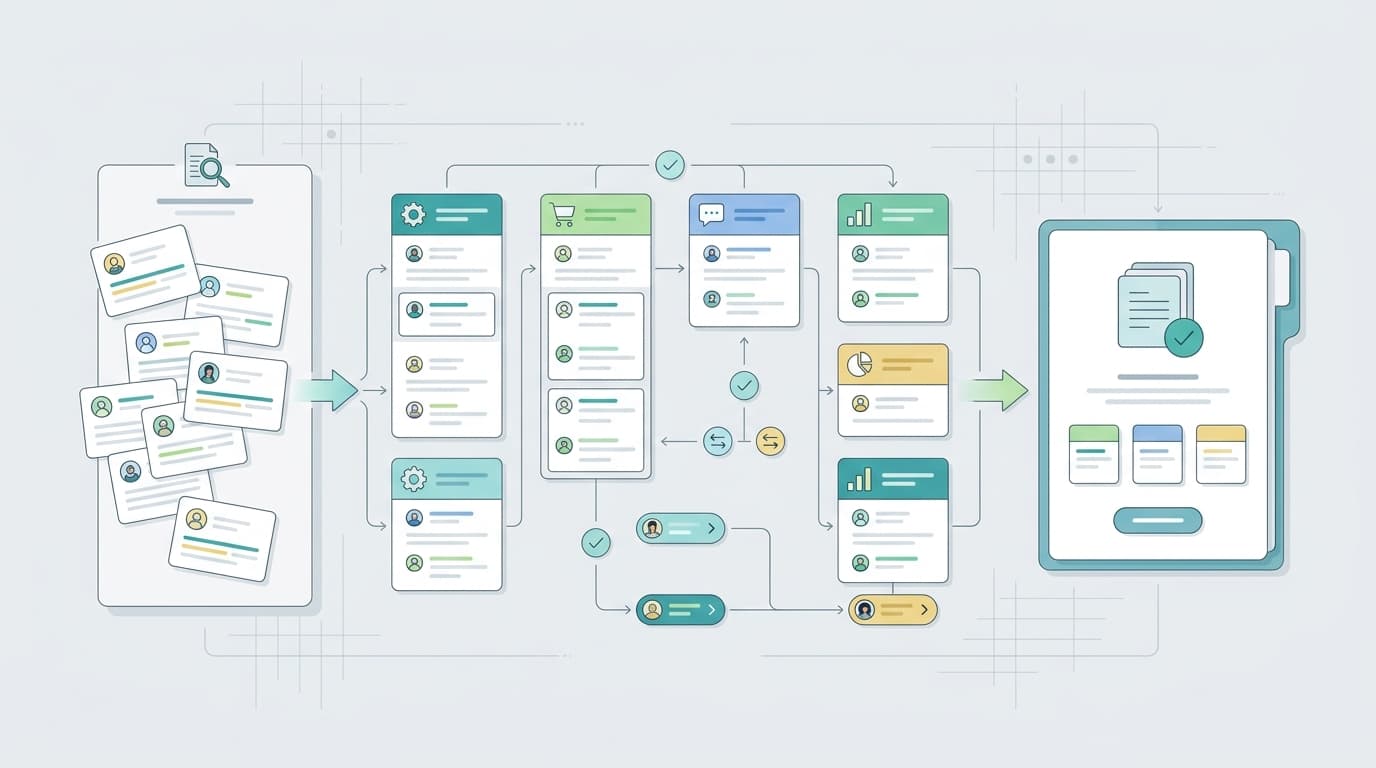
product cohort → customer theme → source evidence → comparison → uncertainty → owner → action
If a tool stops at a polished summary, your team may still need to rebuild the analysis before it can act.
The four categories of Amazon review analysis tools
1. Review authenticity checkers
Authenticity tools focus on whether review patterns appear natural or suspicious. They can help shoppers interpret a rating, but they are usually not designed to answer seller questions such as:
- Which product attribute causes repeat complaints?
- Which variant has a different failure pattern?
- What buyer language should inform a product brief?
- How have complaints changed over time?
ReviewMeta is a familiar example of this category. Use this type of tool when review trust is the primary question. Do not assume an adjusted rating provides the product, competitor, or customer insight required for an operating decision.
2. Review collection and filtering tools
These workflows help teams gather or access reviews and narrow them by fields such as rating, date, variation, or keyword. Filtering is important because a single pooled average can hide meaningful differences.
For example, a complaint may concentrate in:
- one size or color;
- a recent production period;
- one marketplace;
- one use case;
- low-star reviews only;
- verified buyers with a specific expectation.
SellerSprite’s public Review Analysis page emphasizes Amazon-oriented filtering, review statistics, product-definition insight, and review download. Kimola describes a broader workflow that starts with an Amazon product URL, collects reviews, analyzes them, and supports filtering and downloads.
Collection alone is not analysis, however. Check whether the workflow preserves the fields and source references needed to validate conclusions.
3. Review summarizers and AI analyzers
An Amazon review summarizer can reduce reading time by grouping common praise and complaints. That is useful for orientation, especially when a team is evaluating an unfamiliar product.
The risk is compression. A short summary can flatten:
- differences between products or variants;
- recent versus historical reviews;
- common but low-impact issues versus rare but severe failures;
- buyer motivation versus product outcome;
- conflicting evidence;
- the source reviews behind a conclusion.
AMZScout presents an AI Review Analyzer for quickly interpreting customer opinions. Evaluate it—and any similar summarizer—by checking whether important themes can be traced back to the underlying evidence.
For a deeper checklist, see what an Amazon review summarizer should show sellers.
4. Seller-grade review intelligence
Seller-grade workflows connect review evidence to recurring ecommerce decisions. Depending on the platform, that may include:
- buyer motivations and usage scenarios;
- product strengths and weaknesses;
- competitor comparisons;
- recurring complaints and unmet needs;
- listing-copy inputs;
- product-requirement discovery;
- monitoring and signal changes;
- reusable reports for product, CX, growth, or agency teams.
VOC AI’s public Voice of Customer Analysis, review-backed product research, and competitor review analysis pages describe this broader decision-oriented category. Technical teams can also evaluate the Review Analysis API for structured review fields and AI-derived conclusions.
This category is the strongest fit when the organization needs repeatability, evidence sharing, and a path from customer language to an owned action. It may be unnecessary when the only goal is a quick shopper trust check.
How the leading options differ
VOC AI: best fit for structured seller and agency decisions
VOC AI is built around turning review data into structured voice-of-customer insight. It is most relevant when the analysis must support product research, competitor comparison, listing inputs, customer understanding, or an API-enabled workflow.
Strong fit when:
- teams need motivations, scenarios, strengths, weaknesses, and recurring themes;
- source evidence must support a product or growth decision;
- multiple roles need a shared analysis output;
- an agency needs a reusable method across clients or ASINs;
- the workflow must extend beyond a one-paragraph summary.
Verify: the exact data scope, supported workflow, plan access, exports, API requirements, and how your team will validate conclusions.
VOC AI should not be treated as a replacement for every keyword suite, authenticity checker, data collector, or enterprise text-analytics platform. Its fit is strongest when review intelligence must lead to a defensible ecommerce action.
SellerSprite: best fit for Amazon-oriented filtering and review research
SellerSprite’s Review Analysis page describes filters and statistics organized around Amazon review research, including dimensions such as rating, date, and variation. It also presents review download and product-definition use cases.
Strong fit when:
- the team already uses Amazon seller research workflows;
- variant, rating, or time-based filtering is important;
- review exports are part of the research process;
- the analyst wants Amazon-specific context near other seller research.
Verify: supported marketplaces, review limits, plan availability, export fields, evidence links, and the depth of theme or sentiment analysis.
AMZScout AI Review Analyzer: best fit for quick AI-assisted orientation
AMZScout’s public material presents an AI workflow for analyzing customer reviews and surfacing product opinions. This can be useful when a seller wants a faster first pass before deciding whether deeper research is justified.
Strong fit when:
- speed and ease of use are primary requirements;
- the team needs an initial view of recurring pros and cons;
- review analysis is one step inside a broader product-research process.
Verify: how reviews are supplied, how much of the review set is analyzed, whether filters are available, whether conclusions link to evidence, and whether results can be exported or reused.
Kimola: best fit for a broader collect-and-analyze workflow
Kimola’s public workflow describes entering an Amazon URL, collecting reviews, analyzing the data, filtering respondents, and downloading results. That makes it relevant for researchers who need both collection and analysis inside a broader consumer-insight process.
Strong fit when:
- review collection and analysis need to happen in one workflow;
- the team works across sources or broader research projects;
- analyst-controlled filters and downloads matter.
Verify: supported Amazon domains, collection limits, review-field coverage, source traceability, privacy controls, licensing, and platform terms.
ReviewMeta: best fit for authenticity screening
ReviewMeta is positioned as an Amazon review checker. Its purpose is different from seller review intelligence: it helps evaluate review patterns rather than build product requirements or competitor strategy.
Strong fit when:
- the primary user is a shopper;
- the question is whether a rating may be influenced by unnatural review patterns;
- the team needs a trust-screening signal before interpreting review content.
Verify: current availability, methodology, product coverage, and how the result should be interpreted. Treat the output as one signal, not proof that an individual review is genuine or false.
The one-ASIN test: compare tools in 45 minutes
Do not compare marketing pages alone. Run the same bounded test through every shortlisted workflow.
Step 1: define one decision
Choose a narrow question, such as:
What recurring complaint should we investigate before revising the next product version?
Avoid open-ended prompts such as “tell me everything about this product.” A narrow decision makes output quality easier to compare.
Step 2: document the review cohort
Record:
- ASIN and marketplace;
- products or competitors included;
- variants included or excluded;
- rating bands;
- review date range;
- language;
- review count available to the workflow;
- known gaps or collection limits.
This protects against false comparisons. Two tools may produce different answers because they analyzed different review sets.
Step 3: request the same outputs
Ask each workflow for:
- Top purchase motivations
- Common usage scenarios
- Recurring praise themes
- Recurring complaint themes
- Product strengths and weaknesses
- Recent changes or emerging signals
- Three source examples for the most important conclusion
- One contradictory or disconfirming example
- A recommended next action and its uncertainty
Step 4: score evidence, not presentation
Use a simple 1–5 scale for each criterion:
| Criterion | What a strong result looks like |
|---|---|
| Cohort control | The included products, variants, ratings, dates, and markets are explicit |
| Theme quality | Themes are specific, distinct, and useful for the decision |
| Evidence traceability | Important conclusions link back to source reviews or identifiers |
| Comparison depth | The workflow separates products, variants, or time periods |
| Contradiction handling | Conflicting evidence and uncertainty remain visible |
| Buyer language | The output preserves phrases, motivations, objections, and scenarios |
| Actionability | A clear owner can use the result without rebuilding the analysis |
| Repeatability | Another analyst can reproduce the setup and interpretation |
| Team reuse | Results can be exported, shared, or integrated appropriately |
| Governance | Data rights, privacy, retention, and human validation can be managed |
The best Amazon review analysis tool for your team is the one that produces the highest-value evidence for the decision—not the most attractive dashboard.
Red flags when evaluating review analysis software
Watch for these warning signs:
- The tool does not disclose what review set was analyzed.
- Themes cannot be traced to source evidence.
- All reviews are pooled despite meaningful variant or date differences.
- The output uses precise percentages without explaining the denominator.
- Summaries present correlation as product demand or sales causation.
- The workflow hides contradictory reviews.
- Exported results lose the cohort definition.
- The vendor implies guaranteed sales, ranking, conversion, or compliance outcomes.
- The collection method, license, or platform permissions are unclear.
- An old listicle recommends a product that is no longer active.
Freshness matters. For example, TheReviewIndex’s homepage states that the service was permanently shut down on December 1, 2025, so older comparison posts may still list an unavailable option.
Questions to ask before you buy
- Which Amazon marketplaces and review fields are supported?
- Can we control products, variants, dates, ratings, and languages?
- Does the tool show how many reviews support each theme?
- Can we open or identify the evidence behind important conclusions?
- Can it separate motivations, use cases, objections, outcomes, and failure modes?
- Can it compare competitors or time periods without mixing cohorts?
- Can our team reuse the analysis in product, listing, CX, or growth workflows?
- Are exports, APIs, collaboration, and retention appropriate for our process?
- What human validation is expected before acting on an AI conclusion?
- Do the data-access method and intended use fit platform terms, privacy requirements, and applicable rules?
Do not use review analysis to create, buy, suppress, manipulate, or improperly influence customer reviews. Analysis should support better products and clearer customer understanding, not deceptive review practices.
Frequently asked questions
What is an Amazon review analysis tool?
It is software that helps collect, filter, summarize, classify, compare, or interpret Amazon customer reviews. Some tools focus on authenticity, some on review access and filtering, and others on seller decisions such as product research or competitor analysis.
Can AI accurately summarize Amazon reviews?
AI can accelerate grouping and synthesis, but the result should still be checked against the review cohort and source evidence. Accuracy depends on data coverage, prompt or taxonomy quality, product context, and whether contradictions are preserved.
Is a review checker the same as a review analyzer?
Not necessarily. A review checker usually focuses on suspicious or unnatural review patterns. A review analyzer usually focuses on themes, sentiment, buyer language, or product insight. Some workflows may overlap, but the buying criteria are different.
How many reviews should I analyze?
There is no universal minimum that makes every conclusion reliable. Use a cohort that represents the decision, document the available review count, separate meaningful segments, and disclose limitations. A smaller well-defined cohort can be more useful than a large mixed dataset.
Can review analysis predict product demand?
Review analysis can reveal customer language, frustrations, motivations, and product outcomes. It does not by itself prove market demand, sales potential, or conversion impact. Combine it with category, keyword, pricing, sales, and operational evidence.
What should agencies look for?
Agencies should prioritize repeatable cohort setup, source traceability, reusable taxonomies, exports, collaboration, client-safe reporting, and API options. The process should be reproducible across accounts without hiding uncertainty.
Choose the tool that produces a defensible decision
The Amazon review analysis market includes authenticity checkers, collection tools, AI summarizers, and seller-grade intelligence platforms. Each category can be useful, but they are not interchangeable.
Define one decision. Run the same ASIN through your shortlist. Compare cohort control, evidence traceability, theme quality, contradictions, and the usefulness of the next action.
If your team needs to move from summaries to structured buyer motivations, usage scenarios, product strengths, weaknesses, and competitor insight, explore VOC AI’s Voice of Customer Analysis. Agencies and technical teams can also evaluate a Review Analysis API workflow.
Ready to test a real product set? Compare one ASIN with VOC AI.