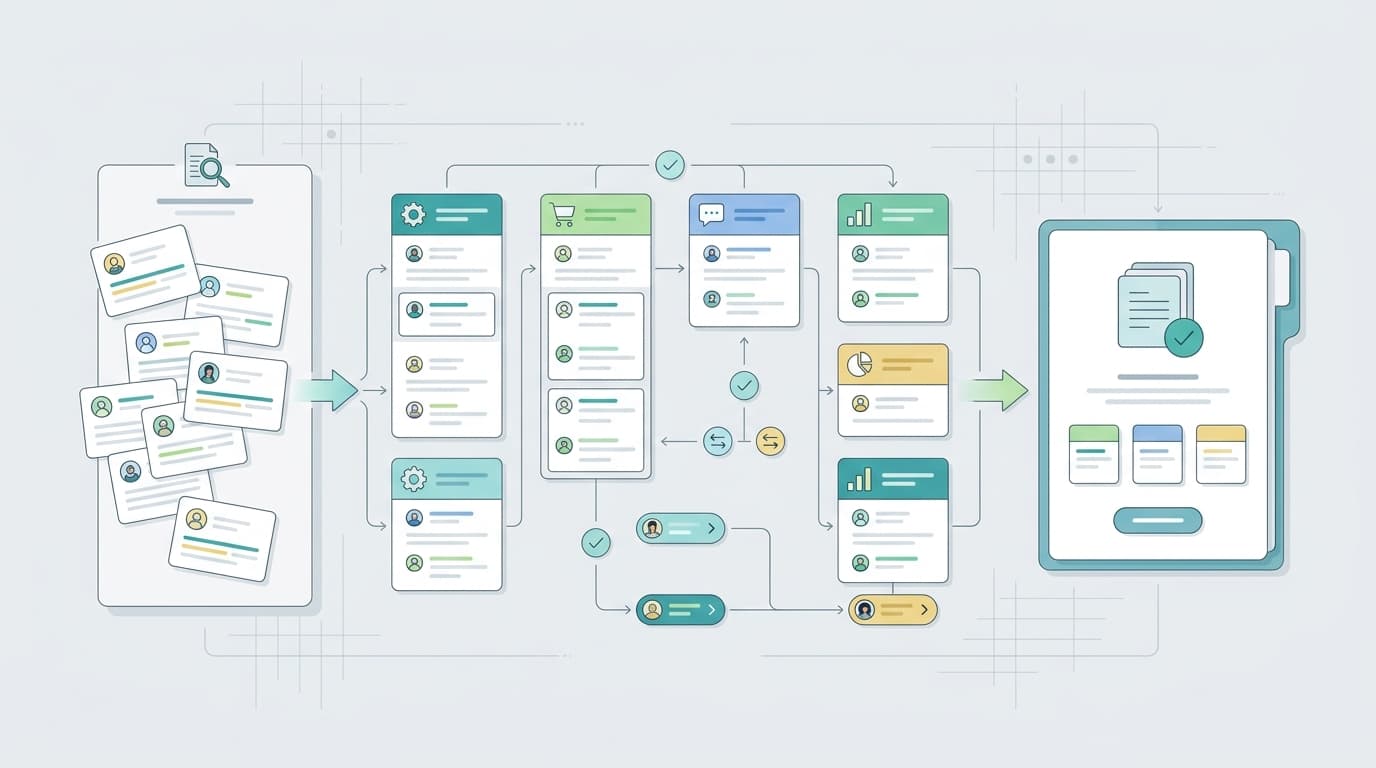
Amazon Review API for Sellers: Dashboards, Alerts, and Weekly Reports
An amazon review api becomes useful when it helps a seller team do something repeatable with review evidence instead of pulling one more export that goes stale after a meeting. The technical surface matters, but the real question is operational: can the team turn review data into a dashboard, an alert, or a weekly report that stays usable after the first test?
That is the gap many seller teams run into. They can get access to reviews, but they still have to rebuild the same workflow every week across spreadsheets, screenshots, manual summaries, and disconnected notes. The result is that review evidence exists, but it does not reliably reach the people who own listing updates, support macros, packaging checks, or product follow-up.
VOC.AI's current public API and MCP pages now frame the offer around Amazon reviews, keywords, and sales data available through REST API, Python SDK, and MCP Server surfaces. That makes the evaluation simpler. A buyer does not need another abstract explanation of what an API is. The buyer needs to know which seller workflow to build first and how to keep that workflow practical.
This guide focuses on the seller-side use cases that fit the broader amazon review api intent best: dashboards, alerts, and weekly reports.
What a seller actually needs from an amazon review api
Most seller teams do not need an API only for access. They need it for continuity.
| Need | Why it matters | What the workflow should preserve |
|---|---|---|
| Dashboard continuity | Teams want one place to review repeated complaints, praise patterns, and product shifts. | Product scope, date windows, rating context, and evidence links |
| Alerting | The team needs to know when a complaint pattern is no longer isolated. | Theme frequency, recency, and who should review it |
| Weekly reporting | Founders, category owners, and operators need the same report structure every week. | Stable sections, comparable periods, and traceable source notes |
| Cross-functional routing | Review evidence often belongs to listing, support, ops, or product owners, not one analyst alone. | Owner fields, severity, and representative buyer wording |
| AI-assisted analysis | Teams want faster synthesis without losing the raw evidence behind the conclusion. | Review-grounded outputs, not unsupported summaries |
That is the difference between an amazon review api and a one-time export. An export gives you data. A working API workflow gives you a repeatable operating surface.
Dashboards are the first strong use case
For many sellers, the first good amazon review api workflow is not a complicated internal product. It is a dashboard that turns scattered review evidence into a stable weekly operating view.
A useful seller dashboard usually needs to show:
- repeated complaint themes,
- stable praise patterns,
- trend movement across time windows,
- product or variation hotspots,
- and owner-ready next actions.
The best dashboard is not the one with the most charts. It is the one that makes the same review questions easier to answer every week.
| Dashboard section | What to show | Why sellers care |
|---|---|---|
| Complaint themes | Repeated negative patterns with counts and recency | Helps decide what needs action now |
| Praise patterns | Consistent positive wording from buyers | Supports listing and ad language updates |
| Trend shifts | What increased or faded since the last review window | Helps teams distinguish current issues from old noise |
| Variation view | Which child ASIN, bundle, or package is affected most | Root causes often hide below the parent listing |
| Action queue | Listing, support, ops, or product follow-up | Keeps the dashboard tied to execution |
Without API-backed refresh, those dashboards often drift into presentation artifacts. With a clean amazon review api workflow, the dashboard can stay current enough to matter between meetings.
Alerts matter when they point to a decision
The second major amazon review api workflow is alerting. Seller teams often think they need more notifications, but the real need is earlier signal with better routing.
A useful alert should not just say that reviews changed. It should help the team understand what changed and who should look first.
| Weak alert | Stronger alert |
|---|---|
| Rating dropped this week | Rating dropped this week and recent low-star reviews repeat the same packaging complaint |
| New negative reviews arrived | A new complaint cluster is rising in one variation and now appears across multiple recent reviews |
| Sentiment worsened | A recent review wave shows repeated expectation-mismatch language that may require listing clarification |
This is where an amazon review api earns its keep. The team can move from broad review movement to more specific triggers tied to repeated wording, time window, rating band, or product scope.
The right implementation pattern is not "automate the business decision." It is "surface the signal early enough that the right owner can inspect it."
Weekly seller reports are where repeatability shows up
Many sellers already run a weekly review readout, even if they do it manually. That is why weekly reporting is one of the clearest amazon review api evaluation use cases.
A weekly seller report usually needs to answer a small set of recurring questions:
- What complaints repeated this week?
- What praise patterns are becoming stronger?
- Did any product, package, or variation show concentrated friction?
- Do recent reviews suggest a listing problem, a support problem, an operations problem, or a product problem?
- What should the team verify before the next meeting?
If the report has to be rebuilt from scratch each time, the workflow does not scale. If the report structure stays stable while the evidence refreshes cleanly, the workflow becomes useful.
| Weekly report block | What it should include |
|---|---|
| Top complaint changes | Repeated issues, recent examples, and likely owner |
| Top praise changes | Positive language worth reinforcing in messaging |
| Variation or ASIN risk | Concentrated friction by child item or package |
| Monitoring notes | What needs another week of observation before action |
| Validation queue | Which raw reviews the team should still inspect directly |
That is also where AI-assisted summaries can help, as long as the report still points back to evidence. A seller team should not accept a polished paragraph if it cannot verify what review language produced it.
Which surface fits which seller workflow
VOC.AI's current public pages present three access surfaces: REST API, Python SDK, and MCP Server. The best choice depends on the workflow you are building.
| Surface | Best fit for sellers | Main advantage | Watch out for |
|---|---|---|---|
| REST API | Internal dashboards, BI layers, repeatable reporting jobs | Flexible for structured recurring pulls | Requires implementation ownership |
| Python SDK | Analyst scripts, one-off reporting automation, notebook workflows | Faster to prototype than wiring raw requests by hand | Still needs someone to maintain the script |
| MCP Server | AI-client and agent workflows inside tools such as Codex, Claude Code, Cursor, or similar setups | Fastest path to review-grounded AI assistance | Prompt quality and output review still matter |
If your team already knows it wants a dashboard, direct API or SDK work may be the shortest path. If the team wants to ask review-analysis questions inside an AI workflow first, MCP may be the cleaner starting point.
MCP is useful when the team wants answers, not another dashboard first
Some seller teams do not want to build the full dashboard first. They want faster access to review-grounded answers inside an existing AI workflow.
That is where MCP can be the better first step. VOC.AI's current public messaging explicitly connects Amazon truth to AI-native workflows, which makes MCP relevant for teams that want to:
- ask for a product-specific complaint summary,
- compare competitor objections,
- draft a founder-ready weekly note,
- extract buyer-language patterns for listing work,
- or prepare a support or packaging follow-up list.
The key guardrail is still the same: the AI layer should accelerate evidence review, not replace it. A seller should be able to trace an important conclusion back to the actual review pattern before changing copy, packaging, support language, or product direction.
A practical first implementation path
The best first implementation is usually narrower than teams expect. Start with one product set, one report structure, and one owner workflow.
| Step | What to do | Why it works |
|---|---|---|
| 1 | Choose one product, variation group, or category slice | Keeps the first workflow small enough to validate |
| 2 | Pick one repeatable output: dashboard, alert, or weekly report | Avoids mixing too many implementation goals |
| 3 | Define the fields that matter most | Prevents a generic surface from replacing operational context |
| 4 | Keep representative raw-review access visible | Protects the workflow from over-trusting summaries |
| 5 | Route each top theme to a real owner | Turns insight into execution, not presentation |
| 6 | Review the same output again next week | Confirms whether the workflow is truly reusable |
If the team cannot explain the first business question the workflow should answer, it probably does not need a broader API rollout yet.
What sellers should verify before buying
The strongest amazon review api evaluation questions are practical.
- Which seller workflow are we trying to support first: dashboard, alerting, or weekly reporting?
- Do we need direct technical integration now, or would an MCP-first workflow help us test faster?
- Can the output preserve product scope, date window, and review evidence well enough for real decisions?
- Does the team know who owns listing, support, operations, and product follow-up when a complaint cluster becomes real?
- Will we still inspect raw reviews before making customer-facing or business-critical changes?
- Can this workflow refresh cleanly without turning into manual spreadsheet work again?
Those questions are more useful than asking only whether the API exists. The better question is whether the team can turn the API into an operating rhythm.
Where VOC.AI fits
VOC.AI is relevant when a seller team wants more than raw review retrieval. Its current public product and integration pages position the platform around:
- Amazon reviews, keywords, and sales data,
- multiple technical surfaces through REST, Python SDK, and MCP,
- and a broader review-analysis workflow tied to listing, product, and operator decisions.
That makes VOC.AI a practical fit for teams that want to:
- keep one review dashboard current,
- build earlier complaint alerts,
- produce a cleaner weekly operator report,
- or bring Amazon review evidence into AI-assisted workflows.
For current public product proof and workflow fit, the most relevant routes are:
- Review Analysis API
- API & MCP
- Voice of Customer Analysis
- How to Analyze Amazon Reviews Using AI
- Amazon Review Analysis API Use Cases for Seller and Agency Workflows
- Pricing
- Contact Sales
If your team already knows the first operating workflow it wants to improve, that is usually enough context for a focused evaluation.
FAQ
What is an amazon review api for sellers?
An amazon review api for sellers is a programmatic way to move Amazon review data into dashboards, alerts, reports, scripts, or AI workflows. The useful version is not just access. It is a repeatable workflow that helps the team act on review evidence faster.
What is the best first use case for an amazon review api?
For many seller teams, the best first use case is a repeatable dashboard or weekly report. Those workflows make recurring review questions easier to answer without rebuilding the same analysis manually every week.
When should a seller use MCP instead of direct API work?
MCP is often a better first step when the team wants review-grounded answers inside an AI workflow quickly and does not want to build a full internal dashboard first.
Can alerts from an amazon review api replace human review?
No. Alerts should surface repeated signals earlier, but teams still need to inspect representative raw reviews before making product, listing, support, or operational decisions.
What should a weekly seller report include?
A useful weekly seller report should include repeated complaint themes, praise patterns, trend shifts, variation or ASIN risk, monitoring notes, and a short queue of raw-review checks before action.
How should a seller evaluate VOC.AI for this workflow?
Start with one product set and one repeatable output, then test whether VOC.AI's current REST, Python SDK, or MCP surfaces can refresh that workflow cleanly while keeping review evidence traceable.