Amazon Review Monitoring Alerts: Which Complaint Signals Need Action First?
Amazon review monitoring is most useful when it helps a team act before a visible rating drop turns into a larger catalog problem. The mistake many operators make is setting alerts that are too broad, too late, or too hard to route.
A generic "rating changed" alert is better than nothing, but it rarely answers the real operating question: what exactly changed in buyer experience, how fast is it spreading, and which team needs to respond first?
That is where better Amazon review monitoring alerts matter. The strongest alerts do not only watch averages. They watch complaint themes, concentration, recency, variation-level patterns, and overlap with returns or support friction.
Why most review alerts fail
Most alerts fail for one of three reasons:
- they trigger only after the average rating already moved
- they mix too many unrelated signals into one notification
- they do not tell the team what to check next
That makes Amazon review monitoring feel noisy instead of useful.
An operations team does not need more pings. It needs alerts that separate a packaging issue from a listing mismatch, a setup problem from a product defect, or a one-off angry review from a real pattern.
The goal of an alert is not awareness alone
The job of Amazon review monitoring is not to produce another dashboard tile that looks red. The job is to create an earlier decision point.
A useful alert should help the team answer:
- Is this signal new or recurring?
- Is it concentrated on one ASIN, variation, batch, or recent time window?
- Does the complaint theme point to ops, support, listing, or product ownership?
- Do review patterns match return reasons or support-ticket wording?
- Is the issue getting worse fast enough to justify action now?
If the alert cannot help answer those questions, it is probably too shallow.
The five alert types that matter most
Amazon review monitoring does not need dozens of alerts to be effective. In most catalogs, five alert classes catch the highest-value problems earlier than rating watching alone.
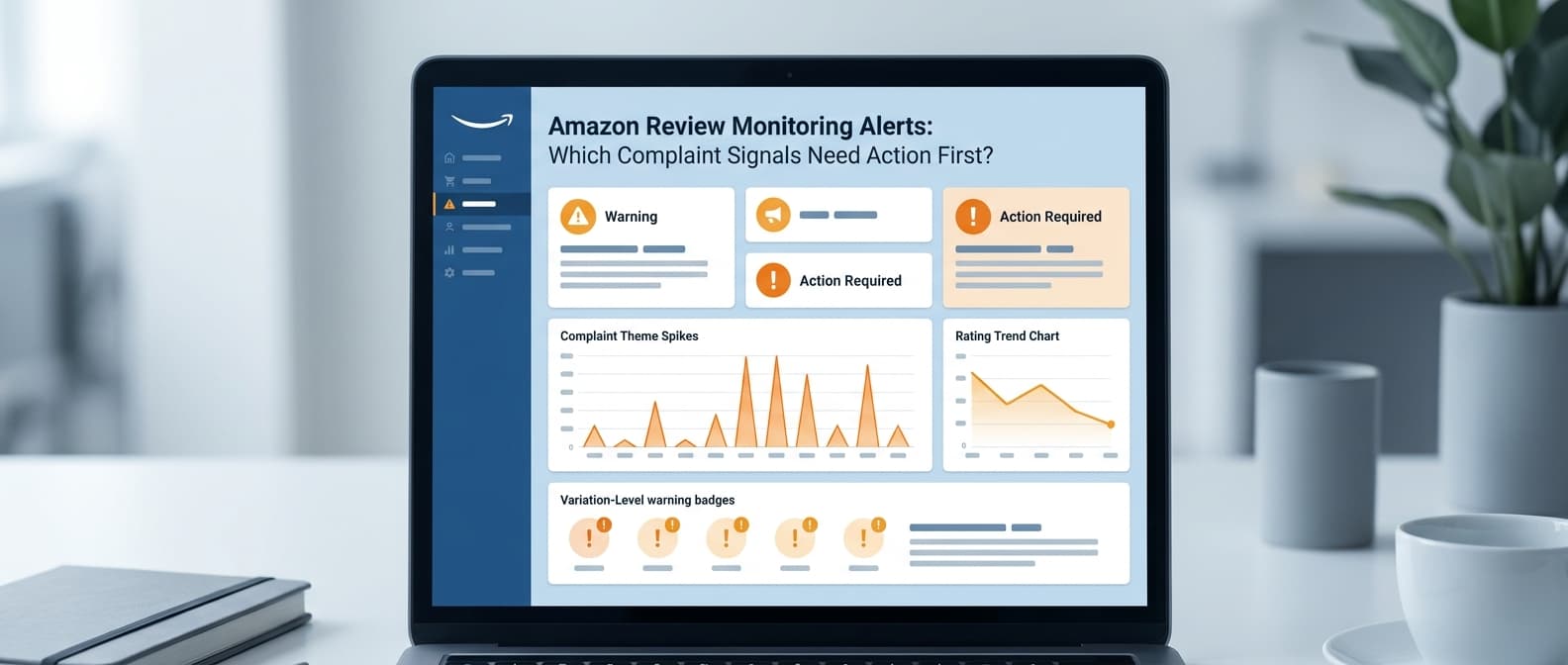
1. Complaint-theme spike alerts
This is the most useful alert type for many teams. Instead of only monitoring the average score, you watch for repeated complaint wording inside a short time window.
Examples:
arrived damagedmissing partnot as describedbattery diedseal was brokeninstructions unclear
One complaint is usually not enough. A repeated theme inside a short span is more important because it suggests the issue may be spreading.
This is why Amazon review monitoring works better when it tracks patterns, not isolated anecdotes.
2. Rating-drop alerts with theme context
Rating-drop alerts still matter. The problem is that many teams stop there.
A stronger Amazon review monitoring workflow pairs the rating-drop alert with the complaint themes that changed underneath it. That turns a surface signal into something the team can investigate.
| Weak alert | Stronger alert |
|---|---|
ASIN rating dropped from 4.4 to 4.2 | ASIN rating dropped from 4.4 to 4.2; most repeated new complaints mention damaged packaging and missing accessories |
The second version is much more actionable because it reduces the time between detection and ownership.
3. Variation-specific alerts
Some catalog problems do not hit every variation equally. One color, size, bundle, or pack format may start generating negative reviews while the parent listing still looks stable.
Amazon review monitoring should catch:
- one variation collecting most low-star reviews
- one bundle creating missing-part complaints
- one size producing fit or expectation mismatch language
- one supplier batch triggering quality concerns
Without variation-level alerts, teams can miss the exact SKU where the problem is forming.
4. Returns-and-reviews overlap alerts
Reviews become more useful when they line up with return reasons or support friction. If the same complaint appears in multiple places, the issue is more likely to be operationally real rather than just emotionally loud.
High-value overlap examples include:
- damaged-box reviews plus return reasons about condition
- setup complaints plus support-ticket wording about confusion
- misleading-image complaints plus refund notes about expectation mismatch
This kind of Amazon review monitoring alert helps teams prioritize better because it ties public feedback to internal cost.
5. Post-change alerts
Some of the most important alerts happen right after a business change:
- a new supplier or prep workflow
- new packaging materials
- updated listing images or bullets
- a promotion, coupon, or traffic spike
- a relaunch, seasonal burst, or creator push
These alerts matter because they turn review monitoring into change monitoring. Instead of asking whether reviews are bad in general, the team asks whether a recent change created new complaint patterns.
Which complaint signals deserve action first
Not every alert deserves the same urgency. Amazon review monitoring should prioritize signals that combine repetition, business risk, and owner clarity.
Use a simple triage model:
| Signal type | Why it deserves faster action | Likely first owner |
|---|---|---|
| Packaging or damaged-delivery complaints | Can spread fast, hurt trust, and drive returns | Ops / supply chain |
| Missing part or incomplete-order complaints | Usually points to packing or fulfillment reliability | Ops |
not as described or expectation-mismatch language | Can often be fixed by listing or image clarity | Listing / merchandising |
| Setup confusion or instruction complaints | Creates both review friction and support load | Support / product |
| Durability or repeated failure complaints | Can indicate a deeper product or quality issue | Product / QA |
The point is not to over-automate urgency. The point is to make Amazon review monitoring route the right kind of review problem to the right team earlier.
How to set thresholds without pretending to be precise
Alert thresholds should be useful, not fake-precise.
It is safer to use rules like:
- repeated complaint language in a short time window
- a theme that appears across multiple recent low-star reviews
- a complaint cluster isolated to one variation
- a complaint pattern that appears in both reviews and returns
- a new complaint theme appearing right after a packaging, listing, or supply change
Avoid claiming that there is one universal number of reviews that always means an emergency. Different catalogs have different volumes, and Amazon review monitoring should reflect that reality.
What a good alert message should include
The best Amazon review monitoring alerts are short, but they still carry enough context for a fast next step.
A good alert should include:
- the affected ASIN or variation
- the complaint theme
- whether the signal is new or recurring
- the short time window involved
- the likely owner to check first
- the next verification step
Example:
New review alert: one variation of ASIN X shows repeated
missing partcomplaints in recent low-star reviews. Check packing accuracy and support-ticket overlap first.
That is more useful than a vague notification that sentiment changed.
How VOC AI fits this workflow
VOC AI is positioned around review intelligence, rating-drop alerts, recurring complaint patterns, and root-cause guidance rather than simple score watching alone.
That fits this topic because better Amazon review monitoring alerts depend on more than raw averages. Teams need to see:
- repeated buyer language
- complaint concentration
- likely root causes
- early warning patterns such as packaging complaints
VOC AI's public positioning supports that workflow through:
- review-derived pain point clusters
- rating drop alerts
- root-cause examples such as packaging complaints
- broader review analysis across active catalogs
For operators, that matters because the point of Amazon review monitoring is not to collect more feedback. It is to turn review patterns into earlier action.
If you want to go deeper, pair this article with What Is Amazon Review Monitoring?, the broader workflow guide on rating drops, returns, and complaint trends, and the packaging-specific example in Packaging Complaints Are an Early Warning Signal. Teams comparing alert quality against surface metrics can also read Amazon Review Monitoring vs. Star Ratings and the core VOC Analysis page.
A simple weekly alert review routine
If your current Amazon review monitoring is still mostly star watching, start with one weekly review cycle:
- Pull new low-star reviews by ASIN and variation.
- Group repeated complaint wording into a few clear themes.
- Check whether any theme appeared suddenly after an operational or listing change.
- Compare the same theme against return reasons or support tickets.
- Assign one owner per high-confidence complaint pattern.
- Recheck the same alert class after the team ships a fix.
This routine is simple enough to maintain, but strong enough to catch early problems before a rating average becomes the only visible signal.
The bottom line
The best Amazon review monitoring alerts do not just tell you that the score changed. They tell you which complaint pattern is growing, how concentrated it is, and what the team should verify next.
That is the difference between passive awareness and useful monitoring.
If your alerts only track ratings, you are usually getting the warning after the customer problem is already visible. If your alerts track complaint themes, variation-level concentration, and overlap with returns or support signals, the team gets a much earlier chance to respond.
That is the kind of Amazon review monitoring alert system that actually helps operators act first instead of react late.
FAQ
What is the most useful alert in Amazon review monitoring?
For many teams, the most useful alert is a complaint-theme spike alert. It catches repeated buyer language before the average rating alone makes the issue obvious.
Should teams still use rating-drop alerts?
Yes. Rating-drop alerts are still useful, but they work better when paired with complaint-theme context so the team can see what changed underneath the score.
Why are variation-level alerts important?
Because one variation can develop a concentrated review problem while the parent listing still looks stable. Variation-level Amazon review monitoring helps isolate the exact SKU or bundle creating the issue.