Amazon Review Monitoring vs. Star Ratings: Why Complaint Themes Catch Problems Earlier
If your team only checks the average star rating, you are usually seeing the problem after it has already spread. Star ratings matter, but they are a summary signal. Amazon review monitoring becomes more useful when you also track complaint themes, rating velocity, return reasons, and repeated wording across reviews.
For Amazon operators, the real question is not "Did the rating move?" It is "What changed in buyer experience, how fast is it spreading, and who needs to act before the next replenishment cycle?"
That is why Amazon review monitoring should not stop at watching stars. A four-star product can already be developing a packaging issue, expectation mismatch, or setup confusion long before the average rating looks alarming.
Why star ratings alone are a weak monitoring system
Star ratings are useful because they are easy to scan. The problem is that they compress too much information into one number.
When a team relies on star averages alone, it misses several early signals:
| What the star rating shows | What it hides |
|---|---|
| The topline average across recent reviews | Which complaint is repeating |
| That satisfaction moved up or down | Whether the drop is tied to one ASIN, one batch, or one competitor event |
| A broad view of customer sentiment | The exact buyer language behind the change |
| A visible marketplace score | Which team should act first |
An average rating can fall because of shipping damage, listing mismatch, setup confusion, a feature regression, a misleading image, or a temporary inventory problem. If you only watch the score, Amazon review monitoring becomes a late warning system.
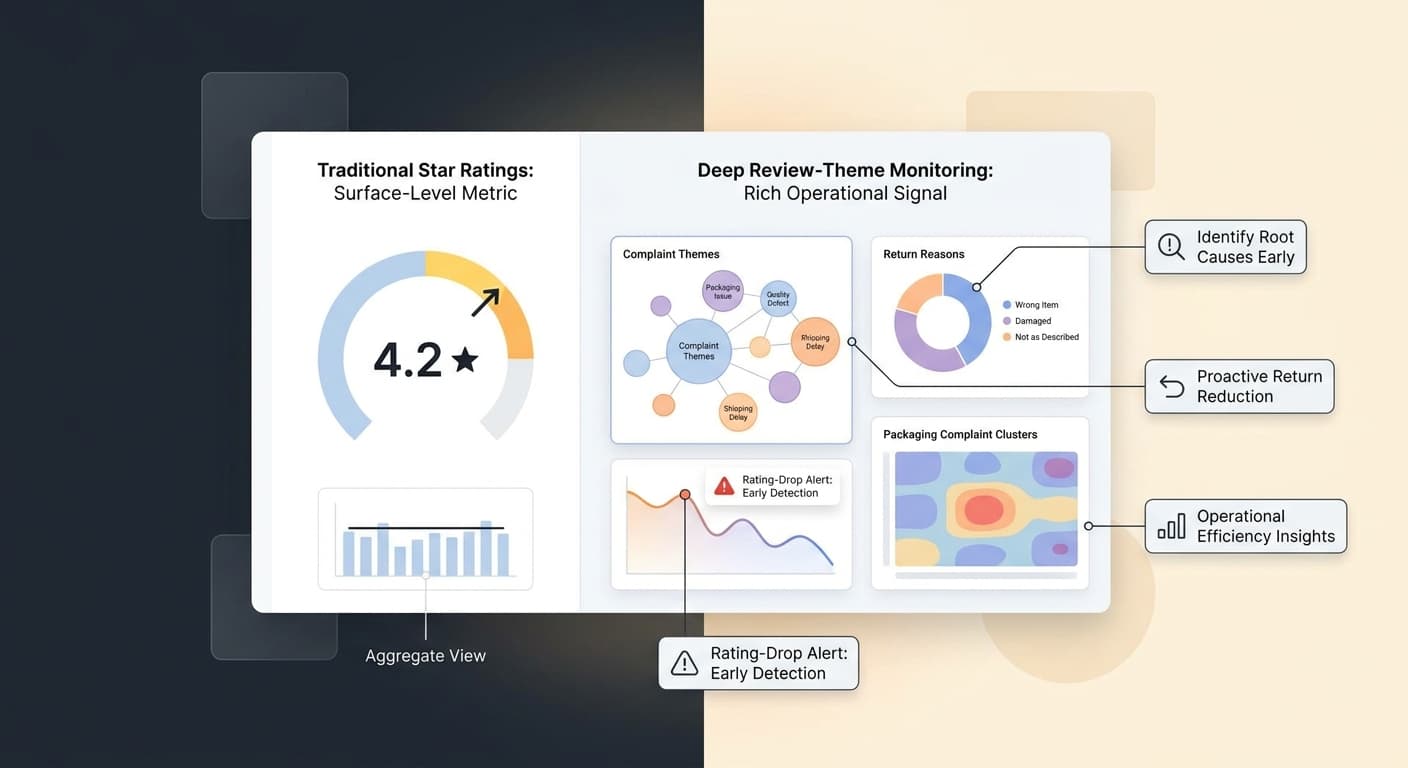
The stronger workflow is to treat star ratings as the surface layer and complaint themes as the operating layer underneath it.
What Amazon review monitoring should catch before the rating drops
Good Amazon review monitoring does more than notify you that something looks off. It helps you identify what changed and whether the issue is spreading.
Before the average star rating moves in a dramatic way, operators can often spot:
- repeated complaint phrases on one ASIN
- one-star or two-star review clusters tied to the same reason
- return reasons that match the same language in reviews
- support-ticket overlap with review wording
- negative shifts after a specific replenishment or prep cycle
- competitor comparison patterns that make your weakness easier to see
For example, seven new low-star reviews mentioning "damaged box," "broken seal," or "arrived crushed" tell you much more than a rating moving from 4.4 to 4.3. The rating change matters, but the complaint theme explains what to investigate.
That is the core difference between basic star watching and real Amazon review monitoring.
Complaint themes are earlier and more actionable than averages
Complaint themes are useful because they help teams move from observation to ownership.
If your Amazon review monitoring workflow surfaces repeated packaging complaints, the next step is clear:
- Check whether the same wording appears in support tickets.
- Compare the timing against the latest inbound batch or 3PL handoff.
- Review whether the listing or imagery created an expectation mismatch.
- Decide whether ops, support, listing, or product owners need to respond first.
That is much harder to do from a star average alone.
The strongest Amazon review monitoring systems translate review language into action categories such as:
| Complaint pattern | Likely issue | First owner |
|---|---|---|
| "Damaged," "torn," "crushed," "broken seal" | Packaging, prep, or transit issue | Ops / supply chain |
| "Smaller than expected," "not as pictured" | Listing expectation mismatch | Listing / merchandising |
| "Stopped working after a week," "battery died fast" | Product quality or feature durability issue | Product / QA |
| "Hard to set up," "instructions unclear" | Onboarding or support issue | Support / product |
This is where Amazon review monitoring becomes operational instead of cosmetic.
Star ratings are lagging indicators, not diagnosis tools
A rating average is a lagging indicator. It tells you that customer experience has already been affected enough to change the score.
But an operator usually wants to know three things sooner:
- which issue is growing
- how concentrated the issue is
- whether the issue is isolated or systemic
Amazon review monitoring should answer those questions before the rating average forces a reaction.
Imagine two products with the same 4.3 rating:
- Product A has stable review language and a normal mix of praise and criticism.
- Product B has a new cluster of complaints around packaging damage, delayed setup success, and return frustration.
If you only watch the star rating, both products look similar. If you monitor complaint themes, Product B clearly has a developing risk.
That is why star ratings should be treated as one metric inside Amazon review monitoring, not the whole system.
The practical workflow: how to monitor beyond stars
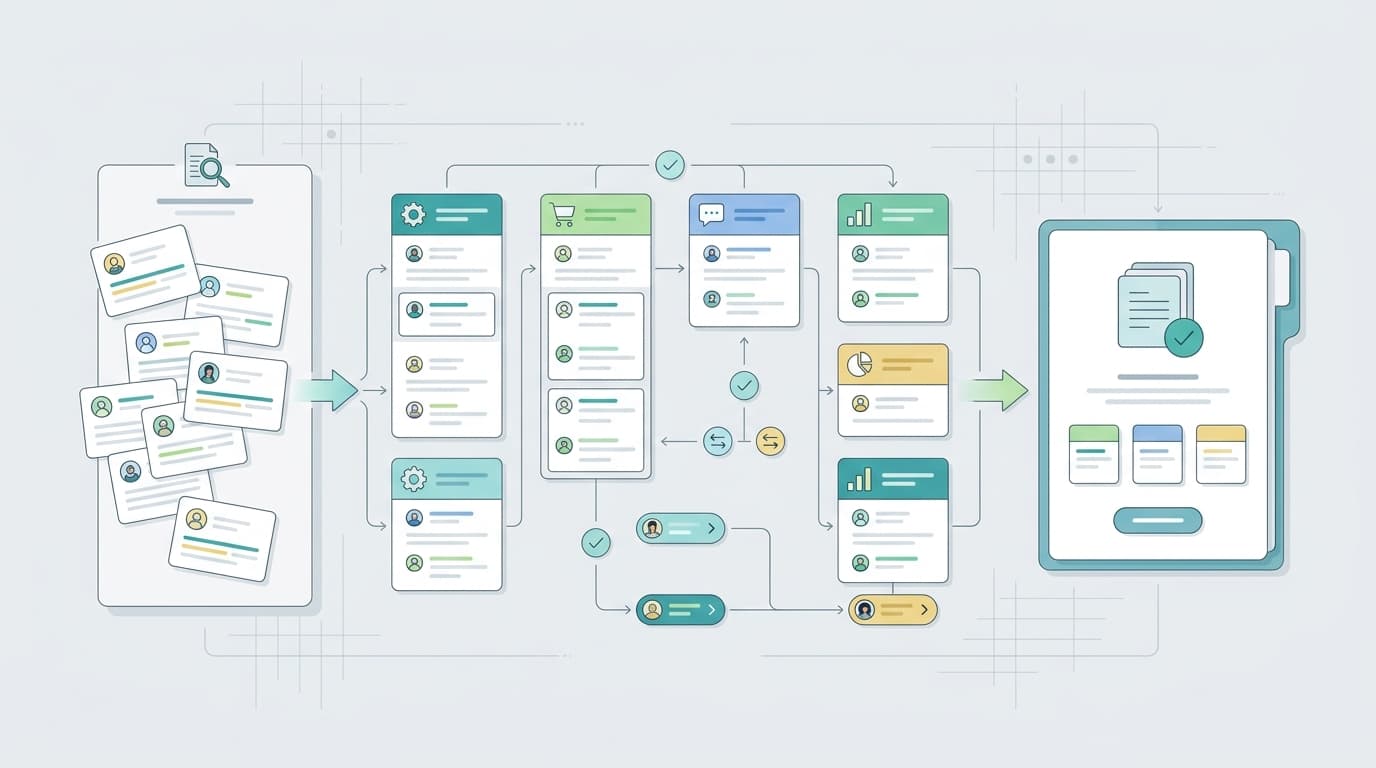
A stronger Amazon review monitoring workflow looks like this:
1. Track rating movement, but do not stop there
Use the average star rating as the trigger for attention, not the final diagnosis.
2. Group new low-star reviews by complaint theme
Look for repeated wording around packaging, quality, instructions, missing parts, misleading images, sizing, or durability.
3. Check velocity, not just totals
Three similar complaints in three days can matter more than ten scattered complaints over two months. Amazon review monitoring works best when the team watches concentration and recency together.
4. Compare reviews against support and return signals
If review wording also appears in tickets or return notes, the problem is more likely to be real and repeatable.
5. Route the issue to the right owner
The job of Amazon review monitoring is not to create another dashboard no one acts on. It is to get the right issue to the right team quickly.
6. Recheck after the fix
Once the team changes packaging, listing copy, support macros, inserts, or prep checks, keep monitoring whether the same complaint language slows down.
When star ratings still matter
This is not an argument against ratings. Star ratings still matter because they affect trust, click-through behavior, and marketplace perception.
But star ratings are strongest when they are used as a summary measure alongside deeper Amazon review monitoring.
Use star ratings to answer:
- Has customer sentiment changed at a high level?
- Which ASIN needs a closer look first?
- Did the situation improve after the fix?
Use complaint-theme monitoring to answer:
- What is the root cause?
- How urgent is it?
- Is the issue spreading?
- Which team owns the response?
That split is important. Ratings tell you where to look. Complaint themes tell you what to do.
A simple comparison: star watching alone vs. review-theme monitoring
| Approach | What you gain | What you miss |
|---|---|---|
| Watch star ratings only | Fast visibility into topline satisfaction | Root causes, repeated wording, ownership, timing, and complaint concentration |
| Manual reading of a few reviews | Some nuance | Poor scale, inconsistent tagging, easy to miss repeating patterns |
| Amazon review monitoring with complaint themes | Faster pattern detection, clearer routing, better prioritization | Requires a workflow and tooling discipline |
This is the main reason Amazon sellers outgrow pure star watching. Once a catalog gets larger or teams split across support, ops, and listing work, the average score is no longer enough.
Where VOC AI fits in this workflow
VOC AI positions itself around review intelligence rather than keyword-only or dashboard-only analysis. On its public site, it emphasizes review-derived pain point clusters, rating drop alerts, root-cause identification, and monitoring across a full catalog.
That matters in this comparison because the operational gap is not "we need more charts." The gap is "we need to understand what buyers are saying before the problem becomes expensive."
VOC AI's public product story focuses on:
2B+reviews indexed- large-scale review analysis rather than manual skimming
- pain point clusters and unmet-need signals
- rating drop alerts with root-cause identification
- review patterns that keyword rank data alone cannot surface
For teams doing Amazon review monitoring, that positioning is useful because it translates buyer language into decisions:
- Which complaint is rising?
- Which ASIN is affected?
- Is the issue likely packaging, listing, product, or support related?
- Which fix should the team validate first?
That is a more useful operating model than waiting for the star average to look bad enough to trigger attention.
If you want to go deeper, pair this comparison with What Is Amazon Review Monitoring?, the broader workflow guide on rating drops, returns, and complaint trends, and the packaging-specific example in Packaging Complaints Are an Early Warning Signal. Teams evaluating tooling can also review VOC Analysis and Competitor Analysis.
What to monitor this week if you want faster signals
If your team wants a better Amazon review monitoring workflow, start with a short weekly checklist:
- Pull all new low-star reviews by ASIN.
- Group repeated phrases into 3 to 5 complaint themes.
- Compare those themes against return reasons and support tickets.
- Flag any theme that appears repeatedly within a short window.
- Assign one owner per complaint cluster.
- Recheck the same themes after the fix ships.
That process gives you earlier warning than star ratings alone and creates a repeatable response loop.
The bottom line
Star ratings are important, but they are not enough for serious Amazon review monitoring.
If you want to catch problems earlier, your team needs to watch complaint themes, not just averages. Repeated buyer language is often the first usable signal that something changed in the product, the packaging, the listing, or the customer experience.
The teams that respond fastest are usually not the teams staring hardest at the average score. They are the teams using Amazon review monitoring to find the pattern behind the score.
If you want to move from star watching to real diagnosis, start with one ASIN, map the last two weeks of complaint themes, and compare them against support and return signals. That is where the next useful decision usually appears.
FAQ
Is star rating still important in Amazon review monitoring?
Yes. Star rating is still a useful summary metric. The mistake is treating it as the only metric. Amazon review monitoring works better when rating trends are paired with complaint-theme analysis.
What is the biggest weakness of watching star ratings alone?
Star ratings do not explain root cause. They show that satisfaction changed, but not whether the issue comes from packaging, quality, expectation mismatch, or support friction.
How does complaint-theme monitoring help sellers act faster?
It turns review language into action categories. Instead of waiting for a bigger rating drop, teams can escalate repeated complaints earlier and route the work to ops, support, listing, or product owners.