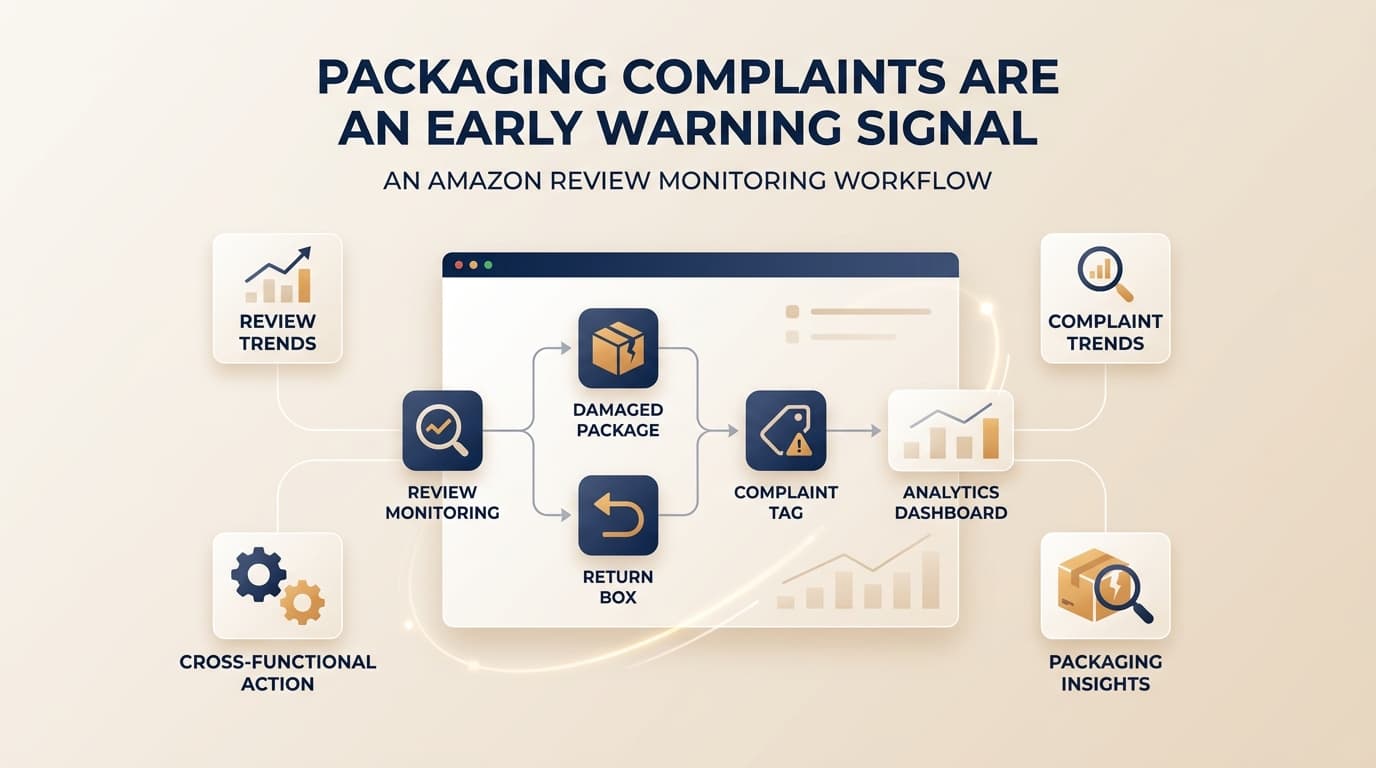
Packaging Complaints Are an Early Warning Signal: An Amazon Review Monitoring Workflow
Packaging complaints rarely start as a dramatic catalog emergency. They usually begin as a few reviews that sound easy to ignore: arrived damaged, box was crushed, seal was broken, missing part, or looked used.
That is exactly why amazon review monitoring matters. By the time a team notices a visible rating slide or a larger returns spike, the packaging issue has often already spread across support, fulfillment, and listing trust.
This article focuses on one practical idea: packaging complaints should be treated as an early warning signal, not a cleanup task after the damage is obvious.
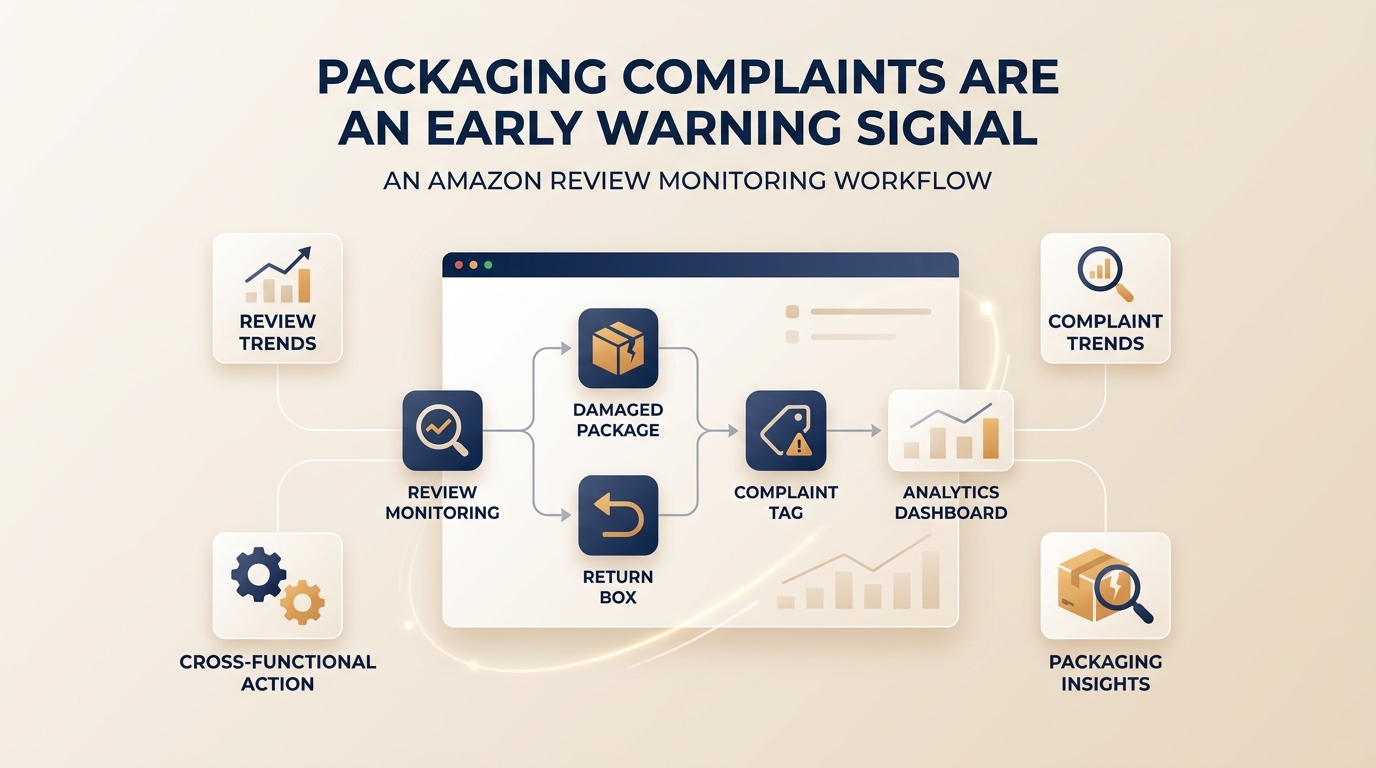
Why packaging complaints matter earlier than most teams think
Packaging problems create a specific kind of catalog risk. Buyers may still like the product itself, but the first experience feels broken. That produces a dangerous mix:
- more low-star reviews with similar wording
- more returns tied to condition, damage, or disappointment
- more support tickets about replacement, refund, or missing items
- more listing distrust when buyers start expecting defects
In other words, packaging complaints often hit reputation and operations at the same time.
That is why amazon review monitoring should not wait for the weekly rating summary alone. Teams need to catch repeated packaging language while the pattern is still small enough to isolate by ASIN, variation, shipment window, or supplier batch.
What packaging complaint language usually signals
Not every complaint about packaging means the same thing. The wording usually points to a different owner and a different next move.
| Review wording pattern | What it often suggests | First owner |
|---|---|---|
arrived damaged, box crushed, broken in transit |
shipping or fulfillment protection failure | ops or 3PL owner |
seal was open, looked used, tampered |
packaging integrity or trust issue | ops owner |
missing part, missing accessory, item incomplete |
packing checklist or fulfillment error | ops owner |
not giftable, box looked cheap, arrived messy |
presentation problem affecting buyer expectation | packaging or brand owner |
different from photos, not as expected when opened |
listing promise mismatch amplified by poor unboxing | listing owner plus ops owner |
The useful move is not just to log these phrases. The useful move is to group them fast enough to decide whether the problem is damage protection, packing accuracy, presentation quality, or listing expectation mismatch.
Why amazon review monitoring beats star-watching here
A rating drop tells you that something worsened. It does not tell you whether the issue came from product quality, size confusion, instructions, or packaging.
Packaging complaints are a good example of why amazon review monitoring needs language, not only averages:
- one damaged-box review may be noise
- five damaged-box reviews in a short window is a pattern
- the same complaint across one variation may indicate a batch issue
- the same complaint after a listing or promotion push may mean fragile expectations are now hitting more buyers
Without complaint clustering, a team can easily misread the problem and spend time changing bullets or price when the real issue sits in packaging protection or fulfillment checks.
A five-step amazon review monitoring workflow for packaging complaints
Step 1: Build a packaging watchlist inside your amazon review monitoring routine
Do not treat every ASIN the same. Start with products most likely to create packaging risk:
- high-revenue ASINs where trust damage matters quickly
- products with fragile components, glass, liquids, or many accessories
- SKUs with recent fulfillment, supplier, or package-material changes
- products pushed by recent ads, deals, or creator campaigns
- gift-oriented products where presentation matters as much as function
That gives your amazon review monitoring process a smaller set of products where packaging language deserves faster review.
Step 2: Group new review language by packaging theme
Do not stop at star count. Group new reviews into specific packaging classes such as:
- transit damage
- crushed or weak outer box
- missing part or accessory
- broken seal or trust issue
- poor presentation or giftability
- mismatch between what the box suggests and what the buyer received
This matters because the action is different for each class. Transit damage may need stronger protection. Missing parts may need a packing audit. Presentation complaints may require both packaging revision and better listing expectation control.
Step 3: Compare timing, variation, and fulfillment context
Once a packaging theme starts repeating, ask three questions:
- Did it appear after a recent packaging, supplier, or warehouse change?
- Is it concentrated in one variation or one product family?
- Did it start after a traffic spike, coupon burst, or creator push?
That is where amazon review monitoring becomes operational. You move from buyers are unhappy to this complaint likely started after a specific business change.
Step 4: Cross-check review wording against returns and support
Packaging complaints often become visible in reviews before they fully show up in return dashboards. But the strongest signal comes when the same wording appears across multiple systems.
| Signal source | What to look for |
|---|---|
| Reviews | arrived damaged, missing part, box crushed, seal broken |
| Returns | damaged on arrival, incomplete package, condition mismatch |
| Support tickets | replacement requests, missing accessory questions, broken-on-arrival claims |
| Listing comments or Q&A | buyers asking whether packaging is improved or parts are included |
If the wording matches across those surfaces, the team should treat the issue as confirmed, not speculative.
Step 5: Route the complaint to the right owner fast
Packaging complaints should not sit in a passive report. Each repeated theme needs an owner:
- ops or 3PL team for protection, packing, and checklist issues
- packaging owner for presentation or material failures
- listing owner for expectation mismatch
- support owner for replacement macro and FAQ updates
- product owner when the packaging complaint reveals a deeper design or accessory issue
If there is no owner, the monitoring loop is incomplete.
A packaging alert matrix teams can reuse
| Alert signal | Why it matters | Immediate action | Owner |
|---|---|---|---|
arrived damaged appears several times in a short window |
likely fulfillment or transit protection failure | isolate affected ASINs and shipment window | ops owner |
missing part repeats across new reviews |
likely packing or component checklist failure | audit pack-out process and support response | ops owner |
box looked used or seal was open starts appearing |
trust and authenticity risk | inspect integrity controls and replacement policy | ops owner |
not giftable or box was embarrassing repeats |
packaging presentation is hurting buyer trust | review outer packaging and merchandising promise | brand or packaging owner |
| packaging complaints rise right after a listing or traffic push | weak expectations may be increasing complaint sensitivity | audit listing promises before changing price | listing owner plus ops owner |
This is also where customer feedback analysis software for ecommerce becomes useful. The value is not just storing complaints. The value is making repeated language visible quickly enough to route the next action.
When to compare against competitor or sibling ASINs
Not every packaging complaint is unique. Sometimes the entire category suffers from fragile shipment conditions. Other times your product alone is underperforming.
Compare packaging themes across:
- sibling ASINs with similar format or bundle structure
- competitor products in the same price band
- older versus newly refreshed packaging versions
If competitors are not collecting the same damaged-box or missing-part language, the issue is likely specific enough to escalate fast. If everyone is seeing similar complaints, the better move may be packaging improvement plus clearer expectation-setting in the listing.
Where VOC AI fits in this workflow
VOC AI positions its review workflow around turning customer reviews into product direction, buyer language, and market-ready decisions. That makes packaging complaints a practical use case because the same review pattern can affect:
- review monitoring and early alerting
- buyer trust in the listing
- support macros and replacement workflows
- competitor comparison
- product and packaging decisions
Teams that already use VOC Analysis, Product Research, Competitor Analysis, or Market Insight can treat packaging complaints as another signal class inside the same decision loop.
For a broader overview of the cluster, the site already covers What Is Amazon Review Monitoring? and How to Analyze Amazon Reviews Using AI.
Common mistakes teams make with packaging complaints
Waiting for a bigger rating drop
By the time the average rating moves enough to look dramatic, the issue has usually been visible in review wording for days or weeks.
Treating packaging as only an ops issue
Many packaging complaints are also expectation problems. If the listing creates the wrong promise, even acceptable packaging may disappoint the buyer.
Mixing isolated complaints with repeated trends
One damaged review is not the same as a cluster. Amazon review monitoring works when teams separate single incidents from repeat language.
Updating price before diagnosing the complaint
Price changes do not fix damaged shipments, missing parts, or weak pack-out controls.
Final takeaway
Packaging complaints are one of the clearest early warning signals in amazon review monitoring because they often show up before a larger rating slide, before a full returns spike, and before support load becomes obviously expensive.
The practical goal is simple: group the language early, compare it by timing and ASIN, match it against returns and support, and route the problem to the owner who can fix it. Teams that do that move faster than teams that wait for the dashboard average to tell the whole story.
When packaging complaints repeat, the question is not whether to pay attention. The question is whether your amazon review monitoring workflow is fast enough to catch them while the fix is still small.