Amazon Review Monitoring for Rating Drops, Returns, and Complaint Trends
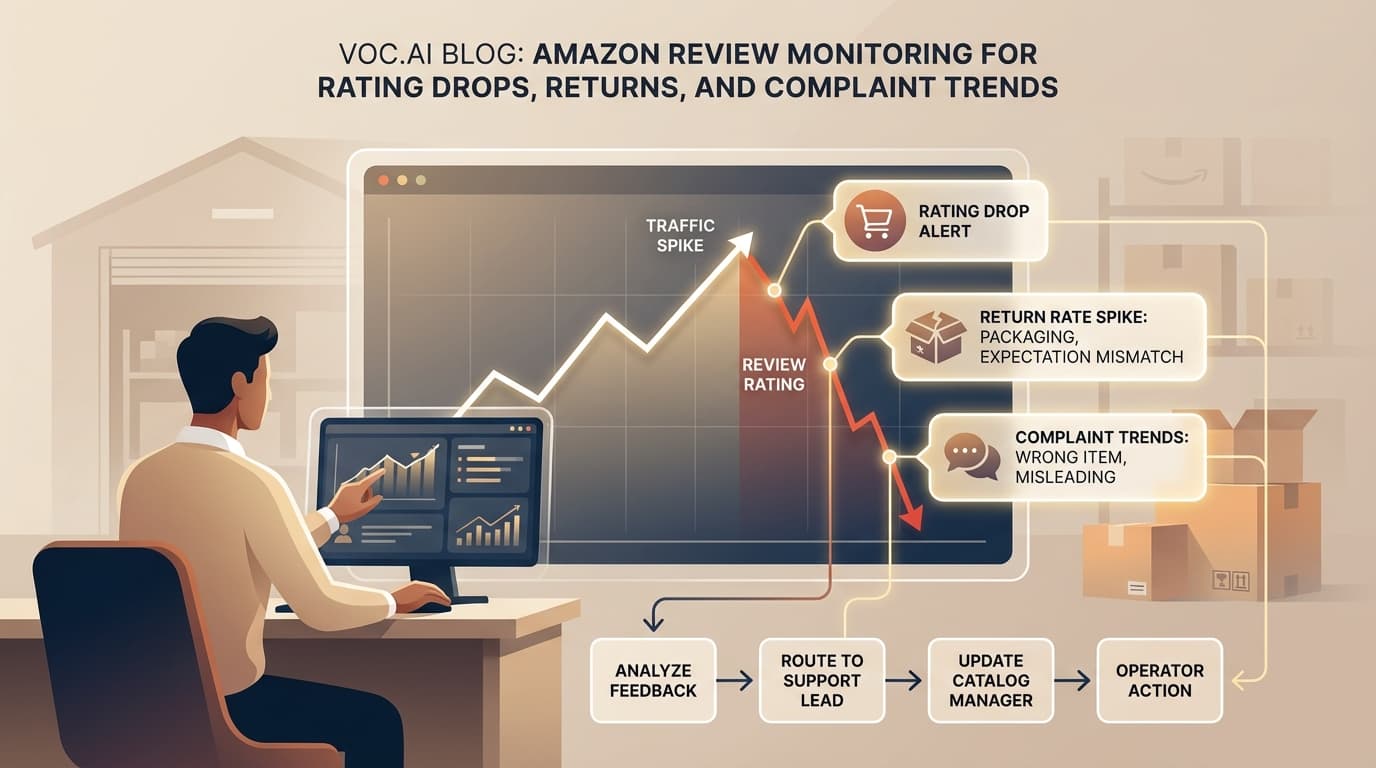
When an Amazon listing starts slipping, the star average is usually the last thing a team should notice. The earlier signals tend to show up in review wording: more buyers mention returns, more complaints cluster around packaging or setup, or a familiar objection starts appearing across multiple ASINs at once.
That is why amazon review monitoring works best as an operating workflow, not a reputation dashboard. A good workflow helps the team see which complaints are repeating, which products are drifting, and which owner should act before the issue spreads into returns, support tickets, and weaker listing performance.
This guide focuses on three signals that matter most for active Amazon catalogs:
- rating drops that need context, not panic
- returns-related complaints that often reveal expectation mismatch
- complaint trends that repeat fast enough to justify action
What amazon review monitoring should help you answer
The goal is not to read every review one by one forever. The goal is to answer a short list of operational questions as fast as possible:
- Which ASINs are showing the biggest negative shift?
- Is the problem isolated to one variation or spreading across the catalog?
- Are buyers describing the same issue in different words?
- Does the review language match support tickets, return reasons, or listing changes?
- Which team owns the next move?
If the workflow cannot answer those questions, it is not really amazon review monitoring. It is just review collection.
Why rating drops alone are not enough
A rating drop matters, but it does not tell the full story by itself. A team that reacts only to stars often misses the root cause:
- one low-star burst may come from a shipping or packaging batch problem
- a returns spike may come from listing promise mismatch, not product quality
- a complaint trend may affect one variation while the parent ASIN still looks healthy
- a competitor may be seeing the same issue, which changes the decision
That is why the strongest amazon review monitoring workflow combines counts with language. The count tells you something changed. The language tells you what to do next.
Start with a focused watchlist, not the whole catalog
Not every product needs the same level of monitoring. Put the highest-risk ASINs on the watchlist first:
- high-revenue products where even a small rating decline matters
- ASINs with recent traffic spikes from deals, ads, creator campaigns, or promotions
- products with recent listing, image, packaging, pricing, or variation changes
- SKUs that already had fragile sentiment or mixed review history
- new launches or refreshed versions that may create expectation mismatch
If possible, keep one stable benchmark ASIN nearby. That makes it easier to separate a product-specific issue from a category-wide pattern.
The three signals that deserve the fastest action
1. Rating drops with repeated low-star wording
A rating drop becomes more useful when you pair it with repeated phrases. If new one-star and two-star reviews keep mentioning the same issue, the problem has already moved beyond noise.
Look for patterns such as:
- arrived damaged
- smaller than expected
- difficult to set up
- missing part
- stopped working
- not as described
The exact wording matters because it helps the team decide whether the problem belongs to product, ops, support, or the listing owner.
2. Returns-related complaints
Many teams track returns in a separate dashboard and reviews in another one. That split slows down diagnosis. Reviews often explain the return reason before the returns report becomes obvious.
Returns-related review language usually points to one of four problems:
| Signal | What it often means | First owner |
|---|---|---|
not as expected |
listing or ad promise mismatch | listing or growth owner |
too small, too big, doesn't fit |
sizing or expectation issue | listing owner or product owner |
arrived broken, damaged box |
fulfillment or packaging failure | ops owner |
hard to use, confusing setup |
onboarding or instructions gap | support owner |
The benefit of amazon review monitoring is speed. If those themes repeat in the first wave of post-purchase feedback, the team should not wait for a larger reporting cycle to route work.
3. Complaint trends across multiple reviews
One review is a data point. Five reviews with the same complaint in different wording is a trend. That distinction is where monitoring becomes useful.
A complaint trend is worth escalating when it shows at least one of these traits:
- it repeats across multiple buyers in a short window
- it affects one variation much more than others
- it matches support-ticket wording
- it appeared after a recent listing or product change
- it is absent on similar competitor listings
The point is not to overreact. The point is to stop treating repeated feedback as isolated.
A simple amazon review monitoring workflow
The workflow below is practical enough for weekly use and strong enough for active catalogs.
Step 1: Watch review velocity and low-star share
Start with volume and distribution:
- new review count by ASIN
- low-star share
- variation-level drift
- time window after traffic or listing changes
This gives you the first clue about where to look deeper.
Step 2: Group new complaints by theme
Do not sort only by star count. Group by repeated complaint classes:
- packaging or shipping damage
- size, fit, or compatibility confusion
- setup difficulty
- durability or quality concern
- missing parts or accessory issues
- listing expectation mismatch
That turns raw feedback into something the team can route.
Step 3: Compare against sibling or competitor ASINs
If one product is collecting a complaint and similar products are not, that is a stronger signal than a category-wide gripe. If competitors are seeing the same problem too, the decision may shift from emergency fix to positioning, documentation, or packaging response.
This is also where competitor review monitoring becomes useful. A complaint trend is more valuable when the team can see whether it is unique, common, or avoidable.
Step 4: Check recent changes before changing price
When a complaint trend appears, teams often reach for price too quickly. That is usually the wrong first move.
Before changing price, check:
- recent bullet or title edits
- ad or creator messaging
- image changes
- packaging updates
- variation merges or catalog edits
Sometimes the product did not fail. The promise changed.
Step 5: Route each pattern to an owner
Every important complaint trend should land in one of four workstreams:
- listing update
- support macro or FAQ update
- ops or packaging escalation
- product investigation
If the insight stays in a spreadsheet without an owner, the monitoring loop is incomplete.
How to treat negative reviews without reading forever
Negative amazon review monitoring matters, but manual reading breaks once traffic scales. The better approach is to preserve verbatim examples while still grouping them into repeatable themes.
A strong workflow should show:
- which negative themes are growing
- which phrases appear across multiple reviews
- which variation is affected
- which similar ASINs are stable
- which owner should act first
That creates decision support instead of passive review logging.
Common mistakes in amazon review monitoring
Mistaking stars for diagnosis
The star average is a signal, not a diagnosis. Without complaint language, it rarely tells a team what to fix.
Waiting too long for more data
If the same complaint appears several times in a short window, the team already has enough evidence to route work.
Treating returns as a separate problem
Returns and reviews are often describing the same failure in different systems. Review wording can surface the issue earlier.
Ignoring expectation mismatch
Many complaint trends come from the wrong buyer promise, not the wrong product. That is why listing changes should be part of the audit.
What a strong monitoring stack should connect
A good workflow should not end at review collection. It should connect review signals to adjacent decisions such as:
For teams that need a broader overview first, the live blog already covers What Is Amazon Review Monitoring? and How to Analyze Amazon Reviews Using AI.
The advantage of connecting those workflows is simple: the same complaint trend can influence packaging, listing copy, support macros, roadmap discussion, and competitor positioning.
A compact scorecard for monitoring decisions
Use a simple scorecard when a trend appears:
| Question | If yes | If no |
|---|---|---|
| Is the complaint repeating across multiple new reviews? | escalate review theme | keep watching |
| Does the same wording appear in support or return signals? | route faster to owner | keep as review-only watch item |
| Is one variation affected more than others? | isolate variation risk | assess parent-ASIN pattern |
| Did the issue appear after a recent change? | audit listing, packaging, or traffic source | compare against longer baseline |
| Are competitors avoiding the same complaint? | treat as product-specific opportunity or risk | check category-wide context |
The scorecard does not automate judgment. It forces faster judgment.
Final takeaway
Amazon review monitoring is most useful when it helps a team move from signal to action. Rating drops matter, but they matter more when you know which complaint caused them. Returns-related language matters, but it matters more when you can see whether the issue is product quality, packaging, or buyer expectation. Complaint trends matter, but only if they get routed to the right owner quickly.
The best teams do not wait for review problems to become obvious. They watch the language early, group repeated objections fast, compare across ASINs, and turn each trend into a concrete next step.