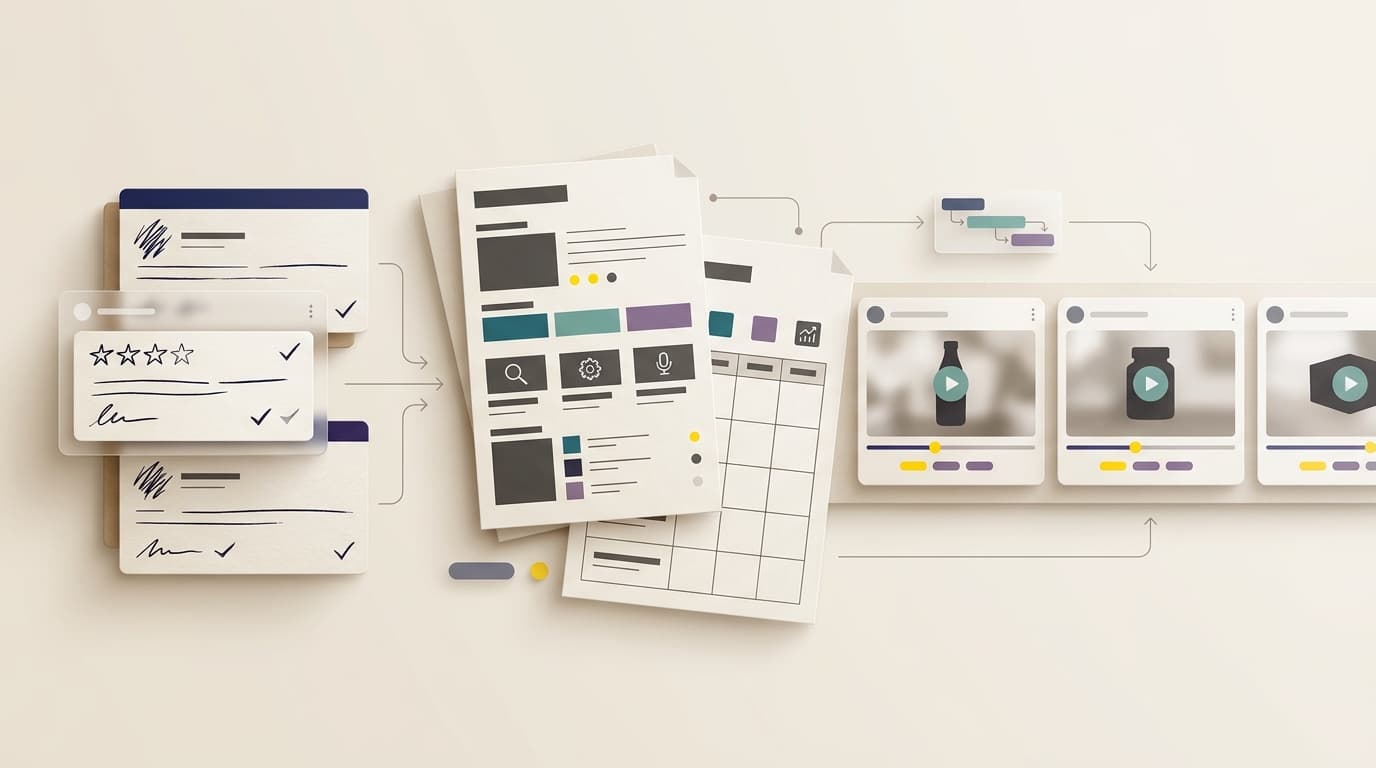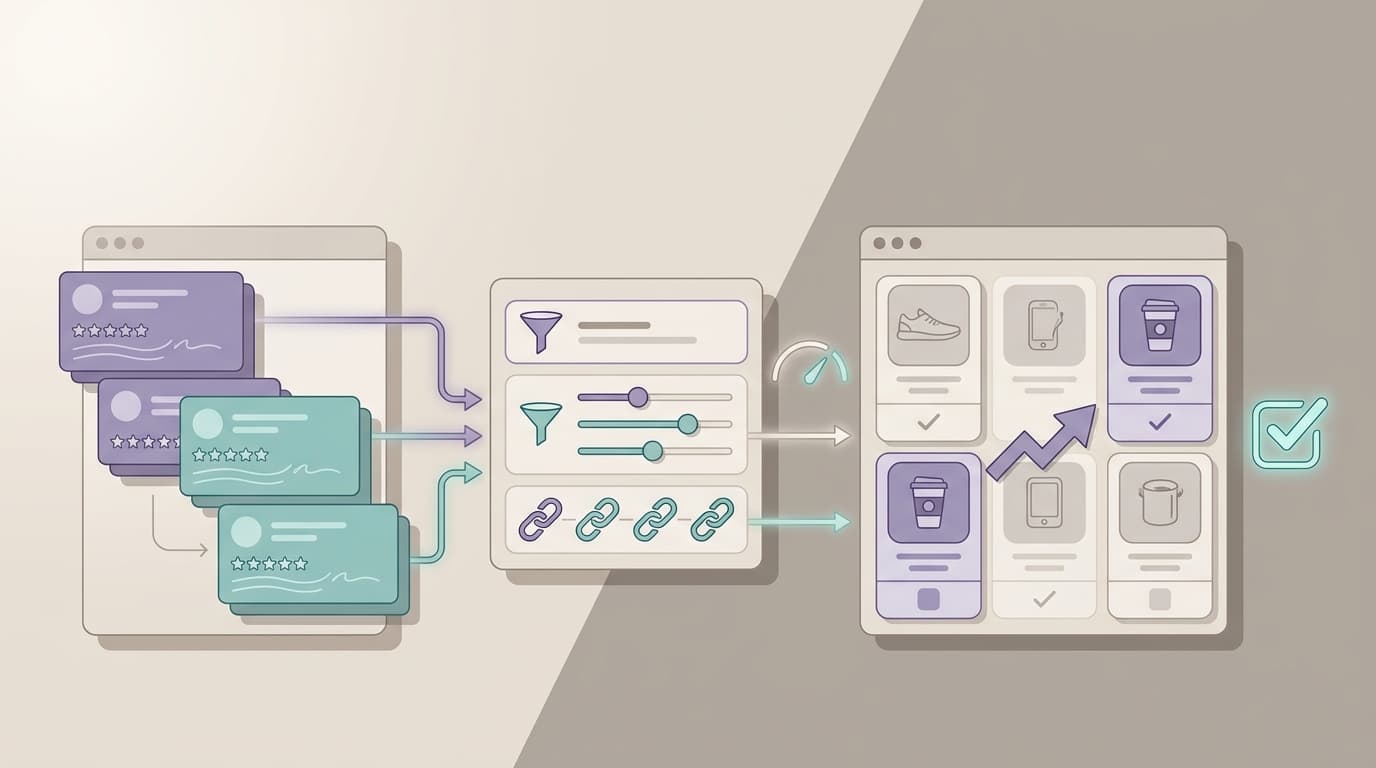
Amazon competitor analysis usually starts with visible things: price, star rating, review count, listing images, coupon strategy, and keyword positioning. Those checks matter, but they still miss the part that tells you what to build next. The real signal is usually buried in competitor bad reviews.
Competitor bad reviews show where buyers feel disappointed, confused, blocked, or under-served. The problem is that most teams still read those reviews like gossip. They skim a few one-star comments, repeat the loudest complaint in a meeting, and turn that into a weak roadmap request. That is not competitor review analysis. That is anecdote collection.
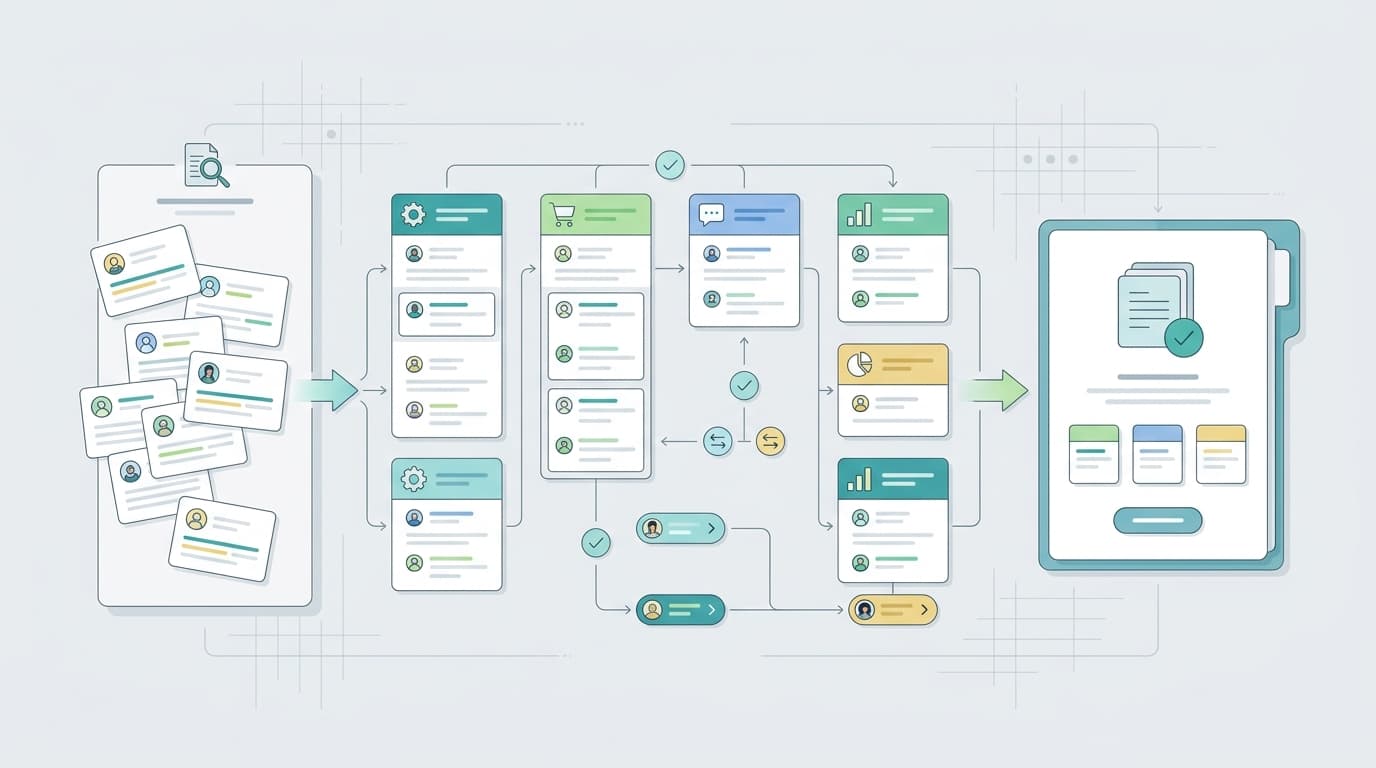
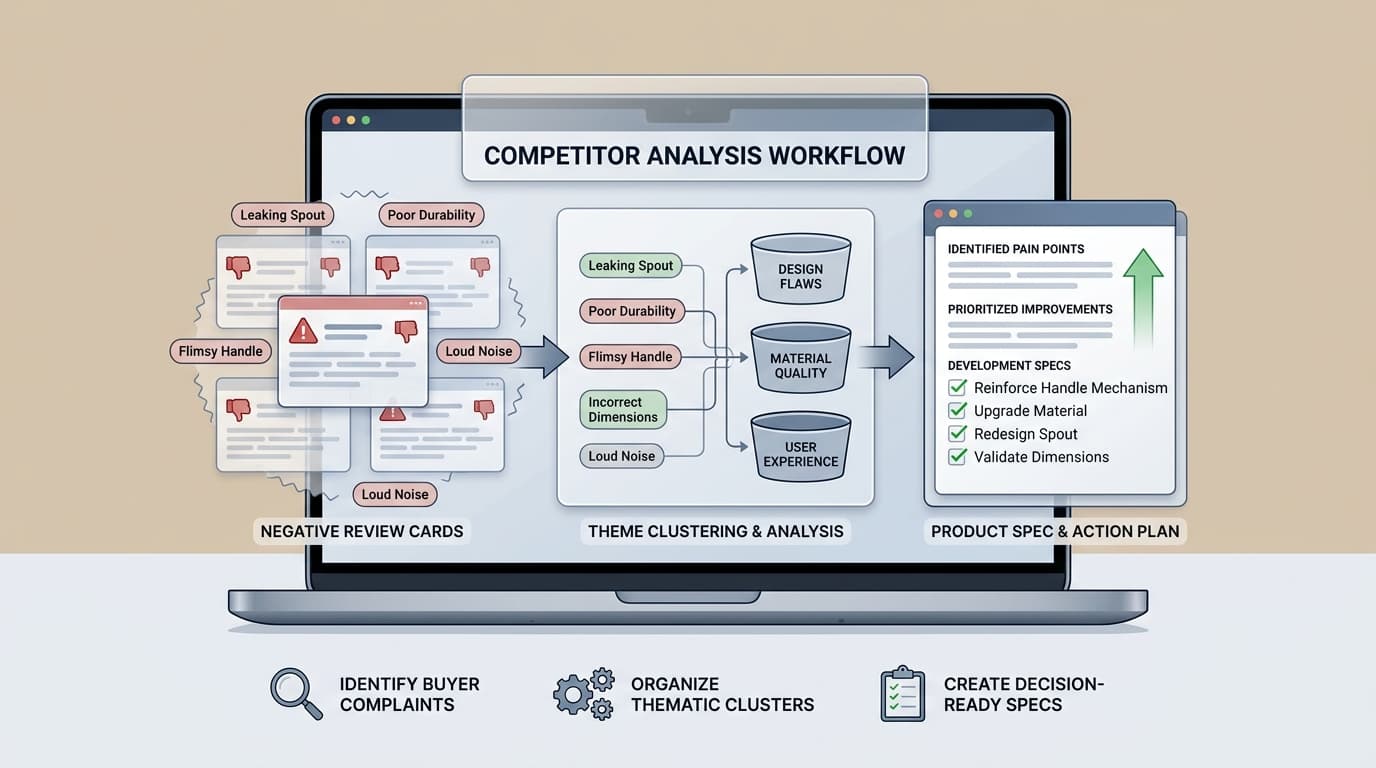
The better workflow is to treat competitor bad reviews like structured evidence. You collect them in a defined window, cluster repeated complaints, separate product issues from packaging and listing issues, then convert the strongest patterns into a product spec or action brief. That is where amazon competitor analysis becomes useful for real product work.
Why competitor bad reviews matter before roadmap lock
By the time your own reviews reveal a serious product weakness, the cost is usually higher. You may already have inventory in flight, creative locked, or support volume rising. Competitor bad reviews give you an earlier read on the same kinds of buyer friction.
They help answer questions like:
- Which product complaints keep repeating in this category?
- Which competitor weaknesses look specific enough for us to exploit?
- Which issues are really packaging, setup, or listing problems instead of product defects?
- Which complaints point to a real product feature gap?
- Which signals are too thin or too old to justify a spec change?
That is why competitor bad reviews belong inside amazon competitor analysis instead of sitting in a screenshot folder no one uses.
What generic amazon competitor analysis usually misses
Most amazon competitor analysis guides stay at the surface level. They compare prices, titles, image count, review totals, estimated sales, and visible features. Those checks are useful for category orientation, but they do not tell you why buyers are unhappy.
Bad reviews add the missing layer:
| Surface comparison | What it tells you | What it misses |
|---|---|---|
| Price | How the offer is positioned | Whether buyers think the value justifies the price |
| Rating average | Overall satisfaction trend | Which complaint clusters actually drive the low ratings |
| Review count | Demand and maturity signal | What buyers repeatedly expected but did not get |
| Listing copy | Messaging and feature claims | Whether the copy created expectation mismatch |
| Visible feature set | What competitors claim to offer | Which feature tradeoffs buyers resent in practice |
If your amazon competitor analysis stops at those surface checks, you still do not know what belongs in the next product spec.
Step 1: collect competitor bad reviews with clear scope
Start with a narrow and defensible collection rule. Pull one-star and two-star reviews first, then add a sample of three-star reviews to catch mixed-sentiment complaints that still point to friction. Keep the scope tight enough that your comparison stays fair.
Define:
- The competitor ASINs you are comparing.
- The marketplace and date window.
- The product version or package version if visible.
- The closest price tier or use case match.
- The minimum review count you need before making decisions.
This matters because competitor review analysis breaks quickly when teams compare unrelated products or mix old reviews with current ones.
Step 2: cluster repeated complaints by theme
A single dramatic review is not the point. You need repeated patterns. Read or process the reviews until you can group them into plain-language complaint themes.
Common clusters include:
- Breakage or durability problems
- Battery life or power complaints
- Size or fit mismatch
- Setup confusion
- Poor instructions
- Missing accessory or missing feature complaints
- Packaging damage
- Shipping damage blamed on the product
- Performance that fails in a specific use case
- Buyers saying the item feels overpriced for what it does
Your first output should be a complaint taxonomy, not a conclusion.
| Complaint cluster | Example buyer meaning | Early interpretation |
|---|---|---|
| Breaks after light use | Reliability feels lower than expected | Possible product quality issue |
| Hard to assemble | Buyer confidence drops before first use | Possible setup or packaging issue |
| Not as described | Listing promised more than delivery matched | Possible expectation mismatch |
| Missing one key function | Buyers compare against better-equipped rivals | Possible product feature gap analysis candidate |
| Not worth the price | Value framing is weak | Could be product, bundle, or positioning issue |
Step 3: separate product problems from non-product problems
This is where many teams go wrong. Not every bad review belongs in the product roadmap. Some complaints should go to packaging, listing, support, or pricing owners instead.
Use a simple routing model:
| Complaint type | Likely owner | Example output |
|---|---|---|
| Material failure, weak parts, unstable performance | Product or sourcing | Spec note, QA requirement, tolerance change |
| Confusing setup, no instructions, unclear packaging | Packaging or CX | Insert revision, quick-start card, setup guide |
| Buyer expected a feature that is not there | Product plus marketing | Feature evaluation or copy reset |
| Size, bundle, accessory, use-case mismatch | Product marketing or merchandising | Listing clarification, variant logic, bundle change |
| Value complaints compared with rivals | Pricing or offer owner | Bundle test, value framing, packaging review |
Amazon competitor analysis becomes more useful when you stop treating every complaint like a product request.
Step 4: compare complaint frequency against praise and expectation language
Bad reviews alone are not enough. Check what buyers praise and what they expected. A complaint matters more when it directly conflicts with the core promise buyers care about.
For example, if buyers praise a competitor for speed but the bad reviews repeatedly mention overheating, your opportunity may be to design for steadier long-session performance. If praise centers on simplicity but bad reviews mention setup confusion, your advantage may come from onboarding clarity more than a new feature.
That is why competitor review analysis should look at repeated complaints, repeated praise, expectation language in mixed reviews, and the comparisons buyers make to other products.
The best product spec ideas usually come from the gap between what buyers hoped for and what the product actually delivered.
Step 5: turn the strongest clusters into spec candidates
Now convert the best evidence into draft spec language. Do not write, "customers are unhappy." Write what should change, for whom, and why.
| Weak note | Better spec candidate |
|---|---|
| Customers hate the battery | Device should maintain usable performance for the target session length without the rapid drop buyers describe in repeated low-star reviews |
| People say setup is confusing | Add a one-minute quick-start path with labeled steps and packaging cues so first-use failure drops |
| Reviewers want more accessories | Include the missing attachment in the base bundle or clarify bundle limits before purchase |
| Competitor has too many durability complaints | Raise the durability requirement for the stressed component and tighten QA checks around that failure mode |
This is the point where a product feature gap analysis becomes concrete. You are no longer just spotting weakness. You are translating weakness into a buildable response.
Step 6: add proof requirements before the issue enters the roadmap
Not every cluster deserves action. Add a proof gate before anything becomes a real product spec.
Use this checklist:
| Proof check | What to confirm |
|---|---|
| Frequency | The issue appears often enough to matter |
| Freshness | The reviews are recent enough to reflect the current product |
| Severity | The issue affects use, satisfaction, return risk, or buyer trust |
| Competitive spread | You know whether this is one rival's weakness or a category-wide complaint |
| Actionability | A realistic product, packaging, listing, or support response exists |
| Ownership | One team can clearly own the next action |
Without that proof gate, amazon competitor analysis turns into roadmap noise.
Step 7: route findings to the right owner
A good competitor review audit ends with accountable next steps. Even if the main output is a product spec, some actions will still belong outside product.
A practical handoff looks like this:
| Output | Owner |
|---|---|
| Product spec candidate | Product, engineering, sourcing |
| Packaging or insert update | Packaging ops or CX |
| Listing clarification | Marketplace or content team |
| Support macro or FAQ update | Support lead |
| Watchlist item for future monitoring | Analyst or category owner |
This is where competitor bad reviews become operational instead of interesting.
How VOC AI helps with competitor review analysis at scale
VOC AI is useful when the bottleneck is not finding a few reviews, but organizing enough review evidence to support a real decision. The live Competitive Analysis page frames VOC AI around comparing rival listings, review patterns, and buyer complaints side by side. The live Product Research page frames the workflow around review-backed demand and buyer tradeoffs. The live Voice of Customer Analysis page frames review analysis around product direction and buyer language.
That combination matters because competitor review analysis only helps when the evidence can move from raw complaints to structured themes and then to action. VOC AI can help teams compare competitor review patterns in one workflow, organize repeated complaint clusters, connect buyer language to product and listing decisions, and route findings into product research or broader voice-of-customer work.
Use VOC AI as decision support, not as an automatic roadmap owner. A product manager, category owner, or operator should still review the final product spec and proof.
Common mistakes when reading competitor bad reviews
- Treating one dramatic review like a market truth
- Mixing unrelated products into one amazon competitor analysis set
- Confusing listing problems with product defects
- Turning every complaint into a feature request
- Ignoring praise language that explains what buyers actually value
- Using outdated reviews without checking recency
- Skipping the proof gate before adding work to the roadmap
Run this workflow before the next product version is approved
The best time to use competitor bad reviews is before you lock the next version, not after your own buyers start saying the same thing. Start with a small review window, build a clean complaint taxonomy, separate product from non-product problems, and turn only the strongest repeated themes into spec candidates.
That is the practical difference between generic amazon competitor analysis and a workflow that actually changes what you build next. If you want a faster way to compare competitor review patterns, organize buyer complaints, and move from review evidence to decision-ready output, start with VOC AI's Competitive Analysis, Product Research, and Voice of Customer Analysis workflows before the next roadmap meeting.
FAQ
What is the most useful way to use competitor bad reviews?
The most useful method is to cluster repeated complaints, separate product issues from packaging or listing issues, then convert only the strongest patterns into spec candidates with proof requirements.
How many bad reviews are enough for competitor review analysis?
There is no universal number, but the pattern should be repeated often enough to be more than an outlier, recent enough to matter, and severe enough to affect buyer trust or product use.
Is amazon competitor analysis only for product teams?
No. Marketplace operators, agencies, support leads, and category managers can use amazon competitor analysis too, as long as the findings are routed to the right owner.
What is a product feature gap analysis in this workflow?
It is the step where you compare repeated buyer complaints against expected use cases and competitor strengths, then translate the strongest gap into a concrete product or offer requirement.
Can competitor bad reviews guarantee that a new product version will win?
No. Competitor bad reviews can reduce guesswork and improve prioritization, but they do not guarantee sales, conversion, ranking, or launch success.