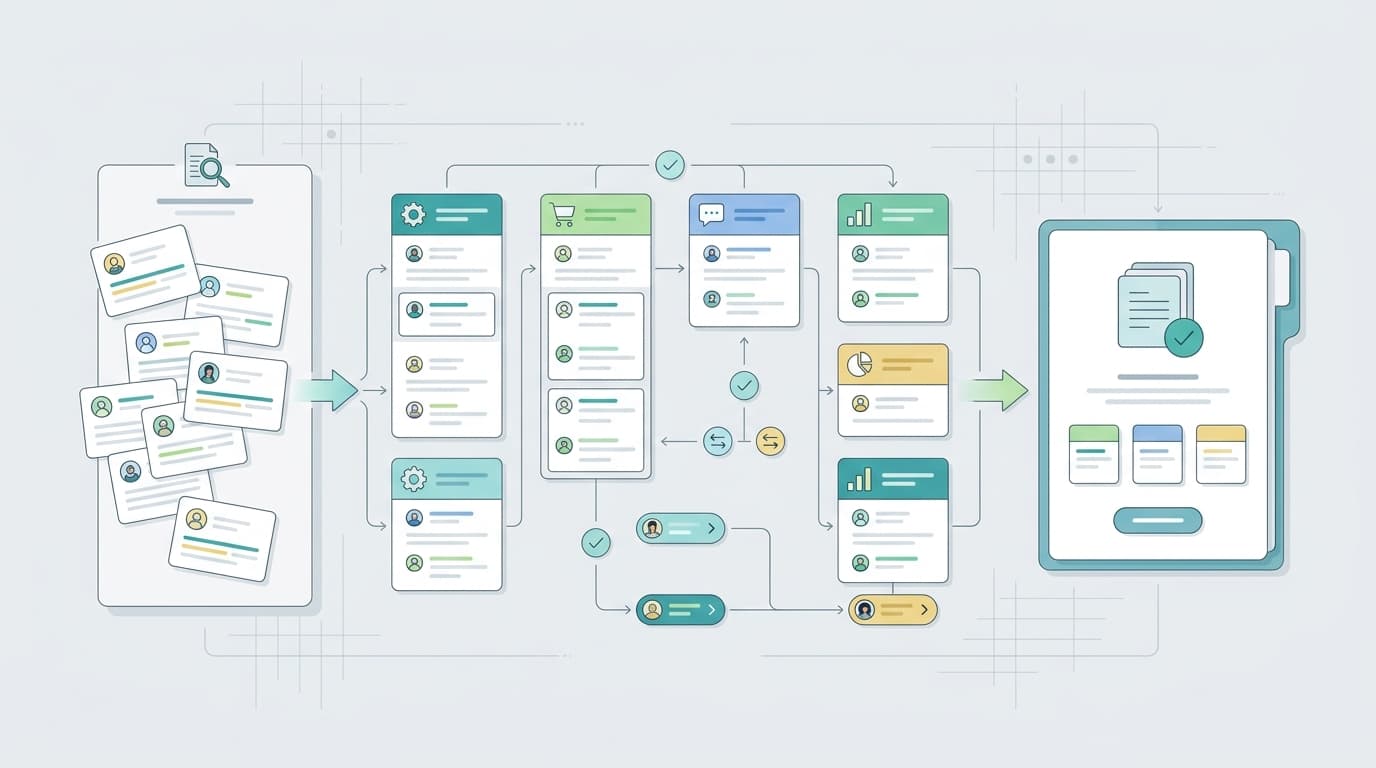
VOC analysis for Amazon sellers means turning buyer language into decisions about product quality, positioning, listings, support, and competitive strategy. Reviews, Q&A, seller feedback, support messages, return reasons, and competitor reviews all contain voice-of-customer signals. The challenge is that those signals arrive as messy sentences, not as a clean roadmap.
A good VOC workflow starts with the question the seller needs to answer. Are buyers confused by the listing? Are returns connected to product fit? Are competitors winning because their product solves a problem yours ignores? The workflow below keeps the analysis practical: collect the right sources, tag themes, compare the market, and assign actions.
Quick Workflow
Area | What to watch | Seller output |
Input | Reviews, Q&A, support messages, competitor reviews | Raw buyer language |
Processing | Theme tags, sentiment, frequency, ASIN and variation mapping | Structured customer signal |
Output | Product fixes, listing edits, support macros, competitor gaps | A decision backlog |
Use this quick view as the starting point, not the final report. The value comes from connecting review language to an owner, an action, and a follow-up date. Otherwise the same theme will reappear in meetings without changing the product or buyer experience.
What Is VOC Analysis?
VOC stands for Voice of Customer. In an Amazon context, VOC analysis means collecting customer language from marketplace signals and turning it into structured insight.
For sellers, that usually means answering questions like:
- Are buyers confused by the listing?
- Are returns connected to fit, size, quality, or missing information?
- Are competitors winning because they solve a problem your product ignores?
- Which complaints repeat across reviews?
- Which themes belong to product, listing, support, or operations?
This is different from simply reading reviews. Review reading is a source activity. VOC analysis organizes those signals into decisions.
ISO’s customer satisfaction monitoring guidance is useful context because it treats customer satisfaction as something organizations should monitor and measure systematically. Amazon sellers can apply the same idea at marketplace speed: collect feedback, classify it, compare patterns, and use the result to improve the customer experience.
Amazon VOC Data Sources
Product reviews are usually the most visible VOC source, but they do not tell the whole story.
A review may say “too small,” but the root cause could be a sizing chart issue, an image problem, a variation mismatch, or a product design problem. A buyer question may reveal confusion before purchase. A return reason may confirm that the confusion continued after delivery. A competitor review may show how another product sets the category expectation.
Useful Amazon VOC sources include:
- Product reviews and review titles
- Star ratings
- Customer Q&A
- Seller feedback
- Support messages
- Return reasons
- Listing edits and change logs
- Competitor reviews
- Search terms and buyer phrasing
Amazon’s official Customer Reviews tool is a useful baseline for eligible brand owners who need to track reviews inside Amazon’s ecosystem. Sellers who need deeper theme clustering or competitor review comparison may add a dedicated review intelligence workflow on top of that official view.
Turning Buyer Language Into Themes
The raw wording matters. Buyers rarely describe a problem the way a seller would.
A seller might write “assembly complexity.” A customer writes “hard to put together.” A product manager might write “material durability concern.” A buyer writes “feels flimsy.”
Good VOC analysis keeps the original language close to the interpretation. First capture the phrase, then group similar phrases into practical themes.
“Hard to assemble,” “setup was confusing,” and “instructions were unclear” can become a setup-friction theme.
“Too small,” “runs tight,” and “not true to size” can become a sizing-expectation theme.
“Box arrived crushed,” “product was scratched,” and “packaging did not protect it” can become a packaging-damage theme.
Research on mining customer product reviews for product development supports this approach: unstructured review text can contain useful product-development information, but the raw language has to be identified and structured before teams can act on it.
Context in VOC Analysis
A simple word count can mislead sellers.
The word “cheap” may mean affordable in one review and poor quality in another. “Light” may mean easy to carry or not durable enough. “Small” may be a benefit for compact storage or a complaint about fit.
That is why VOC analysis should look at context, not just frequency. A useful theme should keep the buyer phrase, ASIN or variation, review date, star rating, source, likely cause, and owner of the next action.
The goal is not to create a perfect taxonomy. The goal is to create stable labels that a product manager, listing owner, support lead, and founder can all understand.
A SAGE article on text mining online product reviews makes a similar point: review text can reveal dimensions that are not visible from star ratings alone.
Competitor Review Analysis
Competitor reviews are useful because they show category expectations.
If several competing ASINs receive praise for easy setup, stronger packaging, a clearer manual, or an included accessory, that feedback can help a seller understand what buyers already expect. If competitors receive repeated complaints about the same issue, that may become a positioning opportunity.
The key is not to treat competitor complaints as proof that your product is better. Sellers still need to verify whether their own product actually solves the same use case.
For sellers who need this at scale, VOC AI competitor analysis can help compare review patterns across ASINs and find recurring customer pain points without manually reading every listing.
Product and Listing Decisions
VOC analysis becomes useful when it creates a short decision backlog.
That backlog may include:
- Product: improve clasp durability after repeated “hard to close” reviews
- Listing: add size comparison image after buyers mention fit confusion
- Support: create setup video after repeated installation questions
- Operations: investigate packaging after recent damage complaints
- Marketing: test buyer language from positive reviews in image copy
- Product roadmap: evaluate accessory bundle after competitor praise
The backlog should stay small. If everything becomes a priority, the VOC workflow turns into another unread report.
For review-heavy workflows, VOC AI’s Amazon review analysis guide is a useful reference. If the team needs to separate praise, complaint, and mixed feedback by topic, VOC AI sentiment analysis can support that layer of the workflow.
VOC Analysis Cadence
VOC analysis does not need to become a big quarterly research project. For many Amazon teams, a simple rhythm works better.
Every week, check the newest negative and mixed reviews for important ASINs. Look for fresh issues, urgent complaints, and repeated buyer wording.
Every month, compare review themes with returns, support messages, listing changes, and competitor feedback. This helps the team decide whether an issue is growing, fading, or staying unresolved.
After launches, promotions, Prime Day traffic, major ad campaigns, or variation updates, review the feedback separately. A product can receive different comments when the audience changes.
Keep a short change log: which theme triggered the action, what changed, and when the team will check again.
Where VOC AI Fits
VOC AI fits Amazon VOC analysis when sellers need to process more review language than a team can reasonably read by hand.
It can help organize buyer phrases into themes, identify sentiment patterns, compare competitor ASINs, and surface product or listing opportunities. For teams exploring category-level demand and buyer priorities, VOC AI market insights can also support early research before a product or listing decision is made.
VOC AI should not be framed as a replacement for every customer research method. Interviews, surveys, support logs, returns, and Amazon-native tools still matter. Its clearest role is helping sellers make Amazon review language and competitor feedback easier to analyze at scale.
For larger teams that want review intelligence inside internal dashboards or client reporting, the VOC AI Review Analysis API may also be relevant.
Validating VOC Findings
Before making a product or listing change, check the strength of the evidence.
A few emotional reviews can reveal a real problem, but they can also exaggerate a rare edge case. Compare recent reviews with older reviews, return reasons, support notes, and competitor language before making expensive changes.
Separate product issues from expectation gaps. If buyers say the product is “smaller than expected,” the answer may be a better image or size chart, not a redesign.
Be careful with claims. Buyer language can inspire listing copy, but sellers should not turn casual review phrases into unsupported product claims.
Finally, keep the theme labels simple. “Packaging damage” is better than “post-delivery protective-material dissatisfaction.” A useful VOC system should make decisions easier, not impress the team with vocabulary.
Final Thoughts
VOC analysis for Amazon sellers turns buyer language into practical decisions. Reviews, Q&A, returns, support messages, and competitor feedback all contain useful signals, but the value comes from grouping them into themes and assigning clear actions.
Sellers do not need a huge research program to start. They need a clear question, reliable sources, plain-language themes, and a habit of checking whether customer feedback actually changes the product, listing, support experience, or market positioning.
FAQ
What is VOC analysis for Amazon sellers?
VOC analysis for Amazon sellers is the process of collecting and structuring buyer language from reviews, Q&A, support messages, return reasons, and competitor feedback so teams can make better product, listing, and positioning decisions.
What data should Amazon sellers use for VOC analysis?
Useful sources include product reviews, review titles, star ratings, Q&A, seller feedback, support tickets, return reasons, competitor reviews, listing change logs, and search-term language.
How is VOC analysis different from review monitoring?
Review monitoring detects new review signals. VOC analysis explains the patterns behind those signals and turns them into product, listing, support, or competitive decisions.
Should sellers analyze competitor reviews?
Yes. Competitor reviews show category expectations, unmet needs, product gaps, and buyer language that may not appear in your own reviews yet.
Can AI help with VOC analysis?
Yes. AI can help group themes, summarize review patterns, compare ASINs, and identify sentiment. Sellers still need human judgment for product claims, compliance-sensitive language, roadmap decisions, and final prioritization.
How often should Amazon sellers run VOC analysis?
For important ASINs, review fresh signals weekly and run a deeper monthly theme review. Also analyze feedback after launches, promotions, listing edits, review spikes, return increases, or major competitor movement.