How to Analyze Amazon Reviews: A Step-by-Step Guide for Sellers (2026)
Your top competitor has 4,200 reviews. You've read maybe 30 of them — the ones that showed up when you filtered for one-star. You think you know what customers are frustrated about, but you're working from a sample size that represents less than 1% of the signal that's already there, publicly available, waiting to be read.
Amazon review analysis is not about reading reviews. It's about reading patterns across reviews — at a scale where human attention breaks down and the real signal emerges. Most sellers who think they "analyze reviews" are actually skimming. The ones who compete on product quality and listing copy tend to have systems that surface what 4,000 reviews say collectively, not what 30 reviews say individually.
This guide walks through how to actually do Amazon review analysis: what to look for, how to organize it, which methods work at different scales, and where the process breaks down if you're doing it by hand.
TL;DR
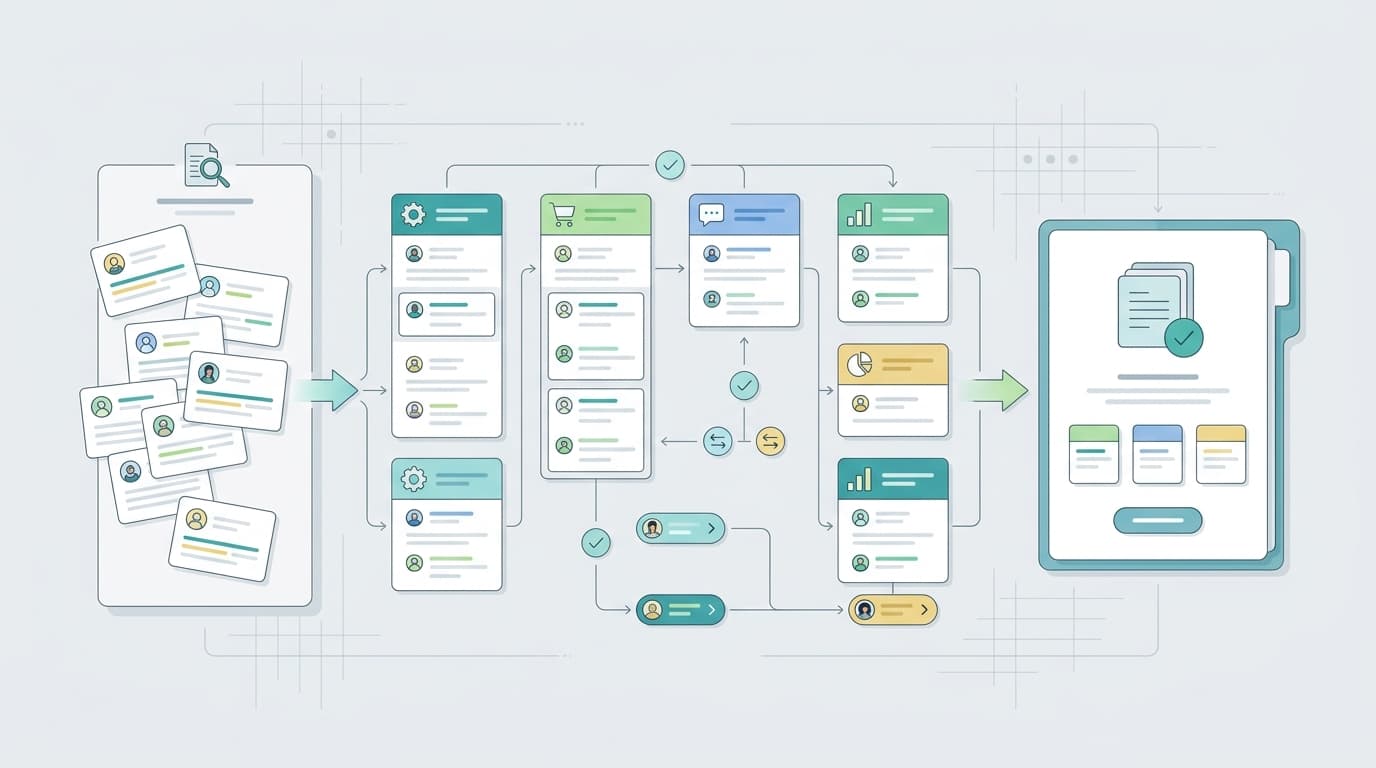
Step | What You're Doing | Why It Matters |
1. Set your scope | Decide which ASINs to analyze and at what scale | Determines which method is feasible |
2. Collect reviews | Pull raw review data from Amazon or a tool | You can't analyze what you haven't collected |
3. Categorize by theme | Group reviews into product dimensions | Turns raw text into structured signal |
4. Run sentiment analysis | Measure positive/negative ratio per theme | Shows where customers are most frustrated |
5. Benchmark competitors | Compare your themes to your top rivals | Reveals differentiation opportunities |
6. Action the insights | Connect review signal to product, listing, or sourcing decisions | This is the only step that makes money |
Why Amazon Review Analysis Matters More Than Most Sellers Realize
Amazon reviews aren't feedback — they're market research, pre-packaged by your customers and your competitors' customers, covering exactly what they tried, what worked, what didn't, and what they wished existed. According to Amazon Seller Central's Customer Review Insights documentation, star ratings and written reviews represent one of the clearest indicators of product-market fit signals available to any seller.
The problem is volume. A subcategory leader might have 10,000 reviews across its top 10 ASINs. If you spent 45 seconds reading each review — fast enough to absorb a single complaint — it would take you over 125 hours to read them all. That's before you try to find the patterns.
The practical limit of manual review reading is somewhere around 50–100 reviews before recall degrades and confirmation bias sets in. Sellers who read 50 reviews and say "customers mostly care about durability" are not analyzing reviews — they're pattern-matching to their priors.
Systematic Amazon review analysis solves this by forcing structure before interpretation.
Step 1: Define Your Scope (Which ASINs, How Many Reviews)
Before you analyze anything, decide what question you're actually trying to answer. The question determines the scope, and the scope determines which method is feasible.
Common scopes and corresponding questions:
Single ASIN — Your own product: - "What are customers most frustrated about with my product?" - "What do my 5-star reviewers love that I should emphasize in my listing?"
Multiple ASINs — Your product vs. 2–3 direct competitors: - "Where does my product outperform competitors in customer perception?" - "What unresolved complaints do my competitors have that I could fix in my version?"
Category-level — Top 10–20 ASINs in a subcategory: - "What pain points are systematically unmet across this entire category?" - "What product improvement would differentiate a new entrant from every existing option?"
The category-level question is where the highest-value insights tend to live — but it's also where manual methods completely break down. You need either a dedicated analysis tool or a significant time investment just to collect the data.
How many reviews do you actually need?
For a single ASIN with under 200 reviews: you can manually read and tag them all in a few hours. For anything above 300–500 reviews, manual reading becomes a sampling exercise, which introduces selection bias. For category-level analysis across thousands of reviews, automated methods are the only path to statistical reliability.
Step 2: Collect the Review Data
Depending on your method, you'll collect review data in one of three ways:
Method A — Manual reading (≤100 reviews)
Navigate to the Amazon product page, click "See all reviews," and sort by "Top reviews." Read through and take notes in a spreadsheet with columns for: star rating, review text, date, and verified purchase status.
This is the right method if you're validating a specific hypothesis ("Are customers complaining about assembly instructions?") or if your ASIN has fewer than 100 reviews total.
Method B — CSV export via scraping tool (100–2,000 reviews)
Tools like AMZScout or Jungle Scout can export review data for a given ASIN to a spreadsheet. You get the raw review text, dates, star ratings, and verified purchase flags in bulk. From there, you can use Excel/Sheets to sort, filter by star rating, and start manual categorization.
This is viable for small-scale competitive analysis — comparing your reviews to one or two competitors, or doing a deep dive on a single high-review-count ASIN.
Method C — AI-powered review analysis platform (2,000+ reviews or category-level)
For any analysis at scale — meaning multiple ASINs, a full competitive set, or an entire subcategory — manual reading and basic spreadsheet analysis aren't sufficient. The volume is too large for meaningful pattern detection by hand.
VOC AI indexes over 2 billion Amazon reviews — collected before Amazon tightened its data access restrictions in 2022 — and applies semantic-level analysis that groups different customer phrasings of the same underlying issue into a single insight. Rather than counting how many times the word "battery" appears, it identifies that "died after a week," "stopped charging after two months," and "battery life terrible" all represent the same product defect and shows you what percentage of the overall review set is expressing this issue.
According to VOC AI, its platform is used by 400,000+ Amazon sellers worldwide. The key differentiator isn't the AI analysis layer — it's the historical dataset size, which allows category-wide cohort comparisons that tools relying on real-time ASIN-by-ASIN data collection cannot replicate.
Step 3: Categorize Reviews by Theme
Whether you're doing this manually or with a tool, the output of this step should be a list of themes — product dimensions that customers mention — with associated counts or percentages.
Standard review theme categories for physical products:
- Quality / durability — "fell apart," "cheap materials," "lasted three years"
- Ease of use / setup — "hard to assemble," "instructions unclear," "intuitive"
- Size / fit / dimensions — "smaller than expected," "perfect fit," "runs large"
- Packaging — "arrived damaged," "over-packaged," "gift-ready"
- Value for price — "overpriced," "best deal I found," "not worth it"
- Customer service — "seller replaced immediately," "no response"
- Comparison to expectations — "photos were misleading," "exactly as described"
For each theme, track: - How many reviews mention it (by star rating) - Whether the sentiment is predominantly positive, negative, or mixed - Specific language customers use when describing the issue
The language detail matters. If customers describe a durability issue as "the seam split," that's a specific manufacturing fix. If they say "feels flimsy," that might be a material issue, a weight issue, or a perception gap between expectation and actual quality.
An important distinction: defects vs. preference vs. expectation gaps
Not every negative review points to a fixable product problem. As one popular seller blog on review analysis notes: "'Too firm' is a preference; 'fell apart' is a defect." The implication matters for what you do next:
- Defect → Product fix or QA improvement
- Preference → Target audience refinement or variant strategy
- Expectation gap → Listing copy correction (the product is fine, the description is misleading)
Categorizing reviews into these three buckets — in addition to theme — transforms a list of complaints into a product roadmap.
Step 4: Run Sentiment Analysis by Theme
Once you have reviews organized by theme, the next step is quantifying sentiment per theme. This is where manual analysis diverges most sharply from tool-based analysis.
Manual sentiment scoring
For each theme, count reviews that express: - Positive sentiment about this dimension (✓) - Negative sentiment (✗) - Mixed/neutral
Calculate a ratio. If 180 of 240 reviews that mention durability express negative sentiment, durability is your biggest product problem — with 75% negative sentiment rate.
Automated semantic sentiment
AI-based tools do this at a different level of granularity. Instead of categorizing a review as "positive" or "negative" overall, they analyze each theme within a review independently. A review can be positive about ease of use but negative about durability simultaneously — and a good review analysis system will score both correctly, even in the same five-star review ("Loved how easy it was to set up, but the hinge started creaking after a month").
The practical upshot: manual sentiment analysis tends to be reliable for aggregate direction ("durability is our main problem") but unreliable for nuance ("the hinge is the specific durability failure point, not the frame"). The latter requires either very careful manual reading at scale or an AI system designed for aspect-level sentiment.
Step 5: Benchmark Against Competitors
Single-ASIN review analysis tells you what your customers think. Competitive review analysis tells you what the market thinks — including the pain points that everyone in your category is failing to address.
How to run a competitive review benchmark:
- Identify your top 5–10 direct competitors by BSR ranking in your subcategory
- Run the same theme categorization and sentiment analysis on their review sets
- Map the results in a comparison table: each row is a product dimension, each column is an ASIN (yours + competitors)
- Look for dimensions where:
- Multiple competitors have high negative sentiment → unmet market need
- Your product has lower negative sentiment → defensible differentiation
- Your product has higher negative sentiment → priority fix before scaling spend
The most valuable output of competitive review analysis isn't understanding your product's weaknesses — it's finding the pain points that the entire category fails to solve, which is where product differentiation creates lasting competitive advantage. The VOC AI case study on a dog leash seller illustrates this: analyzing 84,000 reviews across 200 dog leash ASINs revealed that 31% of buyers mentioned "night walking" as a concern — yet none of the top-10 listings specifically addressed it. The seller who launched a reflective dog leash for night walks went from zero to $170,000/month in three months.
That's not a coincidence or a lucky bet — it's the output of systematic competitive review analysis.
Step 6: Action the Insights
Review analysis produces insights. Insights only create value when they're connected to a specific decision.
Common actions driven by review analysis:
Product improvement: If 40% of negative reviews cite a specific defect (seam splitting, assembly piece breaking), this is a sourcing brief: write the failure mode into your QC checklist or work with your manufacturer on a design change.
Listing copy optimization: If review analysis reveals that customers consistently mention a benefit you don't headline (e.g., 23% of five-star reviews mention "perfect for camping"), that signal should be in your bullet points, A+ content, or title. Buyer language from reviews, used in your listing, improves conversion because you're describing the product in terms buyers already use.
Keyword targeting: The natural language customers use in reviews — not keyword research tool outputs — is often the highest-converting copy for PPC targeting. "For night walking" as a descriptive phrase came from review analysis, not a keyword tool. It matched searcher intent precisely because it came from searchers.
Variant strategy: If a meaningful percentage of reviews express a size or preference complaint (too small, too light, doesn't fit over a helmet), that's a signal for a variant — not a listing fix.
Competitive positioning: If your review analysis shows your competitors consistently fail on customer service response while yours is consistently praised, that's a differentiator worth making explicit in your listing.
Common Mistakes in Amazon Review Analysis
Reading reviews without structure: Spending an hour reading reviews and forming impressions is not analysis — it's qualitative research at a sample size too small to trust. Structure the data collection before you start reading.
Treating all star ratings as equivalent: A 3-star review from a customer who received a damaged item (fulfillment problem, not product problem) is different data than a 3-star from someone who found the product genuinely mediocre. Filter by verified purchase and read the text before making decisions.
Analyzing only negative reviews: Your 5-star reviews contain the features your ideal customers most value — and those should drive listing optimization and targeting, not just the complaints.
Over-indexing on outliers: One memorable one-star review about an unusual failure doesn't represent a pattern. Look for themes that appear across at least 5–10% of the review set before treating them as actionable signals.
Confusing preference with defect: A customer who gave one star because the product was "too heavy" and a customer who gave one star because "the battery stopped working" are expressing completely different problems. The first may not be your customer; the second is a manufacturing quality issue.
FAQ
How many reviews do I need to analyze to get reliable insights? The minimum for statistical reliability depends on what you're trying to measure. For a single product dimension (e.g., "what percentage of reviewers mention durability issues"), 100–200 reviews is typically enough to get a directional read. For nuanced sub-issues (e.g., "is the latch or the hinge more commonly the failure point?"), you likely need 500+ reviews to see meaningful patterns emerge in sub-categories.
Can I analyze Amazon reviews for free? Manual reading is free but breaks down at scale. For basic AI-assisted analysis, AMZScout's AI Review Analyzer starts at $19.99/month. VOC AI has a free plan for initial access. For category-level competitive benchmarking, paid plans are generally required because the data infrastructure is substantial.
Is it against Amazon TOS to scrape reviews? Scraping reviews directly from Amazon's website violates Amazon's Terms of Service. Legitimate review analysis tools obtain data through approved means or use pre-indexed datasets. If you're using a third-party tool, check their data sourcing approach — VOC AI's core dataset was indexed before Amazon tightened its API access policies, which is a legally distinct approach from active scraping.
How often should I run Amazon review analysis? At minimum: once before launching a product (competitive benchmark), once per quarter for active products (to catch emerging issues), and after any significant listing change or product reformulation (to measure impact). For high-competition categories, monthly monitoring of new review signals is not excessive.
What's the difference between review analysis and sentiment analysis? Sentiment analysis answers: "Is this review positive or negative?" Review analysis is broader: it includes sentiment, but also theme identification, defect vs. preference classification, competitive benchmarking, and insight extraction. Most tools marketed as "sentiment analysis" are doing a subset of what a full review analysis process covers.
Does reviewing my competitors' reviews violate any policies? No — competitor Amazon reviews are publicly available and reading/analyzing them is entirely standard competitive research. The restriction applies to review manipulation (incentivizing reviews, review trading, etc.), not to reading and analyzing reviews that already exist.
Source References
- Amazon Seller Central — Customer Review Insights URL: https://sell.amazon.com/uk/blog/customer-review-insights Use for: Amazon's official documentation on review signals and their role in product performance
- VOC AI Platform Statistics and Case Studies URL: https://www.voc.ai Use for: 2B+ reviews indexed, 400K+ sellers, dog leash case study (84,000 reviews, $170K/month outcome)
- SellerSprite — How to Analyze Amazon Reviews for Product Differentiation URL: https://sellersprite.ai/en/blog/analyze-amazon-reviews-for-product-differentiation Use for: Practical approach to separating defect vs. preference in review analysis
- automateed.com — How to Analyze Amazon Reviews for Research in 2026 URL: https://www.automateed.com/how-to-analyze-amazon-reviews-for-research Use for: Structural approach to organizing review data fields