AI Review Summarization Acceptance Checklist: Testing and Handoff
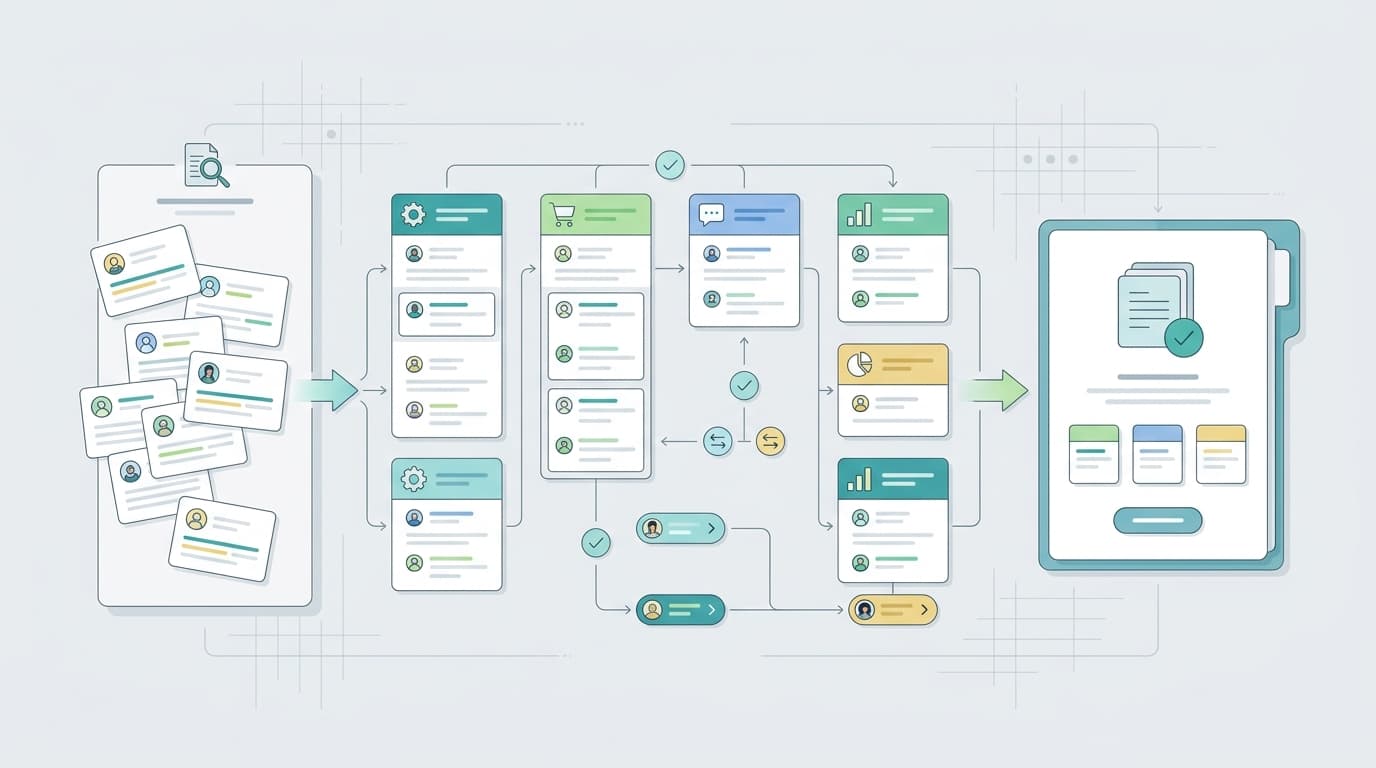
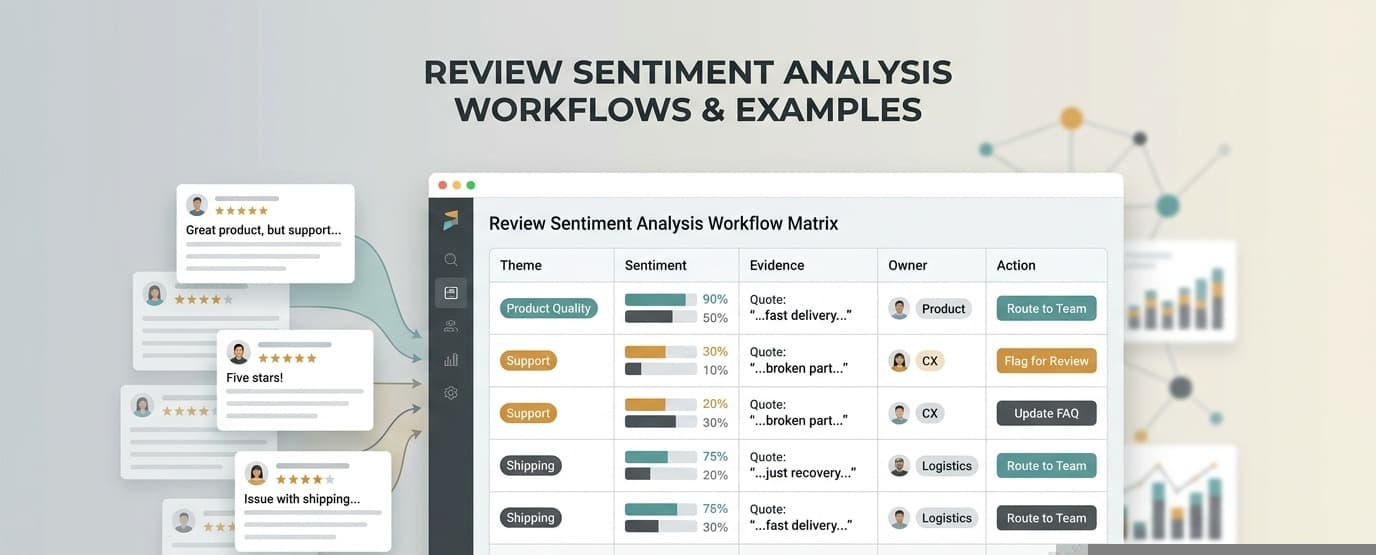
An AI review summarization implementation checklist should not end when the pipeline produces a fluent paragraph. It should end when the team can prove that the summary represents the intended review corpus, links important claims to evidence, preserves minority issues, survives repeatable tests, and has a named owner after handoff.
That distinction matters because a summary can sound correct while hiding a broken input, an unsupported claim, a missed segment, or a workflow nobody is prepared to operate.
This guide covers the acceptance stage between implementation and production rollout. Use the broader AI review summarization implementation checklist to design the pipeline. Use the production rollout checklist for shadow mode, monitoring, incidents, and rollback. Use this page to decide whether the implementation is ready to hand from builders to product, CX, research, or operations owners.
Define acceptance before testing
Complete this statement before anyone runs a benchmark:
For [decision], the system will summarize [defined review corpus] into [output contract]. It will pass when [quality thresholds] hold across [critical segments], every material claim is verifiable within [time limit], and [named owner] accepts the operating handoff.
If the team cannot complete the sentence, it does not have acceptance criteria. It has opinions about output quality.
Acceptance checklist at a glance
| Gate | Evidence required | Reject the handoff when |
|---|---|---|
| 1. Decision contract | Named user, decision, corpus, cadence, exclusions, risk tier | The summary is expected to answer undefined questions |
| 2. Benchmark design | Representative examples, difficult cases, segment coverage, frozen versions | The test set reflects only easy or average reviews |
| 3. Evidence packet | Source IDs, excerpts, counts, denominators, transformations | A reviewer cannot trace a material claim to records |
| 4. Data integrity | Reconciliation, freshness, deduplication, language and segment checks | Missing data can remain hidden inside fluent output |
| 5. Output contract | Required fields, allowed claims, uncertainty and abstention rules | The system can silently change format or overstate evidence |
| 6. Quality evaluation | Claim support, theme coverage, polarity, minority retention, stability | One blended score hides a critical failure |
| 7. User acceptance | Verification time, correction patterns, usefulness, workflow fit | Reviewers cannot use or trust the output in the real decision |
| 8. Handoff package | Owners, runbook, versions, known limits, change control | The builders leave without accountable operators |
1. Lock the decision contract
The acceptance test must be attached to a bounded decision, not to “summarize reviews” in general.
Document:
- The person or team using the output.
- The recurring decision the summary supports.
- Products, markets, languages, channels, ratings, and date ranges included.
- Excluded sources or segments and why they are excluded.
- The denominator behind every percentage or frequency statement.
- Delivery cadence and maximum acceptable data age.
- Claims the summary is allowed to make.
- Claims that require escalation, external evidence, or abstention.
- Consequences of a false positive, false negative, or missing theme.
A weekly product-quality brief and an executive market summary should not share the same acceptance thresholds. Missing a rare safety complaint may be unacceptable in the first workflow even if aggregate theme coverage looks strong. A broad market summary may need stricter sample and segment disclosures because self-selected customer reviews do not represent an entire market.
The NIST AI Risk Management Framework organizes AI risk work around governance, context, measurement, and management. For review summarization, the practical lesson is simple: define the use context and harm before choosing the score.
Acceptance artifact: a one-page decision contract signed by the business owner and quality owner.
2. Build a benchmark that contains the hard cases
A benchmark made from random average reviews will reward fluent mediocrity. Build a test set that represents the real decision and deliberately includes failure-prone cases.
Required benchmark slices
- High-volume and low-volume products.
- Positive, neutral, negative, and mixed-sentiment reviews.
- Short comments and long multi-issue narratives.
- Majority themes and rare but consequential complaints.
- Verified duplicates, near-duplicates, spam-like text, and boilerplate.
- Sarcasm, negation, conditional praise, comparisons, and ambiguous pronouns.
- Different markets, languages, variants, ratings, and time periods.
- Reviews with missing metadata or conflicting fields.
- Cases where the correct behavior is to say evidence is insufficient.
Create separate benchmark groups for development, final acceptance, and future regression testing. If the final acceptance set is repeatedly used to tune prompts or thresholds, it becomes another development set.
For every benchmark item, record:
benchmark_id
source_review_ids
segment labels
expected themes
expected polarity by theme
material evidence excerpts
prohibited or unsupported claims
required uncertainty note
reviewer rationale
benchmark version
Do not force one “gold summary” when several summaries could be valid. Evaluate atomic claims, required themes, prohibited claims, evidence links, and decision usefulness instead.
Acceptance artifact: a versioned benchmark manifest with coverage counts by critical segment.
3. Create the evidence packet before scoring prose
The unit of acceptance should be a verifiable evidence packet, not only the generated paragraph.
Each summary should carry:
- Run ID and release ID.
- Corpus query or snapshot identifier.
- Total records included, excluded, and deduplicated.
- Segment counts and missing-data notes.
- Theme or aspect IDs.
- Claim-level source references.
- Representative excerpts with stable review IDs.
- Frequency denominator and calculation method.
- Confidence or support status.
- Known limitations and abstentions.
A practical claim record can look like this:
{
  "claim_id": "claim-017",
  "theme": "battery life",
  "claim": "Recent one-star reviews increasingly mention rapid drain.",
  "supporting_review_ids": ["r-104", "r-118", "r-131"],
  "comparison_windows": ["2026-05", "2026-07"],
  "denominators": {"2026-05": 214, "2026-07": 198},
  "status": "supported",
  "limitations": "One marketplace; English-language reviews only"
}
Evidence links are not a decorative feature. They are how reviewers find unsupported generalizations, denominator mistakes, and themes that combine different product mechanisms.
For teams that need review data and analyzed outputs inside an existing workflow, the VOC AI Review Analysis API is one route to evaluate. The acceptance rules should remain portable, however: your data contract and evidence schema should not depend on one interface.
Acceptance artifact: one complete evidence packet for every benchmark output.
4. Test data integrity separately from summary quality
Do not ask a language model evaluator to detect every data pipeline failure. Run deterministic checks before generation.
Ingestion checks
- Expected source, product, market, and date partitions arrived.
- Record counts reconcile with the source or approved snapshot.
- Freshness is inside the decision contract.
- Required fields meet completeness thresholds.
- Language detection and locale metadata agree within the approved rule.
- Ratings, dates, variants, and product identifiers parse correctly.
Transformation checks
- Deduplication has a logged rule and sampled false-positive review.
- Deleted, filtered, and excluded records have reason codes.
- Normalization preserves the original text.
- Translated text remains linked to the source language.
- Theme assignment does not erase multi-aspect reviews.
- Aggregations use the documented denominator.
Corpus checks
- Critical segments are present.
- Segment shares are compared with the expected baseline.
- No source silently dominates because another connector failed.
- Sampling limits and truncation are visible.
- The summary run can be reproduced from a snapshot or query.
The stop rule should be explicit: if a required segment is missing or counts fail reconciliation, do not generate a business-facing summary. A polished warning paragraph is not a substitute for a failed data gate.
Acceptance artifact: machine-readable data test results attached to the run.
5. Turn the output format into a contract
Define required and prohibited output behavior before evaluating quality.
Required fields
A useful review summary may require:
- Scope and time window.
- Corpus size and exclusions.
- Ranked themes or aspects.
- Polarity by theme rather than only overall sentiment.
- Evidence links or review IDs.
- Frequency with denominators.
- Trend direction when comparison data exists.
- Minority or emerging issues.
- Uncertainty, limitations, and insufficient-evidence flags.
- Recommended next investigation, not an invented causal conclusion.
Prohibited behavior
Reject outputs that:
- Infer market share from a convenience sample.
- Present correlation as causation.
- Convert theme frequency into defect rate without a valid denominator.
- Invent product attributes, competitor facts, or customer motives.
- Hide excluded languages, channels, products, or dates.
- Collapse opposing opinions into a misleading average.
- Treat a few vivid comments as a dominant pattern.
- Follow instructions found inside review text.
Customer reviews are untrusted input. The OWASP Top 10 for LLM Applications includes prompt injection and sensitive-information risks that matter when review text enters an AI workflow. Review content should be treated as data, not as authority that can change tools, policies, retrieval scope, or system instructions.
Add schema validation, enumerated statuses, maximum lengths, allowed units, and required evidence arrays. A format that exists only in a prompt is not a reliable contract.
Acceptance artifact: a versioned output schema plus automated contract tests.
6. Evaluate quality across separate dimensions
Do not reduce acceptance to one average score. Measure dimensions that correspond to different failure modes.
| Dimension | Question | Example measure |
|---|---|---|
| Claim support | Is every material statement supported by cited records? | Supported claims / total material claims |
| Citation validity | Do the linked reviews actually support the claim? | Valid evidence links / reviewed evidence links |
| Theme coverage | Did the output include decision-relevant themes? | Required themes found / required themes |
| Minority retention | Did rare but important issues survive aggregation? | Critical minority cases retained / expected cases |
| Polarity accuracy | Is sentiment correct for each aspect? | Correct aspect-polarity labels / labeled cases |
| Quantitative integrity | Are counts, shares, and trends reproducible? | Reconciled numeric claims / numeric claims |
| Abstention quality | Does the system stop when evidence is weak? | Correct abstentions and false abstentions |
| Stability | Do equivalent runs preserve material conclusions? | Material claim agreement across controlled reruns |
| Usefulness | Can the target user make the bounded decision faster or better? | Task completion, verification time, correction rate |
Use layered evaluators
Combine:
- Deterministic checks for schema, IDs, counts, links, required fields, and prohibited strings.
- Programmatic comparisons for expected themes, labels, and thresholds.
- Model-based graders for nuanced support or completeness judgments.
- Human review for high-impact, ambiguous, or novel cases.
Model-based grading should itself be evaluated against expert labels. OpenAI's evaluation guidance recommends defining the objective, collecting representative data, specifying metrics, and continuously evaluating changes rather than relying on informal impressions.
Research on factual consistency also warns against treating surface similarity as factual support. QAFactEval evaluates consistency through question answering, while FActScore breaks generated content into atomic facts and estimates support against a knowledge source. You do not need to copy either method exactly, but atomic-claim evaluation is a stronger acceptance unit than “the summary looks close to the reference.”
Set thresholds by risk and segment
Create hard gates for critical dimensions and diagnostic targets for the rest.
Example:
hard gate: 100% of material claims have source references
hard gate: 0 unsupported high-impact claims
hard gate: all required segments pass data reconciliation
hard gate: all critical minority cases are surfaced or explicitly escalated
diagnostic: median reviewer verification time under 5 minutes
diagnostic: correction rate improves against the current manual workflow
Use your own approved thresholds. The important part is that the team sets them before seeing the final result and reports them by critical segment, not only as an overall average.
Acceptance artifact: a scorecard with pass, fail, waiver, owner, and evidence for every gate.
7. Run user acceptance in the real workflow
Technical evaluation does not prove workflow acceptance. Put the summary in front of the people who will use it.
Give reviewers realistic tasks:
- Identify the top issue worth investigating.
- Verify the evidence behind a trend claim.
- Find an important minority complaint.
- Explain the corpus and exclusions.
- Correct a misleading claim.
- Decide whether evidence is sufficient for the next action.
- Export or hand the finding into the team's existing product, CX, research, or support workflow.
Measure:
- Time to locate supporting evidence.
- Time to detect a planted unsupported claim.
- Number and severity of corrections.
- Reviewer agreement on material conclusions.
- Cases where the output created false confidence.
- Cases where it reduced repetitive reading or synthesis work.
- Downstream rework caused by missing context.
Collect corrections in structured form:
run_id
claim_id or theme_id
correction_type
severity
reviewer rationale
correct evidence
root-cause category
accepted by owner
regression test created
Every repeated correction should become a benchmark example, contract rule, data check, or operating policy. Otherwise human review becomes an endless cleanup layer.
If teams are still comparing workflow options, the AI review summarization vendor evaluation checklist provides procurement questions for evidence traceability, evaluation, access, and operating fit.
Acceptance artifact: a signed user-acceptance record with unresolved issues and release conditions.
8. Deliver an operational handoff package
The implementation is not accepted until someone outside the build team can operate, inspect, and escalate it.
The handoff package should contain:
Scope and contracts
- Decision contract.
- Data contract and corpus query.
- Output schema.
- Allowed and prohibited claims.
- Risk classification and escalation topics.
Versions and reproducibility
- Connectors and transformation versions.
- Taxonomy or aspect model version.
- Prompt and model configuration.
- Evaluation suite and benchmark version.
- Code or workflow release ID.
- Last accepted run and evidence packet.
Operating procedures
- Run cadence and owner.
- Data failure and quality failure procedures.
- Human review policy.
- Correction and waiver process.
- Change approval process.
- Access, retention, and deletion rules.
- Monitoring, incident, and rollback links.
Known limitations
- Unsupported markets, languages, sources, or product categories.
- Weak benchmark segments.
- Claims requiring external validation.
- Expected failure modes.
- Temporary manual controls.
- Date for the next limitation review.
Ownership matrix
| Responsibility | Primary owner | Backup | Evidence of readiness |
|---|---|---|---|
| Business decision | Product or CX owner | Team lead | Decision contract accepted |
| Data integrity | Data or operations owner | Platform owner | Reconciliation run completed |
| Summary quality | Quality or research owner | Domain reviewer | Benchmark gates passed |
| Workflow reliability | Engineering or platform owner | On-call backup | Runbook exercised |
| Security and privacy | Security/privacy owner | Legal or governance contact | Access and retention reviewed |
The NIST Generative AI Profile emphasizes governance, content provenance, testing, incident disclosure, and ongoing monitoring across the AI lifecycle. A handoff package turns those principles into names, files, thresholds, and response procedures.
Acceptance artifact: a handoff manifest with links, owners, sign-off status, and unresolved conditions.
A 15-day acceptance test sequence
Days 1–3: contracts and benchmark
- Lock the decision, corpus, user, output, and risk boundaries.
- Inventory critical segments and hard cases.
- Freeze the acceptance benchmark and reviewer guidance.
Days 4–6: deterministic gates
- Add ingestion, reconciliation, freshness, and deduplication checks.
- Validate the output schema and evidence references.
- Test prohibited claims and correct abstention behavior.
Days 7–10: quality evaluation
- Score atomic claim support and citation validity.
- Measure theme coverage, polarity, minority retention, and numeric integrity.
- Run controlled repeats and compare material conclusions.
- Review failures by segment and severity.
Days 11–13: user acceptance
- Run realistic decision tasks with target users.
- Measure verification time and correction patterns.
- Turn repeated corrections into tests or policies.
Days 14–15: handoff decision
- Assemble versions, evidence, limitations, owners, and runbooks.
- Record pass, fail, waiver, and follow-up owners.
- Reject, conditionally accept, or accept the implementation.
- Move accepted systems into the production rollout process.
Copyable AI review summarization acceptance checklist
Decision and corpus
- [ ] The decision, user, cadence, and risk tier are named.
- [ ] Included and excluded sources, products, markets, languages, ratings, and dates are documented.
- [ ] Denominators and data-age limits are explicit.
- [ ] Allowed claims, prohibited claims, and escalation topics are approved.
Benchmark and evidence
- [ ] The benchmark includes difficult, minority, multilingual, and insufficient-evidence cases.
- [ ] Development and final acceptance sets are separated.
- [ ] Every benchmark output has source IDs, excerpts, counts, and limitations.
- [ ] Material claims can be verified without searching the raw corpus manually.
Data and output contracts
- [ ] Source arrival, count, freshness, completeness, and segment checks pass.
- [ ] Deduplication, exclusions, translations, and aggregations are reproducible.
- [ ] The output schema is validated automatically.
- [ ] Review text cannot change system instructions, tools, or retrieval scope.
Quality gates
- [ ] Claim support and citation validity meet the hard gate.
- [ ] Critical themes and minority issues meet segment-specific thresholds.
- [ ] Aspect polarity and numeric claims pass checks.
- [ ] Correct abstention and stability are tested.
- [ ] No critical failure is hidden by an overall average.
User acceptance and handoff
- [ ] Target users can verify claims inside the agreed time.
- [ ] Corrections are logged with severity and root cause.
- [ ] Repeated corrections become tests, rules, or policies.
- [ ] Business, data, quality, platform, and security owners accept their roles.
- [ ] Versions, runbooks, limitations, change control, and next review date are documented.
Build, buy, or combine: keep the acceptance layer portable
The acceptance layer should survive a tool change. Keep the benchmark, evidence schema, output contract, quality thresholds, and user-acceptance tasks separate from a specific model or vendor.
That separation gives teams three options:
- Build a custom pipeline while preserving an independent evaluation suite.
- Buy a review-analysis product but test it against the same evidence and workflow gates.
- Combine an external review-data or analysis API with internal retrieval, summarization, evaluation, and decision workflows.
VOC AI's Voice of Customer Analysis and Review Analysis API can support teams evaluating review intelligence and integration paths. The buying decision should still depend on whether the implementation passes your corpus, evidence, quality, security, and operating requirements.
Frequently asked questions
What is the difference between an implementation checklist and an acceptance checklist?
An implementation checklist explains how to construct the data, extraction, summarization, evaluation, and deployment workflow. An acceptance checklist defines the evidence and thresholds required before business and operational owners agree to use and maintain it.
What is the most important AI review summary metric?
There is no single sufficient metric. At minimum, separate claim support, evidence-link validity, decision-relevant theme coverage, minority-issue retention, polarity accuracy, quantitative integrity, abstention quality, and user verification time.
Should a human review every summary?
The review policy should follow the decision risk, evidence strength, novelty, and failure consequences. High-impact or weak-evidence claims may require approval, while lower-risk recurring outputs may use sampling after the workflow demonstrates stable performance. The policy, sampling rule, and escalation triggers should be explicit.
How large should the benchmark be?
Choose coverage before size. The benchmark must include critical segments and known failure modes, with enough examples to estimate whether each gate is stable. Add cases from production corrections and new segments over time rather than relying on one static average set.
When is an AI review summarization implementation ready for handoff?
It is ready when the decision and corpus are bounded, deterministic data tests pass, material claims are evidence-linked, quality gates pass by critical segment, target users complete realistic tasks, limitations are documented, and named owners accept the operating package.
The final acceptance question
Do not ask, “Does the summary sound good?”
Ask:
Can the intended user verify every material conclusion, understand what the corpus does not support, make the bounded decision, and operate the workflow without relying on the original builders?
If the answer is yes—and the evidence is recorded—the implementation is ready for handoff. If not, the remaining work belongs in the benchmark, data contract, output contract, evaluation suite, or operating model, not in another round of prompt polishing.