Updated August 9, 2026.
AI review summarization looks simple in a demo: send a batch of reviews to a model and ask for the main themes. In production, that shortcut creates a familiar set of problems: duplicate evidence, vague themes, missing minority complaints, unsupported claims, and summaries nobody can audit.
A reliable implementation needs more than a prompt. It needs a controlled pipeline that defines the decision, prepares the evidence, structures the analysis, verifies every important claim, and monitors quality after launch.
This AI review summarization implementation checklist gives product, ecommerce, CX, and research teams a practical path from raw review text to decision-ready summaries. It covers the build sequence, the minimum artifacts, the acceptance tests, and the operating decisions teams usually discover too late: ownership, corpus sizing, evidence contracts, release thresholds, latency and cost controls, and rollback criteria.
Use it as an AI review summarization: implementation checklist when the question is no longer “can a model summarize reviews?” but “can our team ship a summary workflow that survives audit, correction, and the next source-data change?”
The goal is not to make a model write a convincing paragraph. The goal is to create a reproducible decision system in which every important statement can be traced to customer evidence.
What changed in this implementation checklist
This August 9 update adds a sprint-ready implementation layer for teams that already understand the architecture but need to turn it into engineering tickets. The earlier checklist explained the evidence pipeline; this version adds:
- a 10-ticket build backlog;
- a definition-of-done matrix for each implementation layer;
- a release packet template that can be attached to a Jira, Linear, or Notion handoff;
- a route from pilot acceptance to monitoring, rollback, and vendor evaluation.
Use this section when the team is moving from “we agree on the design” to “what exactly needs to exist before we let product, CX, or ecommerce operators rely on the summary?”
The AI review summarization implementation checklist below is organized so each section can become a ticket, acceptance test, or release artifact.
The 10-ticket implementation backlog
A useful AI review summarization implementation checklist should become tickets, not meeting notes. Start with these 10 work items and keep each ticket tied to a return artifact.
| Ticket | Owner | Deliverable | Definition of done |
|---|---|---|---|
| 1. Decision contract | Product or research lead | Named audience, recurring decision, output schema, non-goals | A reviewer can tell what decision the summary supports and which claims it must not make |
| 2. Corpus manifest | Data owner | Source list, filters, stable IDs, excluded-count reasons, version hash | The exact review set can be reconstructed without re-running a vague query |
| 3. Review normalization | Data or engineering owner | Preserved raw text, normalized metadata, language policy, dedupe log | Cleaning changes are documented and original review text is retained |
| 4. Aspect taxonomy | Domain reviewer | Versioned labels, examples, “other” handling, severity rules | Two reviewers can apply the labels consistently enough for the target decision |
| 5. Evidence extraction | Engineering owner | Review-level aspect, claim, sentiment, span, confidence, source ID | Every extracted claim points back to a retrievable source record |
| 6. Claim ledger | QA owner | Claim ID, support IDs, counterevidence IDs, allowed wording | Material summary statements can be accepted, edited, or rejected one by one |
| 7. Grounded generation | Engineering owner | Prompt or template that only uses approved evidence fields | Unsupported causes, market prevalence, and revenue impact are blocked by design |
| 8. Evaluation suite | QA owner | Golden set, challenge set, recent production sample, thresholds | Groundedness, coverage, faithfulness, usefulness, and traceability are scored separately |
| 9. Release packet | Operations owner | Corpus version, taxonomy version, model/prompt version, eval results, approver | A released summary can be reproduced or rolled back |
| 10. Monitoring loop | Operations owner | Source, schema, evidence, quality, cost, and reviewer-feedback metrics | The team can detect drift, pause publication, and add regressions from failures |
Do not collapse these into one “build summarization” ticket. The implementation is reliable only when corpus control, evidence control, generation, evaluation, and operations are separate enough to inspect.
If the AI review summarization implementation checklist cannot name the artifact each owner returns, the team is still discussing a concept rather than implementing a controlled workflow.
Definition of done by implementation layer
Use this matrix as a release gate before a pilot. A missing item does not always mean the project should stop, but it does mean the launch owner should explicitly accept the risk.
| Layer | Must exist before pilot | Blocks production if missing |
|---|---|---|
| Decision | One primary user, one decision, one output contract | Yes. Without this, QA cannot tell whether the answer is useful |
| Corpus | Stable IDs, source metadata, filters, date window, excluded counts | Yes. Without this, the summary cannot be audited |
| Evidence | Aspect, claim, polarity, exact span, source ID, counterevidence | Yes for decision-making summaries; optional only for informal exploration |
| Generation | Required sections, citation format, uncertainty rules, prohibited claims | Yes. Otherwise the model can turn evidence into unsupported narrative |
| Evaluation | Representative set, adversarial cases, rubric, hard-stop thresholds | Yes. A “looks reasonable” review is not a launch gate |
| Release | Versioned corpus, taxonomy, prompt, model, eval result, approver | Yes. Without a release packet, rollback becomes guesswork |
| Monitoring | Quality, source, schema, evidence-link, reviewer-correction metrics | Yes for recurring production use; optional for one-off internal analysis |
The highest-risk omission is usually not model selection. It is an unversioned evidence layer. If the team cannot answer “which reviews support this sentence?” the implementation is not production-ready.
That is the simplest pass/fail test for an AI review summarization implementation checklist: every important sentence should have a path back to source evidence.
Implementation readiness scorecard
Before choosing a model or vendor, score the proposed workflow from 0 to 2 on each dimension: 0 means undefined, 1 means partially defined, and 2 means testable and owned.
| Dimension | 0: Undefined | 1: Partial | 2: Ready |
|---|---|---|---|
| Decision | “Summarize reviews” | General use case | Named user, recurring decision, explicit non-goals |
| Data | Unbounded text dump | Basic filters | Versioned corpus manifest with stable review IDs |
| Evidence | Prose only | Quotes added manually | Claim-level evidence IDs and contradiction records |
| Evaluation | “Looks good” | Ad hoc review | Fixed test set, rubric, thresholds, regression tests |
| Operations | One-off script | Scheduled job | Owners, monitoring, escalation, rollback, audit log |
| Economics | No estimate | Token estimate | End-to-end cost, latency, reviewer time, failure budget |
A score below 8 out of 12 usually means the team is still testing a demo. A score of 8–10 can support a narrow assisted pilot. A score of 11–12 is a reasonable starting point for controlled production—not proof that the system is finished.
Use this scorecard early in the AI review summarization implementation checklist so the team can identify missing controls before writing generation prompts.
Reference architecture
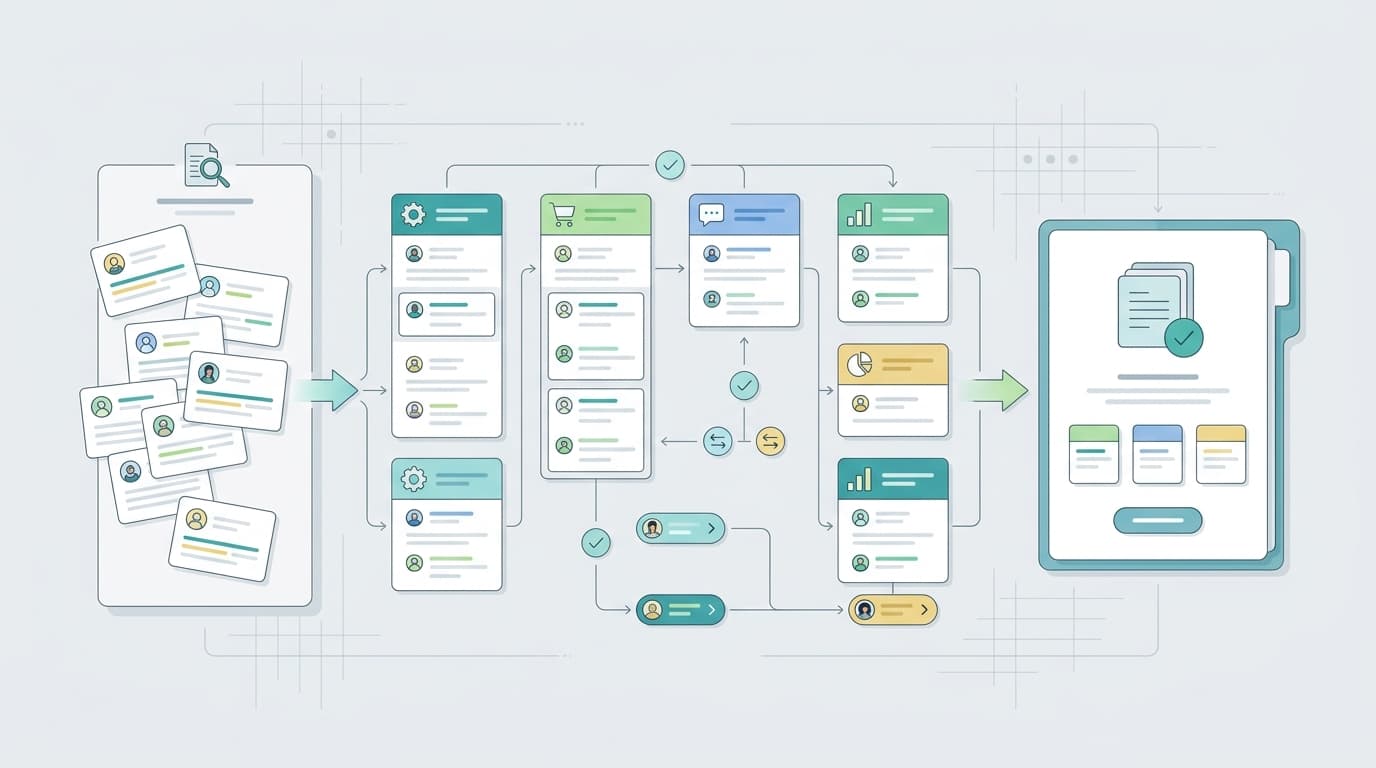
A production workflow should separate six responsibilities even if one platform performs several of them:
- Ingestion: collect reviews and preserve source metadata.
- Corpus control: filter, normalize, deduplicate, segment, and version the dataset.
- Evidence extraction: identify aspects, claims, sentiment, quotations, exceptions, and source IDs.
- Summary generation: transform only approved evidence records into a defined output schema.
- Evaluation: run deterministic checks, model-assisted graders, and human review where required.
- Delivery and monitoring: publish the result, log the release package, collect corrections, and detect drift.
The most important architectural boundary sits between evidence extraction and prose generation. If the model that writes the summary is also free to decide what the evidence was, unsupported claims become difficult to detect. Keep a structured evidence layer that can be inspected independently.
AI review summarization: implementation checklist milestones
If the team only has two weeks, do not start by tuning the model. Build the smallest pipeline that can prove where every statement came from.
| Implementation layer | First version deliverable | Do not ship until |
|---|---|---|
| Decision contract | One named user, one recurring decision, one output schema | The same review batch produces a different answer depending on who asks |
| Corpus manifest | Stable review IDs, source fields, filters, excluded-count reasons, version hash | A reviewer cannot reconstruct the analyzed dataset |
| Evidence table | Aspect, claim, polarity, exact span, source ID, confidence, contradiction flag | Themes only exist as generated prose |
| Summary template | Required sections, evidence links, uncertainty wording, prohibited claims | The model can introduce unsupported causes, market prevalence, or business impact |
| Evaluation set | Representative reviews plus sparse, contradictory, duplicate, multilingual, and adversarial cases | QA is based on “looks reasonable” review |
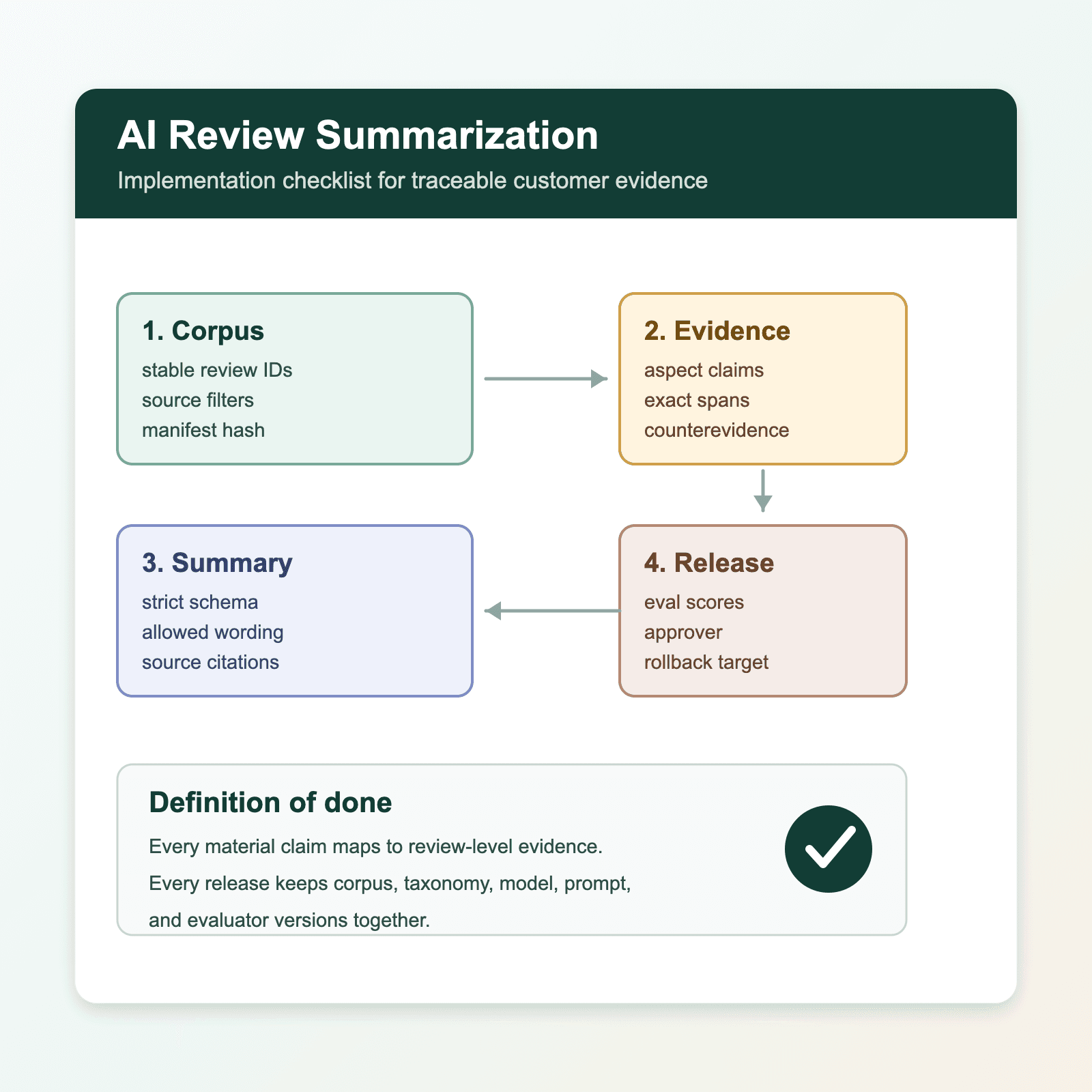
| Release record | Corpus version, taxonomy version, model and prompt version, eval scores, approver, rollback target | The team cannot reproduce or roll back a published summary |
This is the implementation floor. The richer AI review summarization QA checklist, engineering artifacts checklist, acceptance testing checklist, and production rollout checklist deepen each layer after the basic pipeline is real.
For a first release, keep the AI review summarization implementation checklist narrower than the roadmap. Ship one decision workflow that can be audited before expanding to more products, markets, or teams.
The five-step checklist at a glance
| Step | Build | Acceptance test |
|---|---|---|
| 1. Define the decision | Scope, users, output contract, evidence unit | A reviewer can explain what decision the summary supports—and what it does not support |
| 2. Prepare the review corpus | Source fields, normalization, deduplication, filters, language policy | Every included review has a stable ID and can be traced to its source |
| 3. Extract structured evidence | Aspect taxonomy, sentiment, claims, quotations, exceptions | Themes are assembled from review-level records, not invented from a single opaque prompt |
| 4. Generate and evaluate summaries | Grounded generation, citations, test set, scoring rubric, human QA | Material statements are supported, important evidence is covered, and uncertainty is visible |
| 5. Deploy and monitor | Versioning, drift checks, feedback loop, escalation rules | The team can detect quality regression and reproduce any published summary |
Do not treat these as five prompt-writing tips. Each step is a quality gate. If a gate fails, the pipeline should stop or flag the output for review.
The AI review summarization implementation checklist works best when these gates are automated where possible and owned by humans where judgment is required.
Step 1: Define the decision and output contract
The first implementation mistake is starting with “summarize these reviews.” That instruction does not say who will use the output, which decision it should inform, or how much evidence is enough.
Start with a bounded decision statement:
Summarize [review set] so [decision owner] can decide [specific choice] within [time window], while preserving [required evidence and uncertainty].
Examples:
- Summarize recent one- and two-star reviews so a quality lead can identify complaint themes that deserve investigation.
- Compare reviews for three competing products so a product manager can shortlist feature gaps for validation.
- Summarize reviews by use case so a marketing team can test whether customers describe the product differently from the current positioning.
Then define an output contract. A useful contract specifies:
- Unit of analysis: product, SKU, variation, market, segment, rating band, or time period.
- Required fields: theme, description, evidence count, example quotations, source IDs, sentiment, affected segment, confidence, and exceptions.
- Prohibited claims: prevalence outside the analyzed corpus, causal conclusions, defect-rate estimates, or revenue impact without separate evidence.
- Minimum evidence: the threshold for displaying a theme or labeling it recurring.
- Uncertainty language: how the system reports sparse, contradictory, or low-confidence evidence.
- Escalation rules: which topics always require human review, such as safety, legal, medical, privacy, or severe product-failure claims.
This contract prevents an attractive paragraph from becoming the whole product. The summary is only the presentation layer; the evidence record underneath it is the system of record.
In practice, the decision contract is the first artifact in the AI review summarization implementation checklist because it determines the corpus, evidence schema, evaluation rubric, and escalation policy.
Step 1 acceptance criteria
- One named audience and one primary decision.
- Explicit inclusion and exclusion rules.
- A machine-readable output schema.
- A list of claims the system must never infer from reviews alone.
- A human-review policy for high-risk or low-confidence outputs.
Assign owners before implementation
AI review summarization crosses product, data, engineering, domain expertise, and operations. A lightweight ownership matrix prevents quality work from becoming “the prompt engineer’s job.”
| Responsibility | Accountable owner | Required decision |
|---|---|---|
| Use-case scope | Product or research lead | Which decision the summary may influence |
| Source access and retention | Data owner | What can be collected, stored, deleted, and exported |
| Taxonomy and evidence rules | Domain lead | What counts as a theme, exception, or supported claim |
| Pipeline and versioning | Engineering lead | How runs are reproduced and rolled back |
| Evaluation and release | Quality owner | Which thresholds block publication |
| Incident response | Operations owner | Who pauses, investigates, communicates, and restores |
One person may hold several roles in a small team. The key is that every release gate has a named decision-maker. For a deeper handoff package, use the AI review summarization engineering artifacts checklist.
Step 2: Build a clean, traceable review corpus
Model quality cannot repair an undefined dataset. Before summarization, create a review-level record that can survive cleaning, analysis, and audit.
A practical minimum schema looks like this:
{
  "review_id": "stable-source-id",
  "source": "marketplace-or-channel",
  "product_id": "product-or-sku",
  "variation": "size-color-model",
  "market": "US",
  "language": "en",
  "rating": 2,
  "review_date": "2026-07-01",
  "title": "review title",
  "body": "review text",
  "verified_status": "source-provided-value",
  "source_url": "permitted-source-reference",
  "ingested_at": "pipeline timestamp"
}
Add a corpus manifest for every run. The manifest should record the query or source request, collection timestamp, filters, languages, products or SKUs, date window, included count, excluded count by reason, deduplication method, and a hash or immutable version identifier. This lets two people answer the same basic question: “Which reviews did this summary actually analyze?”
Size the corpus around the decision
There is no universal minimum number of reviews. Instead, define sufficiency by segment and decision risk.
| Use case | Better sufficiency question | Common failure |
|---|---|---|
| Complaint triage | Have we covered each priority SKU, market, and recent time window? | A large legacy corpus hides a new issue |
| Feature discovery | Do themes remain stable across resamples and customer segments? | One vocal segment becomes the product roadmap |
| Competitor comparison | Are products, periods, rating mixes, and variants comparable? | Different corpus composition creates a false winner |
| Positioning research | Do use-case phrases recur across independent reviewers? | Memorable wording is mistaken for a broad pattern |
| Executive reporting | Can every headline be reconciled to a fixed reporting window? | The denominator changes between reports |
Use stratified sampling when the full corpus is too large for evaluation. Preserve rare but high-consequence reviews—such as safety or severe failure reports—even if they would disappear in a frequency-based sample.
Add business-specific fields only when they improve analysis. More columns do not automatically create better evidence.
Normalize without erasing meaning
Normalize fields such as dates, ratings, locale codes, product identifiers, and whitespace. Preserve the original review text alongside any cleaned version. If you translate reviews, retain:
- the original language;
- the original text;
- the translated text;
- the translation method and version;
- a flag for passages that may require native-language review.
Do not silently standardize away spelling, slang, product nicknames, or usage phrases. Those details can contain the most valuable customer language.
Deduplicate carefully
Exact duplicates are easy. Near-duplicates are harder because syndicated reviews, copied reviews, short generic comments, and repeated templates can look similar.
Use a layered deduplication policy:
- Match stable source IDs.
- Match normalized exact text within the same product and market.
- Flag high-similarity records for review rather than automatically deleting them.
- Record the deduplication reason and retained canonical record.
The goal is not a magically “clean” dataset. It is a documented corpus whose boundaries can be explained.
Separate corpus frequency from market prevalence
If 18% of included reviews mention setup difficulty, you can report that 18% of the analyzed corpus mentions the theme, assuming the coding is reliable. You cannot automatically conclude that 18% of all customers experience the problem.
Reviews are a self-selected evidence source. Use them to find patterns, language, contradictions, and investigation targets—not to make unsupported population estimates.
Step 2 acceptance criteria
- Stable IDs and source traceability for every record.
- Original text preserved.
- Documented date, rating, market, product, and language filters.
- Logged duplicate handling.
- Personal or sensitive data handled according to the organization’s policy.
- Corpus statistics available before model processing.
For multi-source programs, use a separate normalization workflow before summarization. The guide to analyzing ecommerce feedback across channels covers that broader collection problem.
Step 3: Extract structured evidence before writing prose
Do not ask one model call to discover themes, count evidence, resolve contradictions, select quotations, and write the executive summary simultaneously. Break the job into review-level extraction and corpus-level synthesis.
Create an aspect taxonomy
An aspect is the subject of a customer statement: battery life, setup, packaging, sizing, support response, price, durability, or another domain-specific attribute.
Begin with a small taxonomy based on the decision in Step 1. Allow an “other” class and a discovery pass for emerging themes. Version the taxonomy so a change in labels does not silently alter trend lines.
A useful evidence record can include:
{
  "review_id": "r-1042",
  "aspect": "setup",
  "claim": "instructions were difficult to follow",
  "sentiment": "negative",
  "severity": "medium",
  "evidence_span": "exact supporting passage",
  "confidence": 0.86,
  "model_version": "extractor-version"
}
The exact labels will differ by use case. The important design choice is that every extracted claim points back to a review and, ideally, an exact evidence span.
Preserve contradictions and minority signals
A summary that says “customers find setup easy” may hide a smaller but important group using a different device, configuration, or language. Store positive, negative, and mixed evidence separately before synthesizing a conclusion.
For each theme, calculate at least:
- supporting review count;
- contradicting review count;
- unique products or variations represented;
- date range;
- rating distribution;
- segment or use-case concentration;
- number of reviews with usable evidence spans.
These are corpus descriptors, not proof of broad prevalence. They help the model and the human reviewer see whether a theme is stable, concentrated, recent, or disputed.
Use quotations as evidence, not decoration
Quotation selection should happen after evidence extraction. Require exact spans from the source text. Reject generated paraphrases presented as direct quotes.
A strong theme record contains:
- a concise label;
- a plain-language explanation;
- a representative quotation;
- an exception or contradictory quotation when material;
- source IDs;
- corpus counts;
- confidence and limitations.
Research on aspect-guided and opinion summarization reinforces the value of connecting summaries to specific aspects and supporting opinions rather than producing an unstructured generic abstract. See the MARS benchmark for aspect-oriented review summarization and Wayfair’s work on faithful abstractive product review summarization.
Use a claim-level evidence contract
A theme-level count is not enough when a summary contains several distinct claims. Store an evidence packet for each material statement:
{
  "claim_id": "claim-battery-cold-weather",
  "claim_text": "Cold-weather battery performance is a recurring complaint in the analyzed corpus.",
  "scope": {
    "product_id": "sku-123",
    "market": "US",
    "date_window": "2026-05-01/2026-07-31"
  },
  "supporting_review_ids": ["r-104", "r-318", "r-522"],
  "counterevidence_review_ids": ["r-091", "r-447"],
  "corpus_count": 742,
  "support_count": 18,
  "confidence": "medium",
  "allowed_wording": "recurring in the analyzed corpus",
  "prohibited_wording": "affects most customers"
}
This contract gives the generator less freedom and the evaluator more leverage. It also lets the team change the writing model without rebuilding the evidence layer.
Treat review text as untrusted input. Customer content can contain instructions, copied text, URLs, or attempts to manipulate an automated system. The OWASP prompt-injection guidance recommends separating untrusted content from system instructions and limiting the model’s authority. Review text should never be able to change tool permissions, corpus filters, evaluation rules, or publication settings.
Step 3 acceptance criteria
- Versioned taxonomy and extraction schema.
- Review-level evidence records.
- Exact source spans for material claims.
- Contradictions retained, not averaged away.
- Theme counts computed from records rather than guessed by the generator.
- A reproducible path from summary sentence to source review.
Step 4: Generate grounded summaries and evaluate them
Once the evidence layer exists, the summarization model has a narrower job: compress structured evidence into a useful decision artifact without adding unsupported conclusions.
Give the generator a strict contract
The generation instruction should define:
- the audience and decision;
- the allowed evidence fields;
- the required output structure;
- citation or source-ID format;
- wording for uncertainty;
- rules for conflicting evidence;
- prohibited inferences;
- maximum length;
- what to do when evidence is insufficient.
One practical rule is: if a statement cannot be linked to supplied evidence, omit it or label it as a hypothesis.
Build a test set before launch
Create a representative evaluation set that includes:
- large and small review batches;
- positive, negative, and mixed products;
- sparse themes;
- multilingual reviews;
- duplicates and near-duplicates;
- contradictory evidence;
- reviews with sarcasm or ambiguous language;
- severe complaints requiring escalation;
- products with multiple variations or use cases.
Include adversarial cases. A system tested only on clean, obvious examples will look reliable until it meets production data.
Score the output on five dimensions
Use a 1–5 rubric for each dimension:
| Dimension | Question | Failure example |
|---|---|---|
| Groundedness | Is every material statement supported by supplied evidence? | The summary invents a cause for battery failure |
| Coverage | Does the summary include the decision-relevant themes and exceptions? | It omits a low-frequency safety complaint |
| Faithfulness | Does it preserve polarity, scope, and uncertainty? | “Some reviews” becomes “customers consistently say” |
| Usefulness | Can the intended user make the next decision faster? | The summary lists themes but gives no segmentation or evidence |
| Traceability | Can a reviewer reach the underlying records? | Counts and quotations have no source IDs |
Do not reduce evaluation to one automatic score. Use deterministic checks for schema, source IDs, counts, and quotation matching; model-based grading for semantic qualities; and human review for decision usefulness and high-risk cases.
OpenAI’s evaluation best practices recommend task-specific evals, representative datasets, and continuous evaluation rather than relying on informal impressions. Google Cloud’s documentation for summary evaluation similarly separates qualities such as completeness, correctness, and adherence.
Define release thresholds
Set thresholds before seeing the final scores. For example:
- zero unsupported direct quotations;
- zero missing source IDs for high-priority themes;
- no high-risk claim published without human review;
- minimum groundedness and coverage scores on the test set;
- maximum allowed count mismatch;
- explicit abstention when evidence is below the minimum threshold.
The thresholds should reflect the decision risk. A daily orientation summary can tolerate more uncertainty than a summary used for a product recall investigation or a public claim.
Build an evaluation matrix, not one accuracy score
Create a fixed evaluation set that includes ordinary examples and deliberate stress cases. Every material production failure should become a new regression case.
| Test family | Example case | Pass condition |
|---|---|---|
| Evidence support | Summary claims a recurring defect | Every claim maps to valid source IDs and allowed wording |
| Coverage | Corpus contains one dominant and two minority themes | Dominant theme appears; material minority signals are not erased |
| Contradiction | Reviews disagree by product variant | Output separates variants instead of averaging them together |
| Sparse evidence | Only two reviews mention a topic | System abstains or labels evidence as sparse |
| Quotation integrity | Review includes unusual punctuation | Quote matches the source span exactly |
| Injection resistance | Review text contains instructions to the model | Instructions are treated as content and have no control effect |
| Reproducibility | Same release package is rerun | Output stays within the defined stability tolerance |
| Schema compliance | Generator omits a required field | Validation fails before publication |
OpenAI’s evaluation best-practices guide recommends task-specific evals, logging, automation where possible, and continuous evaluation. The principle applies regardless of model provider: define the behavior you need, test it on representative data, and preserve the failures that matter.
For a formal pre-launch gate, see the AI review summarization acceptance testing and handoff checklist.
Step 4 acceptance criteria
- Versioned prompts and model configuration.
- Representative and adversarial test cases.
- Human-authored reference judgments for a subset.
- Separate groundedness, coverage, faithfulness, usefulness, and traceability scores.
- Fixed release thresholds and escalation rules.
- Failure examples stored for regression testing.
If you are evaluating software rather than building the full stack, the customer review analysis tool requirements guide provides a broader capability checklist.
Step 5: Deploy with monitoring, versioning, and feedback loops
A summarizer can pass a launch evaluation and still degrade. Review language changes, product catalogs change, source fields disappear, taxonomies evolve, prompts drift, and model versions behave differently.
Treat the deployed system as a monitored analytical workflow.
Log enough to reproduce every summary
Store:
- corpus query and filter definition;
- review IDs and corpus snapshot time;
- cleaning and deduplication version;
- taxonomy version;
- extraction model and prompt version;
- generation model and prompt version;
- output and evidence links;
- evaluation results;
- human edits and approval state.
Reproducibility matters when a stakeholder asks why this month’s conclusion differs from last month’s.
Monitor the pipeline, not only the model
Track operational and quality indicators such as:
- ingestion failures and missing fields;
- duplicate rate;
- unclassified aspect rate;
- low-confidence extraction rate;
- evidence-link failure rate;
- quotation mismatch rate;
- count reconciliation errors;
- abstention rate;
- human edit rate;
- reviewer acceptance rate;
- time from ingestion to decision-ready output.
A sudden increase in “other” aspects may indicate taxonomy drift. A drop in theme counts may be a source ingestion problem rather than a real customer trend.
Add three operating budgets:
- Quality budget: the maximum tolerated unsupported-claim, missing-evidence, or severe-omission rate.
- Latency budget: the maximum time from source availability to a usable summary, including retries and human review.
- Cost budget: ingestion, storage, extraction, generation, evaluation, and reviewer minutes per completed decision unit.
The cheapest model call can still produce the most expensive workflow if it creates more manual verification. Measure end-to-end cost per accepted summary, not tokens alone.
Define rollback triggers before launch
Rollback should be automatic or immediately available when:
- Source volume drops unexpectedly or a connector stops updating.
- Schema validation fails for required evidence fields.
- Unsupported claims exceed the quality budget.
- A high-severity theme is published without required review.
- A model, prompt, taxonomy, or retrieval change causes benchmark regression.
- Reviewer corrections cluster around one segment, language, or product variant.
Rollback means restoring a known release package, not merely changing the prompt again. Keep the prior model identifier, prompt version, taxonomy, corpus rules, code revision, and evaluation results together. The production rollout checklist covers shadow mode, incidents, and controlled expansion in more detail.
Create a reviewer feedback loop
Capture why a reviewer changes or rejects a summary. Use structured reasons such as:
- unsupported claim;
- missing important theme;
- wrong polarity;
- misleading generalization;
- weak quotation;
- incorrect count;
- duplicate theme;
- unclear next step;
- escalation required.
Turn these failures into new evaluation cases. That is how the system improves without relying on vague instructions to “make the summary better.”
Apply risk management to the use case
The NIST Generative AI Profile emphasizes managing risks across design, development, deployment, and use. For review summarization, that means documenting limitations, testing foreseeable failure modes, monitoring deployed behavior, and matching controls to the consequence of error. The broader NIST AI Risk Management Framework provides a useful operating sequence: govern ownership, map the use case and affected parties, measure quality and risk, and manage issues over time.
Step 5 acceptance criteria
- End-to-end version logging.
- Quality and operational dashboards.
- Alerts for source, schema, and evidence failures.
- Structured reviewer feedback.
- A regression test added for every material failure.
- A rollback path for model, prompt, taxonomy, and pipeline changes.
A practical 30-day rollout plan
| Period | Goal | Deliverable |
|---|---|---|
| Days 1–5 | Define scope and evidence rules | Decision statement, output schema, risk policy, initial test set |
| Days 6–10 | Build the corpus pipeline | Traceable records, normalization rules, deduplication log, corpus report |
| Days 11–17 | Build structured extraction | Taxonomy, evidence records, quotation checks, contradiction handling |
| Days 18–24 | Generate and evaluate | Summary contract, eval rubric, human review, release thresholds |
| Days 25–27 | Run shadow mode | Compare generated outputs with the current human workflow without changing decisions |
| Days 28–30 | Assisted pilot | Limited production run, dashboard, reviewer feedback, rollback rehearsal |
Keep the first pilot narrow. One product family, one market, one decision owner, and one recurring decision will teach you more than a broad launch with unclear accountability.
At the end of 30 days, make one of three decisions: expand the scope, hold the scope while fixing specific gaps, or stop the workflow. “The summaries seem useful” is not a decision. Compare the pilot against the release thresholds, operating budgets, reviewer time, and the baseline process it was meant to improve.
Implementation handoff map
Use this handoff map when the checklist moves from planning into engineering tickets.
| Owner | Receives | Must return | Blocking question |
|---|---|---|---|
| Product or research lead | Decision contract and output schema | Approved use case, non-goals, escalation topics | What decision changes if the summary is wrong? |
| Data owner | Source list and retention policy | Corpus manifest fields, deletion/export rules, permitted source references | Can every review be traced without exposing unnecessary data? |
| Engineering lead | Corpus and evidence schemas | Versioned pipeline, validation checks, release record, rollback path | Can the run be reproduced after a prompt or model change? |
| Domain reviewer | Aspect taxonomy and sample evidence | Label rules, contradiction rules, severity definitions | Which minority signals must never be averaged away? |
| QA owner | Test set and evaluation rubric | Release thresholds, regression suite, failure log | Which failures block launch rather than create follow-up work? |
| Operations owner | Monitoring requirements | Dashboards, alerts, incident owners, assisted-launch rules | Who pauses the workflow when evidence quality drops? |
The handoff is complete only when every owner has a return artifact. A meeting note that says “approved” is not enough for an AI review summarization implementation checklist. The artifacts need to survive the next release, the next reviewer, and the next source-data change.
Build, buy, or combine?
The checklist applies whether you build with models and APIs, buy a dedicated platform, or combine both.
- Build when the workflow is strategically unique, engineering ownership is stable, and your team can maintain data access, evaluation, security, and monitoring.
- Buy when speed, repeatable review intelligence, analyst usability, and existing workflows matter more than custom infrastructure.
- Combine when a platform handles collection and analysis while an API or internal application delivers outputs into a specific product, research, or reporting workflow.
When comparing options, run the same defined corpus through each workflow. Check evidence traceability, contradiction handling, taxonomy control, evaluation support, and exportability—not only how polished the summary sounds.
VOC AI supports review-analysis workflows across Voice of Customer Analysis, review-backed Product Research, competitor analysis, and the Review Analysis API. The right path depends on whether your immediate need is an analyst workflow, a recurring decision system, or a product integration.
Final implementation checklist
Before launch, confirm that you can answer yes to every question:
- Decision: Is the summary tied to a named user and recurring decision?
- Non-goals: Does the contract state what the summary cannot establish?
- Owner: Is one person accountable for each release gate?
- Corpus: Can every included review be traced to a stable source record?
- Manifest: Can the exact dataset and filters be reconstructed?
- Segmentation: Are product, market, language, rating, and time differences preserved where relevant?
- Deduplication: Are removals logged without erasing legitimate repetition?
- Evidence: Does every material claim link to review-level evidence?
- Counterevidence: Are minority and conflicting signals visible?
- Claims: Are corpus observations separated from population or causal claims?
- Quotes: Are quotations exact, attributable, and protected from prompt injection?
- Schema: Does invalid output fail before publication?
- Evaluation: Have you tested groundedness, coverage, faithfulness, usefulness, and traceability?
- Stress tests: Does the benchmark include sparse, contradictory, segmented, and adversarial examples?
- Thresholds: Are release and abstention criteria explicit?
- Risk: Do high-risk topics trigger human review?
- Versioning: Can you reproduce a summary after a model, prompt, taxonomy, or corpus change?
- Budgets: Are quality, latency, cost, and reviewer-time limits measured end to end?
- Rollback: Can the team restore a known release package quickly?
- Security: Is untrusted review text separated from instructions, tools, and publication controls?
- Learning: Does every material correction become a regression test or rule update?
The implementation is ready when the evidence survives scrutiny—not when the prose sounds fluent.
If you are evaluating a platform rather than building the full stack, apply the same checklist during procurement. Ask the vendor to demonstrate evidence traceability, corpus controls, exports, evaluation, security boundaries, and rollback behavior using your own test set. The AI review summarization vendor evaluation checklist provides a structured scorecard.
Treat this AI review summarization: implementation checklist as the hub. Use the companion pages when the team needs deeper QA tests, engineering artifacts, security controls, acceptance handoff, vendor scoring, or production operations.
Frequently asked questions
What is AI review summarization?
AI review summarization is the use of language models or related natural-language processing systems to compress a defined set of customer reviews into themes, findings, or decision-oriented outputs. A production workflow should preserve source traceability, uncertainty, contradictions, and corpus boundaries.
How many reviews are needed for AI summarization?
There is no universal minimum. The right threshold depends on the decision, product segmentation, review length, theme diversity, and required confidence. Always report the analyzed corpus size and abstain from strong conclusions when evidence is sparse.
Should AI summaries include customer quotes?
Yes, when quotations improve verification and context. Quotes must be exact source spans with stable review IDs or links. Never present a generated paraphrase as a direct quotation.
How do you measure review-summary accuracy?
Measure multiple dimensions: groundedness, coverage, faithfulness, usefulness, and traceability. Combine deterministic checks, model-based evaluation, and human review. Accuracy is not one score because a grammatically correct summary can still omit important evidence or overstate a weak pattern.
What should be in the first engineering ticket?
The first ticket should create the decision contract, corpus manifest, evidence schema, output schema, and validation checks before any production summary is generated. Model selection can happen after the team knows what evidence the system must preserve.
Can a review summary prove how common a problem is?
It can describe frequency inside the analyzed review corpus. It does not automatically estimate prevalence among all customers, explain causation, or predict business impact. Those questions require additional data and a method designed for them.