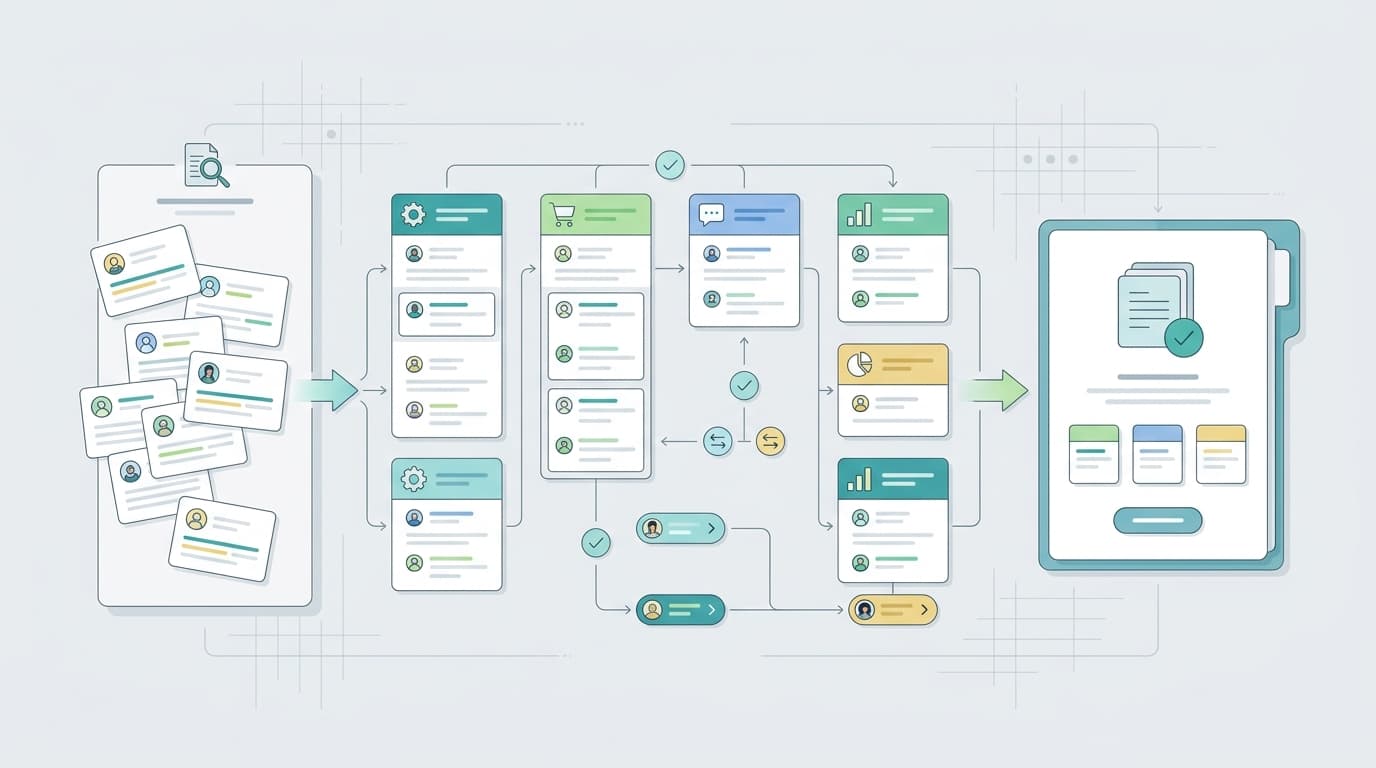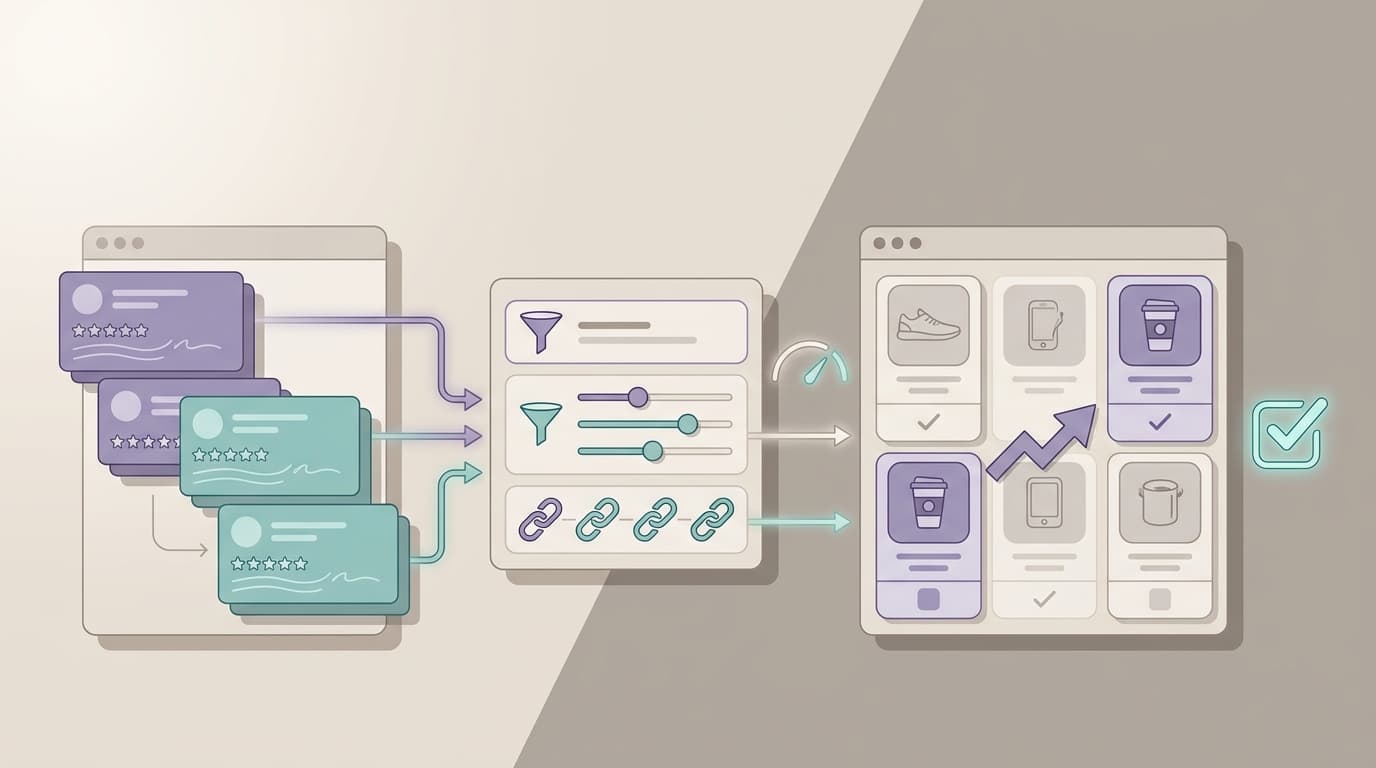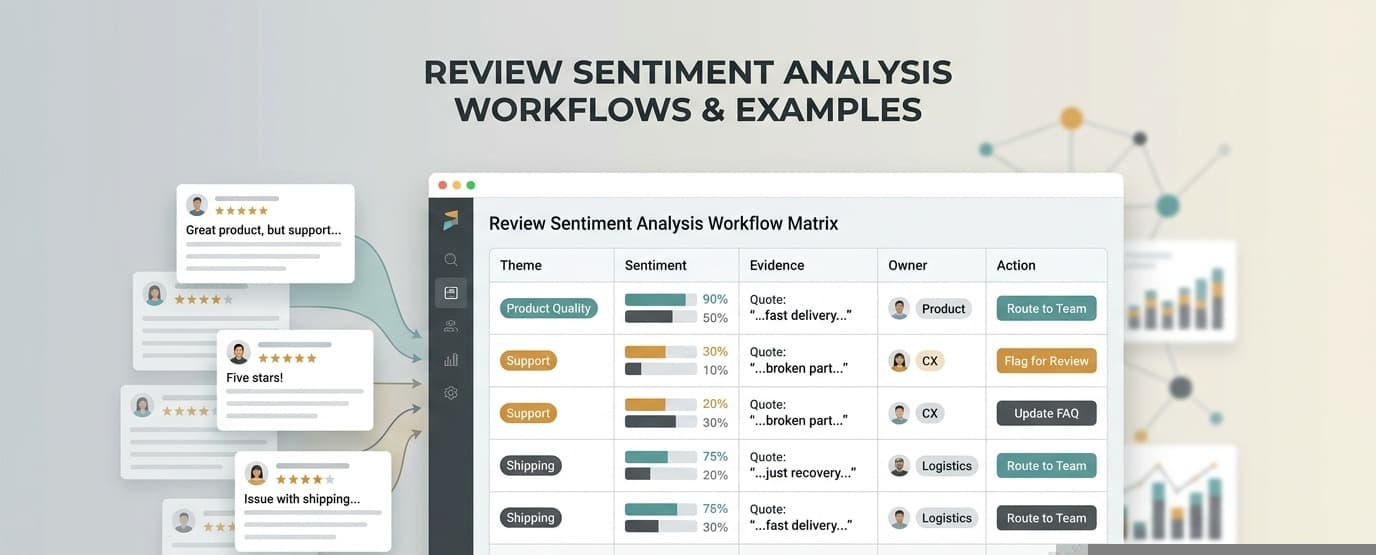
An AI review summarizer can produce an impressive paragraph in a demo and still fail in production.
The difference is not usually fluency. It is whether the system can show its evidence, preserve disagreement, protect customer data, fit the team's workflow, and stay reliable after models, prompts, taxonomies, and source data change.
Use this AI review summarization implementation checklist when you are deciding whether to build, buy, or combine tools. It is designed for product, research, e-commerce, CX, data, security, and procurement teams that need a defensible business evaluation—not another feature list.
If you are designing the technical pipeline itself, start with the five-step AI review summarization implementation guide. This companion guide focuses on evaluating a solution before you commit budget, data, and operational ownership.
The production-readiness checklist at a glance
| Gate | Question you must answer | Evidence to request |
|---|---|---|
| 1. Decision fit | What recurring decision will the summary improve? | Named user, decision, cadence, and action |
| 2. Data fit | Can the system ingest the right corpus without corrupting context? | Source coverage, schema, deduplication, and freshness rules |
| 3. Evidence quality | Can every material claim be checked against reviews? | Review IDs, exact spans, counts, filters, and contradiction handling |
| 4. Evaluation | Does quality hold on your data, not only a vendor demo? | Test set, rubric, failure log, and release thresholds |
| 5. Security and governance | Are data handling and model risks documented? | Retention, access, subprocessors, incident process, and audit evidence |
| 6. Workflow fit | Will the output reach the team where decisions happen? | Exports, API behavior, permissions, integrations, and reviewer loop |
| 7. Economics | Is the full cost justified by a measurable operating change? | Total cost, labor baseline, adoption assumptions, and payback model |
| 8. Pilot acceptance | What must be true before rollout? | Signed scorecard, owners, rollback trigger, and go/no-go rule |
Do not award points for polished prose until the evidence gates pass.
1. Define the decision before evaluating the summary
Start with one sentence:
Every [cadence], [role] uses a summary of [defined review corpus] to decide [action], and records [outcome].
Examples include:
- A product manager reviews monthly complaints for one product family and selects the next usability investigation.
- An e-commerce operator compares recurring complaints across five competing products before changing a listing or product specification.
- A CX leader reviews weekly escalation themes and assigns one process owner to the highest-confidence failure mode.
- A research team triages thousands of open-ended reviews into hypotheses for deeper interviews.
Reject vague goals such as “understand customers better.” A system cannot be evaluated against an undefined decision.
Decision-fit questions
- Who is the primary user?
- What decision do they make today?
- How often is the decision made?
- Which reviews belong in the corpus?
- Which segments must remain separate?
- What action should the output trigger?
- What would make the summary unsafe or unusable?
- What measurable step should become faster, cheaper, or more consistent?
Acceptance criterion: the buyer, operator, and reviewer agree on one narrow use case and one output contract before seeing vendor scores.
2. Test data fit with a real corpus
A vendor's sample data hides the hard parts: duplicated reviews, language variation, missing metadata, stale exports, malformed dates, syndicated content, spam, very short comments, and conflicting product variants.
Ask every option to process the same bounded corpus. Include normal examples and difficult cases. Keep a frozen copy so results can be reproduced later.
Data-fit checklist
- Source coverage: Which marketplaces, review platforms, surveys, tickets, or uploaded files are supported?
- Historical depth: How much history can be imported, and are limits documented?
- Freshness: Is ingestion real time, scheduled, manual, or dependent on an export?
- Metadata: Are product, variant, country, language, rating, date, and source identifiers preserved?
- Deduplication: How are syndicated or repeated records detected without deleting legitimate repetition?
- Language handling: Are languages detected, translated, analyzed separately, or merged?
- Deletion and correction: Can a source record be removed or corrected downstream?
- Exportability: Can you retrieve normalized records and analysis results in a usable format?
The goal is not maximum ingestion. It is a traceable corpus whose boundaries are visible to the person reading the summary.
Red flag: the system produces a finding but cannot show exactly which records and filters were included.
3. Require review-level evidence, not decorative citations
The minimum useful evidence unit is not a link at the bottom of a report. It is a structured connection between a claim and the review records that support, contradict, or qualify it.
For each material theme, request:
- A stable theme or aspect name.
- The number of matching records inside the selected corpus.
- The corpus denominator and active filters.
- Exact source spans or clearly labeled paraphrases.
- Review IDs or source links.
- Product, variant, market, language, rating, and date context.
- Contradictory and minority evidence.
- A confidence or abstention status with a defined meaning.
Then perform three simple checks:
- Claim-to-evidence: Does the cited text actually support the claim?
- Evidence-to-source: Can a reviewer open or retrieve the original record?
- Scope: Does the wording stay inside what the selected corpus can prove?
A review corpus can show what appeared in that corpus. It does not automatically represent every customer, establish causation, or estimate market-wide prevalence.
Acceptance criterion: a reviewer can verify a high-priority claim in under two minutes without asking the vendor for help.
4. Evaluate on your failures, not the average demo
Build a test set before the pilot. Include the decisions and failure modes that matter to your team rather than relying on a generic “accuracy” score.
OpenAI's evaluation guidance recommends task-specific tests, logging, automated scoring where appropriate, and human judgment rather than relying on intuition alone. NIST's Generative AI Profile similarly emphasizes measuring, managing, and documenting risks across the AI lifecycle.
A practical review-summary rubric
Score each dimension from 0 to 4.
| Dimension | 0 | 2 | 4 |
|---|---|---|---|
| Groundedness | Material claims are unsupported | Most claims have evidence, with gaps | Every material claim is supported or explicitly uncertain |
| Coverage | Misses decision-critical themes | Covers common themes but misses edge cases | Covers required themes, contradictions, and notable minority signals |
| Faithfulness | Changes meaning or invents detail | Mostly faithful with occasional overstatement | Preserves meaning, qualifiers, and uncertainty |
| Traceability | Evidence cannot be retrieved | Some claims link to records | Claims link to stable records and exact supporting spans |
| Segmentation | Mixes incompatible products or markets | Basic filters work | Required segments remain separate and auditable |
| Usefulness | Generic prose with no decision value | Partly useful | Produces the agreed decision input in the required format |
| Reproducibility | Result cannot be recreated | Configuration is partly visible | Corpus, model, prompt, taxonomy, and versions are logged |
Add must-pass tests for known risks:
- Conflicting opinions are preserved.
- Sparse evidence triggers abstention rather than certainty.
- A low rating with positive text is not misclassified solely from the star score.
- Product variants are not silently combined.
- A quoted sentence is exact and attributable.
- Changing a date or market filter changes the result as expected.
- Prompt injection or malicious text inside a review cannot change system instructions or expose hidden data.
OWASP's guidance for applications using large language models highlights risks such as prompt injection, sensitive information disclosure, improper output handling, and excessive agency. Even if a summarizer does not take external actions, adversarial or untrusted review text should still be treated as data—not instructions.
Acceptance criterion: the chosen option passes every must-pass test and meets the agreed average score without an unresolved severity-one failure.
5. Complete the security and governance review
Security questionnaires often focus on the vendor's company controls while missing the actual review-analysis data flow. Map the full path: source, connector, storage, model provider, logs, exports, users, and deletion.
Data-handling questions
- What data is sent to which service or model provider?
- Is customer content used to train shared models by default?
- What are the retention periods for inputs, outputs, logs, backups, and failed jobs?
- Can the service support reduced retention or zero-data-retention controls where required?
- Where is data processed and stored?
- Which subprocessors can access it?
- How are tenant boundaries enforced?
- Are data in transit and at rest encrypted?
- How are user access, service accounts, and API keys controlled and revoked?
- Can the vendor fulfill deletion, correction, and export requests?
AI-risk questions
- Is untrusted review text isolated from system instructions and tool permissions?
- Are generated quotations checked against source spans?
- Are unsupported claims blocked, flagged, or merely discouraged in a prompt?
- Is personally identifiable or sensitive information detected and handled?
- Can the system explain model, prompt, taxonomy, and pipeline changes?
- Are incidents, regressions, and customer-reported failures recorded?
- Is there a documented rollback path?
Do not infer a vendor's security posture from a logo wall or a generic “enterprise-ready” claim. Request the evidence your policy requires.
Acceptance criterion: security, legal, privacy, and data owners have documented answers for the intended corpus and deployment—not a different product tier or hypothetical future configuration.
6. Verify workflow and integration fit
The best summary has no value if it becomes another dashboard nobody opens.
Map the full operating loop:
review source -> ingestion -> analysis -> human verification -> decision record -> owner -> action -> outcome -> regression learning
Evaluate whether the option supports:
- Saved filters and repeatable analysis windows.
- Role-based access and separation of sensitive projects.
- Shareable evidence, not only screenshots.
- CSV, JSON, or document export in the format users need.
- API access for recurring or product-embedded workflows.
- Links into product, research, support, or planning records.
- Reviewer comments, corrections, and disposition tracking.
- Version history and reproducible reruns.
- Alerts for ingestion failures, schema changes, and quality regressions.
For an analyst-led workflow, a dedicated interface may reduce setup and speed adoption. For an embedded or recurring system, an API may matter more. VOC AI offers both Voice of Customer Analysis workflows and a Review Analysis API for teams with development resources.
Acceptance criterion: the pilot completes one real decision cycle inside the team's normal operating environment.
7. Compare total cost, not subscription price
The visible license or model bill is only one cost bucket.
Include:
- Software subscription or usage fees.
- Data acquisition, export, connector, or marketplace costs.
- Initial implementation and integration labor.
- Taxonomy, prompt, and evaluation design.
- Human review and quality assurance.
- Security, privacy, legal, and procurement work.
- Monitoring, incident response, and regression maintenance.
- Change management and user training.
- Switching and data-exit costs.
Then compare the proposed workflow with a measured baseline. Useful unit metrics include:
- Analyst minutes per completed review-analysis decision.
- Cost per completed decision.
- Percentage of material claims with retrievable evidence.
- Rework rate after stakeholder review.
- Time from new review data to assigned action.
- Adoption rate among the intended users.
Use the product review mining ROI calculator to model labor savings, recurring costs, break-even, and payback without assuming that faster summaries automatically create revenue.
Red flag: the business case counts speculative revenue but does not measure current labor, rework, or decision throughput.
8. Run a controlled pilot with signed acceptance criteria
A useful pilot is narrow enough to diagnose failure and real enough to expose operational friction.
Recommended pilot design
- Duration: two to four weeks.
- Scope: one product family, market, language set, and recurring decision.
- Corpus: a frozen benchmark plus one live refresh.
- Participants: one decision owner, one operator, one evidence reviewer, and required security or data reviewers.
- Comparison: the current workflow and each shortlisted option use the same task.
- Artifacts: outputs, evidence, time logs, corrections, costs, and failure records.
Weighted pilot scorecard
| Category | Weight | Minimum gate |
|---|---|---|
| Evidence quality and traceability | 25% | 80/100 |
| Decision usefulness | 20% | 75/100 |
| Data and segmentation fit | 15% | 75/100 |
| Evaluation and reproducibility | 15% | 75/100 |
| Security and governance | 10% | Pass all mandatory controls |
| Workflow and integration fit | 10% | Complete one live decision cycle |
| Total economics and exit terms | 5% | Approved business case |
Do not let a high weighted average compensate for a mandatory security, evidence, or data-control failure.
Go, conditional go, or no-go
- Go: all mandatory gates pass, the weighted threshold is met, and an operational owner accepts the runbook.
- Conditional go: no critical gate fails, but a time-bounded remediation has an owner, deadline, and verification test.
- No-go: evidence cannot be verified, data controls are unresolved, required segments are corrupted, critical tests fail, or no team owns production quality.
The 24-question vendor checklist
Copy these questions into your request for information, proof-of-concept plan, or procurement review.
Decision and data
- Which recurring decision is this deployment designed to improve?
- Which sources, languages, markets, and metadata fields are supported?
- How are duplicates, variants, deleted records, and source corrections handled?
- Can we export normalized source records and analysis outputs?
Evidence and quality
- Can every material claim link to review-level evidence?
- Are exact quotations verified against source text?
- How are contradictions, minority signals, and sparse evidence shown?
- Which task-specific evaluation dimensions and release thresholds are supported?
- Can we run a frozen test set after model, prompt, or taxonomy changes?
- Can the system abstain when evidence is insufficient?
Security and governance
- Is our data used to train shared models?
- What are the retention and deletion rules for inputs, outputs, and logs?
- Which model providers and subprocessors receive data?
- How are tenant isolation, encryption, access, and API credentials managed?
- How is prompt injection or malicious source text contained?
- What incident, audit, version, and rollback evidence is available?
Operations and integration
- Can users save filters, rerun analyses, and reproduce prior outputs?
- Which exports, APIs, permissions, and workflow integrations are available now?
- How are reviewer corrections recorded and converted into regression tests?
- Which monitoring signals and alerts are included?
Economics and commercial terms
- What usage, storage, connector, seat, implementation, and support costs apply?
- What internal labor is required to operate and review the system?
- How can we retrieve our data, configurations, and evidence if we leave?
- Which pilot acceptance criteria will be written into the buying decision?
Final recommendation
Evaluate AI review summarization as an evidence system, not a writing feature.
The winning option should make important customer signals easier to verify, compare, assign, and revisit. It should also make its limits visible. If the summary is persuasive but the corpus, evidence, controls, and ownership are unclear, the implementation is not ready.
For broader software requirements beyond summarization, use the customer review analysis tool evaluation guide. For pipeline design, schemas, grounded generation, and monitoring, use the technical implementation checklist.
Frequently asked questions
What should an AI review summarization pilot measure?
Measure evidence quality, decision usefulness, data and segmentation fit, reproducibility, security controls, workflow completion, total operating cost, and rework. Do not rely on a single generic accuracy score.
Should we build or buy an AI review summarizer?
Build when the workflow is strategically unique and your team can own data ingestion, evaluation, security, monitoring, and maintenance. Buy when speed, analyst usability, existing data coverage, and repeatable workflows matter more than custom infrastructure. Combine both when a platform handles review intelligence and an API delivers results into a specialized internal workflow.
How do we compare AI review summarization vendors fairly?
Give every option the same frozen corpus, decision task, filters, output contract, test set, and time window. Score the results with the same rubric and record failures, corrections, labor, and costs.
Is a human reviewer still necessary?
Yes for high-impact decisions, early deployments, disputed themes, sparse evidence, and failure analysis. Human review should be risk-based and should generate reusable regression tests rather than becoming untracked manual cleanup.
What is the biggest red flag in a review summarization demo?
The biggest red flag is a confident theme that cannot be traced to the exact reviews, filters, and supporting text used to produce it.