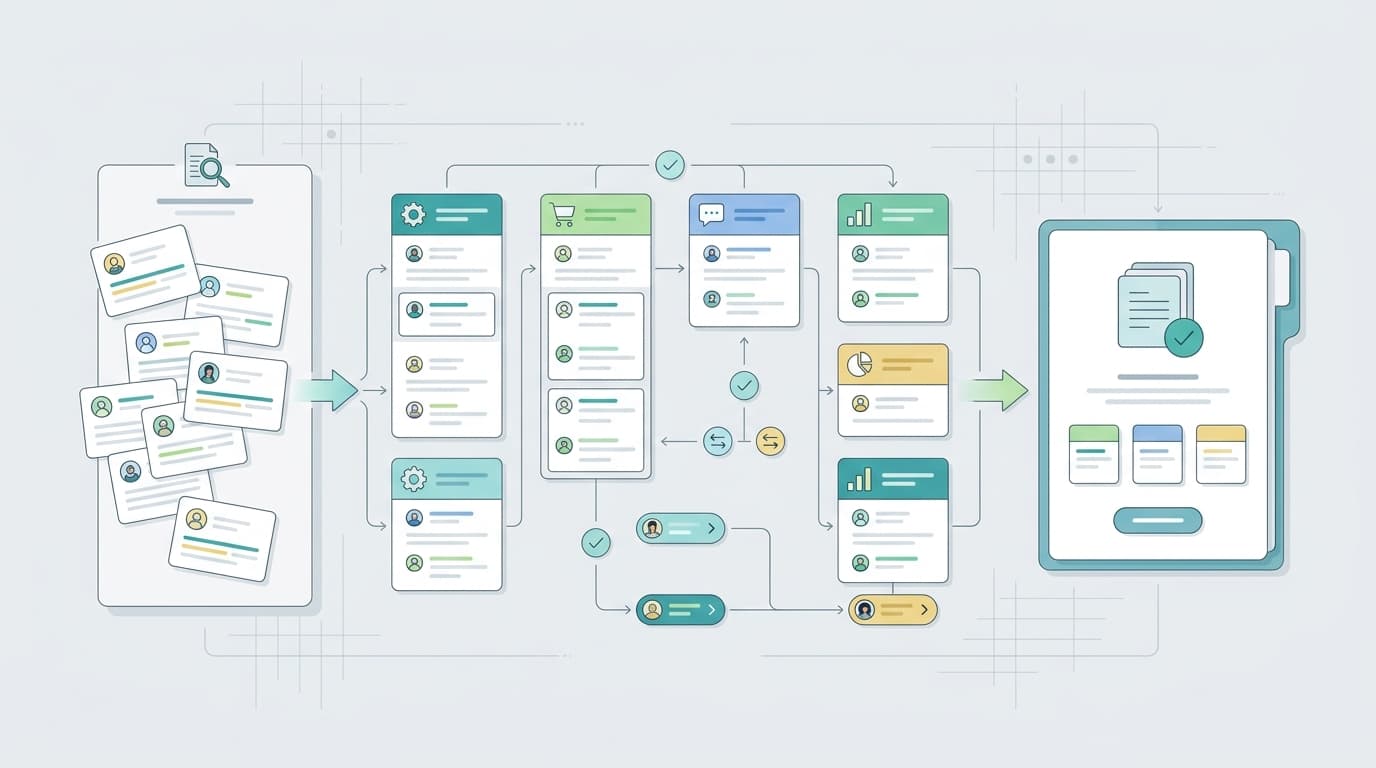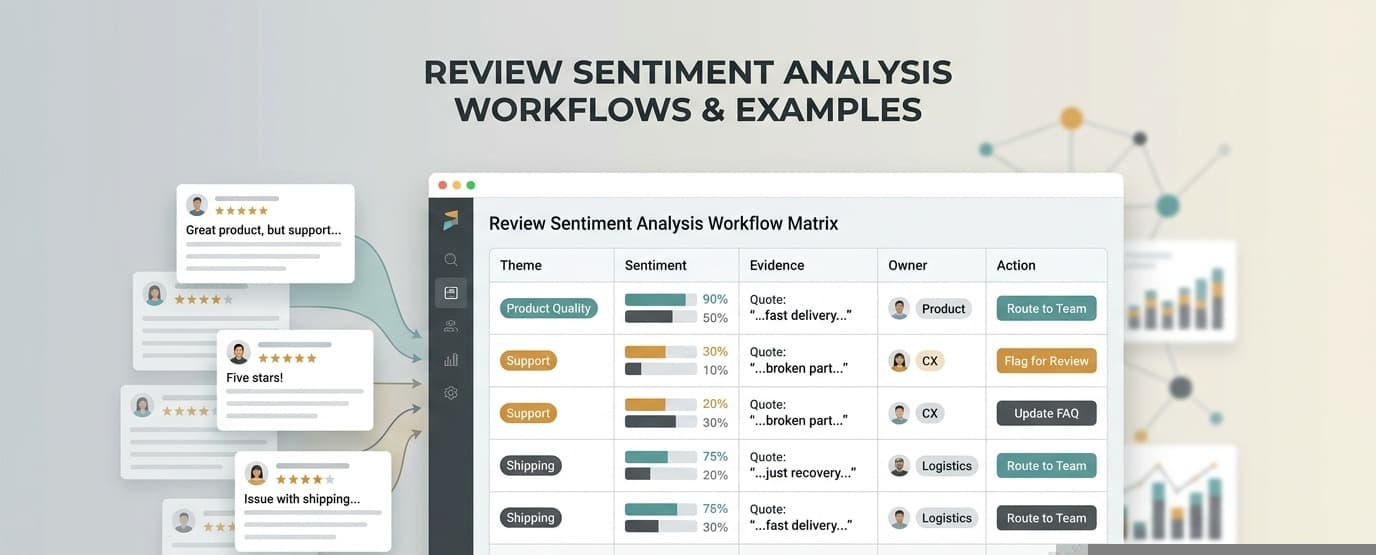
Searching for Amazon review analytics alternatives usually starts with a tool name. It should start with a workflow problem.
Some products help you filter and summarize reviews. Some add review analysis to a larger seller suite. Some expose Amazon customer-feedback data through an API. Others turn review themes into product, positioning, or competitor decisions. A spreadsheet plus a general AI model can also work for a small project—but it creates a very different operating burden.
This guide compares six practical alternatives by the job they do, the evidence they preserve, and the work your team still has to complete after the analysis.
Disclosure: VOC AI publishes this comparison and is included as one option. Capabilities, marketplace coverage, eligibility, limits, and pricing can change. Verify current vendor documentation and your data-use requirements before choosing a workflow.
Quick comparison: which Amazon review analytics alternative fits your job?
| Alternative | Best fit | Main strength | Main tradeoff to test |
|---|---|---|---|
| Amazon Customer Feedback API or native Amazon data | Eligible developers and solution providers building Amazon-native workflows | First-party structured customer-feedback access | Eligibility, available metrics, retention, and the engineering needed to turn data into decisions |
| Seller-suite review insights | Sellers who want review analysis alongside keyword, listing, or product-research tools | Fewer tools and a familiar operating workspace | Review depth may be secondary to the broader suite |
| Specialist Amazon review mining | Sellers and agencies that need filtering, exports, variant analysis, and product-definition research | Amazon-specific review exploration | The team may still need to translate analysis into a repeatable decision process |
| VOC intelligence platform | Teams connecting review evidence to product, market, listing, competitor, or agent workflows | Structured themes, comparisons, buyer language, and reusable outputs | Requires a clear decision and evidence standard—not just a request for a summary |
| Spreadsheet plus general AI | Small, bounded analyses with a controlled review set | Flexible and inexpensive to prototype | Sampling, cleanup, repeatability, hallucination, governance, and maintenance |
| Review checker or lightweight summarizer | Shopper trust checks or fast orientation | Quick answer to a narrow question | Not a substitute for cohort-based seller analytics or source-traceable product research |
The best choice is not the platform with the longest feature list. It is the workflow that answers your decision with evidence your team can inspect and reuse.
What counts as an Amazon review analytics alternative?
“Review analytics” is often used for several different jobs:
- Access: collect or retrieve the relevant reviews and metrics.
- Cohort control: separate marketplaces, ASINs, variants, ratings, languages, and time periods.
- Analysis: identify themes, sentiment, motivations, usage scenarios, objections, and failure modes.
- Comparison: show how products, competitors, segments, or periods differ.
- Evidence: preserve the reviews or identifiers behind important conclusions.
- Activation: turn the finding into a product requirement, listing change, monitoring rule, research brief, or system input.
Two tools can both claim “AI review analysis” while covering different parts of this chain. That is why replacing one product with another often fails: the buyer compares interface features instead of workflow coverage.
Alternative 1: Amazon Customer Feedback API or native Amazon data
Amazon’s Selling Partner API includes a Customer Feedback API. Amazon’s documentation describes use cases such as retrieving review trends and topic-level customer feedback for an ASIN, with optional date filtering. This route is relevant when your organization is eligible for access and wants first-party inputs inside a software product or internal data workflow.
Choose this route when:
- your team is building an application, data product, or internal pipeline;
- Amazon-native review metrics are the required source;
- engineering resources can manage authentication, data models, monitoring, and downstream analysis;
- you want control over how customer-feedback data enters your system.
Test before committing:
- eligibility and role requirements;
- marketplaces, ASIN coverage, metrics, and date ranges;
- rate limits, retention, and permitted uses;
- whether the available output answers your decision directly;
- the effort required to add taxonomies, evidence views, comparisons, alerts, and reporting.
An API can solve access without solving interpretation. If your team still needs to design the analysis layer, budget for that work explicitly.
Alternative 2: seller-suite review insights
Seller suites are attractive when review analysis is one step inside a broader Amazon workflow. Helium 10, for example, describes Review Insights as using Amazon customer-feedback data to surface review trends and themes within its seller platform.
The advantage is context: a seller can move between review findings and adjacent keyword, listing, or product-research work without assembling a separate stack.
Choose a seller-suite workflow when:
- the same users already work in the suite every day;
- review analysis supports listing or product-research decisions;
- convenience matters more than a highly customized research system;
- your team prefers one commercial relationship and operating environment.
Test before committing:
- whether themes link to source evidence;
- whether you can separate products, variants, ratings, dates, and markets;
- whether comparisons preserve different cohorts instead of pooling them;
- export, sharing, collaboration, and API options;
- whether review intelligence is deep enough for product and customer teams, not only seller operations.
A suite can reduce tool sprawl. It can also make review analytics a supporting feature rather than the system of record. Run the same decision through the suite before assuming convenience equals sufficient depth.
Alternative 3: specialist Amazon review mining
Specialist tools focus more directly on Amazon review exploration. SellerSprite’s Review Analysis product, for example, presents review filtering, statistical analysis, variant analysis, product-definition research, and export-oriented workflows.
This category can be a strong fit for agencies, marketplace researchers, and sellers who want more review-specific control than a lightweight summarizer provides.
Choose specialist review mining when:
- Amazon review research is frequent and operational;
- filters and exports are important;
- variant, rating, or time-based differences matter;
- the team wants to inspect review patterns before forming a conclusion.
Test before committing:
- supported Amazon marketplaces and languages;
- whether exports retain the cohort definition;
- how themes are created and updated;
- whether source evidence remains visible after summarization;
- whether the workflow supports competitor sets and recurring analysis;
- how findings move into a product brief, listing plan, or client report.
Specialist mining reduces the manual work of organizing reviews. It does not automatically create a shared decision process. Define who validates a theme, who owns the next action, and where the evidence is stored.
Alternative 4: a VOC intelligence platform
A voice-of-customer platform is designed for teams that need more than a review summary. The output should connect buyer language and recurring themes to a business decision.
VOC AI’s current product stack includes review analysis, product research, competitor intelligence, a conversational agent, and API or MCP access for technical workflows. Its Voice of Customer Analysis route focuses on customer profiles, purchase motivations, usage scenarios, sentiment, product strengths and weaknesses, and listing language. The Review Analysis API supports teams that want review intelligence inside their own applications or agents.
Choose a VOC intelligence workflow when:
- product, research, marketing, CX, or agency teams need a shared evidence base;
- competitor review differences matter as much as one-product summaries;
- buyer motivations, objections, scenarios, and language need to remain distinct;
- findings must be reused in dashboards, reports, agents, or product workflows;
- the team needs a path from review evidence to a prioritized next action.
Test before committing:
- whether important conclusions are traceable to the analyzed cohort;
- how the system handles contradictions and low-frequency signals;
- whether outputs separate observation from recommendation;
- collaboration, export, API, and governance requirements;
- whether the workflow fits your actual operating cadence.
For a more detailed commercial evaluation, use the Amazon review analysis tool buyer scorecard. If you are comparing fast summaries with a deeper evidence-to-decision workflow, see VOC AI vs. Amazon review summarizers.
Alternative 5: spreadsheet plus general AI
A spreadsheet and a general AI model can be a reasonable starting point when the dataset is small, the question is narrow, and a person controls every step.
A practical manual workflow might include:
- Define the ASINs, variants, dates, ratings, and marketplaces.
- Obtain the data through an authorized source.
- Remove duplicates and normalize fields.
- Create a theme taxonomy.
- Ask the model to classify reviews against that taxonomy.
- Inspect examples, contradictions, and uncertain classifications.
- Calculate theme counts using the actual reviewed rows.
- Save the prompt, taxonomy, sample, and validation notes.
Choose this route when:
- the analysis is a one-off or early prototype;
- a trained owner can validate every important output;
- the review set and permitted use are clear;
- repeatability and collaboration requirements are limited.
Watch for:
- biased sampling or missing variants;
- model summaries that invent precision or hide disagreement;
- theme drift between runs;
- sensitive data entering an unapproved system;
- spreadsheet logic that cannot be audited later;
- a prototype quietly becoming a production process.
Manual analysis is not free. The software cost may be low, but the organization pays in analyst time, QA, documentation, and maintenance.
Alternative 6: review checker or lightweight summarizer
Review checkers and lightweight summarizers answer useful but narrower questions.
A review checker such as ReviewMeta focuses on patterns that may affect how a shopper interprets Amazon reviews. A lightweight summarizer focuses on quick pros, cons, or recurring themes. Neither category should automatically be treated as a replacement for seller-grade review analytics.
Choose this route when:
- you need fast orientation before deeper research;
- the primary question is review trust or a simple overview;
- the decision is low-risk and easy to validate manually.
Do not use it as the only input when:
- product requirements, manufacturing changes, or claims are involved;
- variant and time-period differences matter;
- competitor comparison is central;
- your team needs source evidence, exports, or recurring monitoring;
- the result will be reused by multiple functions.
The category boundary matters. A review checker, a review summarizer, and a voice-of-customer platform may all discuss reviews, but they are not interchangeable.
Use this decision tree
Choose the route that matches your constraint:
- Need first-party Amazon inputs inside software? Start with the Customer Feedback API and scope the analysis layer separately.
- Already live in a seller suite? Test its review-insight module against one real decision before adding another platform.
- Need Amazon-specific filtering and exports? Shortlist specialist review-mining tools.
- Need cross-functional, competitor, and evidence-to-action workflows? Evaluate a VOC intelligence platform.
- Need a small controlled experiment? Use a spreadsheet and general AI with explicit QA.
- Need only a trust check or quick overview? Use a checker or lightweight summarizer, then escalate if the decision requires deeper evidence.
Run a 45-minute same-ASIN comparison
Marketing pages are difficult to compare. A bounded test is more useful.
Step 1: write one decision
Use a question such as:
Which recurring complaint should we investigate before the next product revision?
Step 2: lock the cohort
Record the marketplace, ASINs, variants, rating bands, language, date range, and available review count. If two tools analyze different cohorts, their outputs are not directly comparable.
Step 3: request the same deliverables
Ask each workflow for:
- the top five complaint themes;
- theme frequency or supporting-review count;
- three source examples for the leading theme;
- one contradiction or disconfirming example;
- affected variants or periods;
- confidence and data limitations;
- one recommended investigation—not a guaranteed business outcome.
Step 4: score the result
| Criterion | Strong result |
|---|---|
| Cohort clarity | Products, variants, markets, ratings, and dates are explicit |
| Evidence traceability | Important themes link to source reviews or identifiers |
| Theme quality | Themes are specific enough to guide an investigation |
| Contradiction handling | Conflicting evidence remains visible |
| Comparison depth | Products, variants, or periods are not mixed carelessly |
| Repeatability | Another teammate can reproduce the setup |
| Activation | The output has a clear owner and next step |
| Governance | Data rights, privacy, retention, and human QA can be managed |
Do not reward a polished dashboard if your team cannot verify the conclusion.
Migration checklist for changing review analytics tools
Before replacing an existing workflow, document:
- active ASIN, competitor, variant, and marketplace sets;
- saved filters and taxonomies;
- historical trend baselines;
- exports, reports, dashboards, and API dependencies;
- users, owners, and review cadences;
- source links or identifiers required for auditability;
- prompts, labels, and human-validation rules;
- data retention and deletion requirements;
- the acceptance test for the replacement.
Run old and new workflows in parallel on one recurring report. Migrate only after you understand why outputs differ.
Frequently asked questions
What is the best alternative to an Amazon review analytics tool?
The best alternative depends on the job. Use Amazon-native API data for software infrastructure, a seller suite for an integrated operating environment, specialist review mining for Amazon-specific exploration, a VOC platform for evidence-to-decision workflows, or a controlled spreadsheet process for small projects.
Is Amazon Product Opportunity Explorer a review analytics tool?
It is an Amazon-native product-research resource that includes customer-review insights within a broader opportunity workflow. It can be useful for category and unmet-need research, but evaluate whether its scope, access, and level of detail match your review-analysis decision.
Can ChatGPT replace Amazon review analysis software?
A general AI model can help classify and summarize a controlled review set. It does not automatically solve authorized data access, cohort design, source traceability, repeatability, monitoring, governance, or integration. Those workflow costs remain with your team.
Should I choose a seller suite or a specialist review tool?
Choose a suite when convenience and adjacent seller workflows are the priority. Choose a specialist when review filtering, evidence depth, and exports matter more. Test both with the same ASIN and decision.
How do I avoid biased review analysis?
Define the cohort before analyzing, separate meaningful variants and periods, keep contradictions visible, inspect source examples, and avoid turning theme frequency into an unsupported claim about demand, sales, or causation.
Choose the workflow your team can defend
Amazon review analytics alternatives range from first-party APIs and seller suites to specialist mining tools, VOC platforms, spreadsheets, and lightweight checkers. Each can be useful. None removes the need to define the decision and validate the evidence.
Start with one ASIN, one cohort, and one business question. Compare traceability, theme quality, contradictions, repeatability, and the work required after the dashboard closes.
If your team needs to connect review themes to product, competitor, market, listing, or agent workflows, explore VOC AI’s Voice of Customer Analysis or review-backed Product Research.