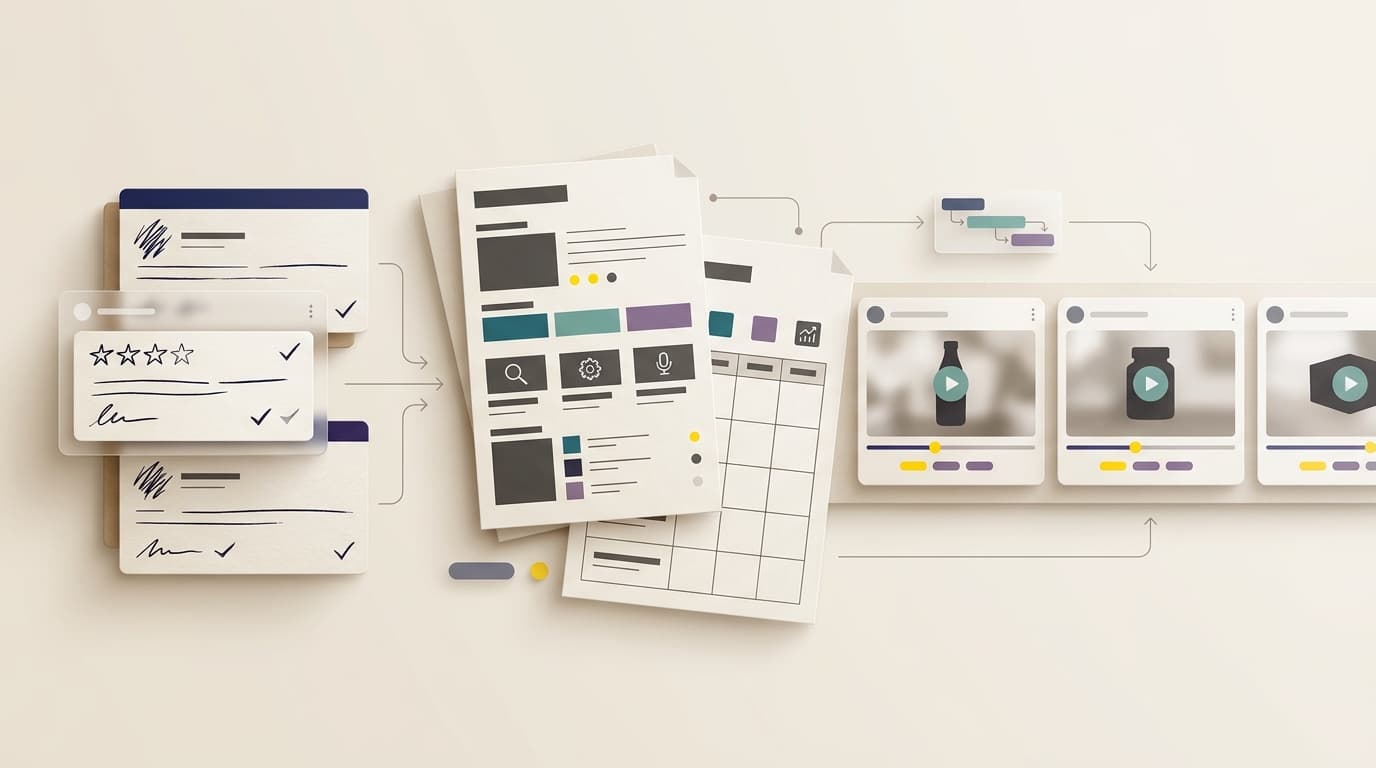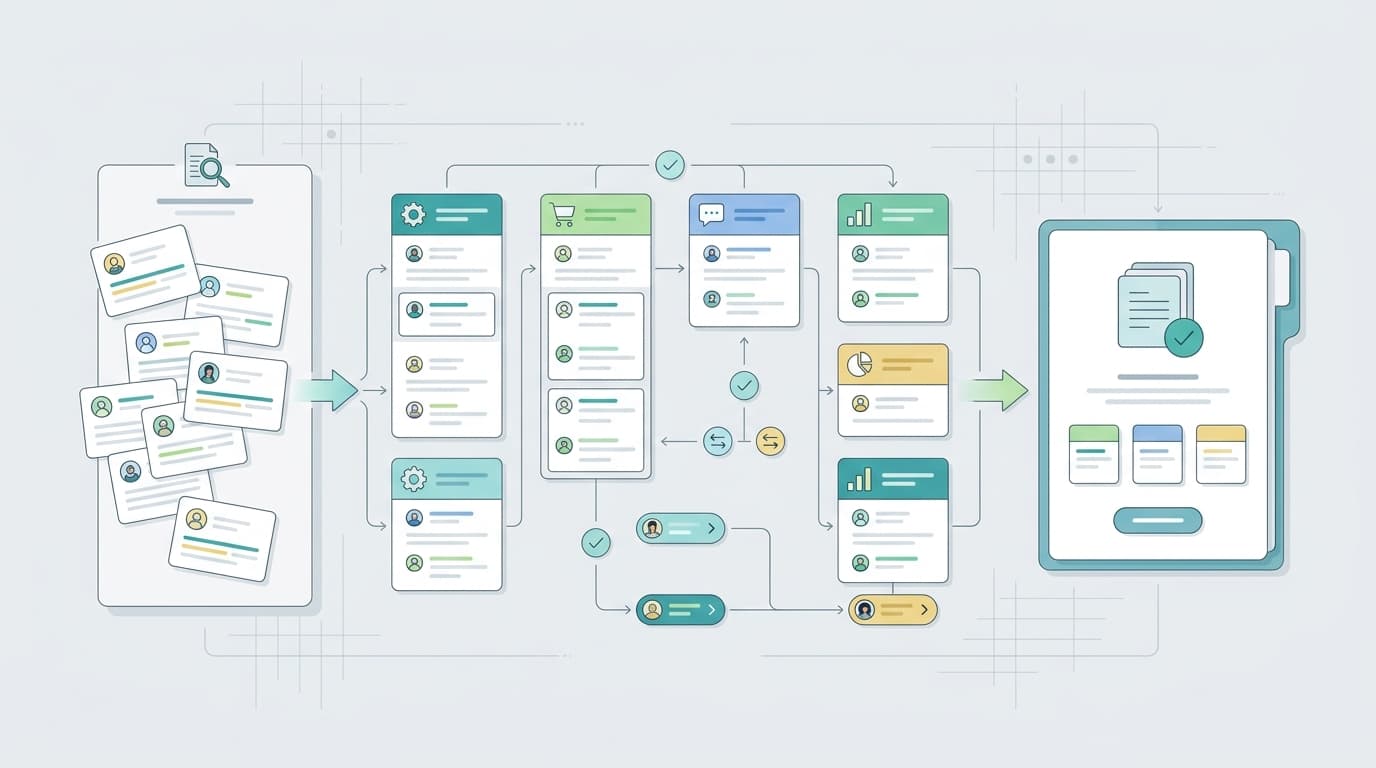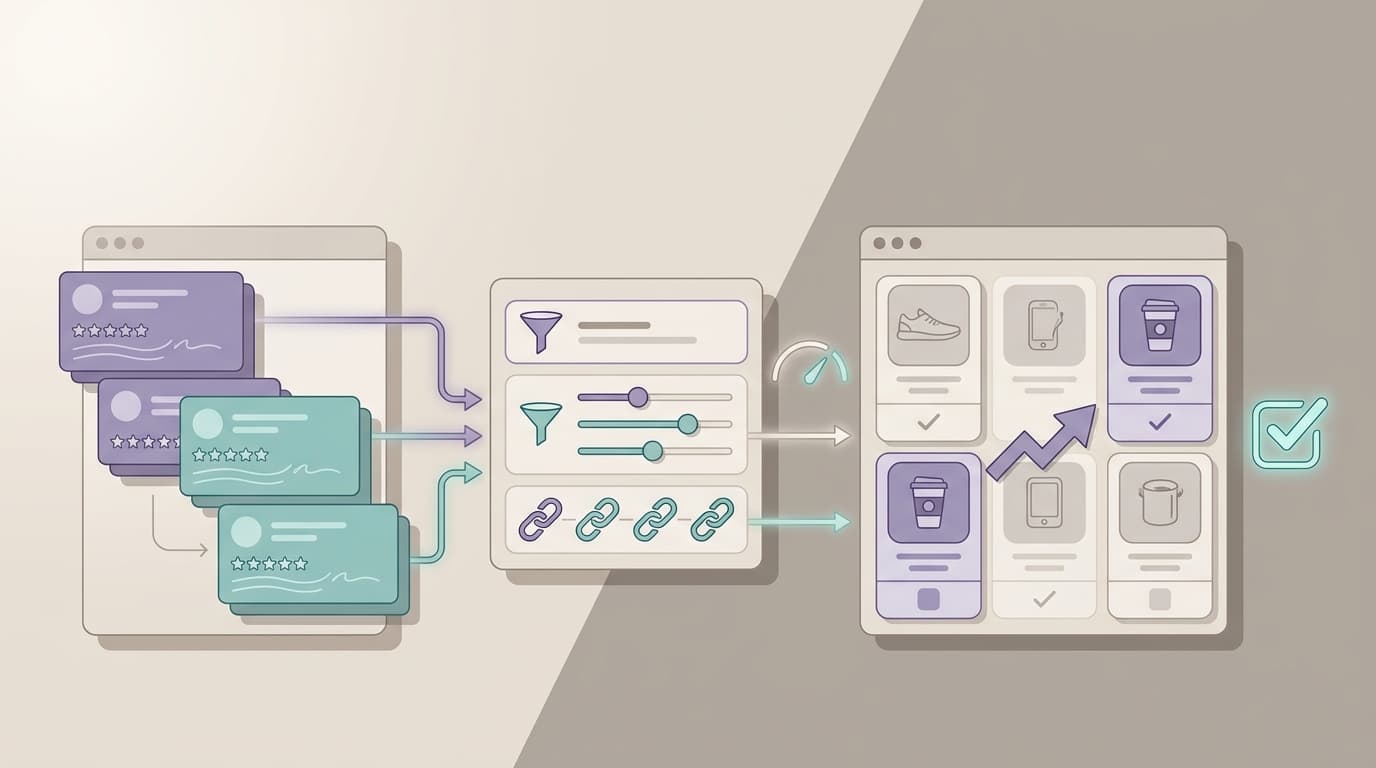
An Amazon review analysis tool should do more than shorten a page of reviews into a paragraph. For sellers, product teams, and agencies, the real job is to turn scattered customer language into evidence that can support a product, listing, competitor, or monitoring decision.
That distinction matters because tools with very different purposes often appear in the same search results. A fake-review checker may help a shopper judge review credibility. A lightweight summarizer may describe common pros and cons. A seller-grade review analysis workflow should help a team compare products, preserve context, test whether a theme is recurring, and trace a recommendation back to customer evidence.
This buyer scorecard gives you a practical way to evaluate those differences. It is designed for teams that need review intelligence they can use—not just a faster way to read reviews.
Start by defining the decision the tool must support
Do not begin with a feature checklist. Begin with the decision you need to make.
Common review-analysis decisions include:
- Which recurring complaints should influence the next product iteration?
- Which buyer objections should the listing address more clearly?
- Which competitor strengths must a new product preserve?
- Which variation, bundle, or model is creating a specific problem?
- Which complaint themes are becoming more frequent or recent?
- Which customer segments describe different use cases or expectations?
- Which findings are strong enough to share with product, CX, or growth teams?
The best Amazon review analysis tool for one decision may be a poor fit for another. A shopper checking whether a listing has suspicious reviews needs a different workflow from a brand comparing complaint patterns across 20 competing ASINs.
Before a demo or trial, write one sentence:
We need this tool to help [team] decide [decision] using review evidence from [products, variants, markets, and time period].
That sentence prevents a polished summary from being mistaken for a decision system.
The Amazon review analysis tool buyer scorecard
Score each criterion from 0 to 3:
- 0 — Missing: The workflow cannot support the requirement.
- 1 — Basic: It provides a limited output with substantial manual work.
- 2 — Useful: It supports the normal workflow with manageable gaps.
- 3 — Strong: It supports the workflow clearly, consistently, and with evidence traceability.
| Evaluation criterion | What a strong workflow should show | Why it matters |
|---|---|---|
| Decision fit | Outputs designed for product, listing, competitor, or monitoring decisions | A generic summary rarely answers a specific business question |
| Review context | Product, variant, rating, date, market, and source context | Themes can become misleading when different cohorts are blended |
| Theme quality | Specific themes tied to outcomes, situations, and product attributes | “Positive” and “negative” are too broad for action |
| Recurrence and spread | Whether a theme repeats across reviews, products, variants, or time | One vivid complaint should not outweigh a stable pattern |
| Evidence traceability | A path from insight back to representative source reviews | Teams need to verify interpretation before acting |
| Comparison depth | Side-by-side differences between products or cohorts | Competitive decisions depend on relative patterns, not isolated summaries |
| Buyer-language capture | Exact phrases, motivations, objections, and usage scenarios | Customer language improves positioning and clarifies expected outcomes |
| Monitoring readiness | Recency views, repeatable refreshes, and change detection | A one-time report cannot reveal a new failure pattern |
| Team usability | Exports, shareable outputs, ownership, and repeatable taxonomy | Insight loses value when every team rebuilds the analysis differently |
| Governance and limits | Clear treatment of sampling, uncertainty, source constraints, and human validation | AI-organized evidence should not be presented as certainty |
A total score is useful, but the pattern matters more. A tool that scores highly on summarization and poorly on context or traceability may still create confident but fragile decisions.
1. Test decision fit, not demo appeal
Ask the vendor to use your actual decision scenario. If your goal is listing optimization, the output should separate buyer motivations, desired outcomes, objections, misunderstood features, and expectation gaps. If your goal is product research, it should distinguish repeated friction from feature requests and connect each opportunity to feasibility questions.
Use a realistic prompt such as:
Compare the top complaint themes across these products, show where the themes differ by variant and recency, provide representative evidence, and identify what we still need to validate before changing the product.
Watch whether the workflow answers the full question or returns a polished list of pros and cons.
2. Check whether context survives the analysis
Review language changes meaning when context disappears. “Too small” may refer to a specific size, an older model, a particular user segment, or a buyer who misunderstood the listing. “Stopped working” may describe a recent batch issue or a long-term durability pattern.
At minimum, useful analysis should preserve the context needed for the decision:
- ASIN or product identity
- Parent and child variation when relevant
- Rating level
- Review date
- Marketplace or language
- Product version, bundle, size, or material when available
- Verified-purchase or other source metadata when available
The tool does not need to display every field in every view. It does need to prevent unlike cohorts from being blended without warning.
3. Evaluate theme specificity
Sentiment is a starting point, not the final output. “Negative reviews increased” tells a team that something may be wrong. It does not reveal whether the issue is packaging damage, fit, installation, durability, instructions, odor, sizing, compatibility, or an expectation created by the listing.
Strong themes combine four elements:
- Object: the product attribute or experience being discussed
- Outcome: what the buyer wanted to happen
- Friction: what prevented that outcome
- Situation: the use case, segment, or condition in which it happened
For example, “assembly complaints” is more useful than “negative setup sentiment.” “First-time buyers cannot identify the correct connector because the instructions do not match the current bundle” is more useful still.
4. Demand recurrence, recency, and spread
An Amazon review analyzer should help you test whether a theme is more than an anecdote.
Look for three dimensions:
- Recurrence: Does the theme appear repeatedly in the selected cohort?
- Recency: Is it still appearing in recent reviews?
- Spread: Does it occur across multiple products, variants, or segments—or only one narrow group?
These checks do not turn reviews into a statistically representative survey. They make the evidence more disciplined. A theme that is repeated, recent, and spread across relevant cohorts deserves more attention than an old complaint concentrated in one discontinued variation.
5. Require evidence traceability
Every important conclusion should have a route back to representative reviews. This lets a human check whether the theme label is fair, whether context was lost, and whether the recommendation overstates the evidence.
During evaluation, choose three generated insights and ask:
- Which reviews support this conclusion?
- Which reviews contradict or complicate it?
- What cohort was included?
- What cohort was excluded?
- How did the tool distinguish repetition from duplicate phrasing or copied content?
If the workflow cannot answer these questions, treat the output as a hypothesis generator rather than decision-ready evidence.
6. Compare products, not just summaries
A standalone summary can tell you what buyers say about one item. Competitive analysis requires differences.
A strong comparison should help you see:
- Which complaints are category-wide versus product-specific
- Which praised attributes buyers consider essential
- Which competitor solves one problem while creating another
- Which price or segment attracts different expectations
- Which themes changed after a product update
- Which differentiation ideas are already common in the category
This is where a seller-grade workflow separates itself from a generic summarizer. The useful question is not only “What do buyers dislike?” It is “Where is the unresolved problem, for which buyer, compared with which alternatives?”
For a deeper workflow, see how to turn competitor complaints into product requirements.
7. Inspect buyer-language capture
Review analysis should preserve how customers describe outcomes in their own language. That language can reveal:
- Why they started searching
- What they expected the product to do
- Which alternative they compared it with
- What made them hesitate
- What they misunderstood before purchase
- Which moment made the product feel valuable or disappointing
Buyer language can inform a listing, but it should not be copied mechanically. The team still needs to verify that claims are accurate, supportable, and appropriate for the product. Use review evidence to clarify what the page must explain, not to manufacture promises.
The Voice of Customer Analysis workflow is designed to organize customer language into needs, scenarios, motivations, and pain points that teams can evaluate further.
8. Separate one-time analysis from monitoring
Some tools create a report once. Others support repeated analysis so teams can see whether themes are changing.
If monitoring matters, test whether the workflow can:
- Reuse the same product and cohort definitions
- Compare recent and historical windows
- Detect new or accelerating complaint themes
- Separate product-level and variation-level signals
- Record who owns the follow-up
- Preserve a history of decisions and checks
A stable rating can hide a developing issue if positive volume remains high. Theme monitoring can surface changes earlier, especially when the same complaint begins appearing across recent reviews. Learn more in the guide to Amazon review monitoring versus star ratings.
9. Test whether teams can reuse the output
Analysis quality is only part of the buying decision. The result must move into a working process.
Ask whether product, CX, and growth teams can share:
- A consistent theme taxonomy
- Representative evidence
- Product and cohort context
- Confidence or uncertainty notes
- An owner and next action
- A decision date and review date
Without these fields, each function may interpret the same reviews differently. A shared customer feedback dashboard can help teams separate evidence, interpretation, priority, and ownership.
For data teams that need to integrate review intelligence into an internal workflow, evaluate whether a documented Review Analysis API is a better fit than a standalone interface.
10. Score governance, uncertainty, and human review
No review-analysis system should remove judgment from a high-impact decision. Reviews are observational evidence from a selected set of customers. They can contain missing context, selection effects, product-version differences, misunderstood expectations, and manipulated content.
Amazon’s public guidance also places important boundaries around customer reviews and seller behavior. Your team should use compliant data-access methods and avoid any workflow that encourages review manipulation, incentives, or attempts to influence customer feedback improperly.
A responsible tool and operating process should make it easy to document:
- The products and time windows included
- Known gaps in the dataset
- Whether variants or versions were mixed
- Themes that conflict with the main conclusion
- Claims that require product, legal, or compliance review
- The human owner who validates the recommendation
The goal is not to make the analysis sound certain. The goal is to make the evidence and uncertainty visible enough for a better decision.
Three common tool categories—and when each fits
| Tool category | Best fit | Typical limitation for seller decisions |
|---|---|---|
| Fake-review checker | Shopper trust checks and suspicious-pattern screening | Usually not designed for product, listing, or competitor decisions |
| Review summarizer | Fast orientation to common pros and cons | May hide cohort differences, recency, contradictions, and source evidence |
| Seller-grade review intelligence | Product research, competitor comparison, listing inputs, and monitoring | Requires clearer decision ownership and disciplined cohort setup |
These categories can overlap. The important step is to verify the workflow instead of relying on the label “AI review analyzer.”
A 30-minute evaluation test
Use the same small product set with every shortlisted tool.
- Choose three to five relevant products with at least one meaningful variation difference.
- Define one decision, such as improving a product requirement or clarifying listing expectations.
- Ask for the top recurring motivations, praise themes, complaint themes, and usage scenarios.
- Compare results by product, variation, rating band, and recent versus older reviews.
- Open the evidence behind three important conclusions.
- Find one disconfirming review for each proposed action.
- Export or share the result with someone who did not run the analysis.
- Ask that person to explain the evidence, uncertainty, and next step.
The strongest tool is not necessarily the one with the longest feature list. It is the one that helps another decision-maker understand what customers said, where the pattern appears, how strong it is, and what still needs validation.
Questions to ask before buying
- Can we define the exact products, variants, markets, ratings, and time windows included?
- Can every major insight be traced back to source reviews?
- Can we compare products and cohorts side by side?
- Can we separate motivations, outcomes, objections, and failure modes?
- Can we detect changes over time without rebuilding the analysis?
- Can we export or share evidence with product, CX, and growth teams?
- Can we reuse a consistent taxonomy across projects?
- Does the workflow expose contradictory evidence and uncertainty?
- Does it fit our compliant data-access and governance requirements?
- Does it connect to the next decision rather than stopping at a summary?
Choose the workflow that makes evidence usable
An Amazon review analysis tool should reduce reading time, but speed alone is not the buying criterion. The real value is a clearer chain from customer language to a decision:
cohort → theme → evidence → comparison → uncertainty → owner → action
Fake-review checkers, summarizers, and seller-grade analysis tools solve different problems. Define your decision first, score the workflow against the ten criteria, and test whether another team member can verify the conclusion without reconstructing the analysis.
If your team needs to move beyond summaries, explore VOC AI’s review-backed product research and Voice of Customer Analysis workflows.