Amazon Review Monitoring by Variation: Catch Child-ASIN Problems Before the Parent Rating Slips
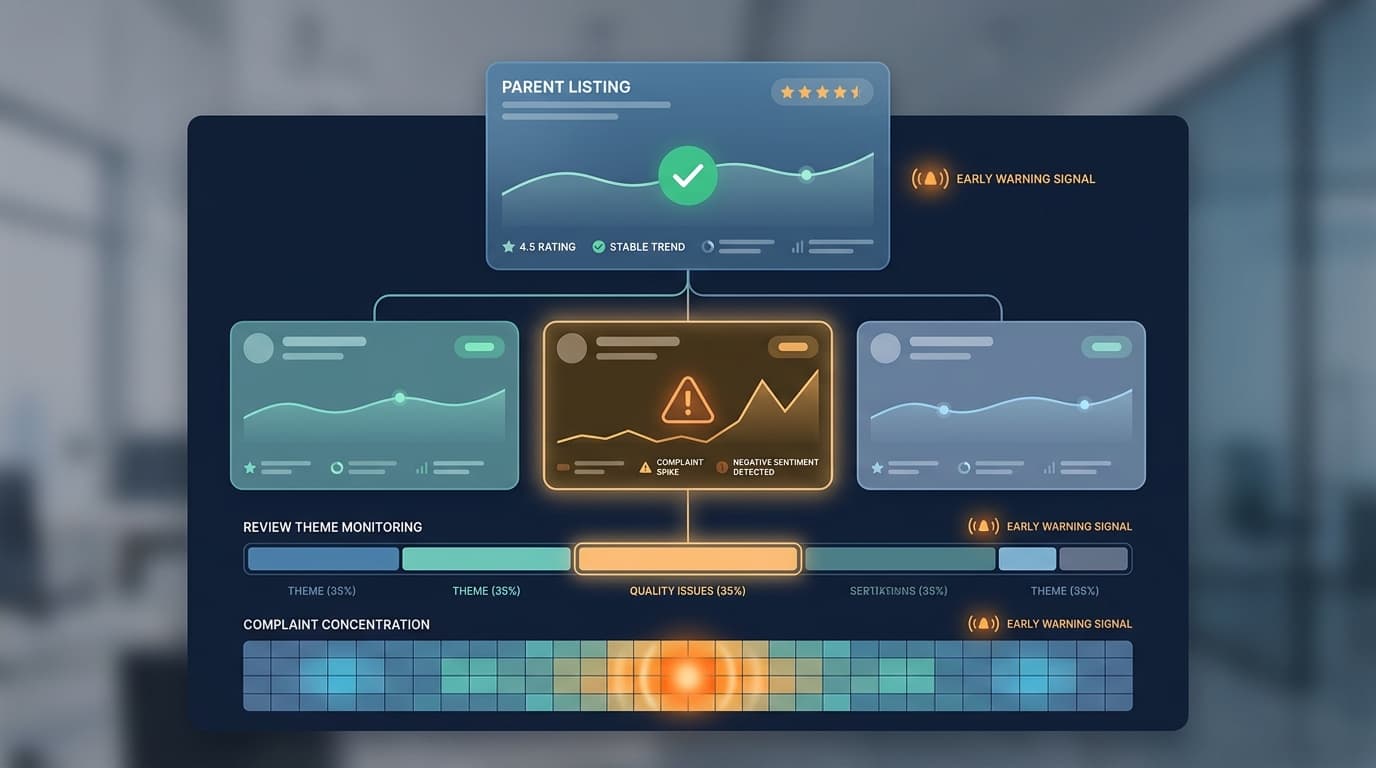
Amazon review monitoring gets much more useful when a team stops treating the parent listing as the only health signal. Many catalog issues start at the variation level first: one size, one color, one bundle, or one replenishment batch begins collecting negative review language while the parent average still looks stable.
That is why variation-level review monitoring matters. If your workflow only checks the parent star rating, you often see the problem after it has already spread across inventory, support tickets, and return reasons.
The better question is not just "Did the listing rating change?" It is "Which child ASIN is developing the complaint pattern, what exactly are buyers saying, and which team should investigate first?"
Why parent-level ratings hide early warning signals
A parent rating is a summary metric. It is useful for quick scanning, but it compresses too much detail into one number.
When teams monitor only the parent listing, they can miss:
- one variation collecting most of the recent low-star reviews
- one bundle driving missing-part complaints
- one color or size creating expectation-mismatch language
- one supplier batch generating quality complaints
- one newly updated variation producing setup or compatibility confusion
Amazon review monitoring should make those differences visible before the parent score becomes the only reason anyone pays attention.
The most common variation-level problems sellers miss
Variation issues are usually operationally specific. They are not random sentiment noise.
| Variation signal | What buyers may actually be describing | Likely first owner |
|---|---|---|
One size gets repeated too small or not true to size reviews | Listing mismatch, size chart gap, or product inconsistency | Listing / merchandising |
One bundle gets missing part or incomplete set complaints | Packing or fulfillment issue | Ops |
One color gets looks different than pictured language | Image or expectation mismatch | Listing / creative |
One version gets stopped working or battery died comments | Product quality or batch issue | Product / QA |
One replenishment window produces damaged or broken seal complaints | Packaging, prep, or transit problem | Ops / supply chain |
This is why Amazon review monitoring should not stop at the parent average. The root cause often lives one level deeper.
Why child-ASIN monitoring catches problems earlier
A parent listing can absorb a surprising amount of variation-level friction before the average rating looks serious enough to escalate. That delay is expensive.
If one child ASIN is responsible for most of the recent negative review language, a parent-only workflow hides:
- where the issue is concentrated
- whether the issue is spreading to other variants
- whether the problem is tied to one batch, prep flow, or listing asset
- which team should own the first response
Amazon review monitoring becomes more actionable when teams can separate:
- parent-level reputation changes
- variation-level complaint concentration
- time-window spikes after a catalog or ops change
That distinction helps operators avoid broad reactions when the issue may still be isolated.
What to look for in variation-level review patterns
Variation-level Amazon review monitoring works best when it tracks patterns, not isolated anecdotes.
Look for:
- repeated low-star complaints on the same child ASIN within a short window
- one variation with a different complaint theme than the rest of the parent family
- review wording that overlaps with return reasons or support tickets
- negative language that begins right after a new listing image, supplier, insert, or packaging change
- a single variant losing trust while adjacent variants remain stable
One negative review is not the story. Repetition, concentration, and recency are the story.
A practical workflow for variation-level Amazon review monitoring
Teams do not need a huge dashboard rollout to make this useful. A simple workflow already improves signal quality.
1. Pull new low-star reviews by child ASIN
Do not start with the parent summary only. Break recent reviews down by variation so you can see where complaints are forming.
2. Group complaint language into a small set of themes
Use categories such as:
- packaging damage
- missing parts
- expectation mismatch
- size or fit issue
- quality or durability
- setup confusion
3. Compare each theme across sibling variations
If only one variant shows the problem, investigate the variant first before rewriting the entire parent strategy.
4. Check overlap with internal cost signals
If the same variation also shows:
- more returns
- more support tickets
- more replacement requests
- more refund notes
the issue is more likely to be real and recurring.
5. Route the issue to one clear owner
Amazon review monitoring should reduce ambiguity. If the signal points to one child ASIN and one likely cause, the next action should also be specific.
6. Recheck after the fix
After changing packaging, images, bullets, prep checks, or support guidance, review the same child-ASIN pattern again. The goal is to see whether the complaint language actually slows down.
Variation monitoring vs. parent-only monitoring
| Monitoring approach | What it does well | What it misses |
|---|---|---|
| Parent-level star watching | Fast surface-level health check | Which child ASIN is causing the problem |
| Manual spot-checking a few reviews | Adds some nuance | Easy to miss recurring patterns across variants |
| Variation-level Amazon review monitoring | Finds complaint concentration, routes ownership faster, isolates local issues earlier | Requires discipline in tagging and review cadence |
Parent-level checks still matter. They are just not enough once a catalog has multiple variations and multiple owners.
How VOC AI fits this workflow
VOC AI's public positioning is already closer to variation-level monitoring than to simple score watching. Its site emphasizes review intelligence, pain point clusters, rating-drop alerts, and root-cause analysis across a larger review dataset.
That makes sense for this workflow because a seller trying to monitor one parent score is not really solving the harder question. The harder question is:
- which variation is creating the complaint pattern
- what buyers keep repeating
- whether the issue is operational, listing-related, or product-related
- how fast the team can act before the problem spreads
VOC AI's public product story supports that operating model through:
- review-derived complaint and pain-point clusters
- rating-drop alerts with root-cause framing
- large-scale review analysis rather than manual skimming
- review patterns that keyword-only workflows cannot surface
For teams working on Amazon review monitoring, that shift matters because the child ASIN usually tells you more than the parent average when a problem first appears.
If you want to go deeper, pair this article with Amazon Review Monitoring for Rating Drops, Returns, and Complaint Trends, Packaging Complaints Are an Early Warning Signal, Amazon Review Monitoring Alerts, and the core VOC Analysis page.
A weekly variation-review checklist
If your team wants a better Amazon review monitoring routine, start with one weekly pass:
- Export new low-star reviews by child ASIN.
- Group repeated wording into 3 to 5 complaint themes.
- Identify whether one variation owns most of the negative signal.
- Compare those themes against return reasons and support notes.
- Assign the issue to ops, listing, support, or product based on the likely root cause.
- Review the same variation after the fix to confirm the signal is weakening.
This is a manageable workflow, but it catches real catalog problems earlier than parent-only rating checks.
The bottom line
Amazon review monitoring works better when the team watches child-ASIN patterns, not just the parent average. Most early catalog issues start locally: one variation, one bundle, one batch, or one listing mismatch creates repeat complaints before the parent score tells the full story.
If you want earlier warning and faster ownership, monitor complaint concentration at the variation level. That is where sellers usually find the first usable signal and the next useful action.
FAQ
Why is variation-level Amazon review monitoring important?
Because one child ASIN can develop a repeated complaint pattern while the parent listing still looks stable. Variation-level monitoring helps isolate the exact SKU, bundle, or version driving the problem.
Can parent-level star ratings still be useful?
Yes. Parent-level ratings are still helpful for a quick health check. They just should not be the only monitoring layer once multiple variations are involved.
What should sellers compare against variation-level review signals?
The best next checks are return reasons, support-ticket wording, replacement requests, and any recent listing, packaging, or supplier change tied to that child ASIN.