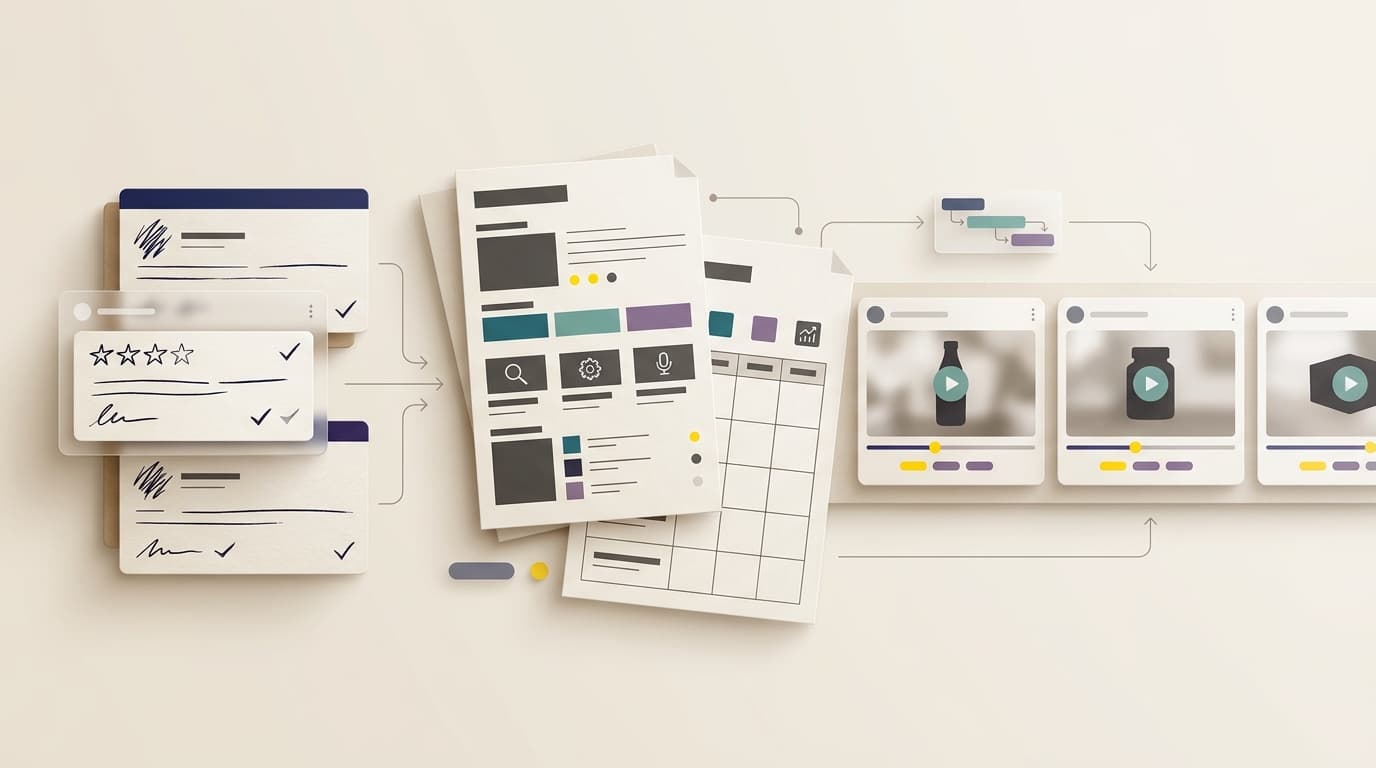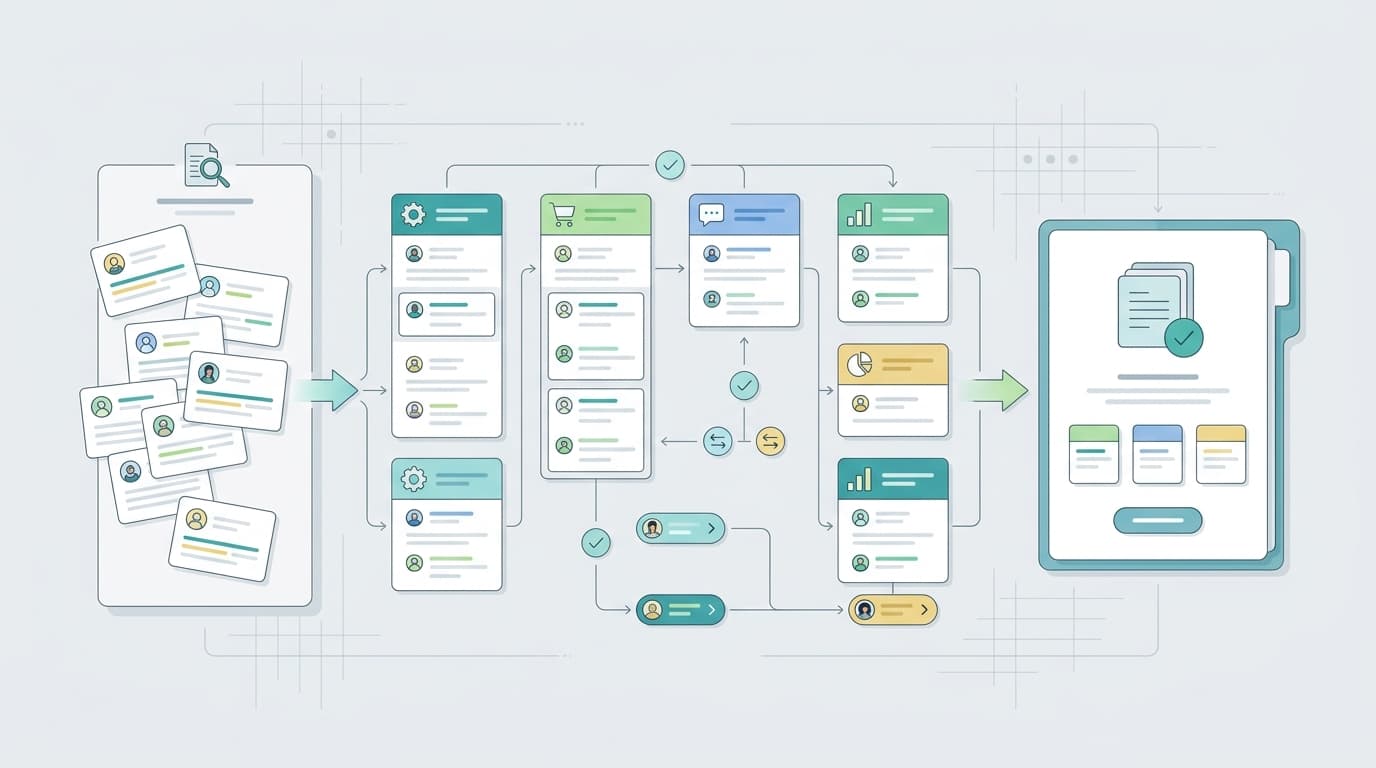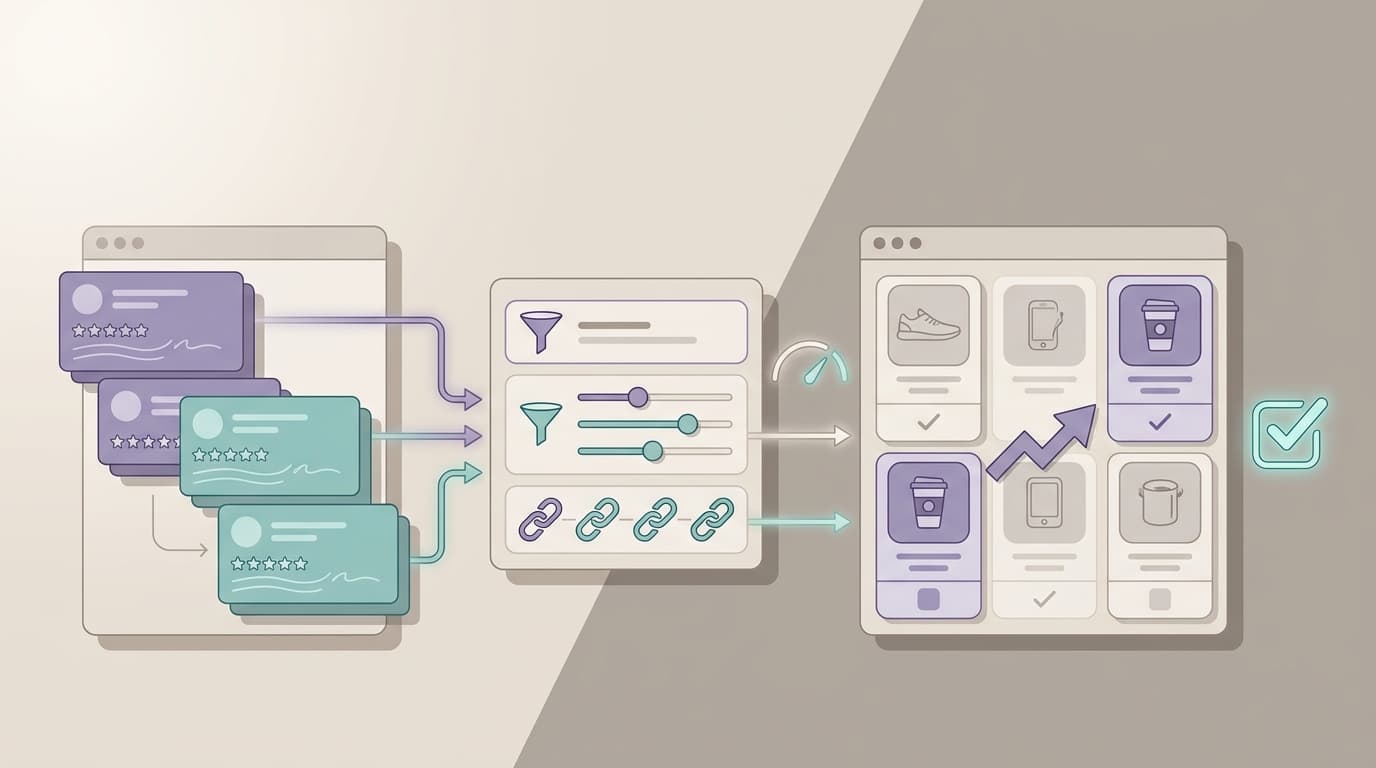
Ecommerce feedback analysis gets difficult when every team sees a different slice of the customer.
Product managers read marketplace reviews. Support leaders read tickets and chats. Growth teams watch social comments, campaign replies, and listing questions. Research teams may add surveys or interviews. Each source is useful, but separate reports create a predictable problem: the same customer friction appears under different labels, with different owners, and without a shared decision rule.
The solution is not another summary. It is a cross-channel feedback taxonomy: one consistent way to classify evidence, preserve source context, compare signals, and route decisions to the right team.
This guide explains how to build that workflow without flattening every source into a single sentiment score.
What Is Ecommerce Feedback Analysis?
Ecommerce feedback analysis is the process of turning customer evidence from reviews, support conversations, social comments, surveys, marketplace questions, and other channels into structured themes that teams can investigate and act on.
A useful workflow answers five questions:
- What happened? Identify the product, service, expectation, or experience being described.
- Who experienced it? Preserve the buyer segment, use case, product variant, market, and channel when available.
- How strong is the signal? Compare recurrence, severity, recency, spread, and evidence quality.
- Which decision could change? Connect the theme to product, support, listing, growth, operations, or research work.
- What evidence should be checked next? Keep representative examples and contradictory evidence instead of relying only on a generated summary.
This is broader than review analysis alone. Reviews are often the richest public source of post-purchase language, but support and social channels can expose problems earlier, clarify context, or reveal questions that never become a review.
Why One Sentiment Score Is Not Enough
Positive, neutral, and negative labels can help with scanning. They are weak decision units by themselves.
Consider three comments:
- “The bottle leaks in my gym bag.”
- “Customer service replaced the lid immediately.”
- “Does this fit in a standard cup holder?”
All three relate to the same product, but they point to different jobs. The first may indicate a seal or usage problem. The second contains service-recovery evidence. The third reveals pre-purchase uncertainty that could be addressed in listing content.
If software reduces these comments to sentiment percentages, the team loses the relationship between the customer’s situation and the decision it could influence.
A stronger approach separates at least four layers:
| Layer | What it captures | Example |
|---|---|---|
| Evidence | The original customer statement and source context | Review excerpt, ticket message, social comment, survey answer |
| Theme | The repeated issue, motivation, outcome, or question | Seal reliability, easy replacement, cup-holder fit |
| Decision area | The team or workflow that can respond | Product, CX, listing, growth, operations |
| Action hypothesis | A change that should be tested, not assumed | Test a revised lid, update a support macro, add dimensions to the listing |
That structure preserves customer language while making feedback operational.
Step 1: Define the Decision Before Collecting More Data
Do not start by importing every available source. Start with a decision question.
Examples include:
- Which recurring complaint should enter the next product sprint?
- Which listing claim creates the most expectation gaps?
- Which support issue needs a clearer macro or self-service answer?
- Which social question should become campaign or PDP content?
- Which competitor weakness is common enough to validate?
- Which return-related theme needs an operations investigation?
A decision question narrows the evidence window, products, markets, and channels. It also prevents a large feedback repository from becoming an interesting but unactionable archive.
Write the decision question at the top of the analysis and name the decision owner. If no one can change a product, process, message, or experiment based on the result, the analysis scope is probably too broad.
Step 2: Build a Source Map
Each feedback source has a different role. Treating them as interchangeable can create false confidence.
| Source | Strongest use | Common limitation | Context to preserve |
|---|---|---|---|
| Marketplace reviews | Post-purchase outcomes, repeated strengths, recurring friction | May lag recent product or packaging changes | Product, variant, rating, date, marketplace, verified context when available |
| Support tickets and chats | Specific failure paths, troubleshooting effort, service recovery | Reflects customers who contacted support, not every buyer | Issue type, resolution, response path, product, market, date |
| Social comments and messages | Fast reactions, questions, campaign confusion, emerging language | Volume can be volatile and context-dependent | Post or campaign, platform, audience, date, reply context |
| Surveys | Direct answers to a defined research question | Wording and sampling can shape responses | Question, audience, sample, collection window |
| Marketplace questions | Pre-purchase uncertainty and missing information | Questions may not reflect actual post-purchase outcomes | Listing, variant, question date, answer quality |
| Returns and reason codes | Commercially important friction and operational patterns | Codes may be broad or inconsistently selected | SKU, reason, date, warehouse or market when relevant |
The goal is not to force every source into the same format. The goal is to create a shared minimum record while keeping source-specific fields available.
Step 3: Create a Shared Minimum Record
Every evidence item should carry enough information to be inspected later.
Use a record like this:
| Field | Purpose |
|---|---|
| Source channel | Review, support, social, survey, question, return, or other source |
| Product and variant | Prevents unrelated versions from being combined |
| Market and language | Preserves regional and translation context |
| Date or period | Enables recency checks and before-versus-after comparison |
| Customer wording | Keeps the original meaning available |
| Theme and subtheme | Applies the shared taxonomy |
| Journey stage | Pre-purchase, onboarding, use, troubleshooting, repeat purchase, or return |
| Sentiment and intensity | Supports scanning without replacing the theme |
| Evidence quality | Direct experience, vague claim, duplicate, unclear, or requires verification |
| Suggested owner | Product, CX, growth, operations, research, or another team |
| Status | New, investigating, testing, monitoring, resolved, or rejected |
This record is the bridge between raw feedback and a shared operating view.
If review data is the main source, VOC AI’s voice-of-customer analysis can help organize buyer motivations, usage scenarios, product strengths, weaknesses, and review themes. Teams that need structured review data in their own systems can also evaluate the Review Analysis API as an input to a broader feedback workflow.
Step 4: Design a Taxonomy That Survives Multiple Channels
A taxonomy should be specific enough to guide decisions and stable enough to use across teams.
Start with five dimensions.
Customer job
What was the buyer trying to accomplish?
Examples: travel with the product, assemble it quickly, clean it after use, give it as a gift, compare alternatives, or solve a recurring household problem.
Outcome
What happened relative to the expected job?
Examples: completed easily, required extra effort, failed under a specific condition, exceeded expectations, or remained uncertain before purchase.
Product or experience area
Where did the evidence occur?
Examples: durability, fit, setup, packaging, instructions, delivery, support response, listing clarity, or subscription management.
Theme type
What kind of signal is it?
- purchase motivation;
- praised strength;
- recurring friction;
- expectation gap;
- unanswered question;
- workaround;
- service-recovery moment;
- switching trigger;
- requested improvement;
- accepted tradeoff.
Decision owner
Who can investigate or test a response?
Possible owners include product, quality, operations, customer experience, marketplace, growth, creative, research, and leadership.
Avoid building a taxonomy around department names alone. A theme such as “unclear sizing” may require product documentation, listing content, support macros, and creative assets. The taxonomy should describe the customer evidence first; routing comes second.
Step 5: Merge Similar Language Without Erasing Meaning
Customers rarely use the same words for the same problem.
“Too small for the cabinet,” “door will not close,” and “dimensions are misleading” may belong to a shared fit-and-dimensions theme. But they should not be merged automatically if one describes an actual product-size problem and another describes unclear listing information.
Use a three-level structure:
- Theme: Fit and dimensions
- Subtheme: Product does not fit the intended space
- Evidence tag: Listing dimensions unclear, cabinet clearance, width, height, or variant mismatch
Keep the original statement attached. Theme clustering should make evidence easier to compare, not replace the evidence.
When language comes from multiple markets, review translation-sensitive themes manually. A direct translation can preserve the words while changing the implied intensity, use case, or cultural context.
Step 6: Score Signals With More Than Frequency
The most common theme is not automatically the most important. Use a simple evidence scorecard.
| Factor | Question | Low signal | Strong signal |
|---|---|---|---|
| Recurrence | Does the theme repeat? | Isolated mention | Repeated pattern within the relevant cohort |
| Severity | What happens when it occurs? | Minor preference | Safety, failure, return, lost use, or high support effort |
| Recency | Is it current? | Concentrated in old versions | Present in recent evidence |
| Spread | How broadly does it appear? | One SKU, variant, source, or segment | Multiple relevant products, variants, sources, or markets |
| Specificity | Can the problem be investigated? | “Bad quality” | Clear condition, outcome, and affected component |
| Business relevance | Which decision or metric could change? | No owner or decision path | Clear product, CX, growth, or operations decision |
| Evidence confidence | Can the team inspect the basis? | Vague, duplicate, or missing context | Representative evidence with context and contradictions |
Do not turn the score into false precision. Its purpose is to make prioritization criteria visible and repeatable.
A lower-frequency theme may deserve immediate attention if its severity is high. A high-frequency question may belong to listing content rather than the product roadmap. A social spike may require fast monitoring before it earns a permanent taxonomy change.
Step 7: Route the Same Theme to Different Teams
Cross-functional analysis works when one theme can produce different team-specific actions without creating different versions of the truth.
| Shared theme | Product or operations question | CX question | Growth or marketplace question |
|---|---|---|---|
| Difficult setup | Can the design or instructions reduce steps? | Which troubleshooting path resolves it? | Does the listing set the right setup expectation? |
| Size confusion | Are dimensions or variants inconsistent? | Which clarification prevents repeat contacts? | Which comparison image or copy needs revision? |
| Packaging damage | Is the failure tied to packaging, carrier, or warehouse conditions? | What evidence should agents collect? | Should promotional timing change until the issue is understood? |
| Feature praise | Which use case drives satisfaction? | How can agents reinforce successful use? | Which buyer language can be tested in compliant messaging? |
| Social question spike | Is this a new use case or misunderstanding? | Does the answer belong in self-service content? | Should the campaign, FAQ, or PDP address it? |
For fast-moving public conversations, social listening can provide an earlier signal that teams can compare with slower post-purchase review patterns. The channels should confirm or challenge one another rather than being blended without context.
Step 8: Run a Weekly Feedback Decision Review
A shared taxonomy becomes valuable when it changes a recurring meeting.
Use a 30-minute weekly review:
- Review new or accelerating themes. Focus on changes, not a static list of everything customers have ever said.
- Inspect representative evidence. Read examples from more than one source when possible.
- Check contradictions. Look for customers, products, or markets where the theme does not hold.
- Assign a decision state. Choose investigate, test, monitor, resolve, or reject.
- Name one owner and one next check. Avoid shared ownership without a responsible person.
- Record the result. Keep the evidence, decision, action, and follow-up date connected.
The review should not become a presentation of sentiment charts. It should end with a small number of explicit decisions and a clear record of why they were made.
What to Look for in Ecommerce Feedback Analysis Software
Software should support the operating method rather than define it for you.
Evaluate whether a customer review analysis tool or broader feedback platform can:
- ingest the sources that matter to your decision;
- preserve product, variant, market, language, time, and channel context;
- keep representative evidence attached to themes;
- support a taxonomy with themes, subthemes, journey stages, and owners;
- separate recurrence from severity and business relevance;
- compare products, competitors, periods, markets, or customer cohorts;
- identify new or accelerating themes without hiding the baseline;
- export or integrate structured data into the systems teams already use;
- support role-specific views while maintaining one evidence model;
- record actions, decisions, and follow-up states;
- let people inspect and correct automated clustering;
- handle access, retention, and governance requirements appropriate to the organization.
For a fuller buying checklist, see Customer Feedback Analysis Software for E-Commerce Teams. If the immediate problem is dashboard design, use the separate guide to structure one feedback dashboard for product, support, and marketing.
A Practical 14-Day Pilot
Before expanding the workflow across the company, test it on one bounded decision.
Days 1–2: Set the scope
Choose one product family, market, time window, and decision question. Name the owner and write the current hypothesis.
Days 3–5: Build the source map
Collect a relevant sample from reviews plus one or two complementary sources. Record known gaps instead of pretending the sample is complete.
Days 6–8: Apply the taxonomy
Tag evidence by job, outcome, experience area, theme type, and owner. Merge synonyms carefully and preserve representative examples.
Days 9–10: Score and challenge themes
Compare recurrence, severity, recency, spread, specificity, relevance, and evidence confidence. Search for disconfirming evidence.
Days 11–12: Route actions
Ask product, CX, operations, and growth owners what decision each high-priority theme could influence. Reject themes with no decision path.
Days 13–14: Review the workflow
Evaluate whether the pilot reduced duplicate analysis, clarified ownership, preserved evidence, and produced a decision that can be tested. Then decide which sources, teams, and products to add next.
Final Takeaway
The goal of ecommerce feedback analysis is not to collect every customer statement or produce the most polished summary. It is to create a reliable path from evidence to decisions.
Start with one decision. Preserve source context. Use a taxonomy that describes customer jobs, outcomes, experience areas, and theme types. Score signals with recurrence, severity, recency, spread, specificity, relevance, and confidence. Then route the same evidence to product, CX, growth, and operations without creating separate truths.
When the workflow is clear, software can make it faster and easier to maintain. When the workflow is unclear, more dashboards usually create more versions of the same confusion.
To explore how VOC AI can support review-led customer evidence and structured analysis, contact the VOC AI team.
Frequently Asked Questions
What is the difference between ecommerce feedback analysis and review analysis?
Review analysis focuses on review data. Ecommerce feedback analysis can combine reviews with support conversations, social comments, surveys, marketplace questions, returns, and other sources while preserving the context of each channel.
Should every feedback source use the same taxonomy?
Use the same core dimensions where they help comparison, such as product, market, journey stage, theme, and owner. Keep source-specific fields so a support resolution, review rating, survey question, or social campaign context is not lost.
How many themes should a taxonomy contain?
Start with the smallest set that supports the current decision. Add subthemes when a broad label cannot distinguish different causes, outcomes, or owners. Avoid creating hundreds of labels before the team has a recurring review process.
Can AI categorize customer feedback automatically?
AI can accelerate clustering, tagging, summarization, and pattern discovery. Teams should still inspect evidence, correct categories, review contradictory cases, and decide whether a pattern is relevant to the product, market, and decision at hand.
Which team should own ecommerce feedback analysis?
One team should own the evidence model and review cadence, but decision ownership should follow the theme. Product, CX, operations, marketplace, growth, and research teams may each own different actions from the same evidence.
What is the best first use case for a cross-channel pilot?
Choose a recurring question with available evidence and a clear owner, such as a product complaint, listing expectation gap, support contact driver, packaging issue, or social question that could change a specific decision.