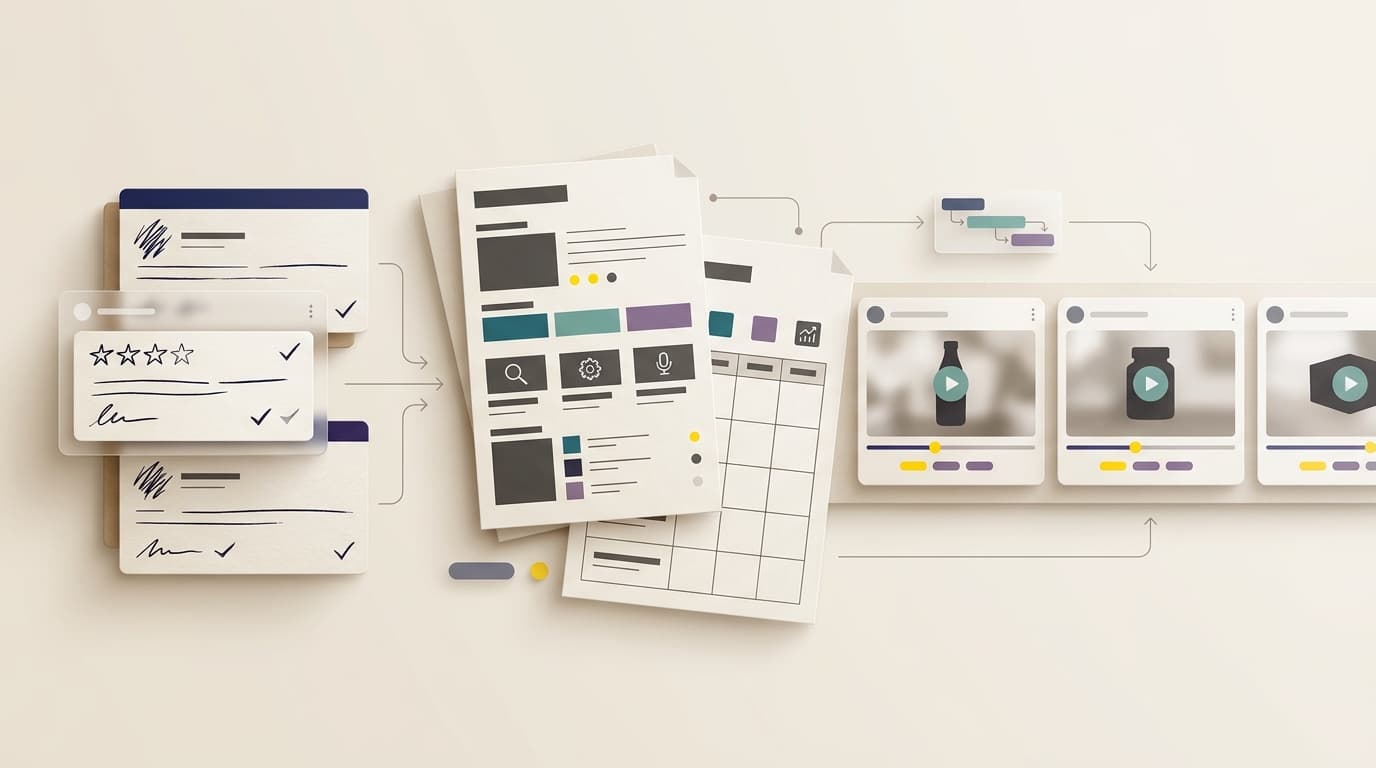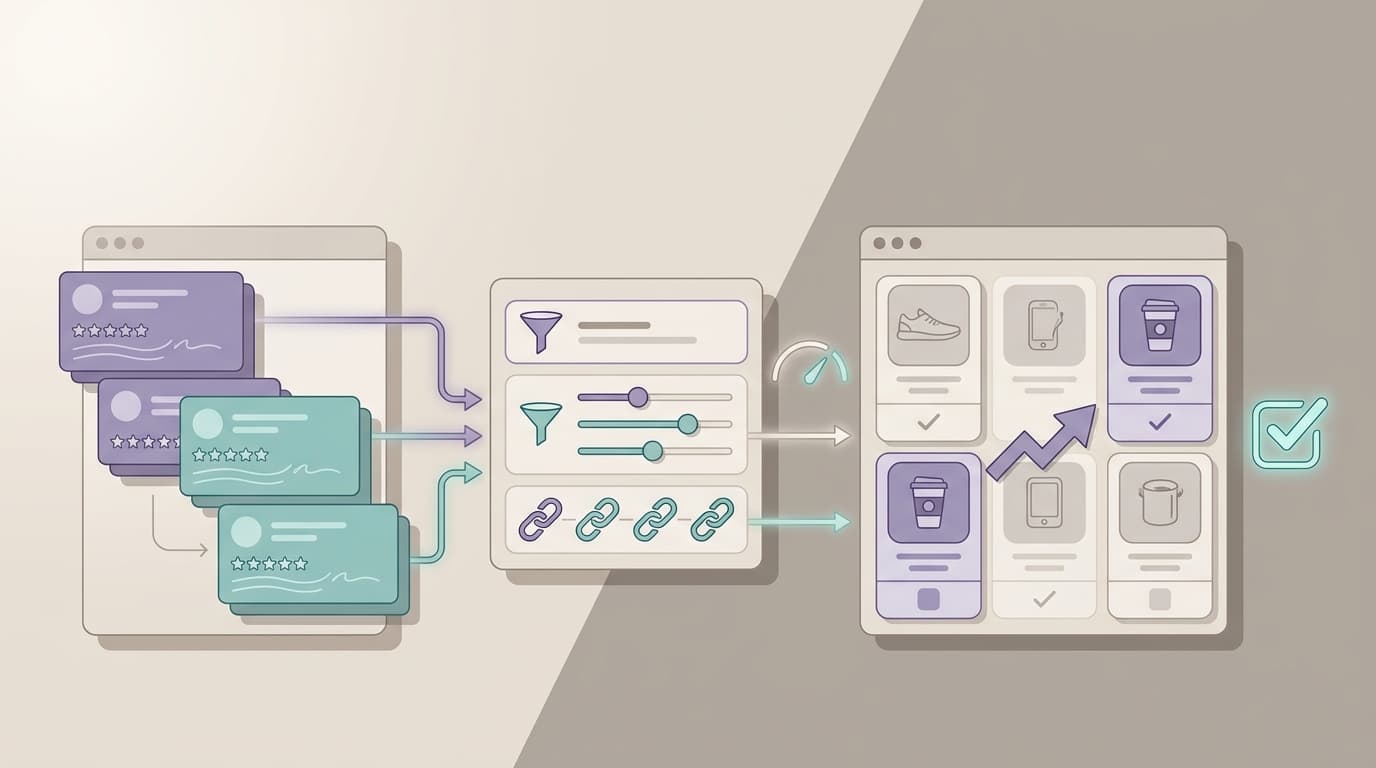
Product teams do not need another folder full of customer quotes. They need a reliable way to decide which feedback should change the product, which should change the packaging or listing, and which should not drive action at all.
That is the purpose of review mining for product development.
Review mining is the structured process of collecting customer reviews, grouping repeated language into themes, checking the evidence behind each theme, and converting the strongest patterns into product decisions. Done well, it helps teams find recurring failure modes, unmet needs, confusing expectations, valued features, and competitor gaps without treating every complaint as a feature request.
This guide shows how to move from raw reviews to an evidence-backed product opportunity backlog. It includes a practical scoring model, a decision-routing framework, and a repeatable operating cadence for ecommerce teams.
What review mining means for product teams
Review mining is more than sentiment analysis.
Sentiment tells you whether feedback is broadly positive, negative, or mixed. Product development requires a more specific answer:
- What happened to the customer?
- In which use case, product variant, or stage of ownership did it happen?
- How often does the pattern appear?
- How severe is the outcome?
- What did the customer expect instead?
- Is the root cause product design, quality, packaging, positioning, instructions, logistics, or support?
- What evidence would justify action?
The difference matters. A cluster of negative reviews may point to a product defect, but it may also reveal a misleading product image, an installation problem, a damaged shipment, or a use case the product was never designed to support.
The goal is not to turn all negative feedback into roadmap items. The goal is to route each customer pattern to the right decision.
Why reviews are valuable product-development evidence
Customer reviews capture the product after it meets real expectations, environments, and constraints. They often describe details that surveys and star ratings miss:
- the task the customer was trying to complete;
- the workaround they created when the product failed;
- the feature they valued enough to mention without prompting;
- the moment their expectation diverged from reality;
- the competitor or previous solution they compared against;
- the words they use to describe the problem and desired outcome.
That makes reviews useful across the product lifecycle.
Before launch, teams can research product opportunities from customer reviews and study competitor weaknesses. After launch, they can monitor whether complaints change by variant, batch, season, or listing update. During roadmap planning, they can connect repeated customer evidence to product requirements and validation tests.
Reviews are not a perfect sample of every customer. They should be combined with returns, support conversations, usage data, supplier findings, and direct research when available. But they are often one of the richest sources of unsolicited customer language available to ecommerce teams.
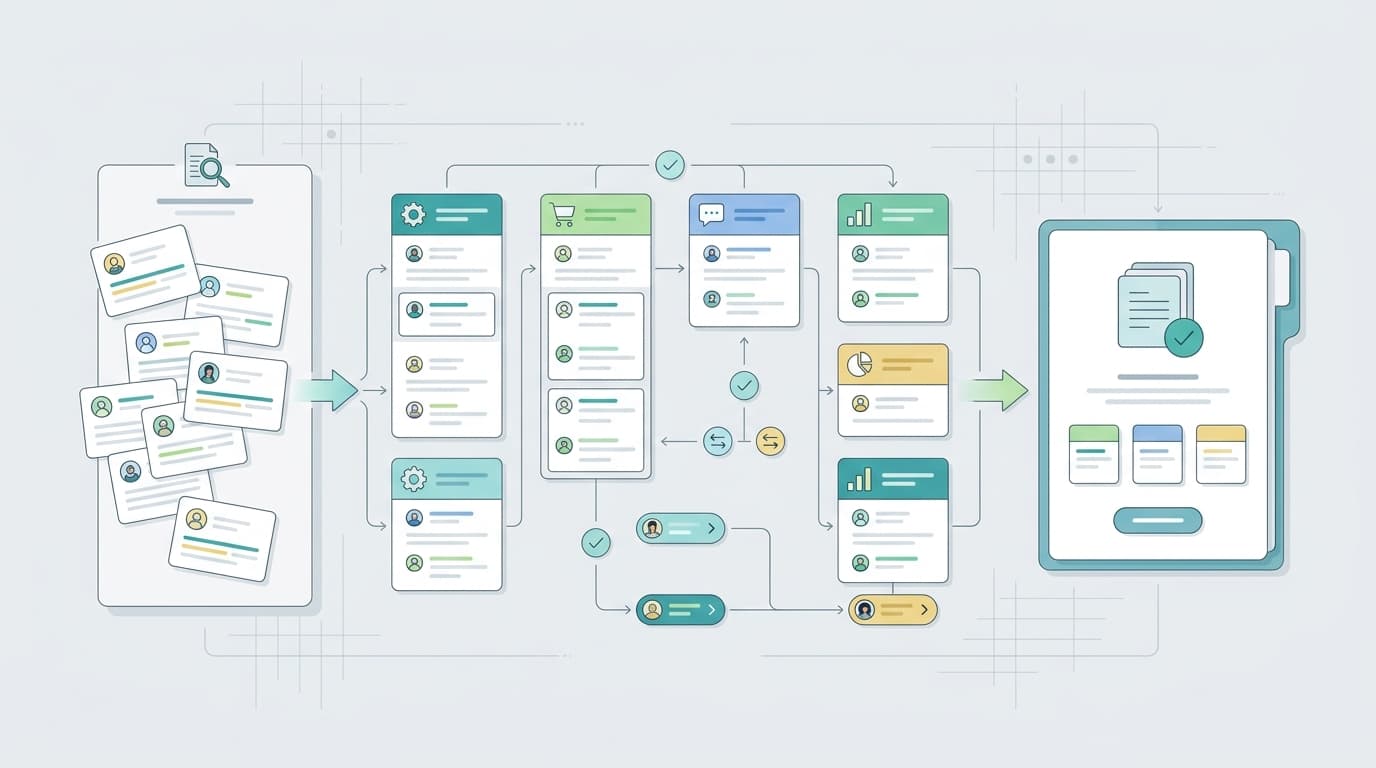
The review-mining workflow at a glance
| Stage | Core question | Output |
|---|---|---|
| 1. Frame | What decision are we trying to make? | Decision statement and scope |
| 2. Collect | Which reviews belong in the evidence set? | Defined review dataset |
| 3. Structure | What customer event does each review describe? | Normalized evidence records |
| 4. Cluster | Which patterns repeat across the dataset? | Theme map |
| 5. Validate | Is the pattern real, important, and actionable? | Evidence-backed opportunity |
| 6. Route | Which team and intervention fit the root cause? | Product, packaging, listing, quality, or support action |
| 7. Prioritize | Which opportunity deserves resources first? | Scored backlog |
| 8. Learn | Did the intervention change customer outcomes? | Post-release evidence loop |
The stages prevent a common failure: jumping from a dramatic quote directly to a feature idea.
Step 1: Start with a decision, not a dashboard
Define the decision before collecting reviews. A broad request such as “analyze customer feedback” creates broad summaries that are difficult to use.
A stronger decision statement is specific:
- Which complaint should the next product revision address first?
- Which competitor weakness is important enough to validate with a prototype?
- Why is one variation receiving more fit complaints than the parent listing suggests?
- Which praised feature should remain protected during cost reduction?
- Is a packaging redesign more valuable than a product redesign?
The decision statement determines the products, time period, ratings, markets, variants, and competitor set you need.
It also makes the final deliverable easier to judge. A useful review-mining project ends with a decision or experiment, not just a list of themes.
Step 2: Build a review set that matches the decision
The evidence set should represent the problem you are investigating.
For a product-improvement decision, include:
- the target ASIN or product line;
- relevant child variations;
- a useful range of ratings, not only one-star reviews;
- recent reviews plus an earlier comparison period;
- direct competitors serving the same customer job;
- enough positive feedback to identify what must not be broken.
For a new-product decision, include competitors at different price points and positioning angles. A premium competitor may reveal valued features, while a lower-priced competitor may reveal the minimum acceptable experience.
Avoid mixing unrelated products simply to increase volume. A large dataset with different customer jobs can hide the pattern you need.
Step 3: Turn each review into a minimum evidence record
Raw review text is difficult to compare. Normalize each useful review into a consistent record.
At minimum, capture:
| Field | What to record |
|---|---|
| Product context | Product, variation, market, date, and rating |
| Customer job | What the customer was trying to accomplish |
| Trigger | The moment the problem or benefit appeared |
| Observed outcome | What actually happened |
| Expected outcome | What the customer believed should happen |
| Theme | The recurring issue, need, or benefit |
| Severity | Inconvenience, failed task, damage, safety concern, return, or abandonment |
| Evidence | A representative excerpt or traceable review reference |
| Possible owner | Product, quality, packaging, listing, logistics, or support |
This structure separates a theme from its context. “Battery complaint” is not enough. “Battery fails before the customer completes an eight-hour outdoor shift” is much more useful because it describes the customer job, timing, and consequence.
Step 4: Cluster by customer event, not just keywords
Keyword counts can be helpful, but product teams need clusters that reflect the same underlying customer event.
For example, customers may describe the same closure failure with different language:
- “the lid pops open”;
- “it leaks in my bag”;
- “the seal will not stay closed”;
- “the top comes loose during travel.”
A useful cluster connects those phrases to one event: closure loses integrity during transport.
Good product-development clusters usually combine:
- Component or experience area — lid, handle, battery, setup, sizing, material, app, instructions.
- Customer event — breaks, leaks, disconnects, confuses, overheats, does not fit, arrives damaged.
- Use context — travel, outdoor use, gifting, frequent cleaning, first-time setup, commercial use.
- Consequence — frustration, failed task, replacement, return, damage, lost trust.
This is where AI-assisted analysis can reduce manual work. A review-analysis workflow can group language variants, summarize recurring patterns, and help teams compare products. But important themes should remain traceable to representative reviews so a product manager can inspect the evidence.
If your team is starting from scratch, use this companion guide on how to do Amazon review analysis before building the product-development layer.
Step 5: Separate symptoms from likely root causes
Customers are experts in their experience, but they may not identify the technical root cause.
“This product is cheap” is a perception. The evidence behind it might be:
- a thin material that bends under normal use;
- a loose component that creates noise;
- a surface finish that scratches quickly;
- packaging damage that makes a new product feel used;
- a listing promise that creates a premium expectation the product does not meet.
Treat the review as evidence of the customer outcome, then investigate the cause with product, quality, operations, and support data.
A simple symptom-to-cause review can use four questions:
- What customer event is consistently described?
- Under what conditions does it occur?
- Which alternative causes could produce the same event?
- What test would distinguish between those causes?
This step prevents teams from writing a product requirement before they understand the problem.
Step 6: Route the insight to the right intervention
Not every review pattern belongs on the product roadmap.
| Review pattern | Likely first intervention |
|---|---|
| Physical failure during normal use | Product design, engineering, or quality |
| Damage concentrated around delivery | Packaging or logistics |
| Product works but buyers expected something else | Listing, imagery, positioning, or comparison content |
| Repeated setup failure | Instructions, onboarding, product design, or support |
| One variation creates most complaints | Variation-level quality, sizing, supplier, or listing review |
| Customers praise a feature competitors lack | Positioning protection and product differentiation |
| Requested feature conflicts with the core use case | Segment research before roadmap commitment |
| Complaint appears after a material or supplier change | Quality investigation and change-control review |
This routing framework reduces roadmap inflation. It also helps product teams work with growth, CX, sourcing, and operations instead of sending every problem to engineering.
For competitor-led discovery, see how to turn competitor bad reviews into a product specification while keeping assumptions separate from validated requirements.
Step 7: Score opportunities with evidence, not volume alone
The most frequent theme is not always the most important. A lower-frequency issue can deserve attention if it causes returns, damage, trust loss, or a failed core task.
Use a scoring model that balances five factors:
| Factor | Question | Suggested score |
|---|---|---|
| Frequency | How consistently does the pattern appear in the relevant segment? | 1–5 |
| Severity | How serious is the customer consequence? | 1–5 |
| Strategic fit | Does solving it strengthen the intended product position? | 1–5 |
| Evidence confidence | How traceable and consistent is the evidence? | 1–5 |
| Feasibility | Can the team test or address it within realistic constraints? | 1–5 |
One practical formula is:
Opportunity score = frequency + (severity × 2) + strategic fit + evidence confidence + feasibility
Doubling severity helps prevent a common-volume issue from automatically outranking a less frequent but more damaging failure.
The score is a discussion aid, not a mechanical truth. Add a confidence note and document what could change the ranking.
Step 8: Convert the theme into a testable product opportunity
A theme becomes useful when it is written as an opportunity with evidence and a validation plan.
Use this format:
Customers trying to [complete a job] experience [event] under [conditions], leading to [consequence]. The pattern appears in [scope of evidence]. We believe [intervention] may improve the outcome. We will test this by [validation method] and measure [customer and business signal].
Example:
Customers carrying the product during daily commutes report that the closure opens when the bag is horizontal, leading to leaks and returns. The pattern appears across two recent variations and is weaker in a premium competitor set. We believe a revised closure tolerance and transport test may improve the outcome. We will validate the design with bench testing and a small customer-use pilot, then monitor closure-related complaints and return reasons after release.
This language keeps the customer problem separate from the proposed solution.
Build a product opportunity backlog, not an insight archive
Each validated opportunity should enter one shared backlog with:
- opportunity statement;
- customer segment and use context;
- theme frequency and severity;
- representative evidence;
- competing explanations;
- proposed intervention;
- owner;
- next validation step;
- confidence level;
- status and decision date.
The backlog should distinguish at least four states:
- Observe — the pattern is worth monitoring but evidence is limited.
- Investigate — the pattern is credible and needs root-cause work.
- Validate — a potential intervention is ready for testing.
- Commit — the evidence and economics justify implementation.
This prevents an AI-generated theme summary from being mistaken for a committed roadmap.
Use a cross-functional review-mining cadence
Review mining works best as a recurring operating loop rather than a one-time research project.
Weekly signal review
Product, CX, and quality owners review new or changing themes, especially severe complaints, variation-level shifts, and post-release feedback.
Monthly opportunity review
Teams compare the highest-scoring opportunities, assign investigations, and close themes that lack evidence or strategic fit.
Pre-roadmap evidence review
Before major planning, product managers combine review patterns with return reasons, support data, commercial performance, supplier constraints, and direct customer research.
Post-release learning review
After a change ships, teams compare the original complaint theme against new reviews, returns, support contacts, and quality findings. This closes the loop described in the customer feedback loop from reviews to the product roadmap.
Common review-mining mistakes
Treating star ratings as product requirements
Ratings show direction, not root cause. Read the language and context behind the score.
Mining only negative reviews
Positive reviews reveal valued features, unexpected use cases, and product qualities that should survive redesign or cost reduction.
Counting words without grouping meaning
Customers use different phrases for the same event. Cluster by customer outcome and context, not exact wording alone.
Confusing a request with a need
A customer may request a larger battery, but the underlying need may be reliable completion of a specific task. The best solution could involve power management, clearer expectations, or a different product tier.
Hiding the evidence behind an AI summary
Summaries accelerate analysis, but high-impact decisions need traceable examples and clear scope.
Sending every insight to product
Many customer problems belong to packaging, listing content, logistics, quality, onboarding, or support. Route before prioritizing.
Ignoring variation and time
A parent-level average can hide a child-variation problem. A lifetime dataset can hide a recent supplier or product change.
How VOC AI supports review mining
VOC AI’s Voice of Customer Analysis is designed to help ecommerce teams analyze review language, organize customer themes, compare products, and turn recurring feedback into clearer decisions.
For product-development work, the value is not a generic summary. It is the ability to move through a repeatable evidence workflow:
- define a product or competitor set;
- identify recurring complaints, needs, and praise patterns;
- compare themes across products or variations;
- inspect representative customer language;
- route findings into product, positioning, quality, and customer-experience actions.
Teams should still validate high-impact decisions with the broader evidence available to them. Review intelligence is strongest when it sharpens investigation and prioritization rather than replacing product judgment.
Frequently asked questions
What is review mining?
Review mining is the structured analysis of customer reviews to identify repeated needs, complaints, benefits, use cases, and expectations. Product teams use those patterns to form and prioritize evidence-backed opportunities.
How is review mining different from sentiment analysis?
Sentiment analysis classifies emotional direction. Review mining adds theme, customer job, context, severity, root-cause investigation, evidence traceability, and decision routing.
Can AI replace manual review analysis?
AI can reduce the work required to organize large review sets and surface patterns. Human review remains important for scoping the decision, validating representative evidence, investigating causes, and committing product resources.
Should product teams analyze only one-star reviews?
No. Low ratings are useful for failures and unmet expectations, while positive reviews reveal differentiation, valued features, and product qualities worth protecting. Mixed ratings often contain useful tradeoffs.
How many reviews are needed for review mining?
There is no universal threshold. The evidence set should be large and relevant enough to reveal repeated patterns within the product, segment, variation, and time period being studied. Confidence should reflect the size, consistency, and scope of the dataset.
What should a review-mining deliverable include?
Include the decision statement, dataset scope, theme map, representative evidence, severity, likely owners, competing explanations, opportunity scores, proposed tests, and an action backlog.
Turn customer language into a better product decision
Review mining creates value when it changes how a team decides.
The strongest workflow moves from raw customer language to structured evidence, from structured evidence to validated opportunities, and from opportunities to owned tests and measurable learning.
Start with one product decision. Build a relevant review set. Cluster customer events, not just keywords. Separate symptoms from causes. Route each pattern to the right intervention. Then prioritize with severity, confidence, strategic fit, and feasibility—not volume alone.
If you want to apply this workflow to a product line or competitor set, talk with the VOC AI team about a review-mining pilot.