Updated August 17, 2026.
A customer insights platform becomes useful when each team knows which customer evidence to inspect at each funnel stage.
Most teams do not have an insight shortage. They have reviews, support tickets, surveys, sales notes, product analytics, session recordings, social comments, competitor feedback, and scattered research notes. The hard part is deciding which evidence should guide awareness, consideration, purchase, activation, retention, and expansion decisions.
That is why this guide takes a funnel-stage view of the customer insights platform category. Instead of asking, "What can the platform analyze?", ask a sharper question:
Which funnel decision will this customer evidence improve, and what proof would make the team comfortable acting on it?
Use this article as a practical use-case map. It is written for growth, product, CX, and ecommerce teams evaluating customer insights platform tools, especially when customer reviews and buyer language are part of the decision loop.
For a broader buying framework, read the customer insights platform strategy guide. This article stays narrower: which use cases belong at each funnel stage, what evidence they require, and where a review-backed platform such as VOC.AI fits.
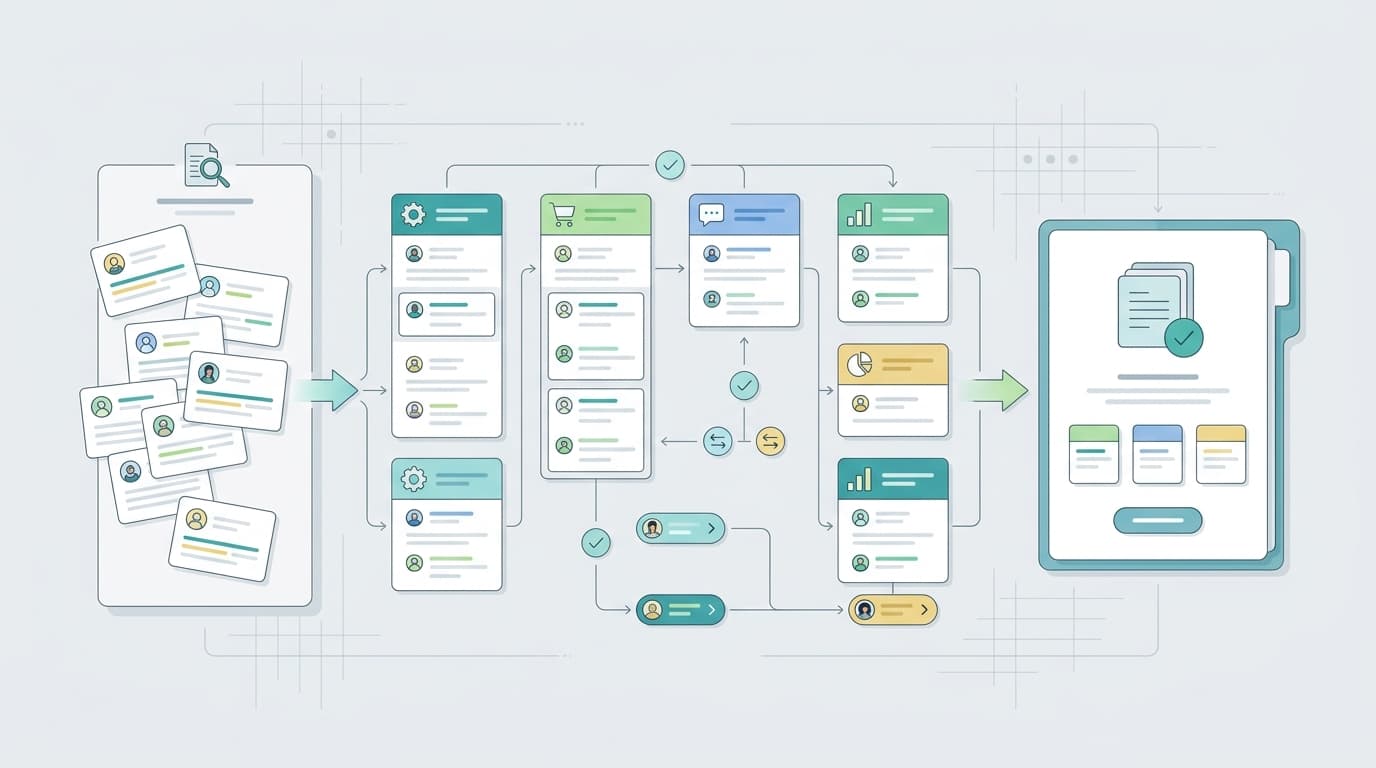
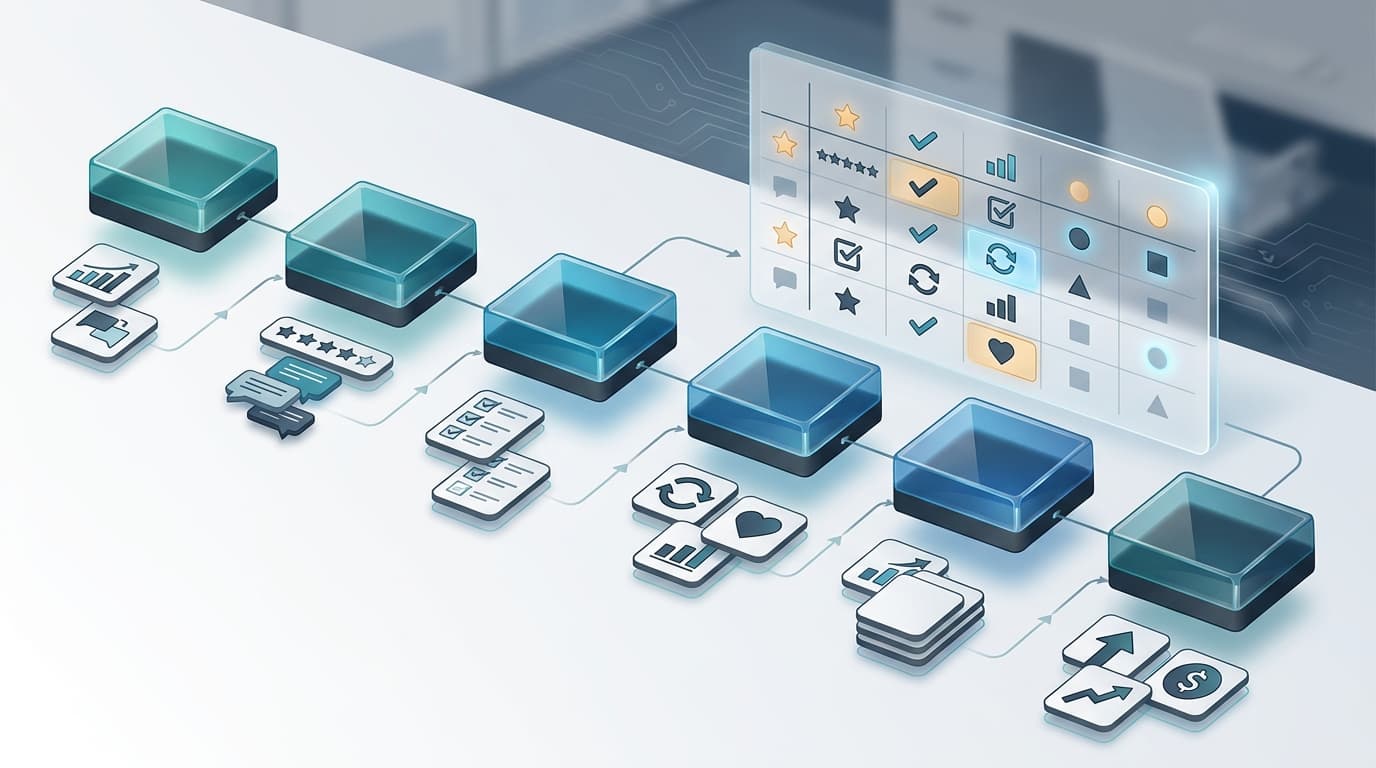
The funnel-stage use-case map
Start with the stage, not the dashboard. A customer insights platform should help the team move from a specific funnel question to a specific action.
| Funnel stage | Customer question | Best evidence | Platform output | Business action |
|---|---|---|---|---|
| Awareness | What problem language already exists in the market? | Public reviews, competitor reviews, communities, search queries, social comments | Pain-point and buyer-language map | Positioning, audience, content, campaign angle |
| Consideration | What alternatives, objections, and trust gaps shape comparison? | Review pros/cons, sales notes, comparison pages, support pre-sale questions | Objection and competitor-evidence matrix | Landing page proof, comparison copy, FAQ, sales enablement |
| Purchase | What keeps high-intent buyers from converting? | Checkout feedback, product reviews, support chats, pricing questions, listing reviews | Purchase-friction report | Offer test, listing rewrite, guarantee, proof block, pricing explanation |
| Activation | What expectation gap appears after signup or delivery? | Onboarding tickets, setup surveys, first-use behavior, low-star reviews | Expectation-gap diagnosis | Onboarding fix, help content, product setup flow, post-purchase messaging |
| Retention | What recurring issue threatens repeat purchase or renewal? | Complaints, returns, churn notes, support escalations, rating trends | Retention-risk theme board | Roadmap fix, support macro, monitoring rule, service recovery |
| Expansion | What language reveals new use cases or segments? | Positive reviews, advanced usage notes, account expansion notes, competitor demand | Expansion-opportunity brief | New bundle, cross-sell, persona page, product line, agency playbook |
This table is the minimum operating model. If a platform cannot preserve source evidence, segment the cohort, and produce a handoff that a decision owner can use, it may still be a useful analytics tool. It is not yet a dependable customer insights platform for funnel work.
Awareness: find the language buyers already use
At the awareness stage, the team is usually trying to decide what market problem to name.
Common questions include:
- Which customer pain should our category content lead with?
- Which competitor weakness creates a credible entry point?
- Which use case is visible before a buyer knows our brand?
- Which words do customers use when they describe the problem?
The best evidence is public and messy: marketplace reviews, app store reviews, competitor product reviews, social posts, forum questions, comments on creator videos, and category-level search behavior.
A customer insights platform should turn that material into a language map, not just a sentiment chart. The useful output is a list of pains, triggers, phrases, desired outcomes, and repeated context.
For ecommerce teams, this is where review intelligence is unusually strong. VOC.AI's Voice of Customer Analysis page positions the product around Amazon review analysis, buyer language, pain points, expectations, and decision-ready outputs. That matters at awareness because customers often describe the category problem before they ever describe a brand.
Good awareness-stage output looks like this:
| Signal | Weak output | Useful customer insights platform output |
|---|---|---|
| Competitor complaint | "Customers dislike durability" | "Buyers who use the product daily complain that the hinge loosens after two weeks; they use phrases such as 'flimsy after travel' and compare it with metal alternatives." |
| Category aspiration | "Customers like convenience" | "Parents buying for school mornings praise products that reduce prep time and mention 'one-hand setup' as a practical advantage." |
| Search/content angle | "Write about benefits" | "Lead with the problem buyers name before purchase: setup effort, confusing compatibility, or risk of buying the wrong size." |
The action is not "create an insight." The action is choosing a content angle, ad hook, audience segment, product research question, or market-entry hypothesis.
Consideration: prove what makes the shortlist
At the consideration stage, buyers are comparing options. They are no longer asking whether the problem exists. They are asking which solution deserves trust.
Use cases for a customer insights platform include:
- Building a competitor objection matrix.
- Finding the proof points buyers need before choosing.
- Separating table-stakes features from true differentiators.
- Identifying phrases that belong on comparison pages, product pages, and sales collateral.
- Finding claims that customers will not believe without evidence.
The evidence should include competitor reviews, your own reviews, sales objections, support questions, survey verbatims, and product analytics for high-intent pages. The platform should preserve the source so a marketer or product owner can inspect the exact customer language before turning it into copy.
The AI review analysis comparison covers how to separate summary-only review tools from decision-grade review analysis. In consideration-stage work, that distinction matters. A summary can say "customers mention quality." A decision-grade platform should show which quality claims are believed, doubted, compared, or contradicted.
Use this consideration-stage checklist:
| Question | Evidence to inspect | Output to create |
|---|---|---|
| Why do buyers choose alternatives? | Competitor review praise, comparison queries, sales notes | Competitor strength map |
| What creates hesitation? | Support questions, low-star reviews, pricing-page exits, pre-sale chat | Objection matrix |
| What proof changes trust? | Positive reviews, customer examples, return reasons, trial notes | Proof-point library |
| What claim should we avoid? | Contradictory reviews, support escalations, refund notes | Claim-risk list |
A good customer insights platform should make the shortlist decision more specific. The team should know which objection to address, which proof to show, and which claim to leave out.
Purchase: remove the friction that appears closest to conversion
Purchase-stage insight work is usually more operational. The buyer is close to acting, but something blocks the decision.
Typical questions include:
- What makes buyers pause at pricing, checkout, or the product listing?
- Which missing detail creates avoidable support questions?
- Which review concern should be answered before the CTA?
- Which guarantee, comparison, FAQ, or proof block should be tested?
For ecommerce teams, product reviews often reveal purchase friction more clearly than post-click analytics. A buyer may not write, "I abandoned cart because the page lacked proof." But they may write, "I was worried it would not fit," "the photos did not show the connector," or "I bought the other one because it included the adapter."
A customer insights platform should connect those phrases to a purchase action:
| Friction type | Customer evidence | Action |
|---|---|---|
| Fit uncertainty | Reviews mention sizing, compatibility, setup, product dimensions | Add fit guide, comparison table, product image, or FAQ |
| Trust gap | Reviews ask for durability proof, certification, warranty, or real usage examples | Add proof block, customer quote, warranty explanation, or usage evidence |
| Value confusion | Pricing questions show uncertainty about credits, limits, bundle value, or replacement cost | Clarify plan logic and who each plan is for |
| Comparison anxiety | Competitor reviews show a rival is chosen for one specific reason | Add honest comparison section or objection-specific landing page |
VOC.AI's current pricing page frames the product around one credit system across API, MCP, and Agent analysis, from a free trial to shared team credit pools. If a team is evaluating a customer insights platform for purchase-stage work, the important question is not only price. It is whether the platform can produce enough repeatable evidence to improve decisions that affect conversion.
Activation: close the gap between promise and first value
Activation-stage insight work starts after signup, purchase, installation, delivery, or first use.
The central question is:
What did the buyer expect, and where did the experience fail to match that expectation?
Useful sources include onboarding surveys, help desk tickets, setup chats, app session data, product returns, low-star reviews, and "I thought it would..." comments.
A customer insights platform should help the team classify expectation gaps:
| Expectation gap | Evidence pattern | Platform output | Action |
|---|---|---|---|
| Setup gap | Customers ask the same first-use question | Setup-friction theme with examples | Change onboarding, insert help content, update packaging or docs |
| Outcome gap | Customers expected a different result | Promise-vs-result evidence set | Rewrite product page, clarify use cases, change feature flow |
| Data/import gap | Users hesitate because setup requires data, permissions, or formatting | Setup-risk diagnosis | Add checklist, sample data, migration guidance |
| Education gap | Customers miss a valuable feature | Discovery and timing map | Trigger, email, tutorial, packaging insert, help article |
This is where source traceability prevents bad fixes. If one segment has a setup problem, do not rewrite onboarding for everyone. If a review complaint comes from an older SKU or previous product version, do not overreact. The platform needs enough cohort control to separate current activation friction from historical noise.
Retention: catch repeated friction before it becomes churn
Retention-stage work is not only for subscription businesses. Ecommerce teams also need to understand repeat purchase, returns, rating decline, warranty issues, customer service volume, and brand trust.
The customer insights platform use cases are:
- Monitoring rating and sentiment changes.
- Finding repeated complaints that predict return or churn risk.
- Comparing support escalations with review trends.
- Spotting quality-control or packaging issues early.
- Turning recurring complaints into roadmap, operations, or support fixes.
The customer feedback intelligence workflow playbook goes deeper on the operating model. For funnel-stage work, the key is to create a retention-risk board that includes evidence strength and owner.
Use this rule:
| Retention signal | Do not stop at | Create instead |
|---|---|---|
| Repeated complaint | A theme label | Owner, affected cohort, source examples, business risk, next check date |
| Rating drop | A sentiment alert | Product/version/source breakdown plus strongest recent quotes |
| Support spike | Ticket count | Customer language, root-cause hypothesis, fix path, follow-up metric |
| Churn reason | Cancellation tag | Evidence packet with counterevidence and expected signal change |
VOC.AI's review monitoring and review analysis positioning is a fit when retention risk appears in product reviews, competitor reviews, ecommerce support patterns, or buyer-language shifts. Do not treat the tool as a replacement for product analytics or financial retention data. Treat it as the customer-language layer that explains why the number may be moving.
Expansion: turn strong customer language into the next growth bet
Expansion-stage use cases are easy to underuse. Teams often mine negative feedback and ignore positive evidence that reveals new segments, bundles, use cases, or product lines.
A customer insights platform should help identify:
- Unexpected use cases in positive reviews.
- Segments that describe value more clearly than the company does.
- Bundles or accessories customers mention together.
- Competitor audiences that appear underserved.
- Product improvements that unlock a higher-value buyer.
- Support or agency workflows that can become repeatable services.
For ecommerce and marketplace teams, the evidence often sits inside phrases such as "I use this for...", "better than the one I bought before...", "wish it came with...", or "I bought a second one for...".
Turn those phrases into an expansion brief:
| Brief field | What to write |
|---|---|
| New use case | The exact customer situation, not a generic segment name |
| Evidence | Representative quotes, source, date, product, competitor if relevant |
| Confidence | How many sources repeat it and which sources contradict it |
| Action | Bundle, landing page, new SKU, feature test, creator script, agency offer, or sales play |
| Follow-up | Metric or review signal to check after the action |
VOC.AI's Review Analysis API is relevant when teams want to route review, keyword, listing, and sales-estimate signals into internal tools, agents, or recurring workflows. That makes sense for expansion-stage work when the same opportunity scan needs to run across many products, competitors, or categories.
How to choose customer insights platform tools by funnel stage
Most teams should not ask one customer insights platform to do every job equally well. Choose by the funnel decision that matters most right now.
| Primary need | Tool type to prioritize | What to verify in the demo |
|---|---|---|
| Awareness and category positioning | Review intelligence, social listening, market intelligence | Can it show raw customer language by competitor, product, and segment? |
| Consideration and proof | Review analysis, research repository, sales intelligence | Can it connect objections to examples and counterevidence? |
| Purchase conversion | Product analytics plus feedback/review intelligence | Can it tie friction themes to page, listing, checkout, or pricing decisions? |
| Activation | Support intelligence, onboarding analytics, survey tools | Can it separate first-use confusion from broad dissatisfaction? |
| Retention | Support intelligence, review monitoring, CX analytics | Can it detect trend changes and assign owners to repeated issues? |
| Expansion | Review intelligence, market intelligence, API-first data workflows | Can it scan many products or competitors and preserve source proof? |
If reviews are central to your funnel decisions, put review intelligence high on the shortlist. If most of the problem is web behavior without clear customer language, product analytics may lead. If the team has formal research studies scattered across docs, a research repository may lead. The right customer insights platform depends on the decision loop, not the category label.
The 45-minute funnel-stage test
Before buying or renewing a customer insights platform, run one real funnel-stage test.
- Pick one stage: awareness, consideration, purchase, activation, retention, or expansion.
- Write one decision question.
- Select one evidence cohort.
- Ask the platform to produce themes with source examples.
- Find counterevidence that narrows or challenges the theme.
- Create a handoff with owner, action, expected signal, and follow-up date.
- Score whether the output changed the decision.
Use this scorecard:
| Check | Pass standard |
|---|---|
| Source traceability | Every important theme links back to original evidence |
| Cohort control | The team can filter by product, segment, channel, date, funnel stage, or competitor |
| Theme specificity | The output explains behavior, not only sentiment |
| Counterevidence | The platform helps find where the conclusion may not apply |
| Decision handoff | The output names the action, owner, expected signal, and next review date |
| Reuse | The insight can be saved, exported, linked, or repeated in a workflow |
Do not choose the tool that writes the smoothest summary. Choose the customer insights platform that improves a real funnel decision and makes the evidence easier to challenge.
Where VOC.AI fits
VOC.AI is a fit when review-backed customer evidence is central to the funnel decision.
The strongest funnel-stage use cases are:
- Awareness: find repeated buyer pain and category language from Amazon reviews and competitor reviews.
- Consideration: build objection, proof, and competitor matrices from review evidence.
- Purchase: identify listing, fit, trust, and value concerns before buyers convert.
- Activation: diagnose expectation gaps after delivery, setup, or first use.
- Retention: monitor recurring complaints, rating changes, and support-relevant review themes.
- Expansion: discover new use cases, bundles, segments, and product-line ideas from positive and competitor review language.
For teams that need repeatable workflows, the Review Analysis API can support internal dashboards, agents, and automated evidence reviews. For teams evaluating the broader category, start with one funnel stage and one decision. A customer insights platform is only worth scaling after it proves that it can turn customer evidence into a better action.