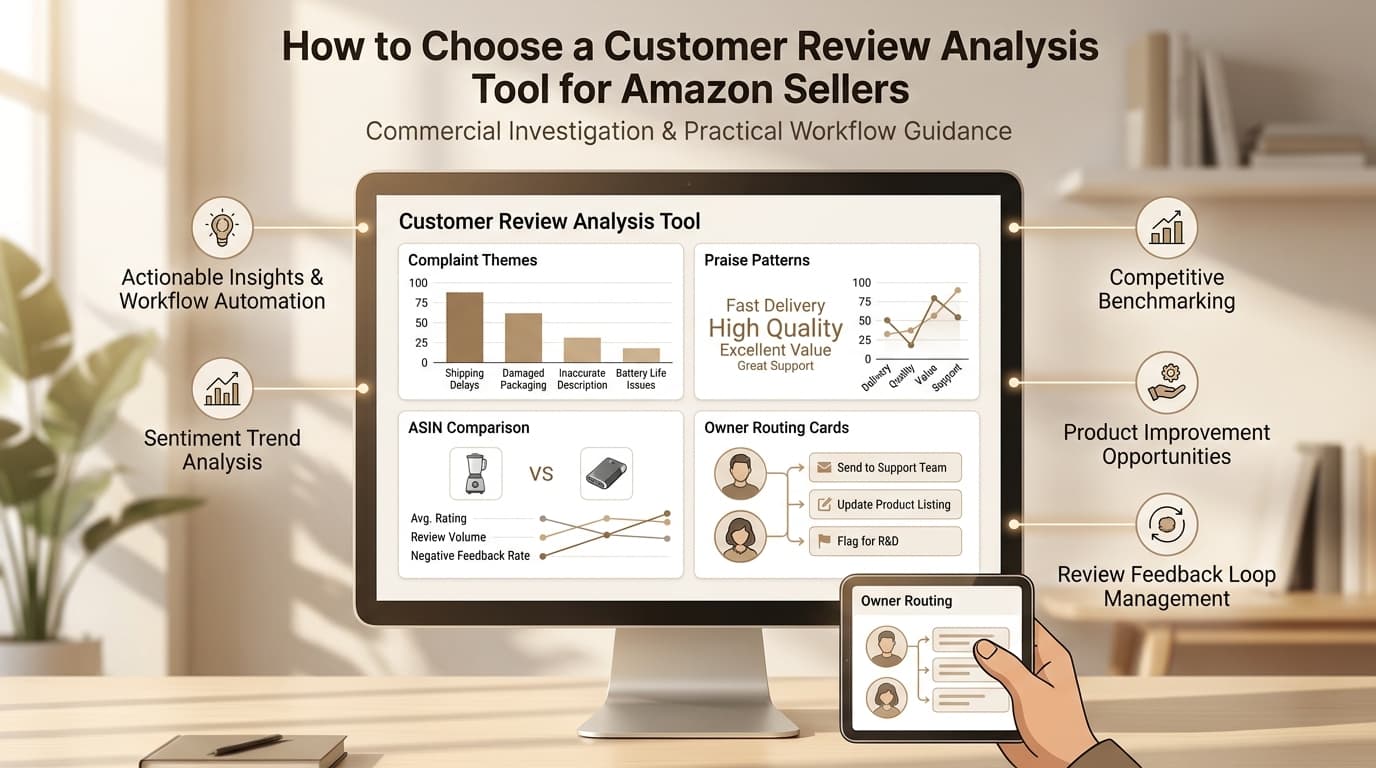
How to Choose a Customer Review Analysis Tool for Amazon Sellers
Most sellers do not need another place to export reviews. They need a faster way to understand what customers keep repeating, which products are affected, and what the team should change next. That is the real job of a customer review analysis tool.
For Amazon teams, the strongest tools do more than count stars or generate a quick summary. They help operators move from raw review text to clearer product, listing, support, and operations decisions. If the tool cannot help with that, it is only solving a small part of the problem.
This guide explains what to look for in a customer review analysis tool, where simple workflows usually break down, and how to choose a setup that fits Amazon seller work instead of generic analytics language.
What a customer review analysis tool should actually help you decide
The best evaluation question is not "Does this tool analyze reviews?" Most tools can say yes. The better question is "What decisions will this help my team make faster?"
A useful customer review analysis tool should help you answer questions like these:
- Which complaint themes are repeating right now?
- Which praise patterns are strong enough to reuse in listing copy?
- Is the issue limited to one ASIN or one variation?
- Is the root problem product quality, packaging, expectation mismatch, or support friction?
- Which owner should act first?
If the tool cannot answer those questions clearly, it will usually become another reporting screen instead of an operating tool.
Why sellers outgrow manual review reading
Manual review reading can still work when a seller has one product, low review volume, and enough time to scroll one by one. It usually stops working when:
- multiple ASINs need monitoring,
- review volume increases after promotions or traffic spikes,
- teams need recurring updates instead of one-off checks,
- competitor comparisons matter,
- or repeated complaints need owner routing across functions.
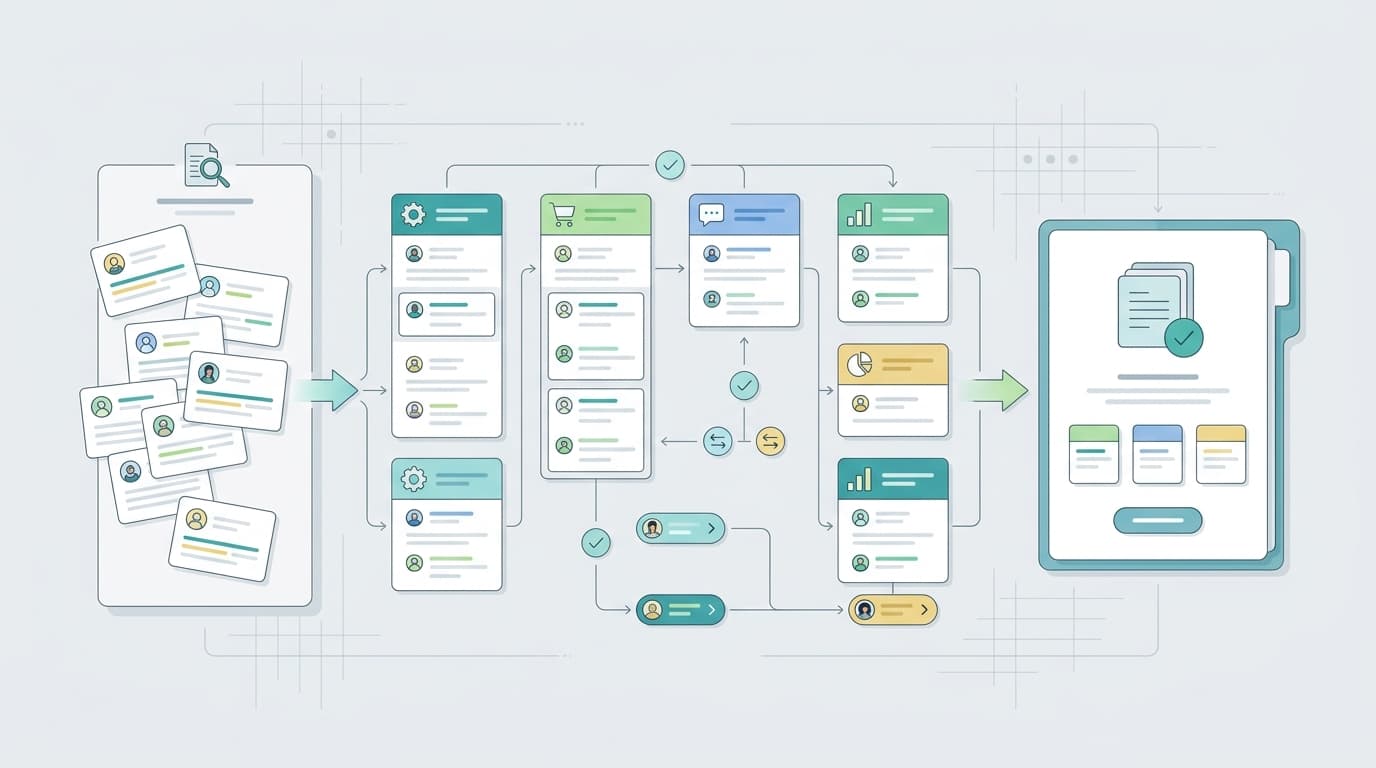
At that point, the problem is not access to reviews. The problem is structure. A customer review analysis tool becomes valuable because it helps the team see repeated language, trend direction, and likely action paths without starting from a blank spreadsheet every time.
The core features that matter most
Many software lists focus on long feature checklists. For Amazon sellers, a smaller set of capabilities matters more.
| Capability | Why it matters for sellers |
|---|---|
| Theme clustering | Groups repeated praise and complaints into usable patterns |
| Sentiment as a first layer | Helps segment large review sets quickly before deeper inspection |
| ASIN or variation comparison | Prevents catalog-wide reactions to isolated product issues |
| Evidence wording | Keeps the analysis tied to real buyer language |
| Trend tracking | Helps teams spot movement instead of reading one static snapshot |
| Owner routing | Makes it easier to turn feedback into next actions |
These are the features that help a tool move from summary output to decision support.
Sentiment labels alone are not enough
Many tools lead with positive, neutral, and negative breakdowns. That can be useful, but it is not enough for real seller work.
A negative review can describe very different issues:
- damaged packaging,
- durability failure,
- missing parts,
- inaccurate listing expectations,
- confusing setup,
- or post-purchase support friction.
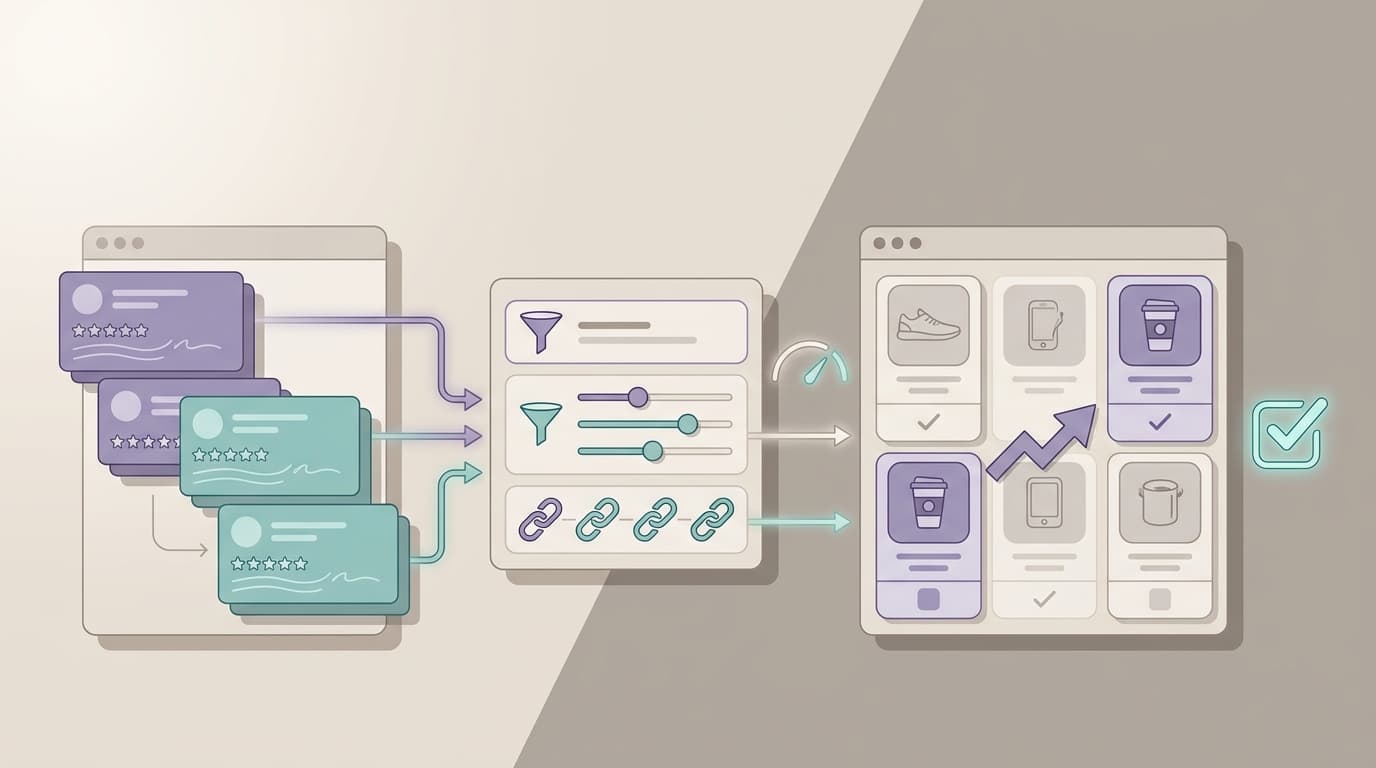
Those are not the same problem, and they should not all land in one undifferentiated negative bucket. A stronger customer review analysis tool uses sentiment as the first cut, then groups the language into themes that point to action.
For teams that want the seller-first explanation behind this idea, Amazon Review Sentiment Analysis for Sellers, Not Data Scientists covers why theme-based review reading is more useful than academic sentiment framing.
Theme clustering matters more than a long summary paragraph
Some tools summarize reviews into one neat block of text. That can save time, but it can also hide the structure a seller needs.
What usually works better is theme clustering that shows:
- the repeated complaint or praise theme,
- how often it appears,
- which ASINs or variations drive it,
- representative customer wording,
- and the likely first owner.
That is the point where a customer review analysis tool starts helping real workflows instead of producing a generic summary that still needs manual interpretation.
Evidence language should stay visible
The original customer wording matters because it helps sellers decide whether the grouping is accurate and useful.
Examples of evidence language a tool should preserve:
| Theme | Useful review wording |
|---|---|
| Packaging damage | "arrived crushed," "box was torn," "seal was broken" |
| Expectation mismatch | "smaller than expected," "looks different from the photo" |
| Setup confusion | "instructions were unclear," "hard to install" |
| Feature praise | "battery lasted all weekend," "easy to use right away" |
When the evidence stays visible, listing, support, and marketing teams can reuse the language directly instead of translating abstract labels back into something actionable.
Look for tools that separate ASIN-level issues from catalog-wide issues
One of the fastest ways to waste time is to treat a variation problem like a full catalog problem. A strong customer review analysis tool should help sellers see whether:
- one child ASIN is driving the complaint,
- one seller bundle has a completeness issue,
- one replenishment cycle created a quality shift,
- or the pattern is truly spreading across the catalog.
This is especially important for teams already tracking review health by product family. The more clearly the tool surfaces concentration, the less often the team will overreact.
For a deeper monitoring workflow, Amazon Review Monitoring for Rating Drops, Returns, and Complaint Trends explains how trend checks and complaint signals work together.
The tool should support both complaint themes and praise patterns
Sellers often focus only on negative reviews. That is understandable, but incomplete.
Complaint themes help with:
- packaging or supplier checks,
- support and FAQ updates,
- listing expectation fixes,
- and product investigation.
Praise patterns help with:
- bullet and title language,
- image-caption emphasis,
- ad-message testing,
- and sharper positioning.
A customer review analysis tool is more valuable when it shows both sides together. Sellers need to know what customers love enough to repeat, not only what frustrates them.
Owner routing is an underrated buying criterion
Many tools can identify a problem. Fewer help teams move from the problem to the next owner. That matters because Amazon review analysis often spans multiple functions.
| Theme type | Likely first owner | Example next move |
|---|---|---|
| Packaging damage | Operations | Check prep, carton protection, and inbound handling |
| Durability issue | Product or QA | Investigate defect patterns and supplier changes |
| Setup confusion | Support | Update help content and macro replies |
| Listing mismatch | Listing team | Rewrite bullets, images, and expectation setting |
| Strong praise pattern | Marketing or listing | Reuse customer language in ads and PDP copy |
If the tool helps the team assign work faster, it becomes part of the operating rhythm. If it stops at observation, the insights usually stall in a doc or spreadsheet.
How to compare a customer review analysis tool against a simple manual workflow
The fairest comparison is not "human vs software." The better question is where software improves the workflow without removing judgment.
| Workflow area | Manual review reading | Customer review analysis tool |
|---|---|---|
| Initial setup | Low effort | Moderate effort |
| Ongoing review volume | Hard to sustain as volume grows | Easier to maintain across recurring review cycles |
| Theme consistency | Depends on the reader | More structured across repeated analyses |
| Evidence reuse | Easy to miss or scatter | Easier to preserve and compare |
| Team sharing | Often trapped in one person's notes | Easier to turn into shared views and action queues |
The manual path still works for narrow, infrequent checks. The tool path becomes more valuable when the team needs repeatable structure and shared visibility.
Where a seller review dashboard fits
Some teams do not just need a one-time analysis. They need a recurring way to share review signals across product, support, operations, and marketing. That is where a dashboard view becomes useful.
Build a Seller Review Dashboard From Complaint Themes and Praise Patterns shows how the same review-analysis output can be organized into a shared operating view with trend movement, evidence language, and owner routing.
If you already know your team needs a recurring operating layer, a customer review analysis tool that can support dashboard-style workflows will usually hold up better than a summary-only tool.
Where VOC AI fits in this category
VOC AI is best framed as a review-intelligence workflow rather than a generic sentiment widget. Its public product positioning already emphasizes review analysis, customer pain points, purchase motivation, usage scenarios, and competitor review comparison.
That means a seller can use VOC AI surfaces such as:
to organize reviews into repeated complaint themes, praise patterns, buyer-language evidence, and comparison views that support listing, product, and monitoring decisions.
That is a safer and more useful promise than claiming a tool will automate every judgment. The value is faster structure, clearer evidence, and a more repeatable decision process.
A practical shortlist for evaluation
If you are choosing a customer review analysis tool, use this shortlist:
- Can it group repeated complaints and praise into clear themes?
- Can it show which ASINs or variations drive the pattern?
- Can it preserve representative customer wording?
- Can it show trend direction across time windows?
- Can it help the team route the issue to the right owner?
- Can the output support both one-off analysis and recurring review workflows?
If the answer is yes across those six questions, the tool is likely strong enough for real Amazon seller use.
Common buying mistakes to avoid
The most common mistakes are predictable:
- choosing a tool because it has a long feature list instead of a usable workflow,
- treating sentiment percentages as the final output,
- ignoring ASIN concentration,
- hiding the original review wording,
- and buying a summary tool when the real need is recurring monitoring or shared reporting.
The strongest choice is usually the one that makes repeated customer language easier to see, easier to trust, and easier to act on.
Conclusion
A customer review analysis tool should help Amazon sellers make better decisions, not just produce cleaner summaries. The best options help teams move from raw review text to complaint themes, praise patterns, ASIN-level context, evidence wording, and owner routing.
That is what makes the software useful in practice. Not the existence of AI alone, and not the number of exported charts. The real value is a workflow that helps the team understand what customers keep repeating and respond before the next issue spreads.