Sentiment Buckets vs. Reading Reviews One by One: A Smarter Amazon Review Sentiment Analysis Workflow
Amazon review sentiment analysis often gets sold as a shortcut: push a button, get a summary, move on. That promise is exactly why many operators distrust it.
They have seen summaries flatten nuance, bury edge cases, and make a real buyer problem look smaller than it is. That skepticism is reasonable. If a team only reads the bucket label and never checks the raw reviews, it can make the wrong listing, product, packaging, or support decision faster.
The better question is not whether sentiment buckets are good or bad. It is when they help, when they mislead, and how to use them without losing useful signal.
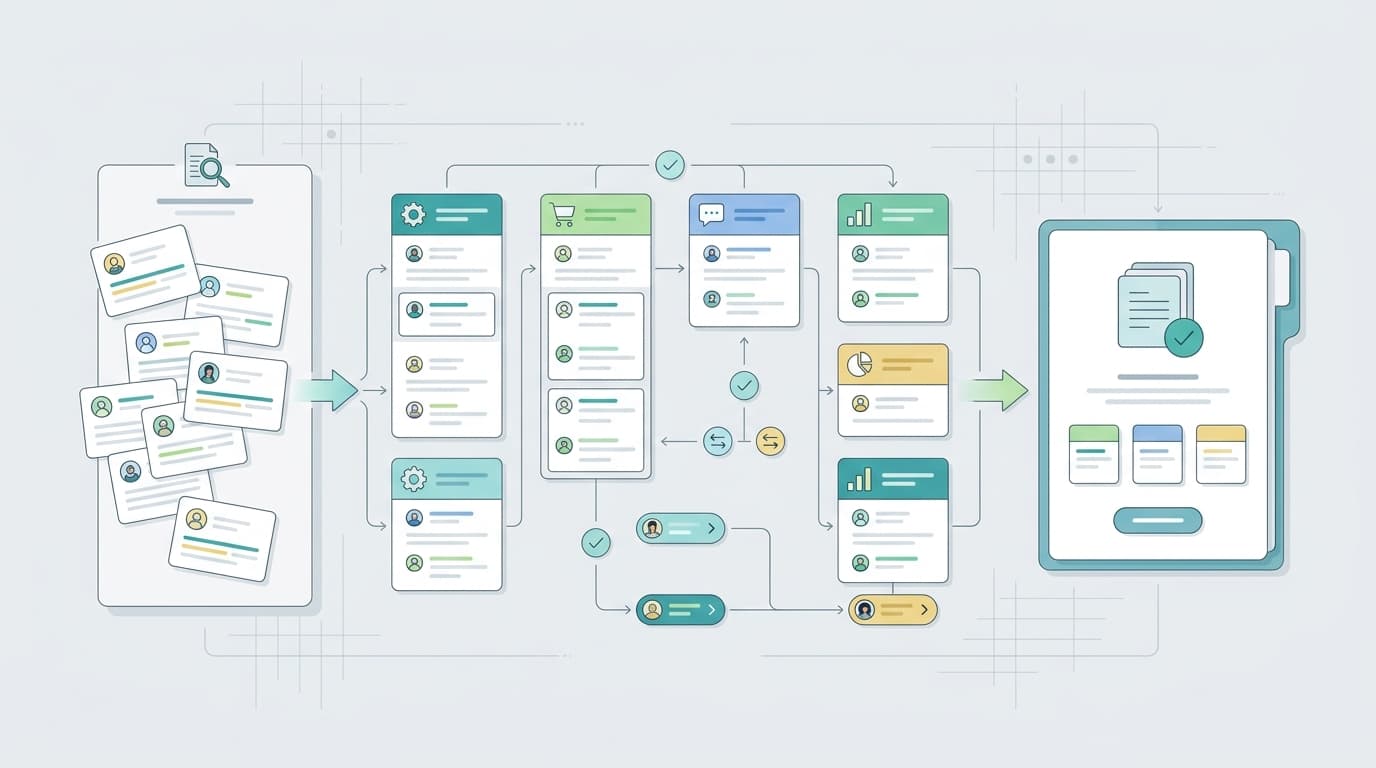
For most seller teams, the best Amazon review sentiment analysis workflow is simple:
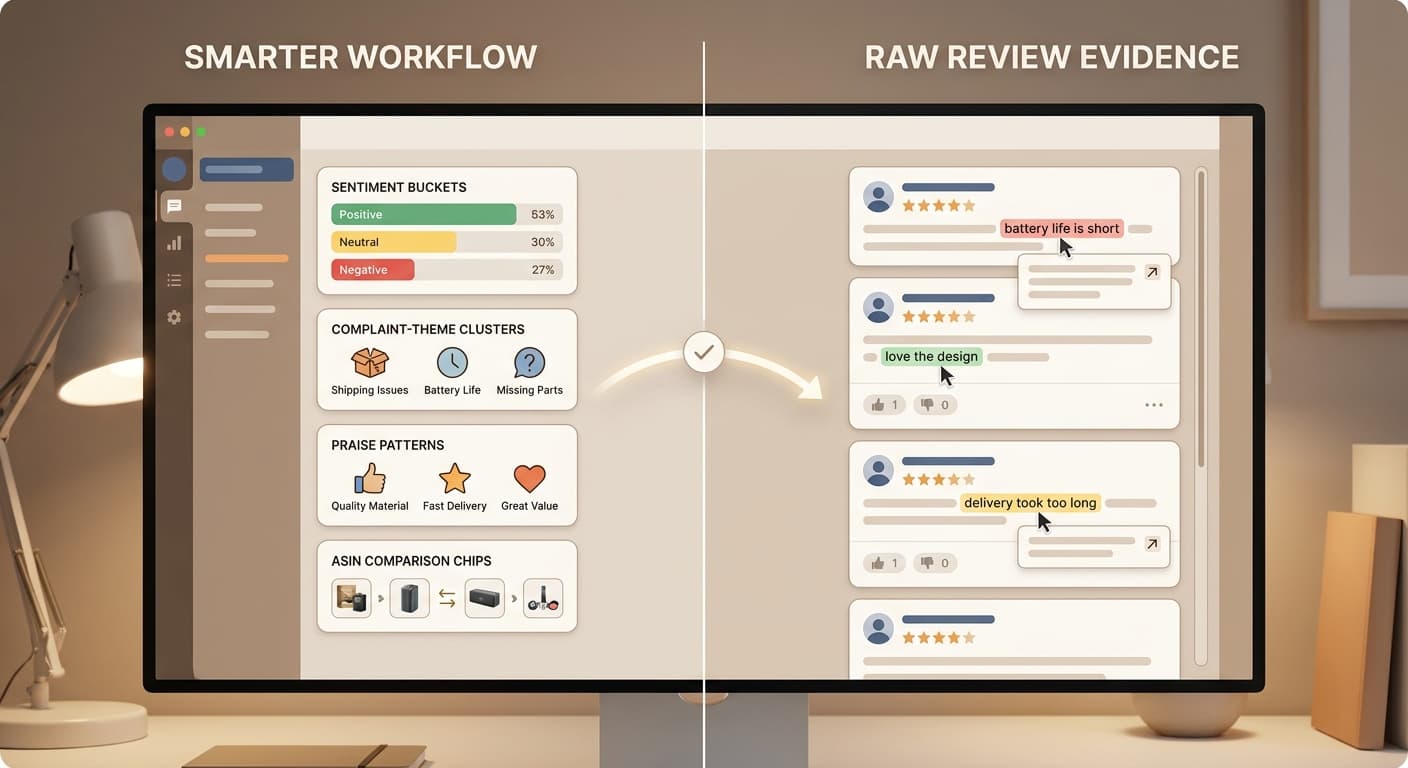
- Use sentiment buckets to surface repeated patterns quickly.
- Open the raw reviews inside the priority buckets.
- Validate the wording, context, and exceptions before acting.
That approach keeps the speed benefits of AI while preserving the evidence a human still needs.
Why operators still read reviews manually
Reading reviews one by one still solves a real problem: nuance.
A single review can reveal context that a label or summary compresses away. One buyer might complain about durability because the item broke in normal use. Another might use the same negative tone because they ordered the wrong size or misunderstood the listing. Those should not trigger the same action.
Manual reading is still useful when a team needs to:
- inspect edge cases before a packaging or product escalation,
- confirm exact buyer wording for listing or support updates,
- check whether a complaint is really recurring or just memorable,
- or review a small batch of recent feedback without building a larger workflow.
This is why operators who know the category well are often skeptical of one-click summarizers. They are not rejecting speed. They are rejecting false confidence.
What sentiment buckets do better than manual reading
The problem with reading reviews one by one is not that it is wrong. It is that it stops scaling early.
Once review volume rises, a manual workflow usually breaks in predictable ways:
- repeated complaint themes are easy to miss,
- one loud review can outweigh a quieter pattern,
- notes become inconsistent from one reader to another,
- and cross-team handoff gets trapped in screenshots or loose comments.
This is where Amazon review sentiment analysis becomes useful. Sentiment buckets can reduce a large review set into a smaller set of signals worth checking first.
What buckets do well:
| Workflow need | Sentiment buckets help because |
|---|---|
| Speed to first pattern | They group large review sets faster than line-by-line reading |
| Repeat-theme detection | They make recurring complaint or praise clusters easier to spot |
| Triage | They help teams decide what to inspect first |
| Shared visibility | They create a more consistent view for listing, product, ops, and support teams |
| Trend comparison | They make it easier to compare one period or ASIN against another |
Used correctly, buckets do not replace the raw review. They narrow the search space.
Where sentiment buckets break down on their own
Amazon review sentiment analysis becomes risky when a team treats the summary layer like the final truth.
A bucket can hide important distinctions such as:
- a packaging failure versus a product defect,
- a listing expectation mismatch versus a real quality problem,
- a one-off shipping incident versus a growing variation-level pattern,
- or a strongly worded exception versus a broad repeat theme.
This is the blind spot that frustrates experienced operators. They know that a "negative" label does not tell them what actually happened.
Here is the practical limitation:
| Bucket-only risk | Why it matters |
|---|---|
| Compressed wording | Exact buyer language can disappear |
| Lost exceptions | Edge cases can get blended into a broad theme |
| Weak owner routing | Teams still do not know whether listing, support, ops, or product should act |
| False urgency | A vivid anecdote can look like a trend if the evidence is not checked |
| Overgeneralization | One child ASIN or batch problem can be mistaken for a catalog-wide issue |
That is why bucket-only workflows are incomplete.
This is also where many teams get disappointed with an Amazon review summarizer. A summarizer can be useful for a first pass, but if it does not preserve review evidence and theme structure, it behaves more like compression than analysis.
Where reading reviews one by one breaks down on its own
Manual reading has a different failure mode: it preserves nuance but loses structure.
The more reviews a team reads without grouping, the easier it becomes to:
- miss the frequency of a recurring complaint,
- overreact to the most emotional review,
- forget which wording repeated across multiple ASINs,
- and spend too long proving something that a pattern layer could have surfaced in minutes.
Reading reviews one by one is strongest when the volume is small and the question is narrow. It becomes weak when a team needs pattern detection, comparison, or recurring analysis.
In practice, that is the difference between lightweight reading and a repeatable Amazon review analysis workflow. The second requires structure, not just attention.
Sentiment buckets vs. reading reviews one by one
The fairest comparison is not AI versus human judgment. It is pattern finding versus evidence validation.
| Decision area | Sentiment buckets | Reading reviews one by one | Best use |
|---|---|---|---|
| Speed | Faster on larger sets | Slower as review volume grows | Buckets first |
| Pattern detection | Better for repeated themes | Easy to miss without tallying | Buckets first |
| Nuance | Can flatten context | Better at preserving context | Raw reviews second |
| Edge-case review | Weak on exceptions alone | Stronger for exception handling | Raw reviews second |
| Team handoff | Easier to share and route | Often trapped in notes | Buckets first |
| Final decision confidence | Not enough by itself | Better for validating action | Hybrid workflow |
The strongest workflow is not choosing one side. It is using each for the job it actually does well.
A better Amazon review sentiment analysis workflow
For most seller teams, the practical workflow looks like this:
1. Start with sentiment buckets to find the repeated signals
Use Amazon review sentiment analysis to identify the top complaint and praise clusters in a defined time window. Keep the window specific. If the real question is whether something changed this week, do not mix in an entire quarter of reviews.
Good first-pass questions:
- Which complaint theme is repeating most often?
- Which praise pattern is stable enough to reuse in copy?
- Did the split change after a promotion, replenishment, or listing update?
- Is one variation driving the problem?
2. Sort the top buckets by business relevance
Not every bucket deserves the same attention. A theme that affects packaging damage, product breakage, missing parts, or misleading listing expectations usually matters more than a small wording preference.
This is where pattern finding becomes prioritization.
3. Open the raw reviews inside the priority buckets
This is the step skeptical operators should never skip.
Read the underlying reviews to confirm:
- the theme description is accurate,
- the problem is not being overstated,
- the same wording really repeats,
- and exceptions are not being buried inside a broad label.
If the bucket says "packaging damage," the team should still inspect the raw evidence. Are buyers talking about crushed boxes, broken seals, leaking product, or missing inserts? Those lead to different next actions.
4. Route the validated signal to the right owner
Once the reviews are checked, the theme becomes actionable.
| Validated theme | Likely first owner | Example next move |
|---|---|---|
| Packaging damage | Operations | Check prep, carton protection, and inbound handling |
| Missing part or defect | Product or QA | Investigate component, supplier, or batch pattern |
| Setup confusion | Support | Update help content or macros |
| Listing mismatch | Listing team | Rewrite bullets, images, or expectation-setting copy |
| Repeated praise wording | Marketing or listing | Reuse buyer language in ads and PDP copy |
5. Keep the evidence linked to the summary
The summary should point back to the raw reviews, not replace them. That makes the workflow more trustworthy and reduces summary drift over time.
When reading reviews one by one is still enough
Not every team needs a larger sentiment workflow on day one.
Reading reviews one by one can still be enough when:
- one ASIN has low recent review volume,
- the question is narrow and time-bound,
- the team only needs a quick sanity check,
- or the goal is to review a small sample before a specific update.
Manual reading is not outdated. It is just limited. Once the volume, frequency, or cross-team coordination requirement grows, Amazon review sentiment analysis becomes more useful as a first layer.
When an Amazon review sentiment analysis workflow becomes necessary
The hybrid workflow becomes necessary when:
- multiple ASINs need recurring review checks,
- teams need to compare one time window against another,
- complaint themes must be routed across functions,
- a seller wants to preserve exact buyer wording while still moving faster,
- or review evidence needs to support monitoring, dashboard, or reporting workflows.
That is where seller teams usually outgrow line-by-line reading alone.
It is also the point where a generic Amazon review analysis tool needs to prove it can do more than summarize. The stronger the workflow requirement, the more the tool must preserve review evidence, surface repeat themes, and support owner routing.
For a broader seller-first foundation, Amazon Review Sentiment Analysis for Sellers, Not Data Scientists explains how review language, complaint themes, and owner routing fit together.
If the next need is ongoing shared visibility rather than one-off review checks, Build a Seller Review Dashboard From Complaint Themes and Praise Patterns shows how to turn the same signals into a recurring team view.
For teams managing trend movement across time windows and ASINs, Amazon Review Monitoring for Rating Drops, Returns, and Complaint Trends covers the monitoring side of the workflow.
Where VOC AI fits
VOC AI is safest and most useful in this workflow when it is framed as a pattern-finding and evidence-organizing layer, not a replacement for judgment.
Its public product positioning already supports review analysis, repeated theme discovery, buyer-language capture, and routing review evidence into product, listing, and competitor workflows. That makes it a practical fit for teams that want to:
- surface repeated complaint themes faster,
- preserve representative buyer wording,
- compare review patterns by ASIN or variation,
- and connect review insights to listing, product, or monitoring decisions.
Relevant workflow surfaces include:
- Voice of Customer Analysis
- Sentiment Analysis
- Product Research
- Competitor Analysis
- How to Analyze Amazon Reviews Using AI
That is a more trustworthy promise than claiming AI can understand every review perfectly. The value is better triage, clearer structure, and faster movement from review evidence to action.
Conclusion
Sentiment buckets and raw-review reading solve different problems. Sentiment buckets help a team move faster across larger review sets. Reading reviews one by one preserves nuance, exceptions, and exact buyer wording.
The best Amazon review sentiment analysis workflow uses both in sequence: patterns first, validation second.
That is how seller teams keep the speed benefit without giving up the evidence quality that real decisions still require.