Customer reviews are usually sorted by star rating, sentiment, or topic. That is useful for monitoring, but it is not enough to improve the customer experience.
The better question is: where in the customer journey did the experience break, what consequence did that create, and which team can change it?
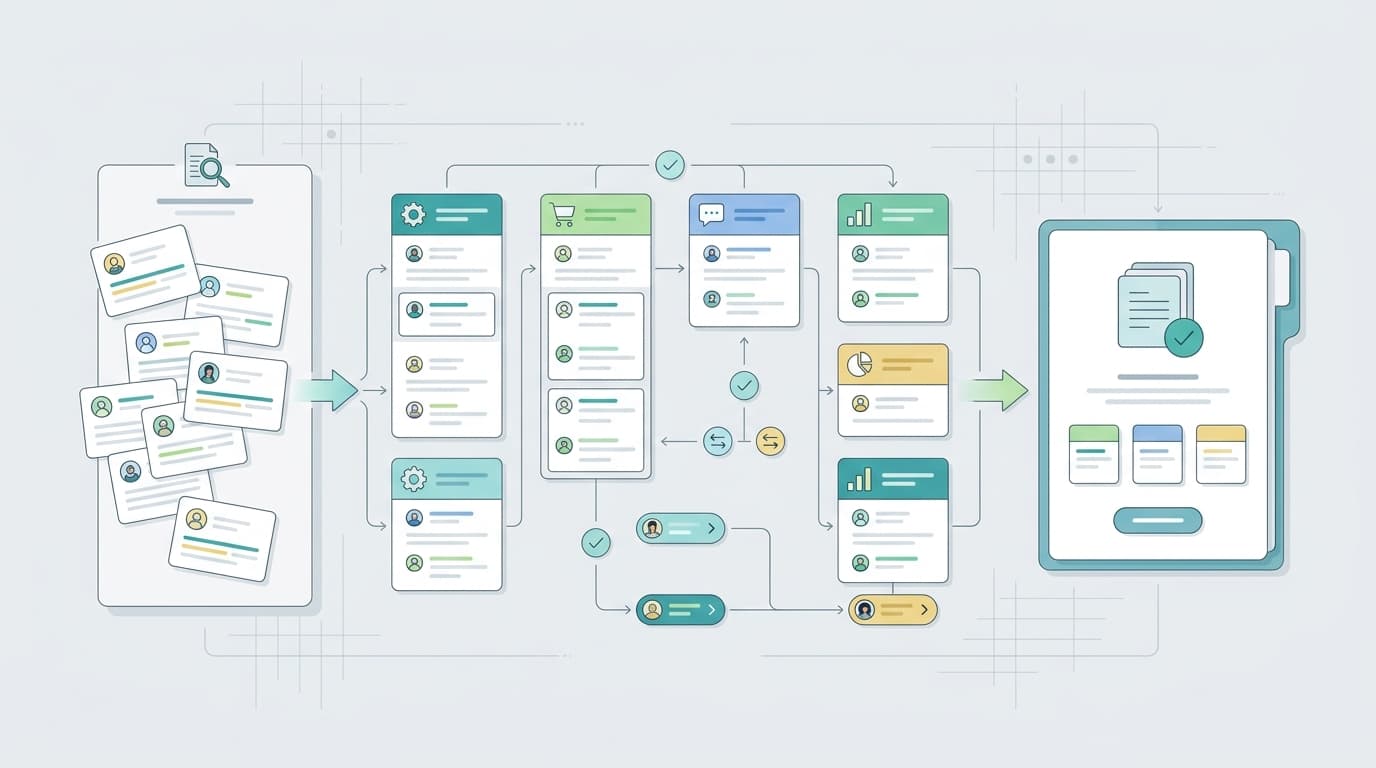
Customer review mining answers that question by turning unstructured review language into traceable experience events. Those events can be mapped to journey stages, compared across segments, and converted into a prioritized friction backlog.
This guide shows how to build that workflow without treating review counts as market prevalence or letting an AI-generated summary erase the evidence.
What is customer review mining?
Customer review mining is the process of extracting structured evidence from review text so a team can identify recurring needs, expectations, failure modes, and outcomes.
A useful review-mining record contains more than a topic and sentiment label. It preserves the full chain:
Customer and situation → journey stage → experience event → consequence → evidence → possible owner → validation needed
For example, “the instructions were confusing” is not yet an actionable insight. A stronger record might be:
- Customer and situation: first-time buyer assembling the product alone
- Journey stage: setup
- Experience event: the diagram did not distinguish two similar parts
- Consequence: incorrect assembly, rework, and a support contact
- Possible owner: documentation or product design
- Validation needed: support-ticket tags, return notes, and a first-use test
That structure keeps the original customer experience visible while making the evidence usable across product, operations, support, content, and quality teams.
Why journey mapping improves review analysis
Theme lists flatten the experience. “Packaging,” “quality,” “delivery,” and “support” may all appear as top themes, but they happen at different moments and create different interventions.
A journey-friction map keeps the sequence intact:
| Journey stage | Question to ask | Typical review evidence | Likely intervention layer |
|---|---|---|---|
| Discover | Did the customer understand who the product was for? | Confusion about use cases or fit | Positioning, navigation, education |
| Decide | Did the listing set the right expectation? | Size, compatibility, feature, or material mismatch | Listing content, comparison tools, product scope |
| Buy | Was the transaction clear and trustworthy? | Price, variant, stock, or checkout confusion | Merchandising, commerce operations |
| Receive | Did the product arrive as expected? | Damage, missing parts, late delivery, poor protection | Packaging, fulfillment, supplier quality |
| Set up | Could the customer reach first value? | Instructions, installation, onboarding, account setup | Documentation, UX, product design |
| Use | Did performance match the promised job? | Reliability, comfort, speed, durability, edge cases | Product, engineering, quality |
| Get help | Could the customer recover from a problem? | Slow response, repeated explanations, unclear policy | Support operations, tooling, policy |
| Repurchase | Did the value persist? | Replacement intent, subscription friction, declining quality | Retention, lifecycle, quality |
The map prevents a common mistake: routing every negative review to the product team. A complaint that sounds like a product defect may actually come from packaging damage, setup ambiguity, listing overclaim, fulfillment, or poor recovery after a support contact.
A seven-step customer review mining workflow
1. Start with a decision, not a dataset
Do not begin with “analyze all reviews.” Define the decision first.
Useful scopes include:
- Reduce avoidable returns for one product family
- Improve first-use success for new customers
- Find the causes behind a rating decline
- Separate product defects from expectation mismatch
- Identify journey friction that creates repeat support contacts
- Compare the recovery experience across products or regions
Write the decision, time window, products, markets, channels, and exclusions before collecting data. This reduces the temptation to turn the most memorable complaint into a universal conclusion.
2. Build an evidence frame
Collect reviews with the context needed to interpret them. Depending on the source, useful fields may include:
- Product, model, or variant
- Review date
- Rating
- Verified-purchase indicator, when available
- Geography and language
- Seller or fulfillment context
- Review title and full text
- Helpful-vote count
- Media attachments
- Response or resolution evidence
Keep source links or stable identifiers so an analyst can trace every coded event back to the original review.
Reviews are a self-selected evidence stream, not a representative survey. Research on online reviews has documented selection and social-influence biases, so review frequency should be reported as frequency within the analyzed corpus, not as the percentage of all customers who experience a problem.
3. Split reviews into experience events
One review can contain several events:
“The delivery was fast, but the box was crushed. Setup took an hour because the diagram was tiny. Support sent the right instructions the next day.”
This should become at least four records:
- Fast delivery
- Packaging damage
- Setup friction caused by unreadable instructions
- Successful but delayed support recovery
Event-level coding prevents mixed reviews from being forced into a single positive, neutral, or negative bucket. It also reveals recovery: the original experience failed, but another touchpoint may have restored trust.
4. Apply a controlled coding system
Use a small, documented taxonomy rather than generating new themes for every batch.
At minimum, code each event for:
| Field | Purpose |
|---|---|
| Journey stage | Locates the friction in sequence |
| Experience theme | Groups comparable events |
| Attribute | Names the specific product or service dimension |
| Sentiment direction | Records praise, friction, or mixed evidence |
| Severity | Estimates the customer consequence |
| Evidence confidence | Shows how directly the review supports the code |
| Segment or situation | Preserves the conditions in which the event occurred |
| Recovery status | Shows whether the issue was resolved |
| Possible owner | Routes investigation without declaring root cause |
Keep an “other” or “needs review” path. A taxonomy that forces every event into an existing category will hide emerging problems.
If AI performs the first pass, review a sample manually, compare disagreements, and retain links to the underlying text. The goal is not perfect automated labeling. The goal is a repeatable evidence system that a human can audit.
5. Build the journey-friction map
Aggregate coded events by journey stage and segment. For each cluster, show:
- Number of supporting events in the corpus
- Number of products, variants, or regions represented
- Severity distribution
- Recency
- Example evidence
- Contradictory or positive evidence
- Recovery rate when the review describes an outcome
- Data gaps
Avoid ranking themes on frequency alone. A less common safety, accessibility, data-loss, or total-failure event can deserve investigation before a frequent minor annoyance.
A transparent investigation score can help teams sort the backlog:
Investigation priority = consequence × recurrence × confidence × strategic relevance
Define each factor on a short scale and show the inputs. The score is a triage device, not a claim that the root cause has been proven.
6. Validate beyond reviews
Reviews are strongest as a hypothesis source. Before making a costly decision, compare the pattern with other evidence:
- Returns and refund reasons
- Support tickets and contact drivers
- Warranty or defect records
- Product analytics and funnel events
- Search queries and help-center behavior
- Interviews or usability tests
- Survey responses
- Logistics and fulfillment data
Look for convergence. If reviews, return notes, and support contacts all describe the same setup failure for the same variant, the hypothesis becomes stronger. If review complaints rise but operational data does not, investigate source mix, seller changes, review manipulation, or a segment-specific issue before acting.
7. Route the intervention and monitor the result
Turn each validated cluster into an action card:
| Field | Example |
|---|---|
| Friction | First-time buyers cannot distinguish two setup parts |
| Journey stage | Set up |
| Affected situation | Solo assembly, first use |
| Evidence | Review events, support contacts, usability observation |
| Proposed intervention | Redesign diagram and add part labels |
| Owner | Documentation with product design |
| Success signal | Fewer setup contacts and fewer instruction-related reviews |
| Review date | Four weeks after release |
Monitor the same evidence frame after the change. Do not expect review text to shift immediately; review lag, product inventory, region, and seller context can delay the signal.
What customer review mining should not do
It should not treat stars as a diagnosis
A one-star review describes dissatisfaction, not necessarily the cause. The failure may sit in product quality, expectation setting, delivery, setup, support, or customer fit.
It should not erase contradictory evidence
If some customers praise the same attribute that others criticize, preserve the conditions around both groups. The useful insight may be segmentation, not consensus.
It should not copy customer language into advertising without governance
Review analysis and testimonial use are different activities. The US Federal Trade Commission's Consumer Reviews and Testimonials Rule addresses fake or false reviews, sentiment-conditioned incentives, undisclosed insider reviews, review suppression, and other deceptive practices. If review language will appear in marketing, route it through the appropriate legal and brand process.
It should not claim market prevalence
“Thirty-two percent of coded review events mentioned setup” is bounded to the analyzed corpus. It is not the same as “32% of customers had setup problems.” Use a representative study when population prevalence matters.
It should not publish an AI summary without evidence
Every important claim should link back to review events, source context, coding definitions, and validation status. A confident paragraph without traceable evidence is not an insight repository; it is an opinion generator.
How VOC AI fits the workflow
VOC AI helps ecommerce teams analyze customer and competitor review data, surface recurring complaint themes, compare products, and move from a large review corpus toward prioritized questions. Teams can use the analysis as the first layer of a broader Voice of Customer workflow, then validate the strongest patterns with support, returns, product, and research data.
For adjacent methods, see:
- Review mining for product development for converting evidence into product opportunities
- Review mining for market research for market tensions and hypothesis formation
- Review mining for competitive analysis for product-gap comparisons
- How to prioritize customer feedback for backlog governance
If you want to test the workflow on a focused product set, talk with VOC AI about a review-intelligence pilot.
Frequently asked questions
What is the difference between review mining and sentiment analysis?
Sentiment analysis labels emotional direction. Review mining extracts the specific customer, situation, attribute, event, consequence, journey stage, and supporting evidence needed to investigate or act.
How many reviews do you need for customer review mining?
There is no universal threshold. Use enough relevant evidence to cover the decision scope, key products or segments, and contradictory cases. Report the corpus size and limits rather than presenting a small sample as representative.
Can AI automate customer review mining?
AI can accelerate event extraction, tagging, clustering, translation, and summarization. Humans should still define the decision, maintain the taxonomy, inspect disagreements, review high-severity cases, and validate important patterns with other evidence.
Should review themes map directly to teams?
No. A theme suggests an investigation path, not a proven owner. “Damaged on arrival” may involve packaging design, supplier quality, warehouse handling, or delivery. Assign an investigation owner while keeping the cause open.
Are online reviews representative of all customers?
Usually not. Reviews are self-selected and can be shaped by platform, solicitation, moderation, timing, and social influence. Treat them as rich qualitative evidence and validate prevalence with more representative data.