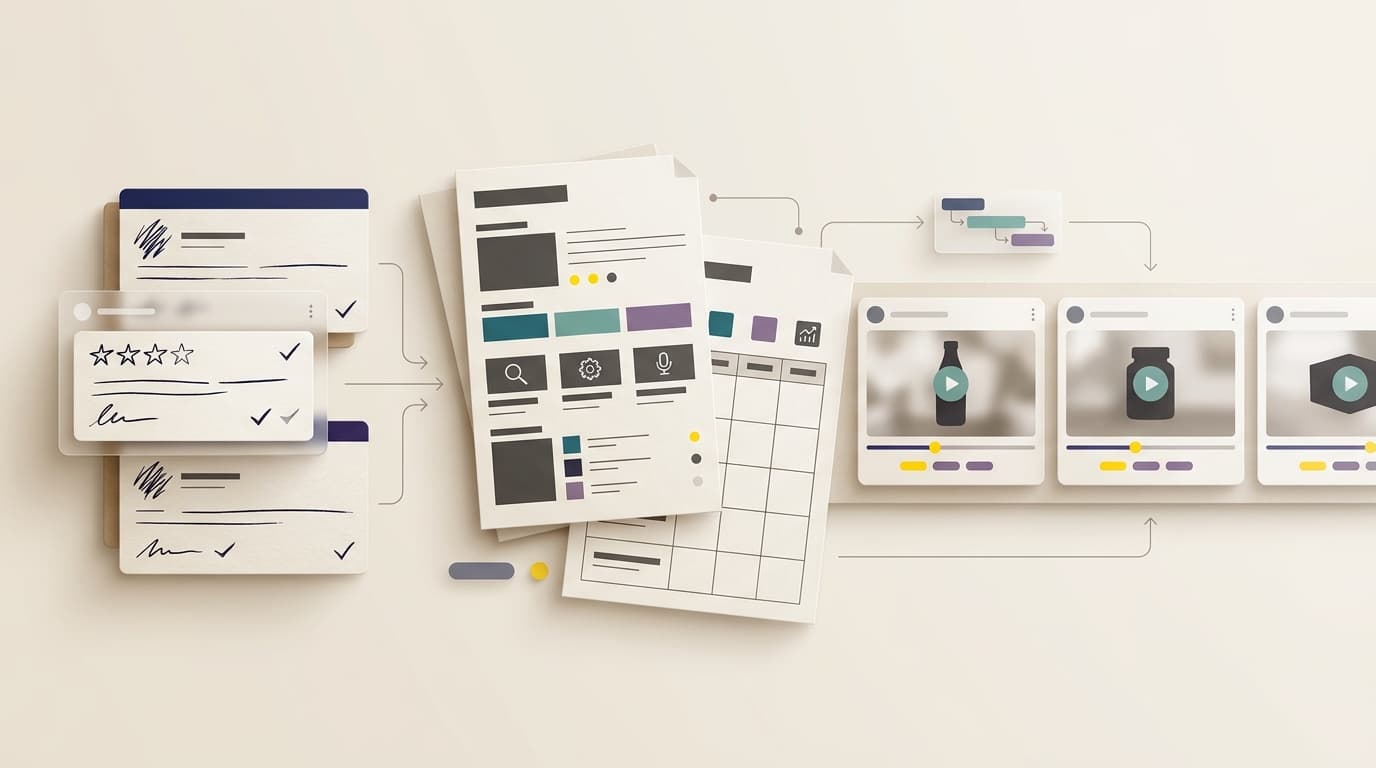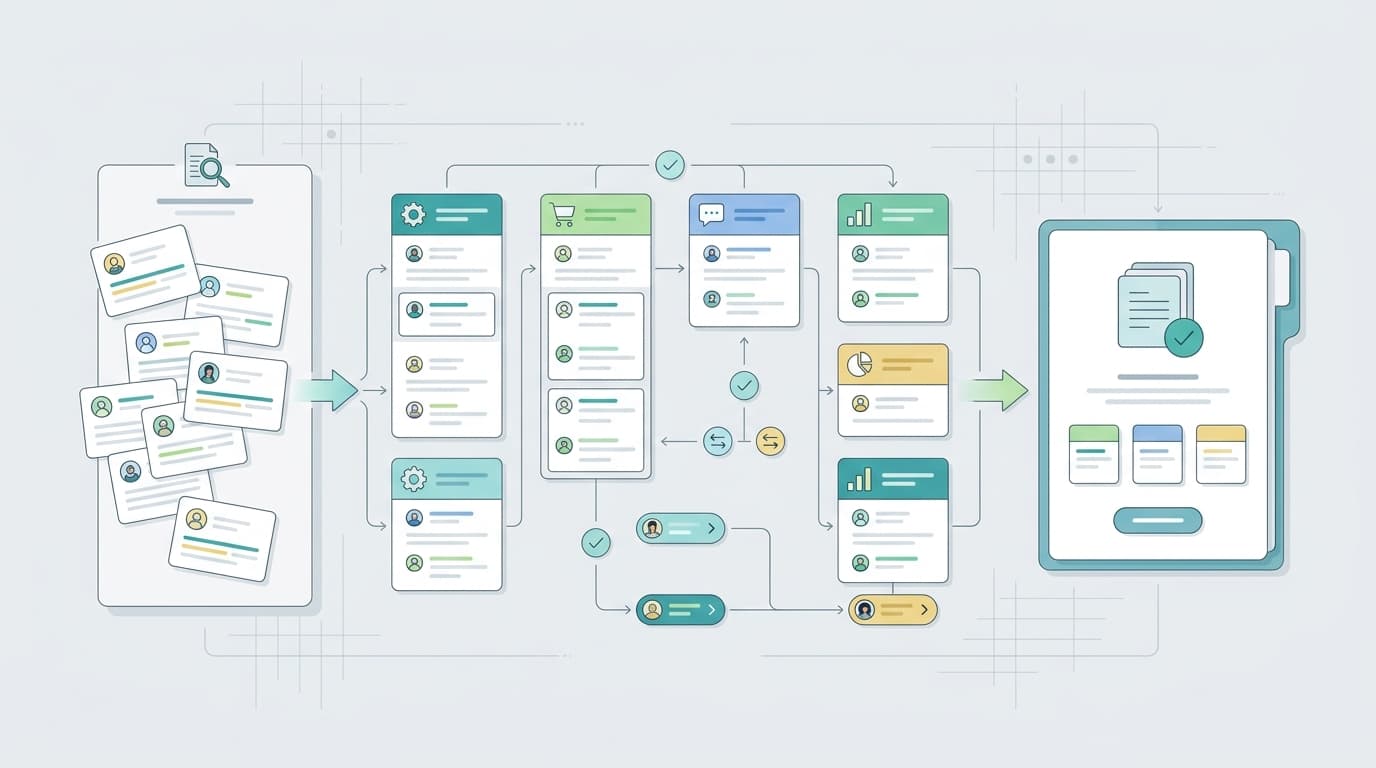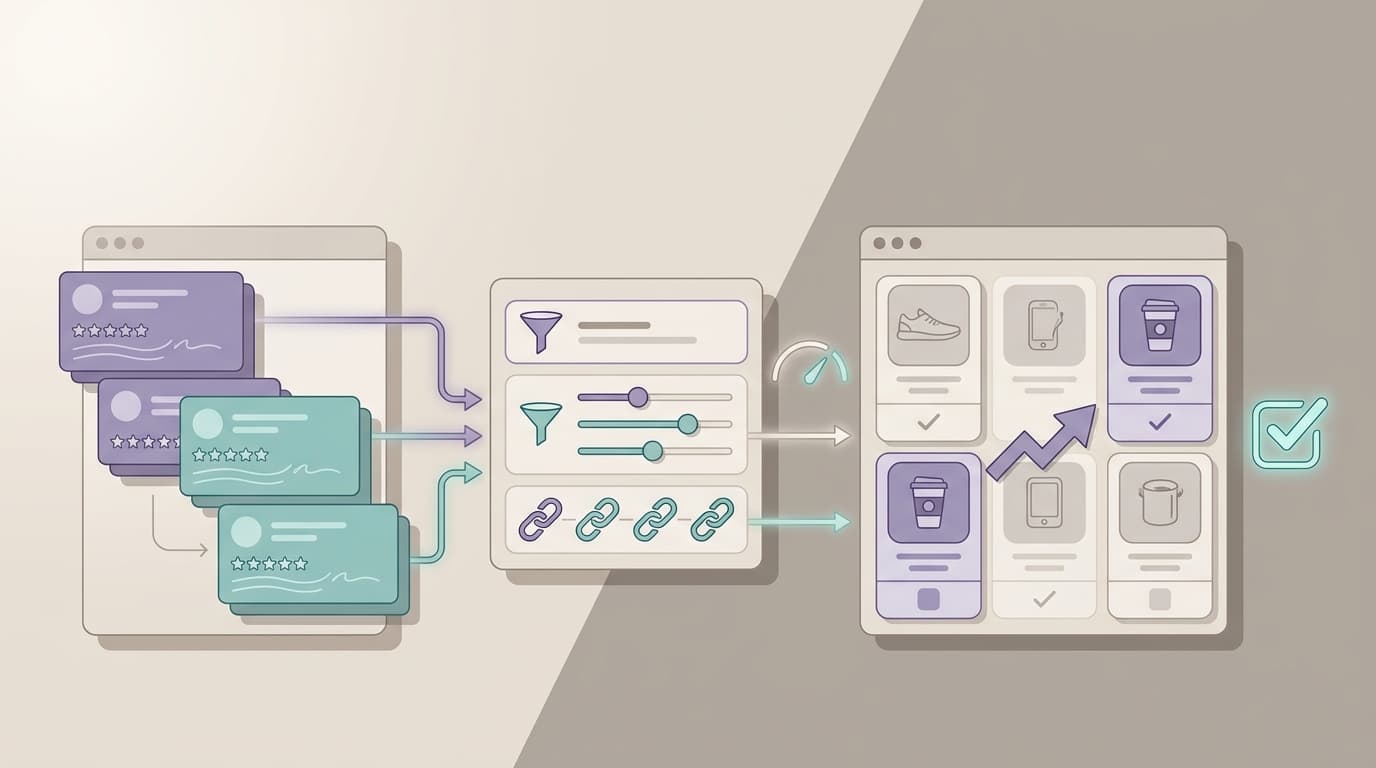
Customer stories are often treated as standalone sales assets: publish one case study, add a logo to the homepage, and wait for trust to improve.
That wastes most of their value.
A strong customer story should also help buyers answer specific questions across your review-analysis, voice-of-customer, customer-service, pricing, and contact pages. The key is not to copy the same testimonial everywhere. It is to distribute the right piece of evidence to the page where that evidence resolves a real buying concern.
This guide shows how to build that proof system without turning one customer result into a universal promise.
The two jobs of customer proof
Customer proof has two different jobs, and they should not be mixed.
The source story owns the exact account of what happened: the customer, context, workflow, reported results, and attribution. The interpretation layer explains what another team can learn from that story: which operating habits mattered, what questions to ask, and what should be tested in a pilot.
VOC.AI’s detailed Anker customer story is the source for Anker-specific facts. The Anker voice of customer case study is the better destination for the transferable feedback-to-action model.
Keeping those roles separate protects credibility. A buyer can inspect the source, while adjacent pages can use the lesson that fits their intent without repeating a dense block of metrics.
Map proof to the question each page must answer
The same customer story can support several pages, but each page needs a different proof unit.
| Page type | Buyer question | Proof that belongs there | Best next step |
|---|---|---|---|
| Review-analysis guide | Can this workflow turn reviews into decisions? | A short example of traceable evidence moving into prioritization | Read the full proof framework |
| Voice of Customer product page | Can teams use one evidence base across functions? | A cross-functional workflow example with clear limits | Explore Voice of Customer Analysis |
| AI customer-service page | Does this help service operations specifically? | Service-specific workflow or outcome, not a generic VOC claim | Review the service workflow |
| Buyer scorecard | How should I compare vendors? | A proof-quality criterion: named source, context, traceability, and repeatability | Apply the scorecard |
| Pricing page | Is the implementation risk acceptable? | A restrained trust link near the plan decision | Review plans or contact sales |
| Contact page | What should I bring to a proof-of-value discussion? | A prompt to define sources, product scope, volume, and decision goal | Discuss a bounded pilot |
This structure makes proof useful without allowing it to overwhelm the page’s primary purpose.
1. Use customer stories on review-analysis pages to prove traceability
Someone reading a review-analysis page is not only asking whether software can summarize comments. They are asking whether a theme can be traced back to evidence and then used in a decision.
The best proof block is therefore a compact workflow:
- Collect a defined review set.
- Group repeated praise, complaints, objections, and use cases.
- Keep the underlying comments available for verification.
- Compare the pattern across products, markets, or time periods.
- Route the finding to a listing, product, support, or monitoring decision.
Link that block to the source story or interpretation article. Do not drop a customer metric into the page without explaining what process produced it.
For commercial evaluation, add a proof criterion to an Amazon review analysis tool buyer scorecard: Can the vendor show how evidence moves from raw reviews to a repeatable decision?
2. Use customer stories on Voice of Customer pages to show cross-functional handoffs
A Voice of Customer page should show more than analysis. It should show how one evidence base can support several teams without losing the original customer language.
A useful proof unit might describe the handoff from review themes to:
- Product teams defining a requirement.
- Marketing teams refining buyer language.
- CX teams identifying recurring friction.
- Support teams preparing responses or escalation rules.
- Leadership teams reviewing the evidence behind a priority.
The proof should remain specific about which parts are documented and which are proposed applications. It should never imply that every function automatically receives the same result.
Readers who need the product workflow can then continue to Voice of Customer Analysis. Readers who need category-selection guidance can use the customer feedback analysis software guide for ecommerce teams.
3. Keep AI customer-service proof service-specific
One of the easiest credibility mistakes is moving an outcome from a broad VOC story onto an AI customer-service page and presenting it as service evidence.
Avoid that shortcut.
Customer-service proof should be tied to service operations, such as:
- The channel and type of customer conversations involved.
- How answers were prepared, reviewed, or escalated.
- What workload or response problem the workflow addressed.
- Which outcome the customer reported.
- Which constraints, markets, products, or time period applied.
If the source story does not document a service-specific result, use it only as contextual trust. Then explain the current AI customer service for ecommerce workflow on its own terms.
This distinction matters because “used customer evidence across CX” and “improved a customer-service metric” are not interchangeable claims.
4. Add proof quality to software comparison pages
Feature checklists are easy to imitate. Proof quality is harder.
When comparing review-analysis or customer-feedback software, score the evidence behind the product—not only the product claims. A useful customer-proof scorecard includes six questions:
| Criterion | What good proof shows |
|---|---|
| Named source | A customer or clearly defined use case you can inspect |
| Context | Product set, market, data source, team, or operating constraint |
| Traceability | A visible link between the claim and the underlying story |
| Workflow | What people and systems actually did |
| Attribution limit | Language such as “reported,” “helped,” or “supported” when causality is not independently established |
| Repeatability | A bounded way for another team to test the workflow |
This scorecard helps buyers distinguish an impressive number from evidence they can actually use in a decision.
5. Keep pricing proof restrained
Pricing pages are decision pages, not case-study archives.
Use customer proof to reduce uncertainty, not to interrupt plan comparison. A short trust link is usually enough:
See how an ecommerce team connected customer evidence to product, marketing, and CX decisions.
That link can point to the relevant story or proof framework. The pricing page should continue to source every plan, credit, and availability statement from the live VOC.AI pricing page.
Avoid placing a large metric block beside a price. It can imply that purchasing a particular plan guarantees the customer’s outcome.
6. Turn the contact page into a proof-of-value handoff
Customer proof is most persuasive when it leads to a concrete evaluation plan.
Instead of a generic “book a demo” transition, invite the buyer to define a small proof of value. Ask them to bring:
- One product line or category.
- The feedback sources they already have.
- The approximate review or conversation volume.
- The decision they need to make.
- The team that will validate the result.
- A success criterion and review date.
This converts inspiration into due diligence. Buyers can discuss a proof-of-value workflow with VOC.AI without assuming their results will match another customer’s.
A citation rule that prevents metric drift
Every numeric customer claim should pass a four-part test before publication:
- Name the customer. Do not present a customer-reported result as a platform-wide benchmark.
- Link the direct source. Send readers to the page that owns the exact claim.
- Preserve the qualifier. Keep “reported,” “more than,” “approximately,” and time-period language intact.
- Keep the context. Include the relevant workflow, market, product, channel, or operating condition.
If any one of these is missing, use a non-numeric workflow example instead.
Also avoid silently “improving” a number. If the canonical customer story changes, update every reused proof unit or remove the metric until it can be verified again.
A practical proof-distribution workflow
Use this sequence when a new customer story goes live:
- Choose the canonical source. Decide which page owns exact facts and reported metrics.
- Create an interpretation page when needed. Explain the operating model, evaluation questions, and limits without competing with the source story.
- List buyer questions by route. Review-analysis, VOC, service, pricing, and contact pages each have a different job.
- Extract the smallest useful proof unit. Reuse only the evidence needed to answer that page’s question.
- Add a direct internal link. Let readers inspect the source or deeper framework.
- Match the CTA to intent. Educational pages should lead to evaluation; product pages can lead to a proof-of-value conversation.
- Run a claim audit. Recheck customer names, numbers, qualifiers, routes, and product claims.
- Measure assisted movement. Track clicks from proof units to product, pricing, and contact routes before claiming conversion impact.
What not to do
Avoid these common proof-distribution failures:
- Copying the same testimonial block across every page.
- Using an exact metric without linking its source.
- Turning a customer-reported result into a guaranteed outcome.
- Moving a VOC result onto an AI service page without service-specific evidence.
- Letting customer proof replace the page’s primary explanation or CTA.
- Publishing stale pricing or product claims inside a case-study block.
- Sending every reader directly to sales before they can inspect the evidence.
Build a proof system, not a proof pile
The goal is not to make one customer story appear everywhere. The goal is to make the right evidence available at the moment a buyer needs it.
Keep exact claims in their canonical source. Use interpretation content for transferable lessons. Give each commercial page a small, relevant proof unit and a clear route to deeper evidence. Then convert interest into a bounded proof-of-value plan rather than an implied promise.
Start with the Anker voice of customer case study, explore VOC.AI Customer Stories, and map one approved proof unit to each high-intent page in your buying journey.