An ecommerce competitor analysis often starts with the obvious facts: price, assortment, promotions, product claims, marketplace ratings, traffic, and ad visibility. Those facts are useful, but they do not explain why buyers choose one product, regret another, or keep asking for a feature nobody delivers well.
That missing layer is customer evidence.
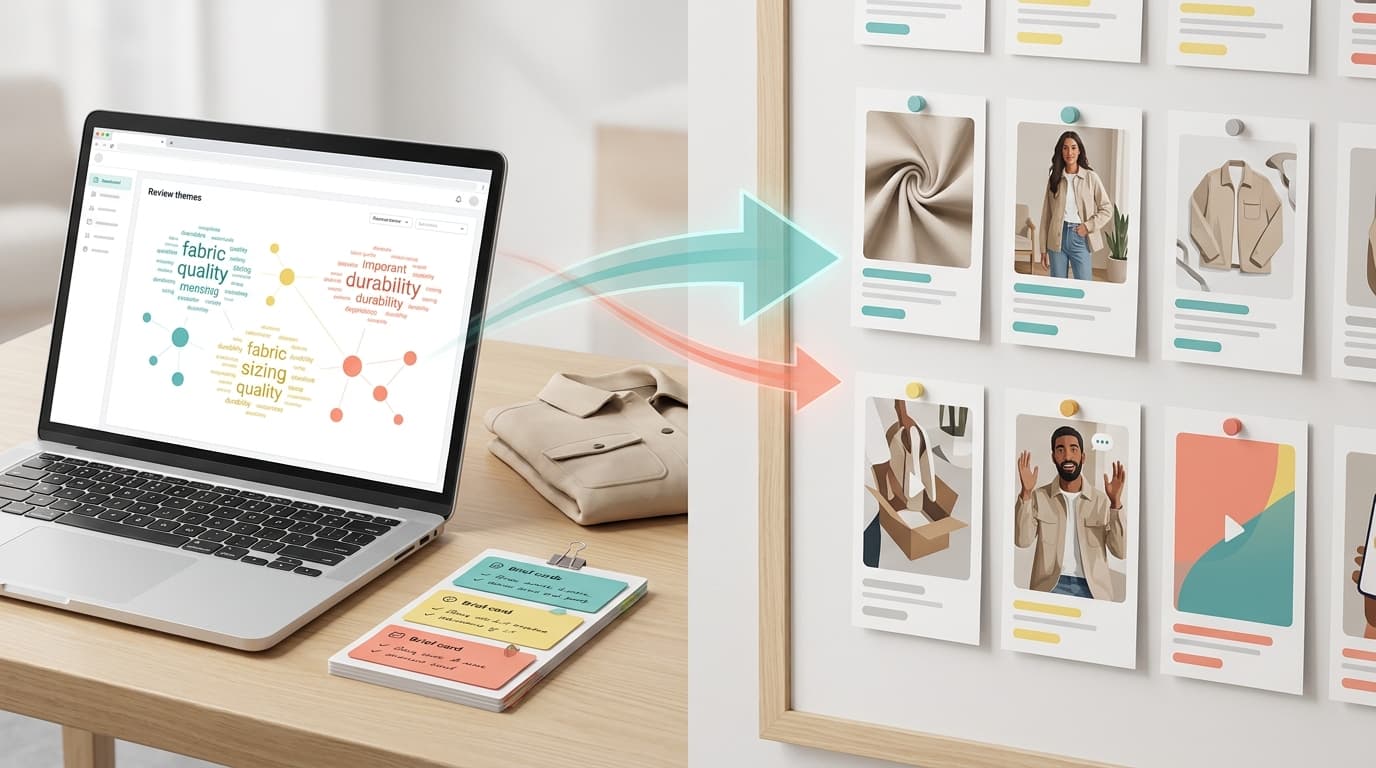
A stronger ecommerce competitor analysis connects what competitors sell with what customers experience. It combines visible market signals with recurring review themes, sentiment, usage context, and unmet expectations. The output is not another oversized spreadsheet. It is a short list of customer-backed moves for product, positioning, content, support, or merchandising.
This guide provides a practical workflow and a reusable scorecard for doing that work.
What is ecommerce competitor analysis?
Ecommerce competitor analysis is the structured comparison of rival brands, products, offers, and customer experiences to identify threats, gaps, and opportunities. It can cover direct competitors that sell a similar product, indirect competitors that solve the same problem differently, and marketplace alternatives competing for the same search or category demand.
Standard competitive analysis usually examines factors such as:
- Product range and feature claims
- Price, discounting, bundles, and shipping terms
- Marketplace and direct-to-consumer presence
- Positioning, creative, and merchandising
- Ratings, review volume, and recent review velocity
- Customer praise, complaints, and unmet expectations
- Retention signals such as repeat-use language or durability concerns
The U.S. Small Business Administration frames competitive analysis as a way to find a market advantage, while Shopify's competitive-analysis guidance emphasizes comparing competitors across products, pricing, positioning, marketing, and customer experience. For ecommerce teams, customer reviews make those comparisons more actionable because they show how the promise performs after purchase.
Why conventional competitor spreadsheets fall short
A competitor spreadsheet is good at storing observable facts. It can show that Brand A is cheaper, Brand B has more variants, and Brand C leads on review count. It becomes less reliable when analysts try to summarize thousands of unstructured customer comments in a few cells.
Three problems appear quickly.
Ratings hide the reason behind the score
Two products can share the same average rating while failing customers in completely different ways. One may have a durability problem. Another may be difficult to assemble. A third may work well but create frustration through confusing sizing or packaging.
The rating is a signal. The review language explains the decision.
Review samples can overrepresent dramatic complaints
Teams often read the newest reviews, the most helpful reviews, or a page of one-star comments. That is efficient, but it may turn an emotional outlier into a strategic priority. Repeated three-star friction can be more commercially useful than a rare one-star failure.
Copying comments does not create a conclusion
Saving review excerpts is not the same as analyzing them. A useful competitor analysis needs consistent themes, affected use cases, frequency, severity, differentiation potential, and a recommended action. Without that structure, the spreadsheet becomes a collection of anecdotes.
The six-layer ecommerce competitor analysis framework
Use six layers to keep market facts and customer evidence connected without mixing them prematurely.
1. Define the decision
Start with one decision, not a general request to “research competitors.” Examples include:
- Which product weakness should our next version solve?
- Which benefit deserves the lead position on a product page?
- Which competitor should we challenge in a comparison campaign?
- Which complaint should support address before it becomes a return?
- Which underserved use case could support a new bundle or variation?
A specific decision determines which competitors, data points, and review themes matter.
2. Build a deliberate competitor set
Choose competitors that represent different strategic positions. A useful five-product set might include:
- The category leader
- A fast-growing challenger
- A premium option
- A value option
- A product with a distinctive feature or audience
This is more informative than selecting the first five results or only the brands your team already knows. It exposes tradeoffs across price, experience, and positioning.
3. Record observable market facts
Capture the facts a shopper can verify before purchase:
- Price and discount pattern
- Pack size, variations, and bundles
- Core feature claims
- Shipping and return promise
- Rating and review count
- Product-page structure and proof
- Marketplace rank or visibility when available
- Promotion, creator, and social presence
Keep this layer factual. Do not infer product quality from copy or assume a large review count means the experience is superior.
4. Analyze customer-review evidence
Organize reviews into themes that answer the decision. Useful theme families include:
- Product quality and durability
- Ease of setup or use
- Fit, sizing, compatibility, or installation
- Performance in specific scenarios
- Packaging and delivery condition
- Value for money
- Missing features and requested improvements
- Support, instructions, and post-purchase friction
Then add context. Note which product or variation the theme affects, the customer scenario, the sentiment, and whether the evidence is recurring or isolated.
VOC AI's competitor analysis, sentiment analysis, and customer analytics capabilities are designed to help teams structure review language into comparable patterns. Teams that need review data in an internal workflow can also evaluate the Review Analysis API.
5. Separate parity from opportunity
Not every popular feature is a differentiator. Divide findings into three groups:
- Table stakes: Buyers expect this, and weak execution creates immediate friction.
- Parity claims: Most competitors make the same promise, so the claim alone will not distinguish the product.
- Open opportunities: Customers repeatedly describe a problem, desired outcome, or use case that competitors do not handle well.
This step prevents teams from prioritizing a feature merely because competitors mention it frequently.
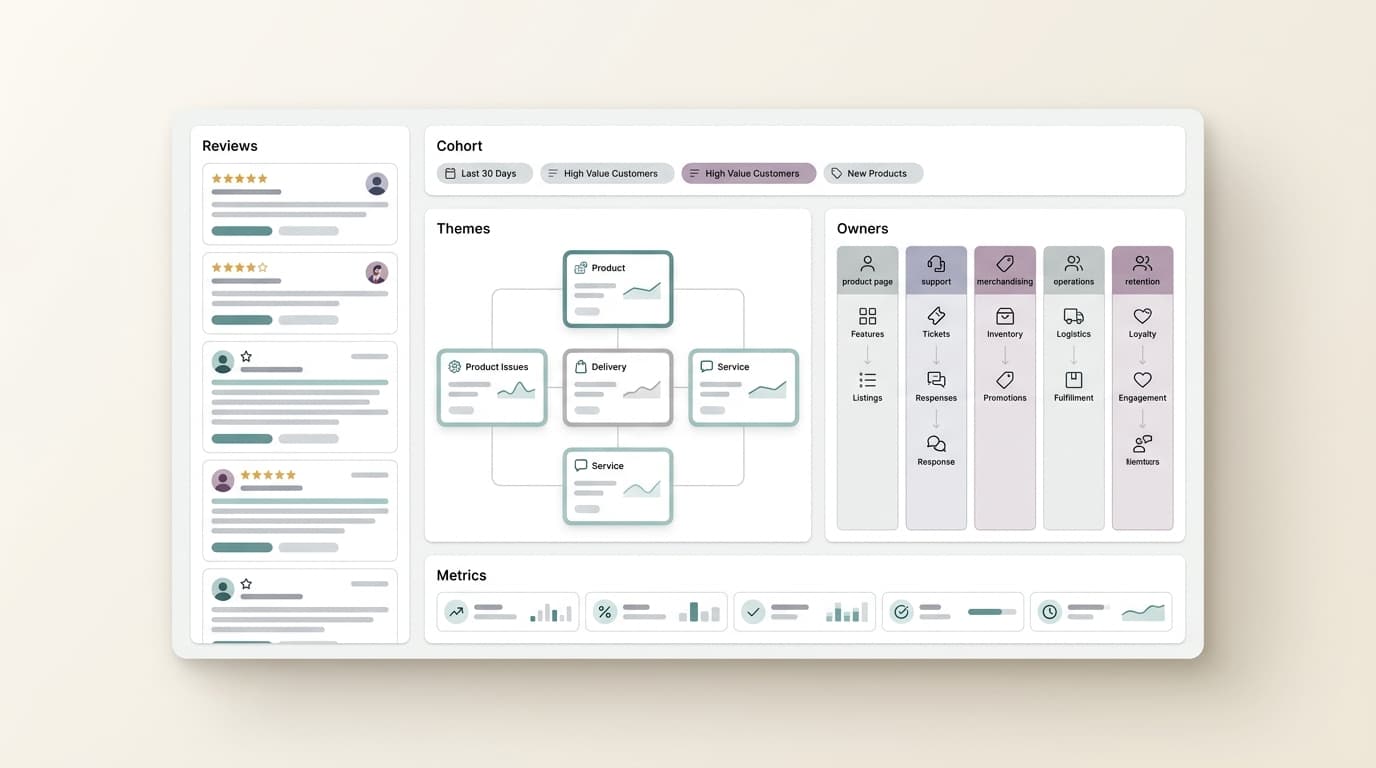
6. Convert evidence into an owned action
Every priority should end with an owner and a next step. Examples include:
- Product: validate a material or design change
- Merchandising: clarify compatibility above the fold
- Marketing: lead with a customer phrase competitors overlook
- Support: create a setup guide for a recurring confusion point
- Operations: investigate packaging damage by variation
- Research: monitor whether a competitor update changes complaint patterns
If a finding cannot produce a plausible action, it may be interesting but not yet useful.
Ecommerce competitor analysis scorecard
Use a 1-to-5 score for each factor, where 5 represents the strongest opportunity for your team. Multiply each score by its weight.
| Factor | Weight | What a high score means |
|---|---|---|
| Complaint recurrence | 20% | The same problem appears repeatedly across relevant reviews |
| Customer impact | 20% | The problem affects product use, trust, retention, or return risk |
| Competitor coverage | 15% | Multiple competitors share the weakness |
| Strategic fit | 15% | Your team can credibly solve or communicate the difference |
| Differentiation value | 15% | Solving it would create a meaningful reason to choose your offer |
| Evidence confidence | 10% | The conclusion is supported by consistent, traceable examples |
| Speed to action | 5% | The team can test or implement the response quickly |
The formula is:
Opportunity score = sum of (factor score × factor weight)
For example, a recurring assembly complaint might score highly on recurrence, impact, competitor coverage, and speed to action if clearer instructions or a product-page video could reduce confusion. A rare request for an expensive new feature might score high on differentiation but low on recurrence, strategic fit, and speed.
The weighted total keeps the loudest comment from automatically becoming the top priority.
A 90-minute competitor analysis workflow
Use this sprint when a team needs direction quickly.
Minutes 0-15: frame the decision
Write the decision, customer segment, market, competitor set, and time period. Agree on what the analysis will not cover.
Minutes 15-35: capture market facts
Record each competitor's offer, price, variations, main claims, visible proof, rating context, and channel presence. Flag information that needs verification rather than filling gaps with assumptions.
Minutes 35-60: compare review themes
Review recurring praise, complaints, use cases, and requests. Group similar language into consistent themes. Preserve representative examples so every conclusion remains traceable.
Minutes 60-75: score opportunities
Score the strongest themes with the weighted framework. Discuss disagreements in the evidence rather than averaging them away.
Minutes 75-90: assign actions
Select the top one to three opportunities. Give each an owner, a test, a success signal, and a refresh date.
The final document should fit on one page. Supporting evidence can remain in VOC AI or an analysis workspace, while the decision sheet contains only the prioritized conclusions.
Common ecommerce competitor analysis mistakes
Comparing too many competitors
A large list creates shallow coverage. Start with a strategically varied set and expand only when a new competitor could change the decision.
Treating every review as equally relevant
Segment by product variation, customer scenario, review date, and decision relevance. A complaint about delivery should not automatically become a product-design conclusion.
Confusing frequency with importance
A frequent cosmetic complaint may matter less than a lower-volume safety, reliability, or compatibility issue. Use both recurrence and customer impact.
Ignoring positive reviews
Praise reveals the experience customers want to preserve. It can also expose why a competitor wins despite visible weaknesses.
Stopping at insight
“Customers dislike the lid” is an observation. “Test a leak-proof lid design and lead with commute use cases” is an action. The analysis is complete only when the evidence changes a decision.
When to refresh the analysis
Refresh your ecommerce competitor analysis when:
- A competitor launches a new product or major variation
- Pricing or promotional behavior changes materially
- Ratings or recent review patterns shift
- Your own product receives a new recurring complaint
- A seasonal buying window approaches
- Your team starts a redesign, listing rewrite, or positioning change
For ongoing categories, maintain the same theme taxonomy and scorecard. Consistency makes changes easier to detect and prevents each refresh from becoming a brand-new research project.
Turn competitive data into a customer-backed decision
The best ecommerce competitor analysis does not produce the most rows. It produces the clearest customer-backed priority.
Start with a specific decision. Compare a deliberately varied competitor set. Keep observable facts separate from review interpretation. Then use a weighted scorecard to choose an action your team can own.
Explore VOC AI's Voice of Customer analysis to compare review themes, sentiment, customer language, and competitor gaps at a scale that manual review audits struggle to maintain.
Frequently asked questions
What should be included in an ecommerce competitor analysis?
Include competitor selection, product and pricing facts, positioning, channel presence, rating context, recurring review themes, customer use cases, unmet expectations, opportunity scores, owners, and next actions.
How many competitors should I analyze?
For a focused decision, start with three to five competitors that represent different positions such as category leader, challenger, premium, value, and differentiated option. Add more only if the first set leaves an important market segment unanswered.
How do customer reviews improve competitor analysis?
Reviews explain why customers praise, tolerate, return, or reject a product. They add usage context and recurring themes that price, features, and average ratings cannot provide alone.
Can I use a spreadsheet for ecommerce competitor analysis?
Yes. A spreadsheet works well for visible facts and final action tracking. For large or recurring review sets, use a structured review-analysis workflow to group themes consistently, then export the priorities into a compact scorecard.
How often should ecommerce competitor analysis be updated?
Update it when a competitor, customer pattern, or business decision changes. Active categories may need scheduled monitoring, while stable categories can use event-based triggers such as launches, rating shifts, seasonal planning, or product revisions.