Ecommerce Insights Weekly Scorecard for Growth Teams
Updated September 6, 2026.
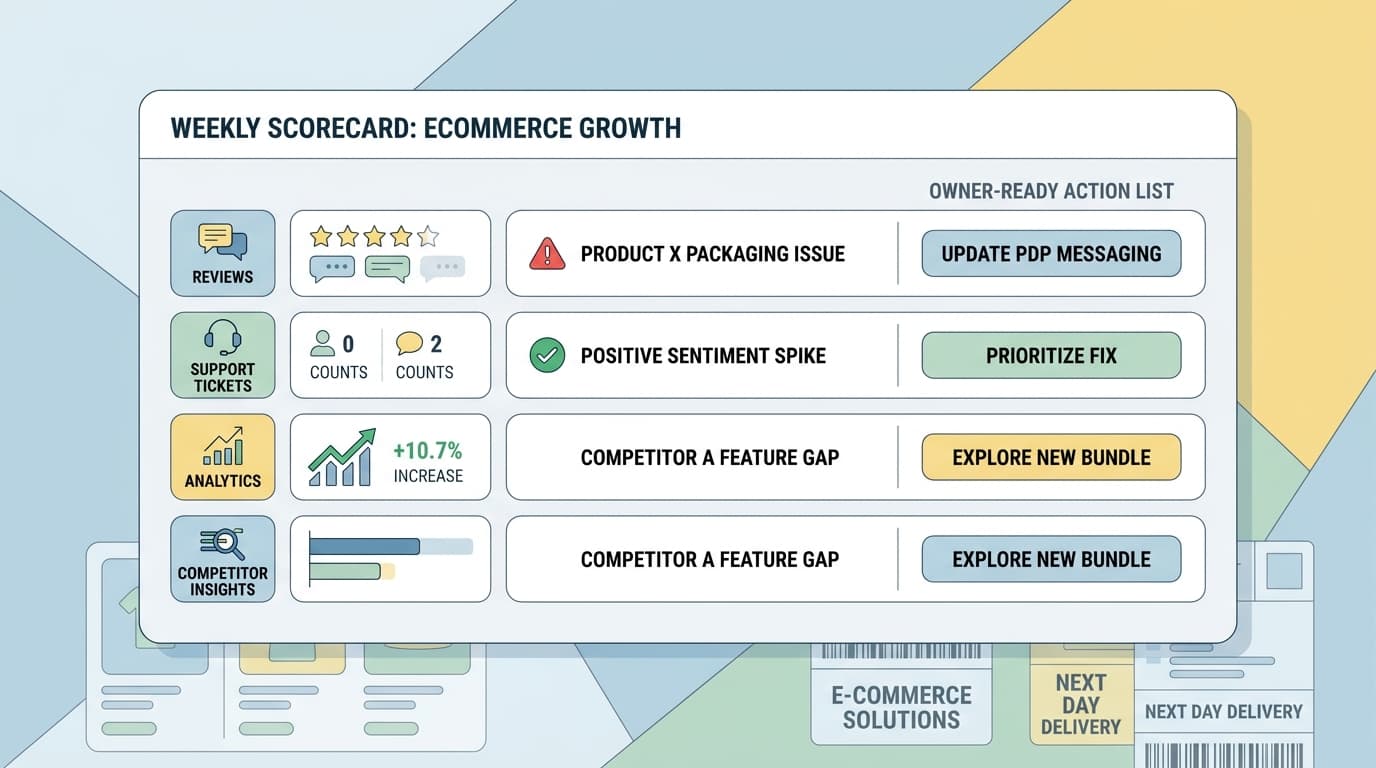
An ecommerce insights weekly scorecard is useful when it changes what a growth team does next. A dashboard can show traffic, conversion, AOV, repeat purchase, refund rate, support volume, and review volume. A scorecard is better when it turns those inputs into one owner-ready action list for the week.
That is the point of this article. It is not another broad ecommerce insights explainer. The broad strategy and use-case articles already exist on VOC.AI. This page shows the weekly operating rhythm: what to track, how to score it, and how to route the result into product, listing, support, or competitor work.
If you need the broader framing first, start with Ecommerce Insights Strategy for Growth Teams or Ecommerce Insights Use Cases by Funnel Stage. This page owns the weekly scorecard.
What an ecommerce insights weekly scorecard should do
A scorecard should answer four questions every week:
- What changed?
- Why did it change?
- What should we do next?
- Who owns the next step?
If the output does not name a decision owner, it is just reporting. If it does not include source evidence, it is just commentary. If it does not get reviewed again next week, it is not an operating system.
The scorecard rule
Each row should combine one evidence source, one growth question, and one follow-up action.
| Scorecard row | Evidence source | Growth question | Example action |
|---|---|---|---|
| Reviews | Product reviews | Which complaint or praise pattern is changing? | Update product page copy or fix a product issue |
| Support tickets | CS/chat/email | Which question is becoming repeated friction? | Improve FAQ, macro, or onboarding |
| Analytics | On-site behavior | Where are buyers hesitating? | Adjust PDP hierarchy or checkout proof |
| Competitor evidence | Competitor reviews or listings | What gap or weakness can we exploit? | Reframe positioning or comparison copy |
| Market movement | Category or trend signal | Is demand shifting fast enough to matter? | Promote, test, or deprioritize a theme |
Build the weekly scorecard from decisions, not dashboards
Start with the decisions your team already has to make.
| Decision | Weak version | Scorecard version |
|---|---|---|
| Product page change | "Conversion is down." | Buyer reviews and session data show hesitation about durability proof, so the PDP needs a stronger evidence block. |
| Listing rewrite | "Customers like the product." | Positive reviews repeatedly use the phrase "easy to set up," so that exact language should move into the title, bullets, and FAQ. |
| Support escalation | "Tickets are up." | Pre-sale chats keep asking the same compatibility question, so support needs a macro and the page needs clearer compatibility copy. |
| Competitor response | "Competitor has more reviews." | Competitor reviews praise setup speed but complain about replacement parts, so the gap is serviceability, not speed. |
| Retention fix | "Repeat purchase is low." | Follow-up reviews mention refill demand, but the current flow does not surface bundles or next-step products. |
The scorecard is doing real work only when it narrows the next action.
A practical weekly rhythm
Use the same cadence every week so the team learns the pattern.
Monday: collect signals
Pull a bounded set of evidence from reviews, support, analytics, and competitor sources. Do not mix six months of history with last week’s signal.
Tuesday: name the question
Pick one decision question. Examples:
- Which complaint is rising?
- Which benefit language should move into the PDP?
- Which competitor weakness is worth responding to?
- Which support issue needs a product or documentation fix?
Wednesday: inspect evidence and counterevidence
Do not trust a theme until you can see the source cohort, the time window, and at least one counterexample.
Thursday: assign the action
Name one owner and one next artifact.
Friday: review the signal again
Decide whether the change is working, whether the theme widened, or whether the team overreacted to a small sample.
What to put on each row
A useful ecommerce insights row should preserve the evidence behind the claim.
| Field | What to capture |
|---|---|
| Source | Review, ticket, analytics event, competitor review, or market signal |
| Cohort | SKU, ASIN, product line, date window, rating band, segment, or channel |
| Theme | The specific customer mechanism |
| Counterevidence | The records that weaken the conclusion |
| Owner | Product, growth, support, merchandising, or ecommerce |
| Action | What to change now |
| Recheck date | When to verify the signal again |
That is the difference between a scorecard and a pile of notes.
Where ecommerce insights tools fit
The best ecommerce insights tools do not replace judgment. They make judgment faster and easier to defend.
Use this rough division:
- Analytics tools answer what happened.
- Review intelligence answers what customers are saying.
- Support tools answer where friction repeats.
- Competitor tools answer what the market is rewarding or missing.
- API workflows make the loop repeatable.
VOC.AI fits best when review-backed evidence needs to feed the weekly scorecard. The Voice of Customer Analysis page is the strongest fit for buyer language and complaint clusters. The Product Research page helps when the weekly question is what to build or improve next. The Review Analysis API matters when the scorecard has to run on a schedule. The Pricing page is the place to check if the team wants a trial, team workflow, or API/MCP path.
A simple scorecard template
| Week | Signal | Evidence | Decision | Owner | Next check |
|---|---|---|---|---|---|
| Week 1 | Setup confusion rose | 18 recent reviews and 42 support chats point to the same issue | Add setup FAQ and improve PDP proof | Ecommerce | Next Friday |
| Week 2 | Competitor gap appeared | Competitor reviews praise fast setup but complain about replacements | Reframe comparison copy around serviceability | Product marketing | Next Friday |
| Week 3 | Positive language repeated | Buyers keep saying "works right away" | Use exact phrase in hero copy | Growth | Next Friday |
| Week 4 | Refill interest increased | Follow-up comments ask about bundles | Add bundle prompt and email follow-up | Retention | Next Friday |
The template is intentionally small. A weekly scorecard becomes useless when it turns into a spreadsheet graveyard.
What to inspect before trusting the scorecard
Before you act on a scorecard row, check these four things:
- The source is visible.
- The cohort is narrow enough to mean something.
- Counterevidence is present.
- Someone owns the next step.
If any of those are missing, the scorecard is not ready for action.
Where this fits in the VOC.AI cluster
This article sits below the broader strategy and use-case pages.
- Use Ecommerce Insights Strategy for Growth Teams for the broader operating model.
- Use Ecommerce Insights Use Cases by Funnel Stage for stage-specific decisions.
- Use Customer Insights Platform Strategy for Growth Teams when the buying question is category-level platform selection.
That structure keeps the cluster clean:
- strategy owns the operating model,
- funnel-stage owns stage-specific decisions,
- this page owns the weekly scorecard.
Conclusion
An ecommerce insights weekly scorecard is worth building when it helps a team decide faster, not when it adds another dashboard.
Keep the rows narrow, keep the sources visible, keep the counterevidence in view, and make sure every row ends with one owner and one next step. That is how ecommerce insights become a weekly habit instead of a one-time report.